 VIPSolutions
Give step-by-step solution with explanation and final answer: {give me the answer with out using bullet points}Autocatalytic reactions, where one of the products acts as a catalyst, are of significant interest in chemical technology, particularly in processes involving biological systems or certain polymerization reactions. In a continuous stirred-tank reactor (CSTR), the unique rate-concentration behavior of autacatalytic kinetics can lead to complex operating regimes, including multiple steady-states and hysteresis phenomena. The reaction rate is typically low at both low and high conversions, passing through a maximum at an intermediate conversion. Understanding this behavior is crucial for designing and controlling reactors to ensure stable and efficient operation. The design optimization often involves selecting an operating point that balances reactor size, conversion, and stability considerations, which can be effectively analyzed using graphical methods. A Ps 7 ® Xa Sketch the Levenspiel plot for an autocatalytic reaction A + R — R + R in a CSTR, and by developing the performance equation, derive the expressions relating reactor volume, inlet conditions, and conversion. . Analyze the condition for the existence of multiple steady-states in the CSTR for this reaction by examining the intersection of the heat generation and heat removal curves, even for isothermal operation. . Derive the analytical expression for the conversion at which the maximum reaction rate occurs for an elementary autocatalytic reaction with a rate law of the form —r4 = kC4Cr. . Sketch the conversion versus space-time curve for the CSTR, clearly indicating the regions of stable and unstable operation corresponding to the multiple steady-states identified in the Levenspiel plot. + Compare the reactor volume required for a given conversion in a CSTR with that in a plug flow reactor (PFR) for an autocatalytic reaction, highlighting the conversion range where a CSTR is more efficient. . Discuss the practical implications of operating a CSTR in the region of multiple steady-states, particularly concerning reactor startup, shutdown, and control in the presence of disturbances.
Question:
Give step-by-step solution with explanation and final answer:
{give me the answer with out using bullet points}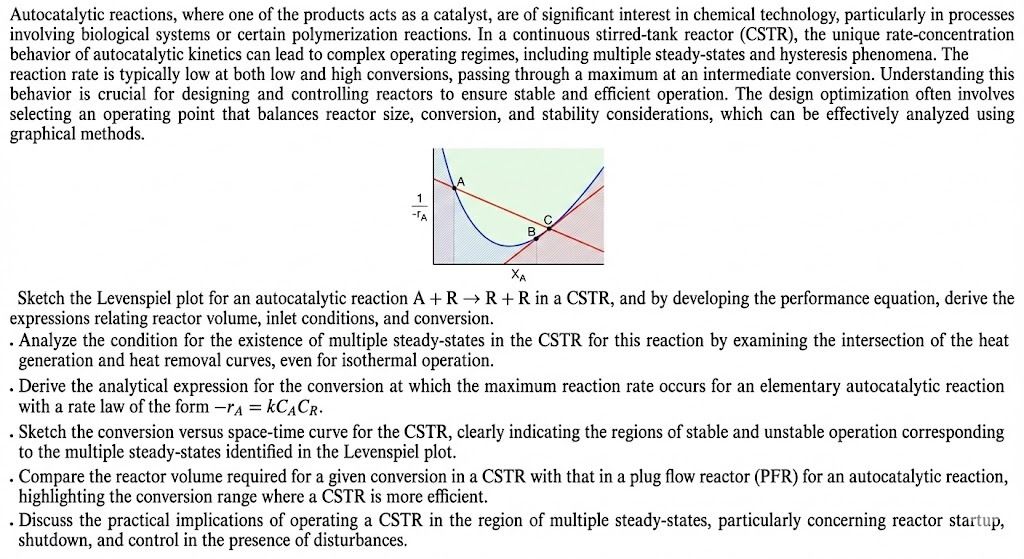 Autocatalytic reactions, where one of the products acts as a catalyst, are of significant interest in chemical technology, particularly in processes
involving biological systems or certain polymerization reactions. In a continuous stirred-tank reactor (CSTR), the unique rate-concentration
behavior of autacatalytic kinetics can lead to complex operating regimes, including multiple steady-states and hysteresis phenomena. The
reaction rate is typically low at both low and high conversions, passing through a maximum at an intermediate conversion. Understanding this
behavior is crucial for designing and controlling reactors to ensure stable and efficient operation. The design optimization often involves
selecting an operating point that balances reactor size, conversion, and stability considerations, which can be effectively analyzed using
graphical methods.
A
Ps
7 ®
Xa
Sketch the Levenspiel plot for an autocatalytic reaction A + R — R + R in a CSTR, and by developing the performance equation, derive the
expressions relating reactor volume, inlet conditions, and conversion.
. Analyze the condition for the existence of multiple steady-states in the CSTR for this reaction by examining the intersection of the heat
generation and heat removal curves, even for isothermal operation.
. Derive the analytical expression for the conversion at which the maximum reaction rate occurs for an elementary autocatalytic reaction
with a rate law of the form —r4 = kC4Cr.
. Sketch the conversion versus space-time curve for the CSTR, clearly indicating the regions of stable and unstable operation corresponding
to the multiple steady-states identified in the Levenspiel plot.
+ Compare the reactor volume required for a given conversion in a CSTR with that in a plug flow reactor (PFR) for an autocatalytic reaction,
highlighting the conversion range where a CSTR is more efficient.
. Discuss the practical implications of operating a CSTR in the region of multiple steady-states, particularly concerning reactor startup,
shutdown, and control in the presence of disturbances.
Autocatalytic reactions, where one of the products acts as a catalyst, are of significant interest in chemical technology, particularly in processes
involving biological systems or certain polymerization reactions. In a continuous stirred-tank reactor (CSTR), the unique rate-concentration
behavior of autacatalytic kinetics can lead to complex operating regimes, including multiple steady-states and hysteresis phenomena. The
reaction rate is typically low at both low and high conversions, passing through a maximum at an intermediate conversion. Understanding this
behavior is crucial for designing and controlling reactors to ensure stable and efficient operation. The design optimization often involves
selecting an operating point that balances reactor size, conversion, and stability considerations, which can be effectively analyzed using
graphical methods.
A
Ps
7 ®
Xa
Sketch the Levenspiel plot for an autocatalytic reaction A + R — R + R in a CSTR, and by developing the performance equation, derive the
expressions relating reactor volume, inlet conditions, and conversion.
. Analyze the condition for the existence of multiple steady-states in the CSTR for this reaction by examining the intersection of the heat
generation and heat removal curves, even for isothermal operation.
. Derive the analytical expression for the conversion at which the maximum reaction rate occurs for an elementary autocatalytic reaction
with a rate law of the form —r4 = kC4Cr.
. Sketch the conversion versus space-time curve for the CSTR, clearly indicating the regions of stable and unstable operation corresponding
to the multiple steady-states identified in the Levenspiel plot.
+ Compare the reactor volume required for a given conversion in a CSTR with that in a plug flow reactor (PFR) for an autocatalytic reaction,
highlighting the conversion range where a CSTR is more efficient.
. Discuss the practical implications of operating a CSTR in the region of multiple steady-states, particularly concerning reactor startup,
shutdown, and control in the presence of disturbances.
Asked by: Francis
Created at: 2026-02-08 08:28:17
Final Answer:
📢 Instructions:
- Ask anything relatd to above question only.
- For new Question goto :