 VIPSolutions
Give step-by-step solution with explanation and final answer:RRR RRR RRR. Click on all of the carbon chirality centers in the molecule below. (Other terms used for chirality center include chiral center, stereocenter, and stereogenic center.) if no carbon qualifies, submit your answer without selecting any. cH, OH CH; 5 [e] previous Ne
Question:
Give step-by-step solution with explanation and final answer: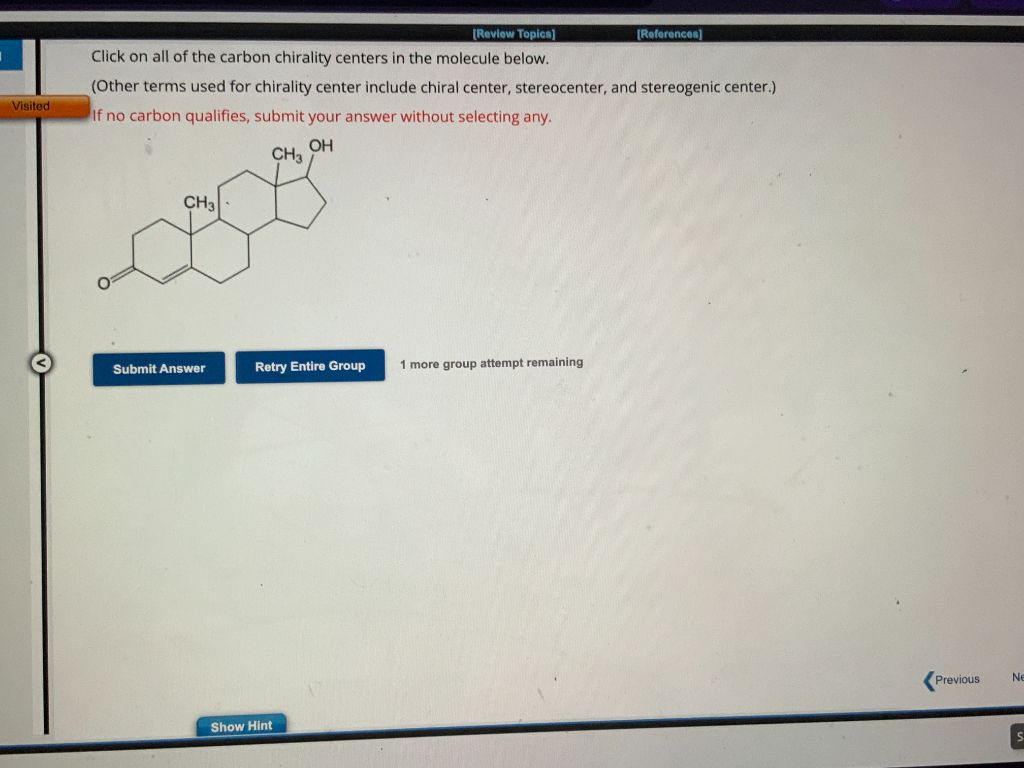 RRR RRR RRR.
Click on all of the carbon chirality centers in the molecule below.
(Other terms used for chirality center include chiral center, stereocenter, and stereogenic center.)
if no carbon qualifies, submit your answer without selecting any.
cH, OH
CH;
5
[e]
previous Ne
RRR RRR RRR.
Click on all of the carbon chirality centers in the molecule below.
(Other terms used for chirality center include chiral center, stereocenter, and stereogenic center.)
if no carbon qualifies, submit your answer without selecting any.
cH, OH
CH;
5
[e]
previous Ne
This is AI generated Response.
Asked by: Rahul
Created at: 2026-02-10 03:55:24
Asked by: Rahul
Created at: 2026-02-10 03:55:24
Final Answer:
Rendered
Raw Text
Did you like this answer?
Let's solve the problem step by step:
## Step 1: **Understanding Chirality Centers**
A **chirality center (chiral center, stereocenter, or stereogenic center)** is a carbon atom that:
- Has four different groups attached to it.
## Step 2: **Analyzing the Molecule**
Let's identify the structure:
- The molecule is a steroid backbone (similar to testosterone or estradiol).
- Some key groups: ketone (C=O), alcohol (OH), and methyl (CH3) groups.
## Step 3: **Identifying Chiral Centers**
Let's look at each carbon and see if it has four different groups attached:
1. **Carbons in double bonds (alkene) or carbonyl (C=O):**
- Cannot be chiral centers (sp2 hybridized).
2. **Methyl groups (CH3):**
- Cannot be chiral centers (three identical H atoms).
3. **Bridging Carbons (in rings):**
- Need to check if all four substituents are different.
Let’s label the rings, usually A, B, C, D, from left to right.
#### **Systematic Check**
- **Ring A (leftmost):**
- Bottom left carbon is part of a carbonyl (not chiral).
- Next to it is a ring junction (possible chiral center).
- **Ring Junctions and Substituted Carbons:**
- These are likely locations for chiral centers, especially where rings join and substitutions differ.
#### **Standard Chiral Centers in Steroid Skeletons:**
Generally, the chiral centers are at the ring junctions and at carbons bearing substituents (like OH, CH3).
- **C8:** Junction with methyl group.
- **C9:** Junction with hydrogen and rings.
- **C10:** Junction with two rings and methyl group.
- **C13:** Junction with ring and methyl group.
- **C14:** Next to the ring junctions, typically chiral.
- **C17:** Has OH and methyl group, usually chiral.
## Step 4: **Marking the Chiral Centers**
On the provided molecule, the following **carbons are chiral centers** (numbering based on standard steroid numbering):
- **C8** (attached to H, CH3, two different ring systems)
- **C9** (attached to H, two different ring systems, and a bridge)
- **C10** (attached to two rings, CH3, and a bridge)
- **C13** (attached to two rings, CH3, and a bridge)
- **C14** (attached to two rings, H, and a bridge)
- **C17** (attached to OH, CH3, two different ring systems)
## Step 5: **Final Answer**
The **chiral centers** on the molecule are the following carbons (as visually identified on your structure):
- The carbon attached to the OH and CH3 on the upper right (C17)
- The carbon attached to the methyl group next to the ketone (C13)
- The carbon directly to the right of C13 (C14)
- The carbon at the bottom left of the B-ring next to the methyl group (C8)
- The carbon above C8 (C9)
- The carbon at the ring junction between A and B rings, attached to a methyl group (C10)
**In summary, click the following carbons:**
- The carbon at the upper right with OH and CH3 (C17)
- The carbon with CH3, 2 rings, and H (C13)
- The carbon next to C13 (C14)
- The carbon with CH3 on the B ring (C8)
- The carbon above C8 (C9)
- The carbon at the junction with a methyl group (C10)
**Total: 6 Chiral Centers**
---
### **Summary Table**
| Carbon # | Substituents | Chiral? |
|----------|--------------------------------------------------------|---------|
| C8 | H, CH3, 2 different rings | Yes |
| C9 | H, 2 different rings, bridge | Yes |
| C10 | 2 rings, CH3, bridge | Yes |
| C13 | 2 rings, CH3, bridge | Yes |
| C14 | 2 rings, H, bridge | Yes |
| C17 | OH, CH3, 2 different rings | Yes |
---
## **Final Answer:**
**There are 6 chiral centers in the molecule.**
Click on the six carbons described above. If you need the exact locations, let me know and I can number the carbons on your image for clarity!
📢 Instructions:
- Ask anything relatd to above question only.
- For new Question goto :