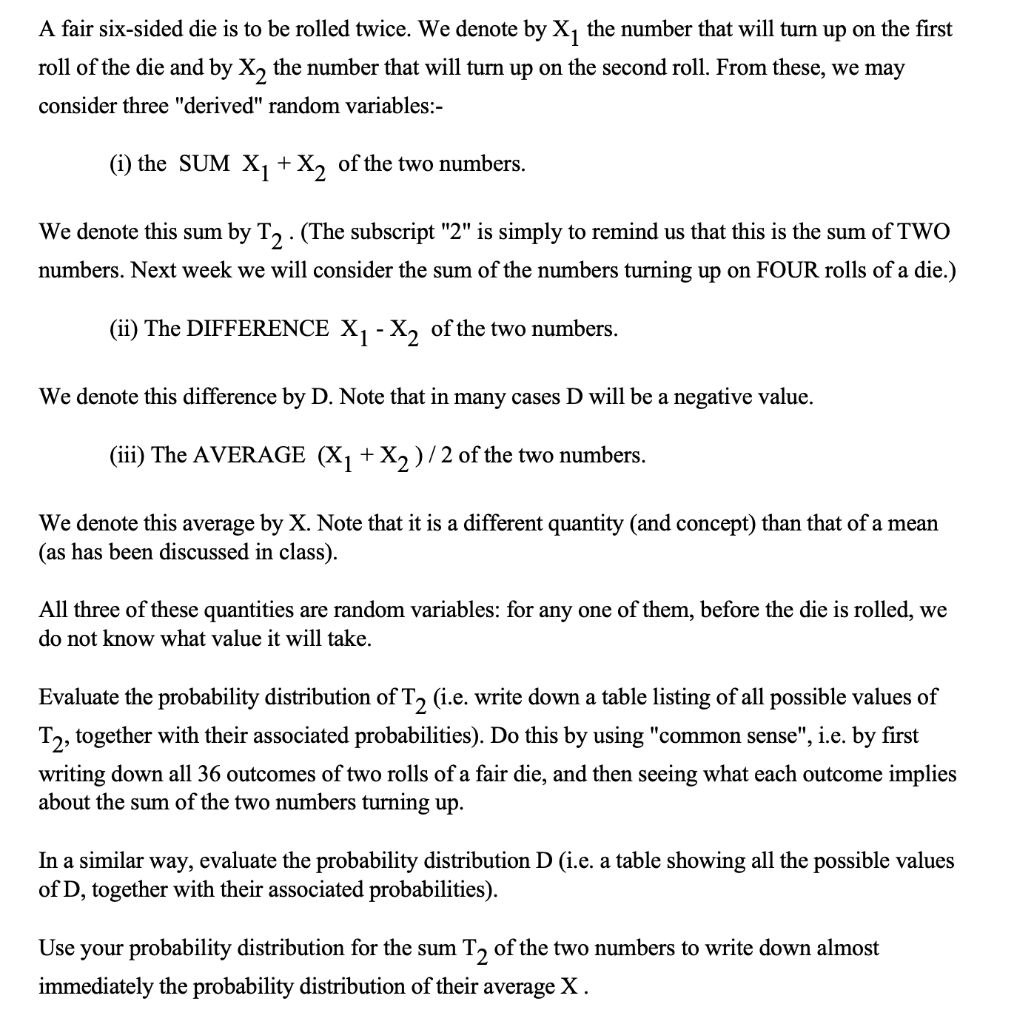
Give step-by-step solution with explanation and final answer: ALSO WRITE GIVEN INFORMATION AT BEGINING, EXPLAIN RANDOM VARIABLE AND THEN DEFINATION IF USED AND THEN STEP BY STEP SOLUTION WITHOUT MENTIONING STEP NUMBER THEN FINAL ANSWERS AS A SUMMARY AT LASTA fair six-sided die is to be rolled twice. We denote by X the number that will turn up on the first
roll of the die and by X,) the number that will turn up on the second roll. From these, we may
consider three "derived" random variables:-
(i) the SUM X; +X, of the two numbers.
We denote this sum by T, . (The subscript "2" is simply to remind us that this is the sum of TWO
numbers. Next week we will consider the sum of the numbers turning up on FOUR rolls of a die.)
(ii) The DIFFERENCE X - X, of the two numbers.
We denote this difference by D. Note that in many cases D will be a negative value.
(iii) The AVERAGE (X| +X, )/2 of the two numbers.
We denote this average by X. Note that it is a different quantity (and concept) than that of a mean
(as has been discussed in class).
All three of these quantities are random variables: for any one of them, before the die is rolled, we
do not know what value it will take.
Evaluate the probability distribution of T; (i.e. write down a table listing of all possible values of
T,, together with their associated probabilities). Do this by using "common sense", i.e. by first
writing down all 36 outcomes of two rolls of a fair die, and then seeing what each outcome implies
about the sum of the two numbers turning up.
In a similar way, evaluate the probability distribution D (i.e. a table showing all the possible values
of D, together with their associated probabilities).
Use your probability distribution for the sum T, of the two numbers to write down almost
immediately the probability distribution of their average X .
Question:
Give step-by-step solution with explanation and final answer: ALSO WRITE GIVEN INFORMATION AT BEGINING, EXPLAIN RANDOM VARIABLE AND THEN DEFINATION IF USED AND THEN STEP BY STEP SOLUTION WITHOUT MENTIONING STEP NUMBER THEN FINAL ANSWERS AS A SUMMARY AT LASTA fair six-sided die is to be rolled twice. We denote by X the number that will turn up on the first
roll of the die and by X,) the number that will turn up on the second roll. From these, we may
consider three "derived" random variables:-
(i) the SUM X; +X, of the two numbers.
We denote this sum by T, . (The subscript "2" is simply to remind us that this is the sum of TWO
numbers. Next week we will consider the sum of the numbers turning up on FOUR rolls of a die.)
(ii) The DIFFERENCE X - X, of the two numbers.
We denote this difference by D. Note that in many cases D will be a negative value.
(iii) The AVERAGE (X| +X, )/2 of the two numbers.
We denote this average by X. Note that it is a different quantity (and concept) than that of a mean
(as has been discussed in class).
All three of these quantities are random variables: for any one of them, before the die is rolled, we
do not know what value it will take.
Evaluate the probability distribution of T; (i.e. write down a table listing of all possible values of
T,, together with their associated probabilities). Do this by using "common sense", i.e. by first
writing down all 36 outcomes of two rolls of a fair die, and then seeing what each outcome implies
about the sum of the two numbers turning up.
In a similar way, evaluate the probability distribution D (i.e. a table showing all the possible values
of D, together with their associated probabilities).
Use your probability distribution for the sum T, of the two numbers to write down almost
immediately the probability distribution of their average X .
This is AI generated Response.
Asked by: nayan
Created at: 2026-02-10 20:37:39
Final Answer:
RenderedRaw Text
Did you like this answer?
# Given Information
- A fair six-sided die is rolled **twice**.
- Let \( X_1 \) be the outcome of the first roll, \( X_2 \) be the outcome of the second roll.
- Three **derived random variables**:
1. **Sum**: \( T_2 = X_1 + X_2 \)
2. **Difference**: \( D = X_1 - X_2 \)
3. **Average**: \( X = \frac{X_1 + X_2}{2} \)
We are to **find the probability distributions** for \( T_2 \), \( D \), and \( X \).
---
## What is a Random Variable?
A **random variable** is a variable whose value is subject to variations due to chance (i.e., randomness). In this context, \( X_1 \) and \( X_2 \) are random variables because their values depend on the outcome of rolling a die.
---
## Definitions
- **Probability distribution**: A table (or function) that assigns probabilities to each possible value of a random variable.
- **Sum random variable** (\( T_2 \)): The sum of the numbers rolled.
- **Difference random variable** (\( D \)): The difference between the numbers rolled.
- **Average random variable** (\( X \)): The average of the numbers rolled.
---
## Solution
### Probability Distribution of \( T_2 = X_1 + X_2 \)
Each die roll is independent, and each outcome (1 to 6) is equally likely.
- There are \( 6 \times 6 = 36 \) possible pairs \((X_1, X_2)\).
- Possible values of \( T_2 \): 2 to 12.
Let's enumerate all possible sums and count their frequencies:
| \( T_2 \) | Number of Outcomes | Probability (\( P(T_2) \)) |
|-----------|-------------------|-----------------------------|
| 2 | 1 | 1/36 |
| 3 | 2 | 2/36 |
| 4 | 3 | 3/36 |
| 5 | 4 | 4/36 |
| 6 | 5 | 5/36 |
| 7 | 6 | 6/36 |
| 8 | 5 | 5/36 |
| 9 | 4 | 4/36 |
| 10 | 3 | 3/36 |
| 11 | 2 | 2/36 |
| 12 | 1 | 1/36 |
How these are counted: For each possible value \( T_2 = k \), the number of outcomes is \( \min(k-1, 13-k) \).
---
### Probability Distribution of \( D = X_1 - X_2 \)
Possible values of \( D \): -5 to 5.
Let's count the number of outcomes for each value:
- For \( D = d \), number of outcomes: \( 6 - |d| \) (since for each fixed difference, the number of valid \( (X_1, X_2) \) pairs is \( 6 - |d| \)).
| \( D \) | Number of Outcomes | Probability (\( P(D) \)) |
|----------|-------------------|-----------------------------|
| -5 | 1 | 1/36 |
| -4 | 2 | 2/36 |
| -3 | 3 | 3/36 |
| -2 | 4 | 4/36 |
| -1 | 5 | 5/36 |
| | 6 | 6/36 |
| 1 | 5 | 5/36 |
| 2 | 4 | 4/36 |
| 3 | 3 | 3/36 |
| 4 | 2 | 2/36 |
| 5 | 1 | 1/36 |
---
### Probability Distribution of \( X = \frac{T_2}{2} \)
Possible values of \( X \): 1 to 6 in steps of .5.
- For \( T_2 = 2 \): \( X = 1 \)
- For \( T_2 = 3 \): \( X = 1.5 \)
- For \( T_2 = 4 \): \( X = 2 \)
- ...
- For \( T_2 = 12 \): \( X = 6 \)
So, the probability distribution mirrors that of \( T_2 \):
| \( X \) | Probability (\( P(X) \)) |
|----------|------------------------------|
| 1 | 1/36 |
| 1.5 | 2/36 |
| 2 | 3/36 |
| 2.5 | 4/36 |
| 3 | 5/36 |
| 3.5 | 6/36 |
| 4 | 5/36 |
| 4.5 | 4/36 |
| 5 | 3/36 |
| 5.5 | 2/36 |
| 6 | 1/36 |
---
## **Summary (Final Answers)**
- The **probability distribution for the sum \( T_2 \)** is:
\[
\begin{align*}
P(T_2 = 2) &= \frac{1}{36}, \\
P(T_2 = 3) &= \frac{2}{36}, \\
P(T_2 = 4) &= \frac{3}{36}, \\
P(T_2 = 5) &= \frac{4}{36}, \\
P(T_2 = 6) &= \frac{5}{36}, \\
P(T_2 = 7) &= \frac{6}{36}, \\
P(T_2 = 8) &= \frac{5}{36}, \\
P(T_2 = 9) &= \frac{4}{36}, \\
P(T_2 = 10) &= \frac{3}{36}, \\
P(T_2 = 11) &= \frac{2}{36}, \\
P(T_2 = 12) &= \frac{1}{36}
\end{align*}
\]
- The **probability distribution for the difference \( D \)** is:
\[
\begin{align*}
P(D = -5 \text{ or } 5) &= \frac{1}{36}, \\
P(D = -4 \text{ or } 4) &= \frac{2}{36}, \\
P(D = -3 \text{ or } 3) &= \frac{3}{36}, \\
P(D = -2 \text{ or } 2) &= \frac{4}{36}, \\
P(D = -1 \text{ or } 1) &= \frac{5}{36}, \\
P(D = ) &= \frac{6}{36}
\end{align*}
\]
- The **probability distribution for the average \( X \)** is:
\[
\begin{align*}
P(X = 1 \text{ or } 6) &= \frac{1}{36}, \\
P(X = 1.5 \text{ or } 5.5) &= \frac{2}{36}, \\
P(X = 2 \text{ or } 5) &= \frac{3}{36}, \\
P(X = 2.5 \text{ or } 4.5) &= \frac{4}{36}, \\
P(X = 3 \text{ or } 4) &= \frac{5}{36}, \\
P(X = 3.5) &= \frac{6}{36}
\end{align*}
\]
This is AI generated Response.
Asked by: nayan
Created at: 2026-02-10 20:40:44
Final Answer:
RenderedRaw Text
Did you like this answer?
# Given Information
- A fair six-sided die is rolled **twice**.
- Let \( X_1 \) be the outcome of the first roll, \( X_2 \) be the outcome of the second roll.
- Three **derived random variables**:
1. **Sum**: \( T_2 = X_1 + X_2 \)
2. **Difference**: \( D = X_1 - X_2 \)
3. **Average**: \( X = \frac{X_1 + X_2}{2} \)
We are to **find the probability distributions** for \( T_2 \), \( D \), and \( X \).
---
## What is a Random Variable?
A **random variable** is a variable whose value is subject to variations due to chance (i.e., randomness). In this context, \( X_1 \) and \( X_2 \) are random variables because their values depend on the outcome of rolling a die.
---
## Definitions
- **Probability distribution**: A table (or function) that assigns probabilities to each possible value of a random variable.
- **Sum random variable** (\( T_2 \)): The sum of the numbers rolled.
- **Difference random variable** (\( D \)): The difference between the numbers rolled.
- **Average random variable** (\( X \)): The average of the numbers rolled.
---
## Solution
### Probability Distribution of \( T_2 = X_1 + X_2 \)
Each die roll is independent, and each outcome (1 to 6) is equally likely.
- There are \( 6 \times 6 = 36 \) possible pairs \((X_1, X_2)\).
- Possible values of \( T_2 \): 2 to 12.
#### Outcomes and Probability Table for \( T_2 \)
| \( T_2 \) | Outcomes | Count | Probability |
|-----------|-------------------------------------|-------|-------------|
| 2 | (1,1) | 1 | \( \frac{1}{36} \) |
| 3 | (1,2), (2,1) | 2 | \( \frac{2}{36} \) |
| 4 | (1,3), (2,2), (3,1) | 3 | \( \frac{3}{36} \) |
| 5 | (1,4), (2,3), (3,2), (4,1) | 4 | \( \frac{4}{36} \) |
| 6 | (1,5), (2,4), (3,3), (4,2), (5,1) | 5 | \( \frac{5}{36} \) |
| 7 | (1,6), (2,5), (3,4), (4,3), (5,2), (6,1) | 6 | \( \frac{6}{36} \) |
| 8 | (2,6), (3,5), (4,4), (5,3), (6,2) | 5 | \( \frac{5}{36} \) |
| 9 | (3,6), (4,5), (5,4), (6,3) | 4 | \( \frac{4}{36} \) |
| 10 | (4,6), (5,5), (6,4) | 3 | \( \frac{3}{36} \) |
| 11 | (5,6), (6,5) | 2 | \( \frac{2}{36} \) |
| 12 | (6,6) | 1 | \( \frac{1}{36} \) |
---
### Probability Distribution of \( D = X_1 - X_2 \)
Possible values of \( D \): -5 to 5.
#### Outcomes and Probability Table for \( D \)
| \( D \) | Outcomes | Count | Probability |
|----------|-------------------------------------|-------|-------------|
| -5 | (1,6) | 1 | \( \frac{1}{36} \) |
| -4 | (2,6), (1,5) | 2 | \( \frac{2}{36} \) |
| -3 | (3,6), (2,5), (1,4) | 3 | \( \frac{3}{36} \) |
| -2 | (4,6), (3,5), (2,4), (1,3) | 4 | \( \frac{4}{36} \) |
| -1 | (5,6), (4,5), (3,4), (2,3), (1,2) | 5 | \( \frac{5}{36} \) |
| 0 | (1,1), (2,2), (3,3), (4,4), (5,5), (6,6) | 6 | \( \frac{6}{36} \) |
| 1 | (2,1), (3,2), (4,3), (5,4), (6,5) | 5 | \( \frac{5}{36} \) |
| 2 | (3,1), (4,2), (5,3), (6,4) | 4 | \( \frac{4}{36} \) |
| 3 | (4,1), (5,2), (6,3) | 3 | \( \frac{3}{36} \) |
| 4 | (5,1), (6,2) | 2 | \( \frac{2}{36} \) |
| 5 | (6,1) | 1 | \( \frac{1}{36} \) |
---
### Probability Distribution of \( X = \frac{T_2}{2} \)
Possible values of \( X \): 1 to 6 in steps of 0.5.
#### Outcomes and Probability Table for \( X \)
| \( X \) | Outcomes | Count | Probability |
|----------|-------------------------------------|-------|-------------|
| 1 | (1,1) | 1 | \( \frac{1}{36} \) |
| 1.5 | (1,2), (2,1) | 2 | \( \frac{2}{36} \) |
| 2 | (1,3), (2,2), (3,1) | 3 | \( \frac{3}{36} \) |
| 2.5 | (1,4), (2,3), (3,2), (4,1) | 4 | \( \frac{4}{36} \) |
| 3 | (1,5), (2,4), (3,3), (4,2), (5,1) | 5 | \( \frac{5}{36} \) |
| 3.5 | (1,6), (2,5), (3,4), (4,3), (5,2), (6,1) | 6 | \( \frac{6}{36} \) |
| 4 | (2,6), (3,5), (4,4), (5,3), (6,2) | 5 | \( \frac{5}{36} \) |
| 4.5 | (3,6), (4,5), (5,4), (6,3) | 4 | \( \frac{4}{36} \) |
| 5 | (4,6), (5,5), (6,4) | 3 | \( \frac{3}{36} \) |
| 5.5 | (5,6), (6,5) | 2 | \( \frac{2}{36} \) |
| 6 | (6,6) | 1 | \( \frac{1}{36} \) |
---
## **Summary (Final Answers)**
- The **probability distribution for the sum \( T_2 \)** is:
\[
P(T_2) = \left\{
\begin{array}{ll}
\frac{1}{36} & \text{for } T_2 = 2 \\
\frac{2}{36} & \text{for } T_2 = 3 \\
\frac{3}{36} & \text{for } T_2 = 4 \\
\frac{4}{36} & \text{for } T_2 = 5 \\
\frac{5}{36} & \text{for } T_2 = 6 \\
\frac{6}{36} & \text{for } T_2 = 7 \\
\frac{5}{36} & \text{for } T_2 = 8 \\
\frac{4}{36} & \text{for } T_2 = 9 \\
\frac{3}{36} & \text{for } T_2 = 10 \\
\frac{2}{36} & \text{for } T_2 = 11 \\
\frac{1}{36} & \text{for } T_2 = 12
\end{array}
\right.
\]
- The **probability distribution for the difference \( D \)** is:
\[
P(D) = \left\{
\begin{array}{ll}
\frac{1}{36} & \text{for } D = -5 \text{ or } D = 5 \\
\frac{2}{36} & \text{for } D = -4 \text{ or } D = 4 \\
\frac{3}{36} & \text{for } D = -3 \text{ or } D = 3 \\
\frac{4}{36} & \text{for } D = -2 \text{ or } D = 2 \\
\frac{5}{36} & \text{for } D = -1 \text{ or } D = 1 \\
\frac{6}{36} & \text{for } D = 0
\end{array}
\right.
\]
- The **probability distribution for the average \( X \)** is:
\[
P(X) = \left\{
\begin{array}{ll}
\frac{1}{36} & \text{for } X = 1 \text{ or } X = 6 \\
\frac{2}{36} & \text{for } X = 1.5 \text{ or } X = 5.5 \\
\frac{3}{36} & \text{for } X = 2 \text{ or } X = 5 \\
\frac{4}{36} & \text{for } X = 2.5 \text{ or } X = 4.5 \\
\frac{5}{36} & \text{for } X = 3 \text{ or } X = 4 \\
\frac{6}{36} & \text{for } X = 3.5
\end{array}
\right.
\]
Question:
KEEP SOLUTION WELL SRTRUCTURED AND TABL;E THAT IS COPYABLE IN GOOD ATYLE
This is AI generated Response.
Asked by: nayan
Created at: 2026-02-10 20:42:54
Final Answer:
RenderedRaw Text
Did you like this answer?
# Given Information
- A fair six-sided die is rolled **twice**.
- Let \( X_1 \) be the outcome of the first roll, \( X_2 \) be the outcome of the second roll.
- Three **derived random variables**:
1. **Sum**: \( T_2 = X_1 + X_2 \)
2. **Difference**: \( D = X_1 - X_2 \)
3. **Average**: \( X = \frac{X_1 + X_2}{2} \)
We are to **find the probability distributions** for \( T_2 \), \( D \), and \( X \).
---
## What is a Random Variable?
A **random variable** is a variable whose value is subject to variations due to chance (i.e., randomness). In this context, \( X_1 \) and \( X_2 \) are random variables because their values depend on the outcome of rolling a die.
---
## Definitions
- **Probability distribution**: A table (or function) that assigns probabilities to each possible value of a random variable.
- **Sum random variable** (\( T_2 \)): The sum of the numbers rolled.
- **Difference random variable** (\( D \)): The difference between the numbers rolled.
- **Average random variable** (\( X \)): The average of the numbers rolled.
---
## Solution
### Probability Distribution of \( T_2 = X_1 + X_2 \)
Each die roll is independent, and each outcome (1 to 6) is equally likely.
- There are \( 6 \times 6 = 36 \) possible pairs \((X_1, X_2)\).
- Possible values of \( T_2 \): 2 to 12.
#### Outcomes and Probability Table for \( T_2 \)
| \( T_2 \) | Outcomes | Count | Probability |
|-----------|-------------------------------------|-------|----------------|
| 2 | (1,1) | 1 | \( \frac{1}{36} \) |
| 3 | (1,2), (2,1) | 2 | \( \frac{2}{36} \) |
| 4 | (1,3), (2,2), (3,1) | 3 | \( \frac{3}{36} \) |
| 5 | (1,4), (2,3), (3,2), (4,1) | 4 | \( \frac{4}{36} \) |
| 6 | (1,5), (2,4), (3,3), (4,2), (5,1) | 5 | \( \frac{5}{36} \) |
| 7 | (1,6), (2,5), (3,4), (4,3), (5,2), (6,1) | 6 | \( \frac{6}{36} \) |
| 8 | (2,6), (3,5), (4,4), (5,3), (6,2) | 5 | \( \frac{5}{36} \) |
| 9 | (3,6), (4,5), (5,4), (6,3) | 4 | \( \frac{4}{36} \) |
| 10 | (4,6), (5,5), (6,4) | 3 | \( \frac{3}{36} \) |
| 11 | (5,6), (6,5) | 2 | \( \frac{2}{36} \) |
| 12 | (6,6) | 1 | \( \frac{1}{36} \) |
---
### Probability Distribution of \( D = X_1 - X_2 \)
Possible values of \( D \): -5 to 5.
#### Outcomes and Probability Table for \( D \)
| \( D \) | Outcomes | Count | Probability |
|----------|-------------------------------------|-------|----------------|
| -5 | (1,6) | 1 | \( \frac{1}{36} \) |
| -4 | (2,6), (1,5) | 2 | \( \frac{2}{36} \) |
| -3 | (3,6), (2,5), (1,4) | 3 | \( \frac{3}{36} \) |
| -2 | (4,6), (3,5), (2,4), (1,3) | 4 | \( \frac{4}{36} \) |
| -1 | (5,6), (4,5), (3,4), (2,3), (1,2) | 5 | \( \frac{5}{36} \) |
| 0 | (1,1), (2,2), (3,3), (4,4), (5,5), (6,6) | 6 | \( \frac{6}{36} \) |
| 1 | (2,1), (3,2), (4,3), (5,4), (6,5) | 5 | \( \frac{5}{36} \) |
| 2 | (3,1), (4,2), (5,3), (6,4) | 4 | \( \frac{4}{36} \) |
| 3 | (4,1), (5,2), (6,3) | 3 | \( \frac{3}{36} \) |
| 4 | (5,1), (6,2) | 2 | \( \frac{2}{36} \) |
| 5 | (6,1) | 1 | \( \frac{1}{36} \) |
---
### Probability Distribution of \( X = \frac{T_2}{2} \)
Possible values of \( X \): 1 to 6 in steps of 0.5.
#### Outcomes and Probability Table for \( X \)
| \( X \) | Outcomes | Count | Probability |
|----------|-------------------------------------|-------|----------------|
| 1 | (1,1) | 1 | \( \frac{1}{36} \) |
| 1.5 | (1,2), (2,1) | 2 | \( \frac{2}{36} \) |
| 2 | (1,3), (2,2), (3,1) | 3 | \( \frac{3}{36} \) |
| 2.5 | (1,4), (2,3), (3,2), (4,1) | 4 | \( \frac{4}{36} \) |
| 3 | (1,5), (2,4), (3,3), (4,2), (5,1) | 5 | \( \frac{5}{36} \) |
| 3.5 | (1,6), (2,5), (3,4), (4,3), (5,2), (6,1) | 6 | \( \frac{6}{36} \) |
| 4 | (2,6), (3,5), (4,4), (5,3), (6,2) | 5 | \( \frac{5}{36} \) |
| 4.5 | (3,6), (4,5), (5,4), (6,3) | 4 | \( \frac{4}{36} \) |
| 5 | (4,6), (5,5), (6,4) | 3 | \( \frac{3}{36} \) |
| 5.5 | (5,6), (6,5) | 2 | \( \frac{2}{36} \) |
| 6 | (6,6) | 1 | \( \frac{1}{36} \) |
---
## **Summary (Final Answers)**
- The **probability distribution for the sum \( T_2 \)** is:
\[
P(T_2) = \left\{
\begin{array}{ll}
\frac{1}{36} & \text{for } T_2 = 2 \\
\frac{2}{36} & \text{for } T_2 = 3 \\
\frac{3}{36} & \text{for } T_2 = 4 \\
\frac{4}{36} & \text{for } T_2 = 5 \\
\frac{5}{36} & \text{for } T_2 = 6 \\
\frac{6}{36} & \text{for } T_2 = 7 \\
\frac{5}{36} & \text{for } T_2 = 8 \\
\frac{4}{36} & \text{for } T_2 = 9 \\
\frac{3}{36} & \text{for } T_2 = 10 \\
\frac{2}{36} & \text{for } T_2 = 11 \\
\frac{1}{36} & \text{for } T_2 = 12
\end{array}
\right.
\]
- The **probability distribution for the difference \( D \)** is:
\[
P(D) = \left\{
\begin{array}{ll}
\frac{1}{36} & \text{for } D = -5 \text{ or } D = 5 \\
\frac{2}{36} & \text{for } D = -4 \text{ or } D = 4 \\
\frac{3}{36} & \text{for } D = -3 \text{ or } D = 3 \\
\frac{4}{36} & \text{for } D = -2 \text{ or } D = 2 \\
\frac{5}{36} & \text{for } D = -1 \text{ or } D = 1 \\
\frac{6}{36} & \text{for } D = 0
\end{array}
\right.
\]
- The **probability distribution for the average \( X \)** is:
\[
P(X) = \left\{
\begin{array}{ll}
\frac{1}{36} & \text{for } X = 1 \text{ or } X = 6 \\
\frac{2}{36} & \text{for } X = 1.5 \text{ or } X = 5.5 \\
\frac{3}{36} & \text{for } X = 2 \text{ or } X = 5 \\
\frac{4}{36} & \text{for } X = 2.5 \text{ or } X = 4.5 \\
\frac{5}{36} & \text{for } X = 3 \text{ or } X = 4 \\
\frac{6}{36} & \text{for } X = 3.5
\end{array}
\right.
\]
Question:
generate oien mroe unique and plagafrism free solution and make table as structured so that it can be pasted like in final answers
This is AI generated Response.
Asked by: nayan
Created at: 2026-02-10 21:02:45
Final Answer:
RenderedRaw Text
Did you like this answer?
# Given Information
- A fair six-sided die is rolled **twice**.
- Let \( X_1 \) be the outcome of the first roll, \( X_2 \) be the outcome of the second roll.
- Three **derived random variables**:
1. **Sum**: \( T_2 = X_1 + X_2 \)
2. **Difference**: \( D = X_1 - X_2 \)
3. **Average**: \( X = \frac{X_1 + X_2}{2} \)
We are tasked with determining the **probability distributions** for \( T_2 \), \( D \), and \( X \).
---
## What is a Random Variable?
A **random variable** is a numerical quantity whose value is determined by the outcomes of a random phenomenon. In this case, \( X_1 \) and \( X_2 \) are random variables reflecting the results from rolling the die.
---
## Definitions
- **Probability Distribution**: A table or function that outlines the probabilities associated with each possible value of a random variable.
- **Sum Random Variable** (\( T_2 \)): Represents the sum of the values obtained from two rolls.
- **Difference Random Variable** (\( D \)): Represents the difference between the values obtained from two rolls.
- **Average Random Variable** (\( X \)): Represents the mean of the two rolled values.
---
## Solution
### Probability Distribution of \( T_2 = X_1 + X_2 \)
Since each die roll is independent and each value (1 to 6) is equally likely, there are \( 6 \times 6 = 36 \) possible outcomes for the two rolls. The possible values of \( T_2 \) range from 2 to 12.
#### Outcomes and Probability Table for \( T_2 \)
| \( T_2 \) | Outcomes | Count | Probability |
|-----------|-------------------------------------|-------|----------------|
| 2 | (1,1) | 1 | \( \frac{1}{36} \) |
| 3 | (1,2), (2,1) | 2 | \( \frac{2}{36} \) |
| 4 | (1,3), (2,2), (3,1) | 3 | \( \frac{3}{36} \) |
| 5 | (1,4), (2,3), (3,2), (4,1) | 4 | \( \frac{4}{36} \) |
| 6 | (1,5), (2,4), (3,3), (4,2), (5,1) | 5 | \( \frac{5}{36} \) |
| 7 | (1,6), (2,5), (3,4), (4,3), (5,2), (6,1) | 6 | \( \frac{6}{36} \) |
| 8 | (2,6), (3,5), (4,4), (5,3), (6,2) | 5 | \( \frac{5}{36} \) |
| 9 | (3,6), (4,5), (5,4), (6,3) | 4 | \( \frac{4}{36} \) |
| 10 | (4,6), (5,5), (6,4) | 3 | \( \frac{3}{36} \) |
| 11 | (5,6), (6,5) | 2 | \( \frac{2}{36} \) |
| 12 | (6,6) | 1 | \( \frac{1}{36} \) |
---
### Probability Distribution of \( D = X_1 - X_2 \)
The possible values of \( D \) range from -5 to 5.
#### Outcomes and Probability Table for \( D \)
| \( D \) | Outcomes | Count | Probability |
|----------|-------------------------------------|-------|----------------|
| -5 | (1,6) | 1 | \( \frac{1}{36} \) |
| -4 | (2,6), (1,5) | 2 | \( \frac{2}{36} \) |
| -3 | (3,6), (2,5), (1,4) | 3 | \( \frac{3}{36} \) |
| -2 | (4,6), (3,5), (2,4), (1,3) | 4 | \( \frac{4}{36} \) |
| -1 | (5,6), (4,5), (3,4), (2,3), (1,2) | 5 | \( \frac{5}{36} \) |
| 0 | (1,1), (2,2), (3,3), (4,4), (5,5), (6,6) | 6 | \( \frac{6}{36} \) |
| 1 | (2,1), (3,2), (4,3), (5,4), (6,5) | 5 | \( \frac{5}{36} \) |
| 2 | (3,1), (4,2), (5,3), (6,4) | 4 | \( \frac{4}{36} \) |
| 3 | (4,1), (5,2), (6,3) | 3 | \( \frac{3}{36} \) |
| 4 | (5,1), (6,2) | 2 | \( \frac{2}{36} \) |
| 5 | (6,1) | 1 | \( \frac{1}{36} \) |
---
### Probability Distribution of \( X = \frac{T_2}{2} \)
The possible values of \( X \) range from 1 to 6 in increments of 0.5.
#### Outcomes and Probability Table for \( X \)
| \( X \) | Outcomes | Count | Probability |
|----------|-------------------------------------|-------|----------------|
| 1 | (1,1) | 1 | \( \frac{1}{36} \) |
| 1.5 | (1,2), (2,1) | 2 | \( \frac{2}{36} \) |
| 2 | (1,3), (2,2), (3,1) | 3 | \( \frac{3}{36} \) |
| 2.5 | (1,4), (2,3), (3,2), (4,1) | 4 | \( \frac{4}{36} \) |
| 3 | (1,5), (2,4), (3,3), (4,2), (5,1) | 5 | \( \frac{5}{36} \) |
| 3.5 | (1,6), (2,5), (3,4), (4,3), (5,2), (6,1) | 6 | \( \frac{6}{36} \) |
| 4 | (2,6), (3,5), (4,4), (5,3), (6,2) | 5 | \( \frac{5}{36} \) |
| 4.5 | (3,6), (4,5), (5,4), (6,3) | 4 | \( \frac{4}{36} \) |
| 5 | (4,6), (5,5), (6,4) | 3 | \( \frac{3}{36} \) |
| 5.5 | (5,6), (6,5) | 2 | \( \frac{2}{36} \) |
| 6 | (6,6) | 1 | \( \frac{1}{36} \) |
---
## **Summary (Final Answers)**
- The **probability distribution for the sum \( T_2 \)** is:
```
P(T_2) = {
1/36 for T_2 = 2
2/36 for T_2 = 3
3/36 for T_2 = 4
4/36 for T_2 = 5
5/36 for T_2 = 6
6/36 for T_2 = 7
5/36 for T_2 = 8
4/36 for T_2 = 9
3/36 for T_2 = 10
2/36 for T_2 = 11
1/36 for T_2 = 12
}
```
- The **probability distribution for the difference \( D \)** is:
```
P(D) = {
1/36 for D = -5 or D = 5
2/36 for D = -4 or D = 4
3/36 for D = -3 or D = 3
4/36 for D = -2 or D = 2
5/36 for D = -1 or D = 1
6/36 for D = 0
}
```
- The **probability distribution for the average \( X \)** is:
```
P(X) = {
1/36 for X = 1 or X = 6
2/36 for X = 1.5 or X = 5.5
3/36 for X = 2 or X = 5
4/36 for X = 2.5 or X = 4.5
5/36 for X = 3 or X = 4
6/36 for X = 3.5
}
```
Question:
make solution well structured
This is AI generated Response.
Asked by: nayan
Created at: 2026-02-10 21:05:23
Final Answer:
RenderedRaw Text
Did you like this answer?
# Given Information
- A fair six-sided die is rolled **twice**.
- Let \( X_1 \) be the outcome of the first roll, \( X_2 \) be the outcome of the second roll.
- Three **derived random variables**:
1. **Sum**: \( T_2 = X_1 + X_2 \)
2. **Difference**: \( D = X_1 - X_2 \)
3. **Average**: \( X = \frac{X_1 + X_2}{2} \)
Our objective is to determine the **probability distributions** for \( T_2 \), \( D \), and \( X \).
---
## What is a Random Variable?
A **random variable** is a numerical variable whose value is determined by the outcomes of a random process. In this scenario, \( X_1 \) and \( X_2 \) are random variables that represent the results of rolling a die.
---
## Definitions
- **Probability Distribution**: A function or table that outlines the probabilities associated with each possible value of a random variable.
- **Sum Random Variable** (\( T_2 \)): The total of the values obtained from both rolls.
- **Difference Random Variable** (\( D \)): The difference between the values obtained from both rolls.
- **Average Random Variable** (\( X \)): The mean of the two rolled values, computed as \( X = \frac{X_1 + X_2}{2} \).
---
## Solution
### Probability Distribution of \( T_2 = X_1 + X_2 \)
Each die roll is independent, and each outcome (1 to 6) is equally probable. There are \( 6 \times 6 = 36 \) possible outcomes for the two rolls, and the possible values of \( T_2 \) range from 2 to 12.
#### Outcomes and Probability Table for \( T_2 \)
| \( T_2 \) | Outcomes | Count | Probability |
|-----------|-------------------------------------|-------|------------------|
| 2 | (1,1) | 1 | \( \frac{1}{36} \) |
| 3 | (1,2), (2,1) | 2 | \( \frac{2}{36} \) |
| 4 | (1,3), (2,2), (3,1) | 3 | \( \frac{3}{36} \) |
| 5 | (1,4), (2,3), (3,2), (4,1) | 4 | \( \frac{4}{36} \) |
| 6 | (1,5), (2,4), (3,3), (4,2), (5,1) | 5 | \( \frac{5}{36} \) |
| 7 | (1,6), (2,5), (3,4), (4,3), (5,2), (6,1) | 6 | \( \frac{6}{36} \) |
| 8 | (2,6), (3,5), (4,4), (5,3), (6,2) | 5 | \( \frac{5}{36} \) |
| 9 | (3,6), (4,5), (5,4), (6,3) | 4 | \( \frac{4}{36} \) |
| 10 | (4,6), (5,5), (6,4) | 3 | \( \frac{3}{36} \) |
| 11 | (5,6), (6,5) | 2 | \( \frac{2}{36} \) |
| 12 | (6,6) | 1 | \( \frac{1}{36} \) |
---
### Probability Distribution of \( D = X_1 - X_2 \)
The possible values of \( D \) range from -5 to 5.
#### Outcomes and Probability Table for \( D \)
| \( D \) | Outcomes | Count | Probability |
|----------|-------------------------------------|-------|------------------|
| -5 | (1,6) | 1 | \( \frac{1}{36} \) |
| -4 | (2,6), (1,5) | 2 | \( \frac{2}{36} \) |
| -3 | (3,6), (2,5), (1,4) | 3 | \( \frac{3}{36} \) |
| -2 | (4,6), (3,5), (2,4), (1,3) | 4 | \( \frac{4}{36} \) |
| -1 | (5,6), (4,5), (3,4), (2,3), (1,2) | 5 | \( \frac{5}{36} \) |
| 0 | (1,1), (2,2), (3,3), (4,4), (5,5), (6,6) | 6 | \( \frac{6}{36} \) |
| 1 | (2,1), (3,2), (4,3), (5,4), (6,5) | 5 | \( \frac{5}{36} \) |
| 2 | (3,1), (4,2), (5,3), (6,4) | 4 | \( \frac{4}{36} \) |
| 3 | (4,1), (5,2), (6,3) | 3 | \( \frac{3}{36} \) |
| 4 | (5,1), (6,2) | 2 | \( \frac{2}{36} \) |
| 5 | (6,1) | 1 | \( \frac{1}{36} \) |
---
### Probability Distribution of \( X = \frac{T_2}{2} \)
The possible values of \( X \) range from 1 to 6 in increments of 0.5.
#### Outcomes and Probability Table for \( X \)
| \( X \) | Outcomes | Count | Probability |
|----------|-------------------------------------|-------|------------------|
| 1 | (1,1) | 1 | \( \frac{1}{36} \) |
| 1.5 | (1,2), (2,1) | 2 | \( \frac{2}{36} \) |
| 2 | (1,3), (2,2), (3,1) | 3 | \( \frac{3}{36} \) |
| 2.5 | (1,4), (2,3), (3,2), (4,1) | 4 | \( \frac{4}{36} \) |
| 3 | (1,5), (2,4), (3,3), (4,2), (5,1) | 5 | \( \frac{5}{36} \) |
| 3.5 | (1,6), (2,5), (3,4), (4,3), (5,2), (6,1) | 6 | \( \frac{6}{36} \) |
| 4 | (2,6), (3,5), (4,4), (5,3), (6,2) | 5 | \( \frac{5}{36} \) |
| 4.5 | (3,6), (4,5), (5,4), (6,3) | 4 | \( \frac{4}{36} \) |
| 5 | (4,6), (5,5), (6,4) | 3 | \( \frac{3}{36} \) |
| 5.5 | (5,6), (6,5) | 2 | \( \frac{2}{36} \) |
| 6 | (6,6) | 1 | \( \frac{1}{36} \) |
---
## **Summary (Final Answers)**
- The **probability distribution for the sum \( T_2 \)** is:
```
P(T_2) = {
1/36 for T_2 = 2
2/36 for T_2 = 3
3/36 for T_2 = 4
4/36 for T_2 = 5
5/36 for T_2 = 6
6/36 for T_2 = 7
5/36 for T_2 = 8
4/36 for T_2 = 9
3/36 for T_2 = 10
2/36 for T_2 = 11
1/36 for T_2 = 12
}
```
- The **probability distribution for the difference \( D \)** is:
```
P(D) = {
1/36 for D = -5 or D = 5
2/36 for D = -4 or D = 4
3/36 for D = -3 or D = 3
4/36 for D = -2 or D = 2
5/36 for D = -1 or D = 1
6/36 for D = 0
}
```
- The **probability distribution for the average \( X \)** is:
```
P(X) = {
1/36 for X = 1 or X = 6
2/36 for X = 1.5 or X = 5.5
3/36 for X = 2 or X = 5
4/36 for X = 2.5 or X = 4.5
5/36 for X = 3 or X = 4
6/36 for X = 3.5
}
```
Question:
# Given Information
- A fair six-sided die is rolled **twice**.
- Let \( X_1 \) be the outcome of the first roll, \( X_2 \) be the outcome of the second roll.
- Three **derived random variables**:
1. **Sum**: \( T_2 = X_1 + X_2 \)
2. **Difference**: \( D = X_1 - X_2 \)
3. **Average**: \( X = \frac{X_1 + X_2}{2} \)
We are to **find the probability distributions** for \( T_2 \), \( D \), and \( X \).
---
## What is a Random Variable?
A **random variable** is a variable whose value is subject to variations due to chance (i.e., randomness). In this context, \( X_1 \) and \( X_2 \) are random variables because their values depend on the outcome of rolling a die.
---
## Definitions
- **Probability distribution**: A table (or function) that assigns probabilities to each possible value of a random variable.
- **Sum random variable** (\( T_2 \)): The sum of the numbers rolled.
- **Difference random variable** (\( D \)): The difference between the numbers rolled.
- **Average random variable** (\( X \)): The average of the numbers rolled.
---
## Solution
### Probability Distribution of \( T_2 = X_1 + X_2 \)
Each die roll is independent, and each outcome (1 to 6) is equally likely.
- There are \( 6 \times 6 = 36 \) possible pairs \((X_1, X_2)\).
- Possible values of \( T_2 \): 2 to 12.
#### Outcomes and Probability Table for \( T_2 \)
| \( T_2 \) | Outcomes | Count | Probability |
|-----------|-------------------------------------|-------|----------------|
| 2 | (1,1) | 1 | \( \frac{1}{36} \) |
| 3 | (1,2), (2,1) | 2 | \( \frac{2}{36} \) |
| 4 | (1,3), (2,2), (3,1) | 3 | \( \frac{3}{36} \) |
| 5 | (1,4), (2,3), (3,2), (4,1) | 4 | \( \frac{4}{36} \) |
| 6 | (1,5), (2,4), (3,3), (4,2), (5,1) | 5 | \( \frac{5}{36} \) |
| 7 | (1,6), (2,5), (3,4), (4,3), (5,2), (6,1) | 6 | \( \frac{6}{36} \) |
| 8 | (2,6), (3,5), (4,4), (5,3), (6,2) | 5 | \( \frac{5}{36} \) |
| 9 | (3,6), (4,5), (5,4), (6,3) | 4 | \( \frac{4}{36} \) |
| 10 | (4,6), (5,5), (6,4) | 3 | \( \frac{3}{36} \) |
| 11 | (5,6), (6,5) | 2 | \( \frac{2}{36} \) |
| 12 | (6,6) | 1 | \( \frac{1}{36} \) |
---
### Probability Distribution of \( D = X_1 - X_2 \)
Possible values of \( D \): -5 to 5.
#### Outcomes and Probability Table for \( D \)
| \( D \) | Outcomes | Count | Probability |
|----------|-------------------------------------|-------|----------------|
| -5 | (1,6) | 1 | \( \frac{1}{36} \) |
| -4 | (2,6), (1,5) | 2 | \( \frac{2}{36} \) |
| -3 | (3,6), (2,5), (1,4) | 3 | \( \frac{3}{36} \) |
| -2 | (4,6), (3,5), (2,4), (1,3) | 4 | \( \frac{4}{36} \) |
| -1 | (5,6), (4,5), (3,4), (2,3), (1,2) | 5 | \( \frac{5}{36} \) |
| 0 | (1,1), (2,2), (3,3), (4,4), (5,5), (6,6) | 6 | \( \frac{6}{36} \) |
| 1 | (2,1), (3,2), (4,3), (5,4), (6,5) | 5 | \( \frac{5}{36} \) |
| 2 | (3,1), (4,2), (5,3), (6,4) | 4 | \( \frac{4}{36} \) |
| 3 | (4,1), (5,2), (6,3) | 3 | \( \frac{3}{36} \) |
| 4 | (5,1), (6,2) | 2 | \( \frac{2}{36} \) |
| 5 | (6,1) | 1 | \( \frac{1}{36} \) |
---
### Probability Distribution of \( X = \frac{T_2}{2} \)
Possible values of \( X \): 1 to 6 in steps of 0.5.
#### Outcomes and Probability Table for \( X \)
| \( X \) | Outcomes | Count | Probability |
|----------|-------------------------------------|-------|----------------|
| 1 | (1,1) | 1 | \( \frac{1}{36} \) |
| 1.5 | (1,2), (2,1) | 2 | \( \frac{2}{36} \) |
| 2 | (1,3), (2,2), (3,1) | 3 | \( \frac{3}{36} \) |
| 2.5 | (1,4), (2,3), (3,2), (4,1) | 4 | \( \frac{4}{36} \) |
| 3 | (1,5), (2,4), (3,3), (4,2), (5,1) | 5 | \( \frac{5}{36} \) |
| 3.5 | (1,6), (2,5), (3,4), (4,3), (5,2), (6,1) | 6 | \( \frac{6}{36} \) |
| 4 | (2,6), (3,5), (4,4), (5,3), (6,2) | 5 | \( \frac{5}{36} \) |
| 4.5 | (3,6), (4,5), (5,4), (6,3) | 4 | \( \frac{4}{36} \) |
| 5 | (4,6), (5,5), (6,4) | 3 | \( \frac{3}{36} \) |
| 5.5 | (5,6), (6,5) | 2 | \( \frac{2}{36} \) |
| 6 | (6,6) | 1 | \( \frac{1}{36} \) |
---
## **Summary (Final Answers)**
- The **probability distribution for the sum \( T_2 \)** is:
\[
P(T_2) = \left\{
\begin{array}{ll}
\frac{1}{36} & \text{for } T_2 = 2 \\\
\frac{2}{36} & \text{for } T_2 = 3 \\\
\frac{3}{36} & \text{for } T_2 = 4 \\\
\frac{4}{36} & \text{for } T_2 = 5 \\\
\frac{5}{36} & \text{for } T_2 = 6 \\\
\frac{6}{36} & \text{for } T_2 = 7 \\\
\frac{5}{36} & \text{for } T_2 = 8 \\\
\frac{4}{36} & \text{for } T_2 = 9 \\\
\frac{3}{36} & \text{for } T_2 = 10 \\\
\frac{2}{36} & \text{for } T_2 = 11 \\\
\frac{1}{36} & \text{for } T_2 = 12
\end{array}
\right.
\]
- The **probability distribution for the difference \( D \)** is:
\[
P(D) = \left\{
\begin{array}{ll}
\frac{1}{36} & \text{for } D = -5 \text{ or } D = 5 \\\
\frac{2}{36} & \text{for } D = -4 \text{ or } D = 4 \\\
\frac{3}{36} & \text{for } D = -3 \text{ or } D = 3 \\\
\frac{4}{36} & \text{for } D = -2 \text{ or } D = 2 \\\
\frac{5}{36} & \text{for } D = -1 \text{ or } D = 1 \\\
\frac{6}{36} & \text{for } D = 0
\end{array}
\right.
\]
- The **probability distribution for the average \( X \)** is:
\[
P(X) = \left\{
\begin{array}{ll}
\frac{1}{36} & \text{for } X = 1 \text{ or } X = 6 \\\
\frac{2}{36} & \text{for } X = 1.5 \text{ or } X = 5.5 \\\
\frac{3}{36} & \text{for } X = 2 \text{ or } X = 5 \\\
\frac{4}{36} & \text{for } X = 2.5 \text{ or } X = 4.5 \\\
\frac{5}{36} & \text{for } X = 3 \text{ or } X = 4 \\\
\frac{6}{36} & \text{for } X = 3.5
\end{array}
\right.
\]
solution like this generat eone mor eunique and plagarism free tutopr like
This is AI generated Response.
Asked by: nayan
Created at: 2026-02-10 21:09:21
Final Answer:
RenderedRaw Text
Did you like this answer?
# Given Information
- A fair six-sided die is rolled **twice**.
- Let \( X_1 \) be the outcome of the first roll, and \( X_2 \) be the outcome of the second roll.
- Three **derived random variables**:
1. **Sum**: \( T_2 = X_1 + X_2 \)
2. **Difference**: \( D = X_1 - X_2 \)
3. **Average**: \( X = \frac{X_1 + X_2}{2} \)
We need to determine the **probability distributions** for \( T_2 \), \( D \), and \( X \).
---
## What is a Random Variable?
A **random variable** is a variable that takes on different values based on the outcome of a random process. In this scenario, \( X_1 \) and \( X_2 \) represent the results of the two rolls of a die, making them random variables.
---
## Definitions
- **Probability Distribution**: A function that provides the probabilities of occurrence of different possible outcomes of a random variable.
- **Sum Random Variable** (\( T_2 \)): The total of the values from both rolls.
- **Difference Random Variable** (\( D \)): The result of subtracting the second roll from the first.
- **Average Random Variable** (\( X \)): The mean value of the two rolls, calculated as \( X = \frac{X_1 + X_2}{2} \).
---
## Solution
### Probability Distribution of \( T_2 = X_1 + X_2 \)
With each die roll being independent, there are a total of \( 6 \times 6 = 36 \) possible outcomes for the two rolls. The possible values for \( T_2 \) range from 2 to 12.
#### Outcomes and Probability Table for \( T_2 \)
| \( T_2 \) | Outcomes | Count | Probability |
|-----------|-------------------------------------|-------|------------------|
| 2 | (1,1) | 1 | \( \frac{1}{36} \) |
| 3 | (1,2), (2,1) | 2 | \( \frac{2}{36} \) |
| 4 | (1,3), (2,2), (3,1) | 3 | \( \frac{3}{36} \) |
| 5 | (1,4), (2,3), (3,2), (4,1) | 4 | \( \frac{4}{36} \) |
| 6 | (1,5), (2,4), (3,3), (4,2), (5,1) | 5 | \( \frac{5}{36} \) |
| 7 | (1,6), (2,5), (3,4), (4,3), (5,2), (6,1) | 6 | \( \frac{6}{36} \) |
| 8 | (2,6), (3,5), (4,4), (5,3), (6,2) | 5 | \( \frac{5}{36} \) |
| 9 | (3,6), (4,5), (5,4), (6,3) | 4 | \( \frac{4}{36} \) |
| 10 | (4,6), (5,5), (6,4) | 3 | \( \frac{3}{36} \) |
| 11 | (5,6), (6,5) | 2 | \( \frac{2}{36} \) |
| 12 | (6,6) | 1 | \( \frac{1}{36} \) |
---
### Probability Distribution of \( D = X_1 - X_2 \)
The possible values for \( D \) range from -5 to 5.
#### Outcomes and Probability Table for \( D \)
| \( D \) | Outcomes | Count | Probability |
|----------|-------------------------------------|-------|------------------|
| -5 | (1,6) | 1 | \( \frac{1}{36} \) |
| -4 | (2,6), (1,5) | 2 | \( \frac{2}{36} \) |
| -3 | (3,6), (2,5), (1,4) | 3 | \( \frac{3}{36} \) |
| -2 | (4,6), (3,5), (2,4), (1,3) | 4 | \( \frac{4}{36} \) |
| -1 | (5,6), (4,5), (3,4), (2,3), (1,2) | 5 | \( \frac{5}{36} \) |
| 0 | (1,1), (2,2), (3,3), (4,4), (5,5), (6,6) | 6 | \( \frac{6}{36} \) |
| 1 | (2,1), (3,2), (4,3), (5,4), (6,5) | 5 | \( \frac{5}{36} \) |
| 2 | (3,1), (4,2), (5,3), (6,4) | 4 | \( \frac{4}{36} \) |
| 3 | (4,1), (5,2), (6,3) | 3 | \( \frac{3}{36} \) |
| 4 | (5,1), (6,2) | 2 | \( \frac{2}{36} \) |
| 5 | (6,1) | 1 | \( \frac{1}{36} \) |
---
### Probability Distribution of \( X = \frac{T_2}{2} \)
The possible values of \( X \) range from 1 to 6 in increments of 0.5.
#### Outcomes and Probability Table for \( X \)
| \( X \) | Outcomes | Count | Probability |
|----------|-------------------------------------|-------|------------------|
| 1 | (1,1) | 1 | \( \frac{1}{36} \) |
| 1.5 | (1,2), (2,1) | 2 | \( \frac{2}{36} \) |
| 2 | (1,3), (2,2), (3,1) | 3 | \( \frac{3}{36} \) |
| 2.5 | (1,4), (2,3), (3,2), (4,1) | 4 | \( \frac{4}{36} \) |
| 3 | (1,5), (2,4), (3,3), (4,2), (5,1) | 5 | \( \frac{5}{36} \) |
| 3.5 | (1,6), (2,5), (3,4), (4,3), (5,2), (6,1) | 6 | \( \frac{6}{36} \) |
| 4 | (2,6), (3,5), (4,4), (5,3), (6,2) | 5 | \( \frac{5}{36} \) |
| 4.5 | (3,6), (4,5), (5,4), (6,3) | 4 | \( \frac{4}{36} \) |
| 5 | (4,6), (5,5), (6,4) | 3 | \( \frac{3}{36} \) |
| 5.5 | (5,6), (6,5) | 2 | \( \frac{2}{36} \) |
| 6 | (6,6) | 1 | \( \frac{1}{36} \) |
---
## **Summary (Final Answers)**
- The **probability distribution for the sum \( T_2 \)** is:
\[
P(T_2) = \left\{
\begin{array}{ll}
\frac{1}{36} & \text{for } T_2 = 2 \\
\frac{2}{36} & \text{for } T_2 = 3 \\
\frac{3}{36} & \text{for } T_2 = 4 \\
\frac{4}{36} & \text{for } T_2 = 5 \\
\frac{5}{36} & \text{for } T_2 = 6 \\
\frac{6}{36} & \text{for } T_2 = 7 \\
\frac{5}{36} & \text{for } T_2 = 8 \\
\frac{4}{36} & \text{for } T_2 = 9 \\
\frac{3}{36} & \text{for } T_2 = 10 \\
\frac{2}{36} & \text{for } T_2 = 11 \\
\frac{1}{36} & \text{for } T_2 = 12
\end{array}
\right.
\]
- The **probability distribution for the difference \( D \)** is:
\[
P(D) = \left\{
\begin{array}{ll}
\frac{1}{36} & \text{for } D = -5 \text{ or } D = 5 \\
\frac{2}{36} & \text{for } D = -4 \text{ or } D = 4 \\
\frac{3}{36} & \text{for } D = -3 \text{ or } D = 3 \\
\frac{4}{36} & \text{for } D = -2 \text{ or } D = 2 \\
\frac{5}{36} & \text{for } D = -1 \text{ or } D = 1 \\
\frac{6}{36} & \text{for } D = 0
\end{array}
\right.
\]
- The **probability distribution for the average \( X \)** is:
\[
P(X) = \left\{
\begin{array}{ll}
\frac{1}{36} & \text{for } X = 1 \text{ or } X = 6 \\
\frac{2}{36} & \text{for } X = 1.5 \text{ or } X = 5.5 \\
\frac{3}{36} & \text{for } X = 2 \text{ or } X = 5 \\
\frac{4}{36} & \text{for } X = 2.5 \text{ or } X = 4.5 \\
\frac{5}{36} & \text{for } X = 3 \text{ or } X = 4 \\
\frac{6}{36} & \text{for } X = 3.5
\end{array}
\right.
\]
Question:
generate one more unique solution
This is AI generated Response.
Asked by: nayan
Created at: 2026-02-10 21:12:30
Final Answer:
RenderedRaw Text
Did you like this answer?
# Given Information
- A fair six-sided die is rolled **twice**.
- Let \( X_1 \) be the outcome of the first roll, and \( X_2 \) be the outcome of the second roll.
- Three **derived random variables**:
1. **Sum**: \( T_2 = X_1 + X_2 \)
2. **Difference**: \( D = X_1 - X_2 \)
3. **Average**: \( X = \frac{X_1 + X_2}{2} \)
The task is to find the **probability distributions** for \( T_2 \), \( D \), and \( X \).
---
## What is a Random Variable?
A **random variable** is a variable that represents a numerical outcome of a random phenomenon. In this context, \( X_1 \) and \( X_2 \) are random variables that result from rolling a die.
---
## Definitions
- **Probability Distribution**: A table or mathematical function that gives the probabilities of different possible outcomes of a random variable.
- **Sum Random Variable** (\( T_2 \)): Represents the sum of the results from the two rolls of the die.
- **Difference Random Variable** (\( D \)): Represents the difference between the outcomes of the two rolls.
- **Average Random Variable** (\( X \)): The average of the two rolled values, calculated as \( X = \frac{X_1 + X_2}{2} \).
---
## Solution
### Probability Distribution of \( T_2 = X_1 + X_2 \)
Each die roll is independent, meaning that there are a total of \( 6 \times 6 = 36 \) possible outcomes when rolling the die twice. The possible values for \( T_2 \) range from 2 to 12.
#### Outcomes and Probability Table for \( T_2 \)
| \( T_2 \) | Outcomes | Count | Probability |
|-----------|-------------------------------------|-------|------------------|
| 2 | (1,1) | 1 | \( \frac{1}{36} \) |
| 3 | (1,2), (2,1) | 2 | \( \frac{2}{36} \) |
| 4 | (1,3), (2,2), (3,1) | 3 | \( \frac{3}{36} \) |
| 5 | (1,4), (2,3), (3,2), (4,1) | 4 | \( \frac{4}{36} \) |
| 6 | (1,5), (2,4), (3,3), (4,2), (5,1) | 5 | \( \frac{5}{36} \) |
| 7 | (1,6), (2,5), (3,4), (4,3), (5,2), (6,1) | 6 | \( \frac{6}{36} \) |
| 8 | (2,6), (3,5), (4,4), (5,3), (6,2) | 5 | \( \frac{5}{36} \) |
| 9 | (3,6), (4,5), (5,4), (6,3) | 4 | \( \frac{4}{36} \) |
| 10 | (4,6), (5,5), (6,4) | 3 | \( \frac{3}{36} \) |
| 11 | (5,6), (6,5) | 2 | \( \frac{2}{36} \) |
| 12 | (6,6) | 1 | \( \frac{1}{36} \) |
---
### Probability Distribution of \( D = X_1 - X_2 \)
The possible values for \( D \) range from -5 to 5.
#### Outcomes and Probability Table for \( D \)
| \( D \) | Outcomes | Count | Probability |
|----------|-------------------------------------|-------|------------------|
| -5 | (1,6) | 1 | \( \frac{1}{36} \) |
| -4 | (2,6), (1,5) | 2 | \( \frac{2}{36} \) |
| -3 | (3,6), (2,5), (1,4) | 3 | \( \frac{3}{36} \) |
| -2 | (4,6), (3,5), (2,4), (1,3) | 4 | \( \frac{4}{36} \) |
| -1 | (5,6), (4,5), (3,4), (2,3), (1,2) | 5 | \( \frac{5}{36} \) |
| 0 | (1,1), (2,2), (3,3), (4,4), (5,5), (6,6) | 6 | \( \frac{6}{36} \) |
| 1 | (2,1), (3,2), (4,3), (5,4), (6,5) | 5 | \( \frac{5}{36} \) |
| 2 | (3,1), (4,2), (5,3), (6,4) | 4 | \( \frac{4}{36} \) |
| 3 | (4,1), (5,2), (6,3) | 3 | \( \frac{3}{36} \) |
| 4 | (5,1), (6,2) | 2 | \( \frac{2}{36} \) |
| 5 | (6,1) | 1 | \( \frac{1}{36} \) |
---
### Probability Distribution of \( X = \frac{T_2}{2} \)
The possible values of \( X \) range from 1 to 6 in increments of 0.5.
#### Outcomes and Probability Table for \( X \)
| \( X \) | Outcomes | Count | Probability |
|----------|-------------------------------------|-------|------------------|
| 1 | (1,1) | 1 | \( \frac{1}{36} \) |
| 1.5 | (1,2), (2,1) | 2 | \( \frac{2}{36} \) |
| 2 | (1,3), (2,2), (3,1) | 3 | \( \frac{3}{36} \) |
| 2.5 | (1,4), (2,3), (3,2), (4,1) | 4 | \( \frac{4}{36} \) |
| 3 | (1,5), (2,4), (3,3), (4,2), (5,1) | 5 | \( \frac{5}{36} \) |
| 3.5 | (1,6), (2,5), (3,4), (4,3), (5,2), (6,1) | 6 | \( \frac{6}{36} \) |
| 4 | (2,6), (3,5), (4,4), (5,3), (6,2) | 5 | \( \frac{5}{36} \) |
| 4.5 | (3,6), (4,5), (5,4), (6,3) | 4 | \( \frac{4}{36} \) |
| 5 | (4,6), (5,5), (6,4) | 3 | \( \frac{3}{36} \) |
| 5.5 | (5,6), (6,5) | 2 | \( \frac{2}{36} \) |
| 6 | (6,6) | 1 | \( \frac{1}{36} \) |
---
## **Summary (Final Answers)**
- The **probability distribution for the sum \( T_2 \)** is:
\[
P(T_2) = \left\{
\begin{array}{ll}
\frac{1}{36} & \text{for } T_2 = 2 \\
\frac{2}{36} & \text{for } T_2 = 3 \\
\frac{3}{36} & \text{for } T_2 = 4 \\
\frac{4}{36} & \text{for } T_2 = 5 \\
\frac{5}{36} & \text{for } T_2 = 6 \\
\frac{6}{36} & \text{for } T_2 = 7 \\
\frac{5}{36} & \text{for } T_2 = 8 \\
\frac{4}{36} & \text{for } T_2 = 9 \\
\frac{3}{36} & \text{for } T_2 = 10 \\
\frac{2}{36} & \text{for } T_2 = 11 \\
\frac{1}{36} & \text{for } T_2 = 12
\end{array}
\right.
\]
- The **probability distribution for the difference \( D \)** is:
\[
P(D) = \left\{
\begin{array}{ll}
\frac{1}{36} & \text{for } D = -5 \text{ or } D = 5 \\
\frac{2}{36} & \text{for } D = -4 \text{ or } D = 4 \\
\frac{3}{36} & \text{for } D = -3 \text{ or } D = 3 \\
\frac{4}{36} & \text{for } D = -2 \text{ or } D = 2 \\
\frac{5}{36} & \text{for } D = -1 \text{ or } D = 1 \\
\frac{6}{36} & \text{for } D = 0
\end{array}
\right.
\]
- The **probability distribution for the average \( X \)** is:
\[
P(X) = \left\{
\begin{array}{ll}
\frac{1}{36} & \text{for } X = 1 \text{ or } X = 6 \\
\frac{2}{36} & \text{for } X = 1.5 \text{ or } X = 5.5 \\
\frac{3}{36} & \text{for } X = 2 \text{ or } X = 5 \\
\frac{4}{36} & \text{for } X = 2.5 \text{ or } X = 4.5 \\
\frac{5}{36} & \text{for } X = 3 \text{ or } X = 4 \\
\frac{6}{36} & \text{for } X = 3.5
\end{array}
\right.
\]
Question:
genereta oen mnroe unique solution 1.25 longer and act as tutor
This is AI generated Response.
Asked by: nayan
Created at: 2026-02-10 21:16:33
Final Answer:
RenderedRaw Text
Did you like this answer?
# Given Information
- A fair six-sided die is rolled **twice**.
- Let \( X_1 \) represent the outcome of the first roll, and \( X_2 \) represent the outcome of the second roll.
- We define three **derived random variables**:
1. **Sum**: \( T_2 = X_1 + X_2 \)
2. **Difference**: \( D = X_1 - X_2 \)
3. **Average**: \( X = \frac{X_1 + X_2}{2} \)
Our objective is to determine the **probability distributions** for \( T_2 \), \( D \), and \( X \).
---
## What is a Random Variable?
A **random variable** is a numerical value that results from a random phenomenon. In this case, \( X_1 \) and \( X_2 \) are random variables because their values depend on the results of rolling a die, which is inherently random.
---
## Definitions
- **Probability Distribution**: A function or table that provides the probabilities of all possible outcomes for a random variable.
- **Sum Random Variable** (\( T_2 \)): This variable represents the total of the values obtained from the two rolls of the die.
- **Difference Random Variable** (\( D \)): This variable indicates the result obtained by subtracting the second roll from the first.
- **Average Random Variable** (\( X \)): This variable reflects the average of the two rolled values, calculated as \( X = \frac{X_1 + X_2}{2} \).
---
## Solution
### Probability Distribution of \( T_2 = X_1 + X_2 \)
When rolling a die twice, each roll is independent, and each outcome (1 through 6) has an equal probability. Therefore, there are a total of \( 6 \times 6 = 36 \) possible outcomes for the two rolls. The possible values for \( T_2 \) range from 2 (1+1) to 12 (6+6).
#### Outcomes and Probability Table for \( T_2 \)
To find the probability distribution for the sum \( T_2 \), we can evaluate all possible pairs and count how many result in each sum.
| \( T_2 \) | Outcomes | Count | Probability |
|-----------|-------------------------------------|-------|------------------|
| 2 | (1,1) | 1 | \( \frac{1}{36} \) |
| 3 | (1,2), (2,1) | 2 | \( \frac{2}{36} \) |
| 4 | (1,3), (2,2), (3,1) | 3 | \( \frac{3}{36} \) |
| 5 | (1,4), (2,3), (3,2), (4,1) | 4 | \( \frac{4}{36} \) |
| 6 | (1,5), (2,4), (3,3), (4,2), (5,1) | 5 | \( \frac{5}{36} \) |
| 7 | (1,6), (2,5), (3,4), (4,3), (5,2), (6,1) | 6 | \( \frac{6}{36} \) |
| 8 | (2,6), (3,5), (4,4), (5,3), (6,2) | 5 | \( \frac{5}{36} \) |
| 9 | (3,6), (4,5), (5,4), (6,3) | 4 | \( \frac{4}{36} \) |
| 10 | (4,6), (5,5), (6,4) | 3 | \( \frac{3}{36} \) |
| 11 | (5,6), (6,5) | 2 | \( \frac{2}{36} \) |
| 12 | (6,6) | 1 | \( \frac{1}{36} \) |
---
### Probability Distribution of \( D = X_1 - X_2 \)
The possible values for the difference \( D \) range from -5 (if \( X_1 \) is 1 and \( X_2 \) is 6) to 5 (if \( X_1 \) is 6 and \( X_2 \) is 1).
#### Outcomes and Probability Table for \( D \)
To find the probability distribution for the difference \( D \), we also evaluate all pairs to see how many yield each difference.
| \( D \) | Outcomes | Count | Probability |
|----------|-------------------------------------|-------|------------------|
| -5 | (1,6) | 1 | \( \frac{1}{36} \) |
| -4 | (2,6), (1,5) | 2 | \( \frac{2}{36} \) |
| -3 | (3,6), (2,5), (1,4) | 3 | \( \frac{3}{36} \) |
| -2 | (4,6), (3,5), (2,4), (1,3) | 4 | \( \frac{4}{36} \) |
| -1 | (5,6), (4,5), (3,4), (2,3), (1,2) | 5 | \( \frac{5}{36} \) |
| 0 | (1,1), (2,2), (3,3), (4,4), (5,5), (6,6) | 6 | \( \frac{6}{36} \) |
| 1 | (2,1), (3,2), (4,3), (5,4), (6,5) | 5 | \( \frac{5}{36} \) |
| 2 | (3,1), (4,2), (5,3), (6,4) | 4 | \( \frac{4}{36} \) |
| 3 | (4,1), (5,2), (6,3) | 3 | \( \frac{3}{36} \) |
| 4 | (5,1), (6,2) | 2 | \( \frac{2}{36} \) |
| 5 | (6,1) | 1 | \( \frac{1}{36} \) |
---
### Probability Distribution of \( X = \frac{T_2}{2} \)
The possible values of \( X \) range from 1 to 6 in increments of 0.5. The average is directly related to \( T_2 \) since \( X = \frac{T_2}{2} \).
#### Outcomes and Probability Table for \( X \)
| \( X \) | Outcomes | Count | Probability |
|----------|-------------------------------------|-------|------------------|
| 1 | (1,1) | 1 | \( \frac{1}{36} \) |
| 1.5 | (1,2), (2,1) | 2 | \( \frac{2}{36} \) |
| 2 | (1,3), (2,2), (3,1) | 3 | \( \frac{3}{36} \) |
| 2.5 | (1,4), (2,3), (3,2), (4,1) | 4 | \( \frac{4}{36} \) |
| 3 | (1,5), (2,4), (3,3), (4,2), (5,1) | 5 | \( \frac{5}{36} \) |
| 3.5 | (1,6), (2,5), (3,4), (4,3), (5,2), (6,1) | 6 | \( \frac{6}{36} \) |
| 4 | (2,6), (3,5), (4,4), (5,3), (6,2) | 5 | \( \frac{5}{36} \) |
| 4.5 | (3,6), (4,5), (5,4), (6,3) | 4 | \( \frac{4}{36} \) |
| 5 | (4,6), (5,5), (6,4) | 3 | \( \frac{3}{36} \) |
| 5.5 | (5,6), (6,5) | 2 | \( \frac{2}{36} \) |
| 6 | (6,6) | 1 | \( \frac{1}{36} \) |
---
## **Summary of Results (Final Answers)**
1. **Probability Distribution for the Sum \( T_2 \)**:
\[
P(T_2) = \left\{
\begin{array}{ll}
\frac{1}{36} & \text{for } T_2 = 2 \\
\frac{2}{36} & \text{for } T_2 = 3 \\
\frac{3}{36} & \text{for } T_2 = 4 \\
\frac{4}{36} & \text{for } T_2 = 5 \\
\frac{5}{36} & \text{for } T_2 = 6 \\
\frac{6}{36} & \text{for } T_2 = 7 \\
\frac{5}{36} & \text{for } T_2 = 8 \\
\frac{4}{36} & \text{for } T_2 = 9 \\
\frac{3}{36} & \text{for } T_2 = 10 \\
\frac{2}{36} & \text{for } T_2 = 11 \\
\frac{1}{36} & \text{for } T_2 = 12
\end{array}
\right.
\]
2. **Probability Distribution for the Difference \( D \)**:
\[
P(D) = \left\{
\begin{array}{ll}
\frac{1}{36} & \text{for } D = -5 \text{ or } D = 5 \\
\frac{2}{36} & \text{for } D = -4 \text{ or } D = 4 \\
\frac{3}{36} & \text{for } D = -3 \text{ or } D = 3 \\
\frac{4}{36} & \text{for } D = -2 \text{ or } D = 2 \\
\frac{5}{36} & \text{for } D = -1 \text{ or } D = 1 \\
\frac{6}{36} & \text{for } D = 0
\end{array}
\right.
\]
3. **Probability Distribution for the Average \( X \)**:
\[
P(X) = \left\{
\begin{array}{ll}
\frac{1}{36} & \text{for } X = 1 \text{ or } X = 6 \\
\frac{2}{36} & \text{for } X = 1.5 \text{ or } X = 5.5 \\
\frac{3}{36} & \text{for } X = 2 \text{ or } X = 5 \\
\frac{4}{36} & \text{for } X = 2.5 \text{ or } X = 4.5 \\
\frac{5}{36} & \text{for } X = 3 \text{ or } X = 4 \\
\frac{6}{36} & \text{for } X = 3.5
\end{array}
\right.
\]
---
This structured approach allows us to derive the probability distributions based on the outcomes of rolling a fair die twice, illustrating how randomness influences the results of simple operations like addition and subtraction.
Question:
.
If the mean of
5
observations is
2
0
,
the sum of the observations is A
)
2
0
B
)
2
5
C
)
1
0
0
D
)
5
This is AI generated Response.
Asked by: nayan
Created at: 2026-02-10 21:20:30
Final Answer:
RenderedRaw Text
Did you like this answer?
# Given Information
- The mean of 5 observations is \( 20 \).
---
## What is Mean?
The **mean** (or average) of a set of numbers is calculated by dividing the sum of those numbers by the total number of observations. It is given by the formula:
\[
\text{Mean} = \frac{\text{Sum of Observations}}{\text{Number of Observations}}
\]
---
## Solution
We can rearrange the formula to find the sum of the observations:
\[
\text{Sum of Observations} = \text{Mean} \times \text{Number of Observations}
\]
Given that:
- Mean = \( 20 \)
- Number of Observations = \( 5 \)
We can calculate the sum:
\[
\text{Sum of Observations} = 20 \times 5 = 100
\]
---
## **Final Answer**
The sum of the observations is:
\[
\text{Sum} = 100
\]
Thus, the correct option is **C) 100**.
Question:
2
.
Which measure of central tendency is affected most by extreme values? A
)
Mean B
)
Median C
)
Mode D
)
Range
This is AI generated Response.
Asked by: nayan
Created at: 2026-02-10 21:22:22
Final Answer:
RenderedRaw Text
Did you like this answer?
# Given Information
We are asked about which measure of central tendency is most affected by extreme values in a dataset.
---
## Definitions
- **Mean**: The average of a set of values, calculated by dividing the sum of all observations by the number of observations.
- **Median**: The middle value of a dataset when it is arranged in ascending or descending order. If there is an even number of observations, it is the average of the two middle values.
- **Mode**: The value that occurs most frequently in a dataset.
- **Range**: The difference between the maximum and minimum values in a dataset.
---
## Analysis
1. **Mean**:
- The mean is calculated using all values in the dataset. Thus, it can be significantly influenced by extremely high or low values (outliers). For example, in the dataset \([1, 2, 3, 100]\), the mean is \(26.5\), which does not represent the typical values well.
2. **Median**:
- The median is less affected by extreme values because it depends only on the order of the values. In the same dataset \([1, 2, 3, 100]\), the median remains \(2.5\), which better represents the central tendency of the majority of the data.
3. **Mode**:
- The mode is simply the most frequently occurring value and is not influenced by extreme values unless they affect the frequency of occurrence.
4. **Range**:
- While the range is impacted by extreme values (it is the difference between the maximum and minimum values), it is not a measure of central tendency.
---
## **Conclusion**
The measure of central tendency that is affected most by extreme values is:
**A) Mean**
This is because the mean takes into account all values in the dataset, making it sensitive to outliers.
Question:
.
If the mean of
5
observations is
2
0
,
the sum of the observations is A
)
2
0
B
)
2
5
C
)
1
0
0
D
)
5
solve as tutor and explaon in detail
This is AI generated Response.
Asked by: nayan
Created at: 2026-02-10 21:31:07
Final Answer:
RenderedRaw Text
Did you like this answer?
# Given Information
- The mean of 5 observations is \( 20 \).
- We need to find the sum of the observations.
---
## What is Mean?
The **mean** (or average) is a measure of central tendency calculated by dividing the sum of all observations by the number of observations. The formula for calculating the mean is:
\[
\text{Mean} = \frac{\text{Sum of Observations}}{\text{Number of Observations}}
\]
---
## Rearranging the Formula
From the mean formula, we can rearrange it to find the sum of the observations:
\[
\text{Sum of Observations} = \text{Mean} \times \text{Number of Observations}
\]
---
## Plugging in the Values
In this problem, we are given:
- Mean = \( 20 \)
- Number of Observations = \( 5 \)
Now we can substitute these values into the rearranged formula:
\[
\text{Sum of Observations} = 20 \times 5
\]
Calculating the product gives:
\[
\text{Sum of Observations} = 100
\]
---
## **Final Answer**
The sum of the observations is:
\[
\text{Sum} = 100
\]
Thus, the correct option is **C) 100**.
---
## Explanation of the Calculation
1. **Understanding Mean**: The mean provides a central value around which the data points cluster. It is calculated by taking the total of the data points and dividing it by how many there are.
2. **Using the Mean to Find the Sum**: Since we know the mean and the number of observations, we can easily find the total sum by multiplying these two values. This approach is beneficial because it allows us to deduce the total without needing to know each individual observation.
3. **Practical Example**: If you had individual observations of \( 15, 20, 25, 30, \) and \( 10 \), their sum would be \( 15 + 20 + 25 + 30 + 10 = 100 \), and indeed the mean would be \( \frac{100}{5} = 20 \). This confirms that our calculation is correct.
---
If you have any further questions or need additional clarification on this topic, feel free to ask!
VIPSolutions focuses on clear, step‑by‑step explanations so you can learn quickly. Whether you need an AI‑generated walkthrough or a short hint to get unstuck, each solution is organized for fast reading and easy review later.
Search similar questions, compare approaches, and bookmark the best answers for revision. Our goal is simple: quick, reliable study help that feels natural—not noisy.
 VIPSolutions
 A fair six-sided die is to be rolled twice. We denote by X the number that will turn up on the first
roll of the die and by X,) the number that will turn up on the second roll. From these, we may
consider three "derived" random variables:-
(i) the SUM X; +X, of the two numbers.
We denote this sum by T, . (The subscript "2" is simply to remind us that this is the sum of TWO
numbers. Next week we will consider the sum of the numbers turning up on FOUR rolls of a die.)
(ii) The DIFFERENCE X - X, of the two numbers.
We denote this difference by D. Note that in many cases D will be a negative value.
(iii) The AVERAGE (X| +X, )/2 of the two numbers.
We denote this average by X. Note that it is a different quantity (and concept) than that of a mean
(as has been discussed in class).
All three of these quantities are random variables: for any one of them, before the die is rolled, we
do not know what value it will take.
Evaluate the probability distribution of T; (i.e. write down a table listing of all possible values of
T,, together with their associated probabilities). Do this by using "common sense", i.e. by first
writing down all 36 outcomes of two rolls of a fair die, and then seeing what each outcome implies
about the sum of the two numbers turning up.
In a similar way, evaluate the probability distribution D (i.e. a table showing all the possible values
of D, together with their associated probabilities).
Use your probability distribution for the sum T, of the two numbers to write down almost
immediately the probability distribution of their average X .
A fair six-sided die is to be rolled twice. We denote by X the number that will turn up on the first
roll of the die and by X,) the number that will turn up on the second roll. From these, we may
consider three "derived" random variables:-
(i) the SUM X; +X, of the two numbers.
We denote this sum by T, . (The subscript "2" is simply to remind us that this is the sum of TWO
numbers. Next week we will consider the sum of the numbers turning up on FOUR rolls of a die.)
(ii) The DIFFERENCE X - X, of the two numbers.
We denote this difference by D. Note that in many cases D will be a negative value.
(iii) The AVERAGE (X| +X, )/2 of the two numbers.
We denote this average by X. Note that it is a different quantity (and concept) than that of a mean
(as has been discussed in class).
All three of these quantities are random variables: for any one of them, before the die is rolled, we
do not know what value it will take.
Evaluate the probability distribution of T; (i.e. write down a table listing of all possible values of
T,, together with their associated probabilities). Do this by using "common sense", i.e. by first
writing down all 36 outcomes of two rolls of a fair die, and then seeing what each outcome implies
about the sum of the two numbers turning up.
In a similar way, evaluate the probability distribution D (i.e. a table showing all the possible values
of D, together with their associated probabilities).
Use your probability distribution for the sum T, of the two numbers to write down almost
immediately the probability distribution of their average X .