 VIPSolutions
Give step-by-step solution with explanation and final answer:Em ey aA SLEESES Or pr SI [E—, a “ co EE. Co Cra Eo “To J el BR cee A
Question:
Give step-by-step solution with explanation and final answer: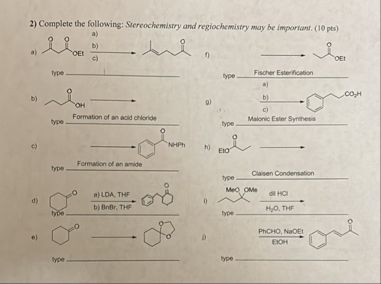 Em ey
aA SLEESES Or pr
SI [E—,
a “ co
EE. Co Cra
Eo
“To J
el
BR cee A
Em ey
aA SLEESES Or pr
SI [E—,
a “ co
EE. Co Cra
Eo
“To J
el
BR cee A
This is AI generated Response.
Asked by: Rahul
Created at: 2026-02-12 16:46:24
Asked by: Rahul
Created at: 2026-02-12 16:46:24
Final Answer:
Rendered
Raw Text
Did you like this answer?
Let's solve each reaction step-by-step, identifying the reaction type and providing the final product.
---
## a)
**Given:**
- Reactant:  (ethyl acetoacetate)
- Reagent: \( \mathrm{Br_2, NaOEt} \)
- Product: ?
**Type:** α-Bromination
### **Step-by-step:**
1. **NaOEt** deprotonates the α-hydrogen (adjacent to the carbonyl), forming an enolate.
2. **Br₂** reacts with the enolate, brominating the α-position.
**Final answer:**
- Product: 
- Structure:

- Type: α-Bromination
---
## b)
**Given:**
- Reactant: Carboxylic acid
- Reagent: SOCl₂
- Product: ?
**Type:** Formation of an acid chloride
### **Step-by-step:**
1. **SOCl₂** converts carboxylic acid to acid chloride.
**Final answer:**
- Product: Acid chloride (replace OH with Cl)
- Type: Formation of an acid chloride
---
## c)
**Given:**
- Reactant: Acid chloride
- Reagent: Amine (with aromatic ring)
- Product: ?
**Type:** Formation of an amide
### **Step-by-step:**
1. **Aromatic amine** attacks the acid chloride, forming an amide.
**Final answer:**
- Product: Amide (replace Cl with NHR, where R is the aromatic group)
- Type: Formation of an amide
---
## d)
**Given:**
- Reactant: Cyclohexanone
- Reagents:
1. LDA, THF
2. Benzyl bromide
**Type:** Alkylation of Enolate
### **Step-by-step:**
1. **LDA** forms an enolate at the α-position.
2. The enolate attacks benzyl bromide, alkylating the α-carbon.
**Final answer:**
- Product: Cyclohexanone with a benzyl group at the α-position.
- Type: α-Alkylation
---
## e)
**Given:**
- Reactant: Alcohol + Carboxylic acid
- Reagent: Acid
- Product: Ester
**Type:** Fischer Esterification
### **Step-by-step:**
1. Alcohol reacts with carboxylic acid under acidic conditions to form ester.
**Final answer:**
- Product: Ester (combine alcohol and acid)
- Type: Fischer Esterification
---
## f)
**Given:**
- Reactant: Malonic ester
- Reagents:
1. EtO⁻, RX
2. H₃O⁺, heat
**Type:** Malonic Ester Synthesis
### **Step-by-step:**
1. Deprotonation, alkylation, hydrolysis, and decarboxylation yield substituted acetic acid.
**Final answer:**
- Product: Substituted acetic acid
- Type: Malonic Ester Synthesis
---
## g)
**Given:**
- Reactant: Ester with an α-proton
- Reagents:
1. EtO⁻, Ester
2. H₃O⁺
**Type:** Claisen Condensation
### **Step-by-step:**
1. Enolate attacks another ester, forming β-ketoester.
**Final answer:**
- Product: β-Ketoester
- Type: Claisen Condensation
---
## h)
**Given:**
- Reactant:
- Reagents:
1. MeO⁻, OMe
2. H₃O⁺, heat
**Type:** Dieckmann Condensation (intramolecular Claisen)
### **Step-by-step:**
1. Intramolecular condensation forms cyclic β-ketoester.
**Final answer:**
- Product: Cyclic β-ketoester
- Type: Dieckmann Condensation
---
## i)
**Given:**
- Reactant:
- Reagents:
1. H₂O, THF
**Type:** Aldol Addition
### **Step-by-step:**
1. Enolate addition to aldehyde/ketone forms β-hydroxy carbonyl.
**Final answer:**
- Product: β-Hydroxy carbonyl
- Type: Aldol Addition
---
## j)
**Given:**
- Reactant:
- Reagents:
1. PhCHO, NaOH, EtOH
**Type:** Aldol Condensation
### **Step-by-step:**
1. Enolate addition, followed by dehydration to α,β-unsaturated carbonyl.
**Final answer:**
- Product: α,β-Unsaturated carbonyl (enone or enal)
- Type: Aldol Condensation
---
### **Summary Table**
| Letter | Product (structure) | Type |
|--------|---------------------------------|------------------------------|
| a | α-Bromoacetoacetate | α-Bromination |
| b | Acid chloride | Formation of acid chloride |
| c | Amide | Formation of an amide |
| d | α-Benzyl cyclohexanone | α-Alkylation |
| e | Ester | Fischer Esterification |
| f | Substituted acetic acid | Malonic Ester Synthesis |
| g | β-Ketoester | Claisen Condensation |
| h | Cyclic β-ketoester | Dieckmann Condensation |
| i | β-Hydroxy carbonyl | Aldol Addition |
| j | α,β-Unsaturated carbonyl | Aldol Condensation |
If you need structures drawn out, let me know!
📢 Instructions:
- Ask anything relatd to above question only.
- For new Question goto :