Give step-by-step solution with explanation and final answer:ey
Pap : : p
PON 7 Cu =HPy
Gas | PaiN. i
TEE EE
Gas-liquid} Cai! }
: a
i es
H Tm
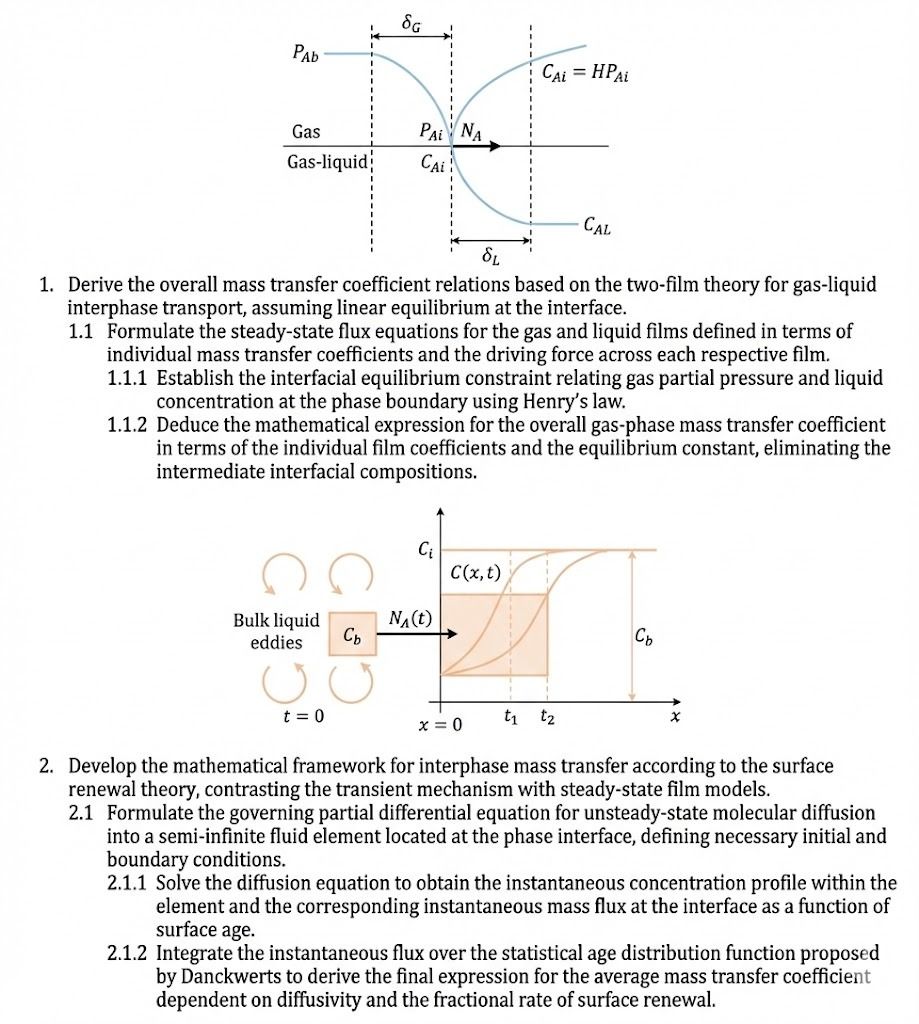
1. Derive the overall mass transfer coefficient relations based on the two-film theory for gas-liquid
interphase transport, assuming linear equilibrium at the interface.
1.1 Formulate the steady-state flux equations for the gas and liquid films defined in terms of
individual mass transfer coefficients and the driving force across each respective film.
1.1.1 Establish the interfacial equilibrium constraint relating gas partial pressure and liquid
concentration at the phase boundary using Henry's law.
1.1.2 Deduce the mathematical expression for the overall gas-phase mass transfer coefficient
in terms of the individual film coefficients and the equilibrium constant, eliminating the
intermediate interfacial compositions.
[4
Clx,t)
Bulk liquid Na(®)
eddies CG Co
t=0 x0 ht x
2. Develop the mathematical framework for interphase mass transfer according to the surface
renewal theory, contrasting the transient mechanism with steady-state film models.
2.1 Formulate the governing partial differential equation for unsteady-state molecular diffusion
into a semi-infinite fluid element located at the phase interface, defining necessary initial and
boundary conditions.
2.1.1 Solve the diffusion equation to obtain the instantaneous concentration profile within the
element and the corresponding instantaneous mass flux at the interface as a function of
surface age.
2.1.2 Integrate the instantaneous flux over the statistical age distribution function proposed
by Danckwerts to derive the final expression for the average mass transfer coefficient
dependent on diffusivity and the fractional rate of surface renewal.
Question:
Give step-by-step solution with explanation and final answer:ey
Pap : : p
PON 7 Cu =HPy
Gas | PaiN. i
TEE EE
Gas-liquid} Cai! }
: a
i es
H Tm
1. Derive the overall mass transfer coefficient relations based on the two-film theory for gas-liquid
interphase transport, assuming linear equilibrium at the interface.
1.1 Formulate the steady-state flux equations for the gas and liquid films defined in terms of
individual mass transfer coefficients and the driving force across each respective film.
1.1.1 Establish the interfacial equilibrium constraint relating gas partial pressure and liquid
concentration at the phase boundary using Henry's law.
1.1.2 Deduce the mathematical expression for the overall gas-phase mass transfer coefficient
in terms of the individual film coefficients and the equilibrium constant, eliminating the
intermediate interfacial compositions.
[4
Clx,t)
Bulk liquid Na(®)
eddies CG Co
t=0 x0 ht x
2. Develop the mathematical framework for interphase mass transfer according to the surface
renewal theory, contrasting the transient mechanism with steady-state film models.
2.1 Formulate the governing partial differential equation for unsteady-state molecular diffusion
into a semi-infinite fluid element located at the phase interface, defining necessary initial and
boundary conditions.
2.1.1 Solve the diffusion equation to obtain the instantaneous concentration profile within the
element and the corresponding instantaneous mass flux at the interface as a function of
surface age.
2.1.2 Integrate the instantaneous flux over the statistical age distribution function proposed
by Danckwerts to derive the final expression for the average mass transfer coefficient
dependent on diffusivity and the fractional rate of surface renewal.
This is AI generated Response.
Asked by: venky
Created at: 2026-02-14 23:19:07
Final Answer:
RenderedRaw Text
Did you like this answer?
Let's address each part step-by-step as requested.
---
# 1. **Derive the Overall Mass Transfer Coefficient Relations (Two-Film Theory)**
### **1.1 Steady-State Flux Equations for Gas and Liquid Films**
The two-film theory assumes two stagnant films (gas and liquid) at the interface, across which mass transfer occurs by molecular diffusion.
#### **Gas Film:**
\[
N_A = k_G (P_{Ab} - P_{Ai})
\]
- \( N_A \): Molar flux of A (mol/(area·time))
- \( k_G \): Gas-phase mass transfer coefficient (mol/(area·time·pressure))
- \( P_{Ab} \): Bulk gas-phase partial pressure
- \( P_{Ai} \): Interfacial gas-phase partial pressure
#### **Liquid Film:**
\[
N_A = k_L (C_{Ai} - C_{AL})
\]
- \( k_L \): Liquid-phase mass transfer coefficient (length/time)
- \( C_{Ai} \): Interfacial liquid-phase concentration
- \( C_{AL} \): Bulk liquid-phase concentration
---
### **1.1.1 Interfacial Equilibrium (Henry's Law)**
At the interface, equilibrium is assumed:
\[
C_{Ai} = H P_{Ai}
\]
- \( H \): Henry’s law constant (mol/(L·atm))
---
### **1.1.2 Derive the Overall Gas-Phase Mass Transfer Coefficient**
#### **Step 1: Equate Fluxes**
At steady state, the flux through both films is equal:
\[
k_G (P_{Ab} - P_{Ai}) = k_L (C_{Ai} - C_{AL})
\]
#### **Step 2: Substitute Interfacial Equilibrium**
\[
C_{Ai} = H P_{Ai}
\]
\[
k_L (C_{Ai} - C_{AL}) = k_L (H P_{Ai} - C_{AL})
\]
#### **Step 3: Express Everything in Terms of Gas-Phase Quantities**
From above:
\[
N_A = k_G (P_{Ab} - P_{Ai})
\]
\[
N_A = k_L (H P_{Ai} - C_{AL})
\]
Set equal to each other:
\[
k_G (P_{Ab} - P_{Ai}) = k_L (H P_{Ai} - C_{AL})
\]
Solve for \(P_{Ai}\):
\[
k_G P_{Ab} - k_G P_{Ai} = k_L H P_{Ai} - k_L C_{AL}
\]
\[
k_G P_{Ab} + k_L C_{AL} = k_G P_{Ai} + k_L H P_{Ai}
\]
\[
k_G P_{Ab} + k_L C_{AL} = (k_G + k_L H) P_{Ai}
\]
\[
P_{Ai} = \frac{k_G P_{Ab} + k_L C_{AL}}{k_G + k_L H}
\]
#### **Step 4: Substitute Back for Flux**
\[
N_A = k_G (P_{Ab} - P_{Ai})
\]
\[
N_A = k_G \left(P_{Ab} - \frac{k_G P_{Ab} + k_L C_{AL}}{k_G + k_L H}\right)
\]
\[
N_A = k_G \left(\frac{(k_G + k_L H)P_{Ab} - (k_G P_{Ab} + k_L C_{AL})}{k_G + k_L H}\right)
\]
\[
N_A = k_G \left(\frac{k_L H P_{Ab} - k_L C_{AL}}{k_G + k_L H}\right)
\]
\[
N_A = \frac{k_G k_L H}{k_G + k_L H} \left(P_{Ab} - \frac{C_{AL}}{H}\right)
\]
#### **Step 5: Define Overall Gas-Phase Mass Transfer Coefficient \(K_G\)**
\[
N_A = K_G (P_{Ab} - P_{AL}^*)
\]
where \(P_{AL}^* = \frac{C_{AL}}{H}\) (the equilibrium gas-phase concentration corresponding to \(C_{AL}\)).
So,
\[
K_G = \frac{k_G k_L H}{k_G + k_L H}
\]
or equivalently,
\[
\frac{1}{K_G} = \frac{1}{k_G} + \frac{1}{k_L H}
\]
**This is the classic two-film theory result.**
---
## **Summary Table**
| Phase | Driving Force | Coefficient | Flux Expression |
|---------|-------------------|--------------|----------------------------------|
| Gas | \( P_{Ab} - P_{Ai} \) | \( k_G \) | \( N_A = k_G (P_{Ab} - P_{Ai}) \) |
| Liquid | \( C_{Ai} - C_{AL} \) | \( k_L \) | \( N_A = k_L (C_{Ai} - C_{AL}) \) |
| Overall | \( P_{Ab} - P_{AL}^* \) | \( K_G \) | \( N_A = K_G (P_{Ab} - P_{AL}^*) \) |
---
# 2. **Surface Renewal Theory (Danckwerts Theory)**
## **2.1 Governing Equation for Unsteady-State Diffusion**
Consider a semi-infinite slab with initial concentration \(C_b\) everywhere except at the interface (\(x = \)), where the concentration is suddenly changed to \(C_i\) at \(t = \).
**Diffusion Equation:**
\[
\frac{\partial C}{\partial t} = D \frac{\partial^2 C}{\partial x^2}
\]
- \(D\): Diffusion coefficient
**Initial and Boundary Conditions:**
- \(C(x,) = C_b\) for \(x > \)
- \(C(,t) = C_i\) for \(t > \)
- \(C(\infty, t) = C_b\) for \(t > \)
---
## **2.1.1 Solution: Instantaneous Flux**
The solution to the diffusion equation:
\[
C(x, t) = C_i + (C_b - C_i) \ \mathrm{erf}\left(\frac{x}{2\sqrt{Dt}}\right)
\]
The instantaneous flux at the interface (\(x = \)):
\[
N_A(t) = -D \left.\frac{\partial C}{\partial x}\right|_{x=} = \frac{(C_i - C_b)}{\sqrt{\pi D t}}
\]
---
## **2.1.2 Average Flux (Danckwerts' Surface Renewal Theory)**
Assume each element of fluid at the interface is replaced (renewed) at a rate \(s\) (fractional rate of surface renewal).
**Average flux:**
\[
\overline{N}_A = s \int_^{\infty} N_A(t) e^{-s t} dt
\]
Insert expression for \(N_A(t)\):
\[
\overline{N}_A = s \int_^{\infty} \frac{(C_i - C_b)}{\sqrt{\pi D t}} e^{-s t} dt
\]
This integral evaluates to:
\[
\overline{N}_A = (C_i - C_b) \sqrt{\frac{D s}{\pi}}
\]
Thus, the **average mass transfer coefficient** is:
\[
k_L = \sqrt{\frac{D s}{\pi}}
\]
---
## **Final Answers**
### **1. Overall Mass Transfer Coefficient (Two-Film Theory):**
\[
\boxed{
\frac{1}{K_G} = \frac{1}{k_G} + \frac{1}{k_L H}
}
\]
### **2. Surface Renewal Theory (Danckwerts):**
\[
\boxed{
k_L = \sqrt{\frac{D s}{\pi}}
}
\]
- \(k_L\): Average liquid-phase mass transfer coefficient
- \(D\): Diffusion coefficient
- \(s\): Fractional rate of surface renewal
---
## **Summary**
- Two-film theory gives the overall mass transfer coefficient as the sum of resistances in each phase.
- Surface renewal theory leads to a mass transfer coefficient that depends on the diffusivity and the renewal rate of surface elements.
VIPSolutions focuses on clear, step‑by‑step explanations so you can learn quickly. Whether you need an AI‑generated walkthrough or a short hint to get unstuck, each solution is organized for fast reading and easy review later.
Search similar questions, compare approaches, and bookmark the best answers for revision. Our goal is simple: quick, reliable study help that feels natural—not noisy.
 VIPSolutions
 ey
Pap : : p
PON 7 Cu =HPy
Gas | PaiN. i
TEE EE
Gas-liquid} Cai! }
: a
i es
H Tm
1. Derive the overall mass transfer coefficient relations based on the two-film theory for gas-liquid
interphase transport, assuming linear equilibrium at the interface.
1.1 Formulate the steady-state flux equations for the gas and liquid films defined in terms of
individual mass transfer coefficients and the driving force across each respective film.
1.1.1 Establish the interfacial equilibrium constraint relating gas partial pressure and liquid
concentration at the phase boundary using Henry's law.
1.1.2 Deduce the mathematical expression for the overall gas-phase mass transfer coefficient
in terms of the individual film coefficients and the equilibrium constant, eliminating the
intermediate interfacial compositions.
[4
Clx,t)
Bulk liquid Na(®)
eddies CG Co
t=0 x0 ht x
2. Develop the mathematical framework for interphase mass transfer according to the surface
renewal theory, contrasting the transient mechanism with steady-state film models.
2.1 Formulate the governing partial differential equation for unsteady-state molecular diffusion
into a semi-infinite fluid element located at the phase interface, defining necessary initial and
boundary conditions.
2.1.1 Solve the diffusion equation to obtain the instantaneous concentration profile within the
element and the corresponding instantaneous mass flux at the interface as a function of
surface age.
2.1.2 Integrate the instantaneous flux over the statistical age distribution function proposed
by Danckwerts to derive the final expression for the average mass transfer coefficient
dependent on diffusivity and the fractional rate of surface renewal.
ey
Pap : : p
PON 7 Cu =HPy
Gas | PaiN. i
TEE EE
Gas-liquid} Cai! }
: a
i es
H Tm
1. Derive the overall mass transfer coefficient relations based on the two-film theory for gas-liquid
interphase transport, assuming linear equilibrium at the interface.
1.1 Formulate the steady-state flux equations for the gas and liquid films defined in terms of
individual mass transfer coefficients and the driving force across each respective film.
1.1.1 Establish the interfacial equilibrium constraint relating gas partial pressure and liquid
concentration at the phase boundary using Henry's law.
1.1.2 Deduce the mathematical expression for the overall gas-phase mass transfer coefficient
in terms of the individual film coefficients and the equilibrium constant, eliminating the
intermediate interfacial compositions.
[4
Clx,t)
Bulk liquid Na(®)
eddies CG Co
t=0 x0 ht x
2. Develop the mathematical framework for interphase mass transfer according to the surface
renewal theory, contrasting the transient mechanism with steady-state film models.
2.1 Formulate the governing partial differential equation for unsteady-state molecular diffusion
into a semi-infinite fluid element located at the phase interface, defining necessary initial and
boundary conditions.
2.1.1 Solve the diffusion equation to obtain the instantaneous concentration profile within the
element and the corresponding instantaneous mass flux at the interface as a function of
surface age.
2.1.2 Integrate the instantaneous flux over the statistical age distribution function proposed
by Danckwerts to derive the final expression for the average mass transfer coefficient
dependent on diffusivity and the fractional rate of surface renewal.