 VIPSolutions
Give step-by-step solution with explanation and final answer:2.4.12 A bicycle with unequal wheels. For the bicycle shown in the figure, assume the mass of the bicycle (and possibly the rider) to be a point mass located at C. A vertical downward force F is applied on the front pedal. a) Draw a free-body diagram of the front wheel. b) Draw a free-body diagram of the back wheel. c) Draw a free-body diagram of the entire bicycle. d) What assumptions have you made in modeling the interaction force of the ground with the wheels? M = | c® g | Lr h = 2Ry Le |T Ry | S——) Filename: pfig3-2-weirdbic; 4 b Problem 2.4.12
Question:
Give step-by-step solution with explanation and final answer: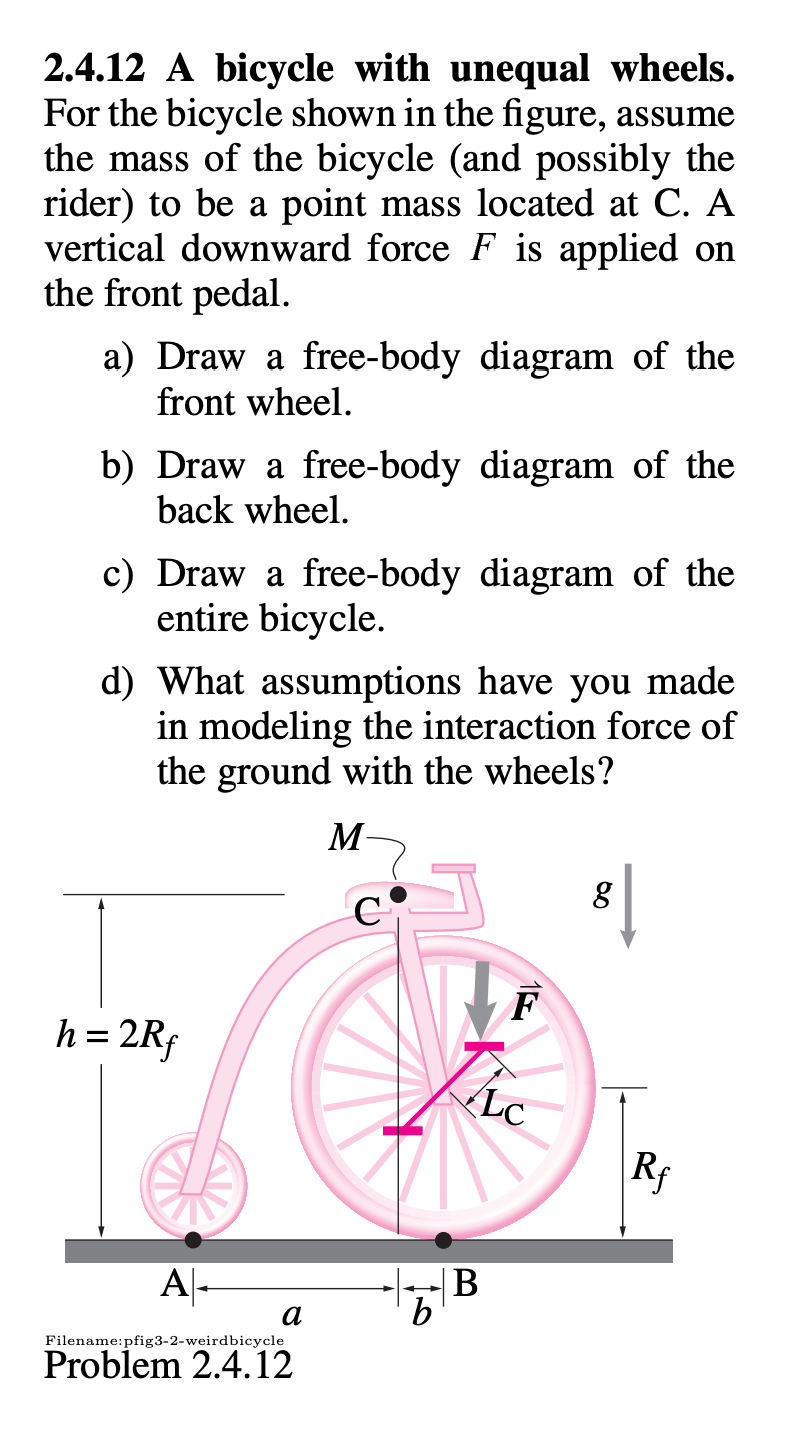 2.4.12 A bicycle with unequal wheels.
For the bicycle shown in the figure, assume
the mass of the bicycle (and possibly the
rider) to be a point mass located at C. A
vertical downward force F is applied on
the front pedal.
a) Draw a free-body diagram of the
front wheel.
b) Draw a free-body diagram of the
back wheel.
c) Draw a free-body diagram of the
entire bicycle.
d) What assumptions have you made
in modeling the interaction force of
the ground with the wheels?
M
=
| c® g |
Lr
h = 2Ry
Le |T
Ry
|
S——)
Filename: pfig3-2-weirdbic; 4 b
Problem 2.4.12
2.4.12 A bicycle with unequal wheels.
For the bicycle shown in the figure, assume
the mass of the bicycle (and possibly the
rider) to be a point mass located at C. A
vertical downward force F is applied on
the front pedal.
a) Draw a free-body diagram of the
front wheel.
b) Draw a free-body diagram of the
back wheel.
c) Draw a free-body diagram of the
entire bicycle.
d) What assumptions have you made
in modeling the interaction force of
the ground with the wheels?
M
=
| c® g |
Lr
h = 2Ry
Le |T
Ry
|
S——)
Filename: pfig3-2-weirdbic; 4 b
Problem 2.4.12
This is AI generated Response.
Asked by: Rahul
Created at: 2026-02-17 03:58:33
Asked by: Rahul
Created at: 2026-02-17 03:58:33
Final Answer:
Rendered
Raw Text
Did you like this answer?
Let's break down each part of the problem step-by-step:
---
## **a) Free-body diagram of the front wheel**
**Forces acting on the front wheel:**
- **Contact force from the ground at B:** This can be decomposed into a normal force \( N_B \) (upward) and possibly a horizontal friction force (not shown in the problem, so assumed zero).
- **Force from the bicycle frame:** The frame exerts a downward force (from the mass at \( C \)), and the force \( F \) acts vertically downward at the pedal.
- **Action-reaction pair:** The wheel exerts an upward force on the frame.
**Diagram:**
```
| (Bicycle frame applies downward force)
↓ F + part of Mg
-----
| | (Front wheel)
-----
↑ N_B (Ground reaction at B)
```
---
## **b) Free-body diagram of the back wheel**
**Forces acting on the back wheel:**
- **Contact force from the ground at A:** Normal force \( N_A \) (upward). Typically, we neglect friction if not specified.
- **Force from the bicycle frame:** The frame exerts a downward force (due to mass at \( C \)), but most of the weight is supported at the front.
**Diagram:**
```
| (Bicycle frame applies downward force)
↓ part of Mg
-----
| | (Back wheel)
-----
↑ N_A (Ground reaction at A)
```
---
## **c) Free-body diagram of the entire bicycle**
**Forces acting on the entire bicycle:**
- **Weight \( Mg \) at C:** Acts vertically downward.
- **Vertical downward force \( F \):** Applied at the pedal.
- **Normal forces from the ground:** \( N_A \) at A (back wheel), \( N_B \) at B (front wheel).
**Diagram:**
```
(C) (F at pedal)
↓ ↓
*---------*
| |
/ \
(A) (B)
↑ N_A ↑ N_B
```
---
### **Force directions:**
- \( Mg \) at point \( C \), downward.
- \( F \) at pedal, downward.
- \( N_A \) at A, upward.
- \( N_B \) at B, upward.
---
## **d) Assumptions in modeling the interaction force of the ground**
- **Normal forces only:** The ground exerts only vertical normal forces at points A and B (\( N_A \) and \( N_B \)).
- **No friction:** Unless otherwise specified, frictional forces are neglected.
- **Point contacts:** The wheels are considered as point contacts with the ground (no area).
- **Rigid bodies:** The wheels and frame are assumed to be rigid.
- **Statics:** The system is in equilibrium (no acceleration).
---
## **Summary Table of Forces**
| Force | Point of Application | Direction |
|------------|---------------------|-------------|
| \( Mg \) | C | Downward |
| \( F \) | Pedal (front wheel) | Downward |
| \( N_A \) | A (back wheel) | Upward |
| \( N_B \) | B (front wheel) | Upward |
---
### **Final Answer Summary**
1. **Front wheel:** Upward normal from ground (\( N_B \)), downward force from frame (weight + pedal force component).
2. **Back wheel:** Upward normal from ground (\( N_A \)), downward force from frame (weight component).
3. **Entire bicycle:** Downward \( Mg \) at C, downward \( F \) at pedal, upward \( N_A \) at A, upward \( N_B \) at B.
4. **Assumptions:** Only vertical (normal) ground forces, no friction, point contact, rigid bodies, system in static equilibrium.
Let me know if you'd like diagrams for each part!
Question:
Solved bidaut diagram
This is AI generated Response.
Asked by: Rahul
Created at: 2026-02-17 03:59:26
Asked by: Rahul
Created at: 2026-02-17 03:59:26
Final Answer:
Rendered
Raw Text
Did you like this answer?
# Bicycle with Unequal Wheels - Step-by-Step Solution
## **a) Free-body Diagram of the Front Wheel**
### **Forces Acting on the Front Wheel:**
1. **Contact Force from the Ground (B):**
- Normal Force \( N_B \) (upward).
- Potential horizontal friction force (assumed zero for simplicity).
2. **Force from the Bicycle Frame:**
- Downward force due to the weight at point \( C \) and the force \( F \) applied at the pedal.
### **Diagram:**
```
| (Downward force from frame)
↓ F + part of Mg
-----
| | (Front wheel)
-----
↑ N_B (Ground reaction at B)
```
---
## **b) Free-body Diagram of the Back Wheel**
### **Forces Acting on the Back Wheel:**
1. **Contact Force from the Ground (A):**
- Normal Force \( N_A \) (upward).
2. **Force from the Bicycle Frame:**
- Downward force due to the weight at point \( C \) (less than at the front due to the bicycle’s tilt).
### **Diagram:**
```
| (Downward force from frame)
↓ part of Mg
-----
| | (Back wheel)
-----
↑ N_A (Ground reaction at A)
```
---
## **c) Free-body Diagram of the Entire Bicycle**
### **Forces Acting on the Entire Bicycle:**
1. **Weight \( Mg \):**
- Acts vertically downward at point \( C \).
2. **Vertical Downward Force \( F \):**
- Applied at the pedal.
3. **Normal Forces from the Ground:**
- \( N_A \) at A (back wheel).
- \( N_B \) at B (front wheel).
### **Diagram:**
```
(C) (F at pedal)
↓ ↓
*---------*
| |
/ \
(A) (B)
↑ N_A ↑ N_B
```
---
### **Force Directions:**
- \( Mg \): Downward at C.
- \( F \): Downward at the pedal.
- \( N_A \): Upward at A.
- \( N_B \): Upward at B.
---
## **d) Assumptions in Modeling Interaction Force of the Ground**
1. **Normal Forces Only:** The ground exerts only vertical normal forces (\( N_A \) and \( N_B \)).
2. **No Friction:** Frictional forces are neglected unless specified.
3. **Point Contacts:** Wheels are considered point contacts with the ground.
4. **Rigid Bodies:** Assumes wheels and frame are rigid.
5. **Statics:** The system is in static equilibrium (no acceleration).
---
## **Summary Table of Forces**
| Force | Point of Application | Direction |
|------------|---------------------|-------------|
| \( Mg \) | C | Downward |
| \( F \) | Pedal (front wheel) | Downward |
| \( N_A \) | A (back wheel) | Upward |
| \( N_B \) | B (front wheel) | Upward |
---
### **Final Answer Summary**
1. **Front Wheel:**
- Upward normal force \( N_B \).
- Downward forces \( F \) and part of \( Mg \).
2. **Back Wheel:**
- Upward normal force \( N_A \).
- Downward force from the frame (weight component).
3. **Entire Bicycle:**
- Downward forces \( Mg \) at C and \( F \) at the pedal.
- Upward forces \( N_A \) and \( N_B \).
4. **Assumptions:**
- Only vertical normal forces, no friction, point contact, rigid bodies, system in static equilibrium.
Feel free to ask for any further clarifications or additional diagrams!
📢 Instructions:
- Ask anything relatd to above question only.
- For new Question goto :