 VIPSolutions
Give step-by-step solution with explanation and final answer:A national bank conducted a performance review of 240 loan applicants over a six - month period to analyze loan approval patterns and repayment capacity. For each applicant, the bank recorded monthly income (220,000 to 21,50, 000), credit score (300 to 900), loan amount requested (350, 000 to 10,00, 000), and loan status (Approved or Rejected) . The management wants to study the distribution of income and credit scores, examine the relationship between income level and loan approval, and estimate probabilities related to approval trends. You are required to generate realistic data within the given ranges and complete the following tasks by creating tables only (no graphs required): Create a grouped frequency distribution table for monthly income using class interval width of 20,000. Include frequency, cumulative frequency, relative frequency, and percentage columns. Create a grouped frequency distribution table for credit scores using suitable class intervals (e.g., width of 100). Construct a two - way contingency table showing income class intervals versus loan status (Approved/ Rejected) . Prepare a summary table showing average loan amount requested within each income class. Using relative frequencies, determine the probability that a randomly selected applicant has income above 280,000 and the loan is approved. All answers must be presented in clearly structured statistical tables with proper headings and totals.
Question:
Give step-by-step solution with explanation and final answer: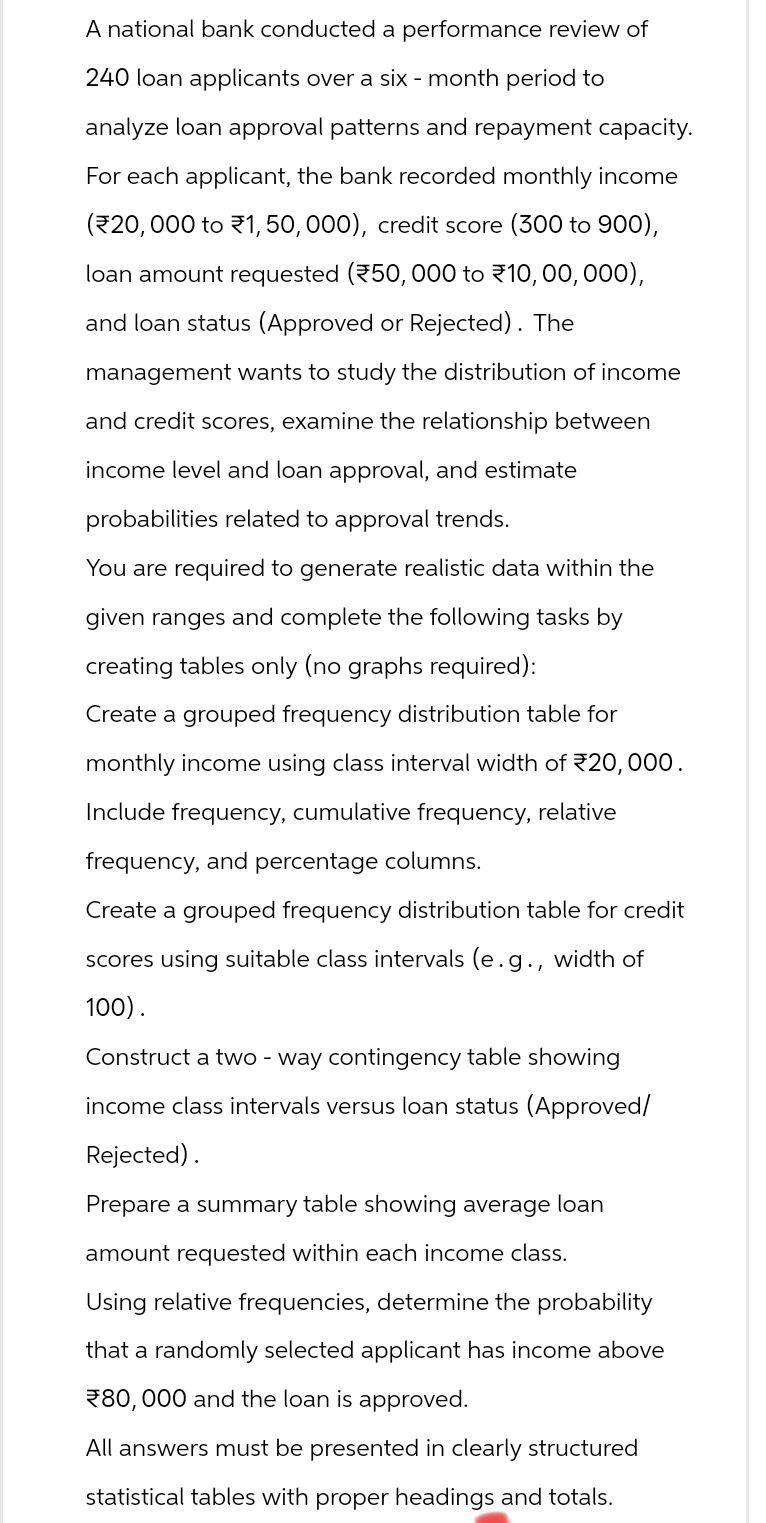 A national bank conducted a performance review of
240 loan applicants over a six - month period to
analyze loan approval patterns and repayment capacity.
For each applicant, the bank recorded monthly income
(220,000 to 21,50, 000), credit score (300 to 900),
loan amount requested (350, 000 to 10,00, 000),
and loan status (Approved or Rejected) . The
management wants to study the distribution of income
and credit scores, examine the relationship between
income level and loan approval, and estimate
probabilities related to approval trends.
You are required to generate realistic data within the
given ranges and complete the following tasks by
creating tables only (no graphs required):
Create a grouped frequency distribution table for
monthly income using class interval width of 20,000.
Include frequency, cumulative frequency, relative
frequency, and percentage columns.
Create a grouped frequency distribution table for credit
scores using suitable class intervals (e.g., width of
100).
Construct a two - way contingency table showing
income class intervals versus loan status (Approved/
Rejected) .
Prepare a summary table showing average loan
amount requested within each income class.
Using relative frequencies, determine the probability
that a randomly selected applicant has income above
280,000 and the loan is approved.
All answers must be presented in clearly structured
statistical tables with proper headings and totals.
A national bank conducted a performance review of
240 loan applicants over a six - month period to
analyze loan approval patterns and repayment capacity.
For each applicant, the bank recorded monthly income
(220,000 to 21,50, 000), credit score (300 to 900),
loan amount requested (350, 000 to 10,00, 000),
and loan status (Approved or Rejected) . The
management wants to study the distribution of income
and credit scores, examine the relationship between
income level and loan approval, and estimate
probabilities related to approval trends.
You are required to generate realistic data within the
given ranges and complete the following tasks by
creating tables only (no graphs required):
Create a grouped frequency distribution table for
monthly income using class interval width of 20,000.
Include frequency, cumulative frequency, relative
frequency, and percentage columns.
Create a grouped frequency distribution table for credit
scores using suitable class intervals (e.g., width of
100).
Construct a two - way contingency table showing
income class intervals versus loan status (Approved/
Rejected) .
Prepare a summary table showing average loan
amount requested within each income class.
Using relative frequencies, determine the probability
that a randomly selected applicant has income above
280,000 and the loan is approved.
All answers must be presented in clearly structured
statistical tables with proper headings and totals.
Asked by: Rahul
Created at: 2026-02-21 04:33:32
Final Answer:
📢 Instructions:
- Ask anything relatd to above question only.
- For new Question goto :