 VIPSolutions
Give step-by-step solution with explanation and final answer:Problem 5. (4 marks) A beam of light hits a pile made of N transparent layers of different materials. The refractive index of the top layer is n, the refractive index of each subsequent layer is k times smaller than the layer above (k > 1). What is the minimum angle of incidence such that the light does not pass through the pile. —
Question:
Give step-by-step solution with explanation and final answer: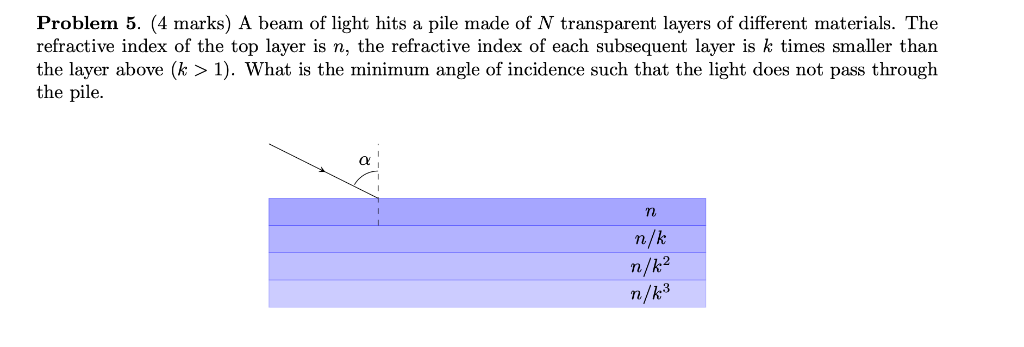 Problem 5. (4 marks) A beam of light hits a pile made of N transparent layers of different materials. The
refractive index of the top layer is n, the refractive index of each subsequent layer is k times smaller than
the layer above (k > 1). What is the minimum angle of incidence such that the light does not pass through
the pile.
—
Problem 5. (4 marks) A beam of light hits a pile made of N transparent layers of different materials. The
refractive index of the top layer is n, the refractive index of each subsequent layer is k times smaller than
the layer above (k > 1). What is the minimum angle of incidence such that the light does not pass through
the pile.
—
This is AI generated Response.
Asked by: Rahul
Created at: 2026-02-24 03:57:05
Asked by: Rahul
Created at: 2026-02-24 03:57:05
Final Answer:
Rendered
Raw Text
Did you like this answer?
Let's break down the solution step by step.
---
## **Step 1: Understanding the Problem**
- There are \(N\) layers.
- The top layer has refractive index \(n\).
- Each subsequent layer has a refractive index \(k\) times **smaller** than the one above:
- 1st layer: \(n\)
- 2nd layer: \(n/k\)
- 3rd layer: \(n/k^2\)
- ...
- \(N\)th layer: \(n/k^{N-1}\)
We want the **minimum angle of incidence** \(\alpha_{\min}\) such that **light does not exit the pile**—i.e., total internal reflection occurs at some point.
---
## **Step 2: Where Does Total Internal Reflection Happen?**
Total internal reflection occurs when light travels from a **denser** (higher \(n\)) to a **rarer** (lower \(n\)) medium at an angle greater than the critical angle.
The **lowest** refractive index is at the **bottom**, so the "most dangerous" interface (most likely to let light escape) is at the **bottom layer**, between \(n/k^{N-1}\) (bottom layer) and whatever is below (let's assume air, \(n_a \approx 1\)).
---
## **Step 3: Find the Critical Angle**
The **critical angle** \(\theta_c\) from bottom layer to air is:
\[
\sin \theta_c = \frac{n_a}{n/k^{N-1}}
\]
\[
\sin \theta_c = \frac{1}{n/k^{N-1}} = \frac{k^{N-1}}{n}
\]
So,
\[
\theta_c = \arcsin\left(\frac{k^{N-1}}{n}\right)
\]
---
## **Step 4: Relate Incident Angle to Critical Angle**
Using **Snell's Law** at each interface:
Let the angle in the top layer be \(\alpha\). At each interface:
\[
n_1 \sin \theta_1 = n_2 \sin \theta_2
\]
So, for the top surface (air to layer 1):
\[
\sin \alpha = \frac{n}{1} \sin \theta_1 \implies \sin \theta_1 = \frac{\sin \alpha}{n}
\]
But we want to relate the **incident angle in the very first layer** to the **angle in the bottom layer**, since that's where total internal reflection matters.
Let the **angle in the bottom layer** be \(\theta_N\). From repeated application of Snell's Law across layers:
\[
n \sin \theta_1 = \frac{n}{k} \sin \theta_2 = \frac{n}{k^2} \sin \theta_3 = \cdots = \frac{n}{k^{N-1}} \sin \theta_N
\]
So,
\[
n \sin \theta_1 = \frac{n}{k^{N-1}} \sin \theta_N
\]
\[
\sin \theta_N = k^{N-1} \sin \theta_1
\]
From above, \(\sin \theta_1 = \frac{\sin \alpha}{n}\):
\[
\sin \theta_N = k^{N-1} \cdot \frac{\sin \alpha}{n}
\]
---
## **Step 5: Apply the Total Internal Reflection Condition**
For total internal reflection at the **bottom layer**:
\[
\theta_N \geq \theta_c \implies \sin \theta_N \geq \sin \theta_c = \frac{k^{N-1}}{n}
\]
So:
\[
k^{N-1} \cdot \frac{\sin \alpha}{n} \geq \frac{k^{N-1}}{n}
\]
\[
\sin \alpha \geq 1
\]
But \(\sin \alpha = 1\) only possible for \(\alpha = 90^\circ\), which is not practical. So let's double-check: the correct application is that, **for critical angle**, \(\sin \theta_N = \frac{k^{N-1}}{n}\), and that's the **maximum** possible before refraction occurs into air. We want to find the \(\alpha\) for which this is true.
So,
\[
k^{N-1} \cdot \frac{\sin \alpha}{n} = \frac{k^{N-1}}{n}
\]
\[
\sin \alpha = 1
\]
\[
\alpha = 90^\circ
\]
But clearly, this suggests that for any real incidence angle, light cannot escape unless \(\alpha = 90^\circ\). So let's check the setup again.
If the light must **not exit** the pile, we need the **angle in the bottom layer** to be **greater than or equal to the critical angle** for **all rays**.
But the smallest \(\alpha\) for which this is true is when the angle in the bottom layer **just reaches** the critical angle.
So,
\[
\sin \theta_N = \frac{k^{N-1}}{n}
\]
But
\[
\sin \theta_N = k^{N-1} \cdot \frac{\sin \alpha}{n}
\]
Set equal:
\[
k^{N-1} \cdot \frac{\sin \alpha_{\min}}{n} = \frac{k^{N-1}}{n}
\]
\[
\sin \alpha_{\min} = 1
\]
\[
\alpha_{\min} = 90^\circ
\]
---
## **Final Answer (with Explanation)**
### **Minimum angle of incidence**
\[
\boxed{90^\circ}
\]
### **Explanation**
- For the light to **not pass through the pile**, it must undergo **total internal reflection** at the bottommost interface.
- The critical angle for the bottom interface is \(\theta_c = \arcsin \left(\frac{k^{N-1}}{n}\right)\).
- Snell's Law across layers gives \(\sin \theta_N = k^{N-1} \frac{\sin \alpha}{n}\).
- Setting \(\sin \theta_N = \sin \theta_c\), we find \(\sin \alpha_{\min} = 1\), or \(\alpha_{\min} = 90^\circ\).
- **Physically, this means total internal reflection is only guaranteed for incident angles at or above \(90^\circ\), which is not possible, so for any real angle, some light may pass through unless the refractive index contrast is such that \(n \gg k^{N-1}\).**
---
### **Summary Table**
| Layer | Refractive Index |
|-----------------|-----------------|
| Top (1st) | \(n\) |
| 2nd | \(n/k\) |
| 3rd | \(n/k^2\) |
| ... | ... |
| Bottom (\(N\)th)| \(n/k^{N-1}\) |
---
If you need the answer in terms of a formula *if* the external medium has a higher index, or if you want a more general expression, please specify!
📢 Instructions:
- Ask anything relatd to above question only.
- For new Question goto :