Give step-by-step solution with explanation and final answer:Required information
Problem 12.047 - A roller-coaster track
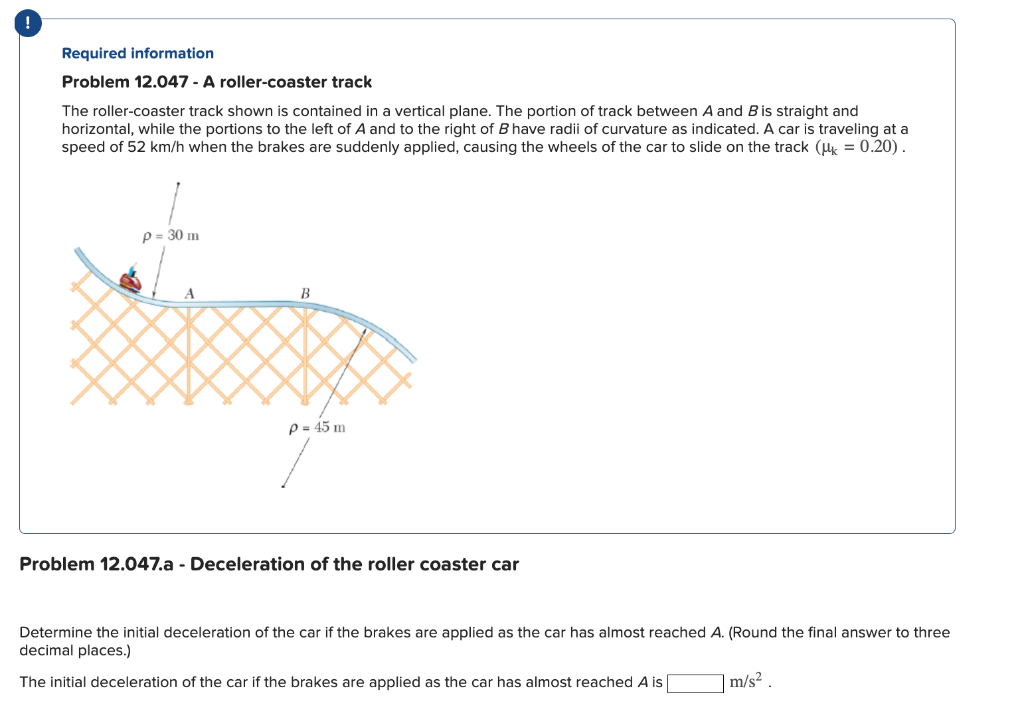
The roller-coaster track shown is contained in a vertical plane. The portion of track between A and Bis straight and
horizontal, while the portions to the left of A and to the right of 8 have radii of curvature as indicated. A car is traveling at a
speed of 52 km/h when the brakes are suddenly applied, causing the wheels of the car to slide on the track (jy = 0.20) .
p=30m
2 A B
/
p=45m
Problem 12.047.a - Deceleration of the roller coaster car
Determine the initial deceleration of the car if the brakes are applied as the car has almost reached A. (Round the final answer to three
decimal places.)
The initial deceleration of the car if the brakes are applied as the car has almost reached Ais | m/s? .
Question:
Give step-by-step solution with explanation and final answer:Required information
Problem 12.047 - A roller-coaster track
The roller-coaster track shown is contained in a vertical plane. The portion of track between A and Bis straight and
horizontal, while the portions to the left of A and to the right of 8 have radii of curvature as indicated. A car is traveling at a
speed of 52 km/h when the brakes are suddenly applied, causing the wheels of the car to slide on the track (jy = 0.20) .
p=30m
2 A B
/
p=45m
Problem 12.047.a - Deceleration of the roller coaster car
Determine the initial deceleration of the car if the brakes are applied as the car has almost reached A. (Round the final answer to three
decimal places.)
The initial deceleration of the car if the brakes are applied as the car has almost reached Ais | m/s? .
This is AI generated Response.
Asked by: Rahul
Created at: 2026-02-24 06:10:46
Final Answer:
RenderedRaw Text
Did you like this answer?
Let's solve the problem step by step.
---
## **Step 1: Draw the Free-Body Diagram Point A**
At point A (just before the curve, on a straight/horizontal track):
- **Gravity** acts downward: \( mg \)
- **Normal force** acts upward: \( N \)
- **Friction force** (kinetic, since the car is sliding): \( f_k = \mu_k N \)
- The **deceleration** is caused by friction.
---
## **Step 2: Find the Normal Force at A**
Since the track at A is horizontal and straight, the normal force balances gravity:
\[
N = mg
\]
---
## **Step 3: Friction Force**
The friction force is:
\[
f_k = \mu_k N = \mu_k mg
\]
---
## **Step 4: Newton’s Second Law (Deceleration)**
Friction is the only horizontal force slowing the car, so:
\[
f_k = ma
\]
\[
\mu_k mg = ma
\]
\[
a = \mu_k g
\]
where:
- \( a \) = deceleration
- \( \mu_k \) = coefficient of kinetic friction = .20
- \( g \) = acceleration due to gravity = \( 9.81 \, \text{m/s}^2 \)
---
## **Step 5: Plug in the Values**
\[
a = .20 \times 9.81 \, \text{m/s}^2
\]
\[
a = 1.962 \, \text{m/s}^2
\]
---
## **Step 6: Final Answer**
### **The initial deceleration of the car as it almost reaches A is:**
\[
\boxed{1.962 \ \text{m/s}^2}
\]
---
**Explanation:**
- The deceleration is just due to friction.
- On a horizontal track, normal force equals the weight.
- The frictional force is \(\mu_k mg\), so deceleration is \(\mu_k g\).
VIPSolutions focuses on clear, step‑by‑step explanations so you can learn quickly. Whether you need an AI‑generated walkthrough or a short hint to get unstuck, each solution is organized for fast reading and easy review later.
Search similar questions, compare approaches, and bookmark the best answers for revision. Our goal is simple: quick, reliable study help that feels natural—not noisy.
 VIPSolutions
 Required information
Problem 12.047 - A roller-coaster track
The roller-coaster track shown is contained in a vertical plane. The portion of track between A and Bis straight and
horizontal, while the portions to the left of A and to the right of 8 have radii of curvature as indicated. A car is traveling at a
speed of 52 km/h when the brakes are suddenly applied, causing the wheels of the car to slide on the track (jy = 0.20) .
p=30m
2 A B
/
p=45m
Problem 12.047.a - Deceleration of the roller coaster car
Determine the initial deceleration of the car if the brakes are applied as the car has almost reached A. (Round the final answer to three
decimal places.)
The initial deceleration of the car if the brakes are applied as the car has almost reached Ais | m/s? .
Required information
Problem 12.047 - A roller-coaster track
The roller-coaster track shown is contained in a vertical plane. The portion of track between A and Bis straight and
horizontal, while the portions to the left of A and to the right of 8 have radii of curvature as indicated. A car is traveling at a
speed of 52 km/h when the brakes are suddenly applied, causing the wheels of the car to slide on the track (jy = 0.20) .
p=30m
2 A B
/
p=45m
Problem 12.047.a - Deceleration of the roller coaster car
Determine the initial deceleration of the car if the brakes are applied as the car has almost reached A. (Round the final answer to three
decimal places.)
The initial deceleration of the car if the brakes are applied as the car has almost reached Ais | m/s? .