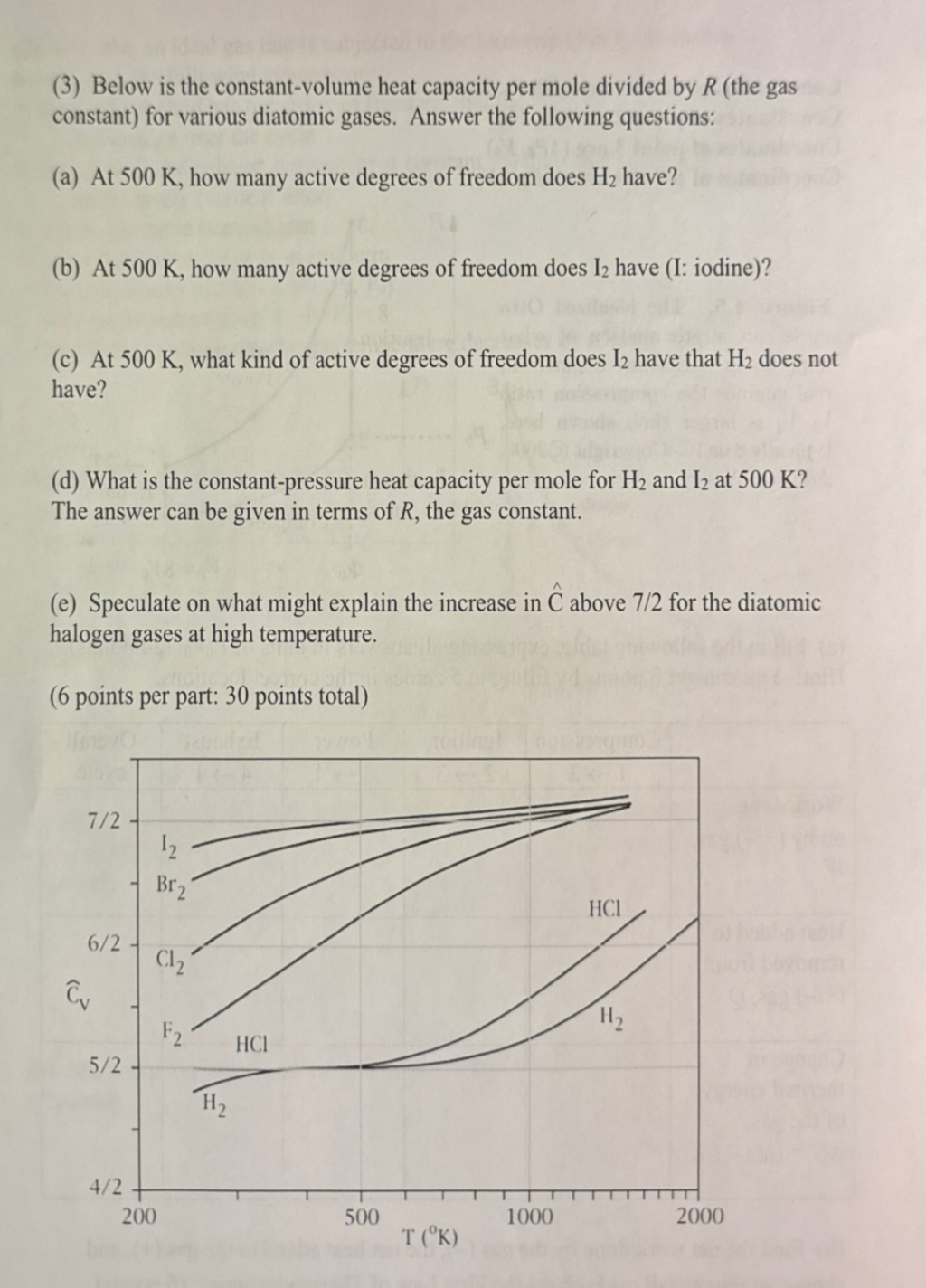
Give step-by-step solution with explanation and final answer:(3) Below is the constant-volume heat capacity per mole divided by R (the gas
constant) for various diatomic gases. Answer the following questions:
(a) At S00 K, how many active degrees of freedom does Hz have?
(b) At 500 K, how many active degrees of freedom does I> have (I: iodine)?
(c) At 500 K, what kind of active degrees of freedom does I> have that H> does not
have?
(d) What is the constant-pressure heat capacity per mole for Hz and I» at 500 K?
The answer can be given in terms of R, the gas constant.
(e) Speculate on what might explain the increase in C above 7/2 for the diatomic
halogen gases at high temperature.
(6 points per part: 30 points total)
7/2 ee ————
Br
2 HCI
6/2 a,
C
Y F tH,
x 2 HCl
5/ pr
il,
4/2
200 500; aE 1000 2000
T (°K)
Question:
Give step-by-step solution with explanation and final answer:(3) Below is the constant-volume heat capacity per mole divided by R (the gas
constant) for various diatomic gases. Answer the following questions:
(a) At S00 K, how many active degrees of freedom does Hz have?
(b) At 500 K, how many active degrees of freedom does I> have (I: iodine)?
(c) At 500 K, what kind of active degrees of freedom does I> have that H> does not
have?
(d) What is the constant-pressure heat capacity per mole for Hz and I» at 500 K?
The answer can be given in terms of R, the gas constant.
(e) Speculate on what might explain the increase in C above 7/2 for the diatomic
halogen gases at high temperature.
(6 points per part: 30 points total)
7/2 ee ————
Br
2 HCI
6/2 a,
C
Y F tH,
x 2 HCl
5/ pr
il,
4/2
200 500; aE 1000 2000
T (°K)
This is AI generated Response.
Asked by: Rahul
Created at: 2026-02-24 23:26:49
Final Answer:
RenderedRaw Text
Did you like this answer?
Let's solve each part-by-step using the provided graph and physical principles:
---
## (a At 500 K, how many active degrees of freedom does H₂ have?
**Step 1:**
From the graph, at 500 K, the value of \( \hat{C}_V \) for H₂ is very close to \( 5/2 \).
**Step 2:**
For an ideal diatomic gas:
- Translational degrees of freedom = 3
- Rotational degrees of freedom = 2 (for H₂, a linear molecule)
Each degree of freedom contributes \( \frac{1}{2}R \) to \( C_V \):
\[
C_V = \frac{\text{# degrees of freedom}}{2} R
\]
So for H₂:
\[
\frac{5}{2}R \implies 5 \text{ degrees of freedom are active at 500 K}
\]
**Final Answer:**
**5 active degrees of freedom** for H₂ at 500 K.
---
## (b) At 500 K, how many active degrees of freedom does I₂ have (I: iodine)?
**Step 1:**
From the graph, at 500 K, the value of \( \hat{C}_V \) for I₂ is close to \( 7/2 \).
**Step 2:**
\[
\frac{7}{2}R \implies 7 \text{ active degrees of freedom}
\]
**Final Answer:**
**7 active degrees of freedom** for I₂ at 500 K.
---
## (c) At 500 K, what kind of active degrees of freedom does I₂ have that H₂ does not have?
**Explanation:**
- Both H₂ and I₂ have 3 translational and 2 rotational degrees of freedom.
- At 500 K, I₂ also has **2 vibrational degrees of freedom** contributing to heat capacity (each vibrational mode counts as 2 degrees due to kinetic and potential energy).
- For H₂, vibrational modes are not thermally populated at 500 K due to high vibrational energy spacings.
**Final Answer:**
**Vibrational degrees of freedom** are active in I₂ at 500 K, but not in H₂.
---
## (d) What is the constant-pressure heat capacity per mole for H₂ and I₂ at 500 K? (In terms of \( R \))
Recall:
\[
C_P = C_V + R
\]
- For H₂: \( C_V = \frac{5}{2}R \)
- For I₂: \( C_V = \frac{7}{2}R \)
**So:**
- \( C_P(\text{H}_2) = \frac{5}{2}R + R = \frac{7}{2}R \)
- \( C_P(\text{I}_2) = \frac{7}{2}R + R = \frac{9}{2}R \)
**Final Answers:**
- **H₂:** \( C_P = \frac{7}{2}R \)
- **I₂:** \( C_P = \frac{9}{2}R \)
---
## (e) Speculate on what might explain the increase in \( \hat{C} \) above \( 7/2 \) for the diatomic halogen gases at high temperature.
**Explanation:**
- The classical maximum for a rigid diatomic molecule is \( 7/2 R \) (3 translational, 2 rotational, and 1 vibrational mode).
- An increase above \( 7/2 R \) at high \( T \) suggests **higher vibrational modes** are being excited (overtones, anharmonic effects), or **additional electronic excitations** are becoming thermally accessible.
- **Anharmonicity** and **excitation of higher vibrational states** increase the heat capacity above the simple \( 7/2 \) value.
**Final Answer:**
**The increase in \( \hat{C} \) above \( 7/2 \) at high temperature is due to the excitation of higher vibrational states (overtones, anharmonic effects) and possibly low-lying electronic excitations.**
---
## **Summary Table**
| Part | Answer |
|------|--------|
| (a) | **5 active degrees of freedom (H₂ at 500 K)** |
| (b) | **7 active degrees of freedom (I₂ at 500 K)** |
| (c) | **Vibrational degrees of freedom (I₂, not H₂)** |
| (d) | **H₂: \(\frac{7}{2}R\), I₂: \(\frac{9}{2}R\)** |
| (e) | **Excitation of higher vibrational/electronic states at high T** |
If you need further explanation on any part, let me know!
VIPSolutions focuses on clear, step‑by‑step explanations so you can learn quickly. Whether you need an AI‑generated walkthrough or a short hint to get unstuck, each solution is organized for fast reading and easy review later.
Search similar questions, compare approaches, and bookmark the best answers for revision. Our goal is simple: quick, reliable study help that feels natural—not noisy.
 VIPSolutions
 (3) Below is the constant-volume heat capacity per mole divided by R (the gas
constant) for various diatomic gases. Answer the following questions:
(a) At S00 K, how many active degrees of freedom does Hz have?
(b) At 500 K, how many active degrees of freedom does I> have (I: iodine)?
(c) At 500 K, what kind of active degrees of freedom does I> have that H> does not
have?
(d) What is the constant-pressure heat capacity per mole for Hz and I» at 500 K?
The answer can be given in terms of R, the gas constant.
(e) Speculate on what might explain the increase in C above 7/2 for the diatomic
halogen gases at high temperature.
(6 points per part: 30 points total)
7/2 ee ————
Br
2 HCI
6/2 a,
C
Y F tH,
x 2 HCl
5/ pr
il,
4/2
200 500; aE 1000 2000
T (°K)
(3) Below is the constant-volume heat capacity per mole divided by R (the gas
constant) for various diatomic gases. Answer the following questions:
(a) At S00 K, how many active degrees of freedom does Hz have?
(b) At 500 K, how many active degrees of freedom does I> have (I: iodine)?
(c) At 500 K, what kind of active degrees of freedom does I> have that H> does not
have?
(d) What is the constant-pressure heat capacity per mole for Hz and I» at 500 K?
The answer can be given in terms of R, the gas constant.
(e) Speculate on what might explain the increase in C above 7/2 for the diatomic
halogen gases at high temperature.
(6 points per part: 30 points total)
7/2 ee ————
Br
2 HCI
6/2 a,
C
Y F tH,
x 2 HCl
5/ pr
il,
4/2
200 500; aE 1000 2000
T (°K)