 VIPSolutions
Give step-by-step solution with explanation and final answer:| J \ il be FD p S6o% £422 pe Fl 2 g8g=22z Bez” | 8 81 1 £282 £2794 >=5 185% | SZ = =” B rF-3 sz Bg Z2F = sd £52 SEE SE» =%E : ES Ah bt, ~ HH 4H
Question:
Give step-by-step solution with explanation and final answer: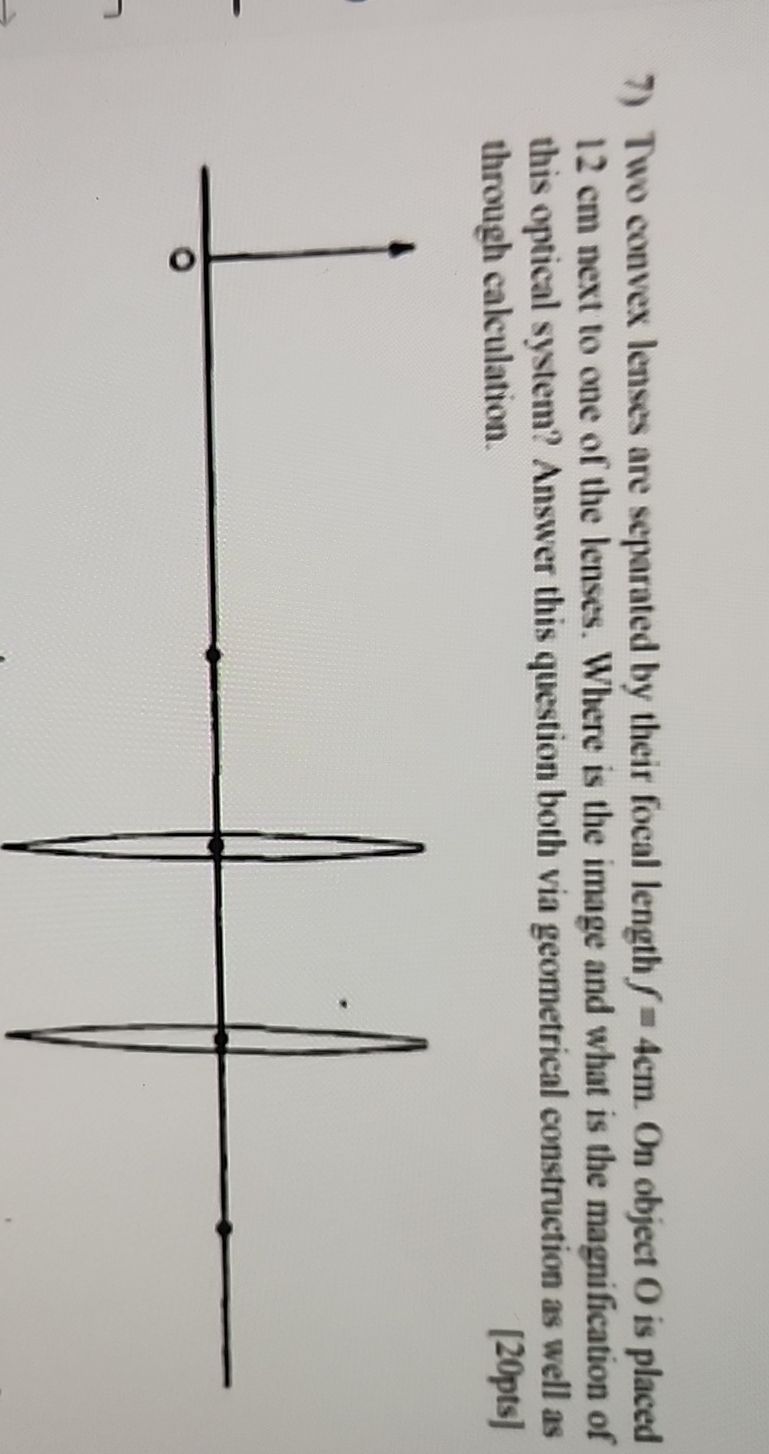 | J \ il
be
FD
p S6o%
£422
pe Fl 2
g8g=22z
Bez”
| 8 81 1
£282
£2794
>=5
185%
| SZ =
=” B
rF-3
sz
Bg
Z2F
=
sd
£52
SEE
SE»
=%E
: ES
Ah
bt,
~
HH
4H
| J \ il
be
FD
p S6o%
£422
pe Fl 2
g8g=22z
Bez”
| 8 81 1
£282
£2794
>=5
185%
| SZ =
=” B
rF-3
sz
Bg
Z2F
=
sd
£52
SEE
SE»
=%E
: ES
Ah
bt,
~
HH
4H
This is AI generated Response.
Asked by: Rahul
Created at: 2026-02-26 07:40:18
Asked by: Rahul
Created at: 2026-02-26 07:40:18
Final Answer:
Rendered
Raw Text
Did you like this answer?
Let's solve the problem step by step:
---
## **Given Data**
- Two convex lenses, each focal length \( f = 4 \) cm.
- The lenses are separated by their focal length: **distance between them = 4 cm**.
- Object O is placed 12 cm next to one of the lenses (let’s call it **Lens 1**).
- We need to find the **position** and **magnification** of the final image after both lenses.
---
## **Step 1: Find the Image Formed by Lens 1**
Let’s define the setup:
- Place **Lens 1** at \( x = \).
- **Lens 2** is at \( x = 4 \) cm.
- The **object** is at \( x = -12 \) cm (since it is 12 cm to the left of Lens 1).
**Lens Formula:**
\[
\frac{1}{f} = \frac{1}{v} - \frac{1}{u}
\]
Where:
- \( f \) = focal length of Lens 1 = \( +4 \) cm (convex, so positive)
- \( u = -12 \) cm (object is on the left of the lens, so negative)
Plug in the values:
\[
\frac{1}{4} = \frac{1}{v_1} - \frac{1}{-12}
\]
\[
\frac{1}{4} = \frac{1}{v_1} + \frac{1}{12}
\]
\[
\frac{1}{v_1} = \frac{1}{4} - \frac{1}{12} = \frac{3 - 1}{12} = \frac{2}{12} = \frac{1}{6}
\]
\[
v_1 = 6 \text{ cm}
\]
**Interpretation:**
The image formed by Lens 1 is **6 cm to the right** of Lens 1.
---
## **Step 2: Use Image from Lens 1 as Object for Lens 2**
- **Lens 2** is at \( x = 4 \) cm.
- The image from Lens 1 is at \( x = + 6 = 6 \) cm.
So, the **object distance for Lens 2** (relative to Lens 2):
\[
u_2 = \text{(position of image from Lens 1)} - \text{(position of Lens 2)}
\]
\[
u_2 = 6 \text{ cm} - 4 \text{ cm} = +2 \text{ cm}
\]
**Positive sign:** The object is on the right side of Lens 2 (real object for Lens 2).
**Lens 2 focal length:** \( f = 4 \) cm
Apply the lens formula for Lens 2:
\[
\frac{1}{f} = \frac{1}{v_2} - \frac{1}{u_2}
\]
\[
\frac{1}{4} = \frac{1}{v_2} - \frac{1}{2}
\]
\[
\frac{1}{v_2} = \frac{1}{4} + \frac{1}{2} = \frac{1 + 2}{4} = \frac{3}{4}
\]
\[
v_2 = \frac{4}{3} \text{ cm}
\]
**Interpretation:**
The final image is **4/3 cm to the right of Lens 2**.
---
## **Step 3: Position of the Final Image Relative to Lens 1**
- Lens 2 is at \( x = 4 \) cm.
- Final image is \( 4/3 \) cm to the right of Lens 2:
\[
x_{\text{final image}} = 4 \text{ cm} + \frac{4}{3} \text{ cm} = \frac{12}{3} + \frac{4}{3} = \frac{16}{3} \approx 5.33 \text{ cm}
\]
So the final image is **5.33 cm to the right of Lens 1**.
---
## **Step 4: Calculate the Total Magnification**
Magnification by Lens 1:
\[
m_1 = -\frac{v_1}{u_1} = -\frac{6}{-12} = .5
\]
Magnification by Lens 2:
\[
m_2 = -\frac{v_2}{u_2} = -\frac{4/3}{2} = -\frac{2}{3}
\]
**Total Magnification:**
\[
m = m_1 \times m_2 = .5 \times \left(-\frac{2}{3}\right) = -\frac{1}{3}
\]
---
## **Final Answers**
### **(a) Position of the final image:**
**5.33 cm to the right of Lens 1.**
### **(b) Total Magnification:**
**-1/3**
### **(c) Geometrical Construction (Ray Diagram):**
- Object is placed far left.
- First lens forms a real, inverted, reduced image between the two lenses.
- Second lens forms an even smaller, inverted image to the right of the second lens.
---
### **Summary Table**
| Step | Position (cm) | Magnification |
|---------------|---------------|--------------|
| Lens 1 Image | 6 right of L1 | .5 |
| Lens 2 Image | 4/3 right of L2 | -2/3 |
| **Final Image (from L1)** | 5.33 right of L1 | **-1/3** |
---
### **Boxed Final Answers**
\[
\boxed{
\begin{array}{l}
\text{Position of final image:} \quad 5.33\, \text{cm to the right of Lens 1} \\
\text{Total magnification:} \quad -\frac{1}{3}
\end{array}
}
\]
📢 Instructions:
- Ask anything relatd to above question only.
- For new Question goto :