 VIPSolutions
Give step-by-step solution with explanation and final answer:Practice Predicting Reaction Direction A reaction profile diagram (aka energy diagram or reaction coordinate diagram) shows the relative energy of the starting materials and products. Endthermic Resin Exctharmic Rescion Favors ronan vor proces) £ i Products Reacants Resciants Products Reaction Coordnste Reaction Coordinate e Draw a reaction profile diagram for each of the reactions on the previous page. a. b. c. d. ec.
Question:
Give step-by-step solution with explanation and final answer: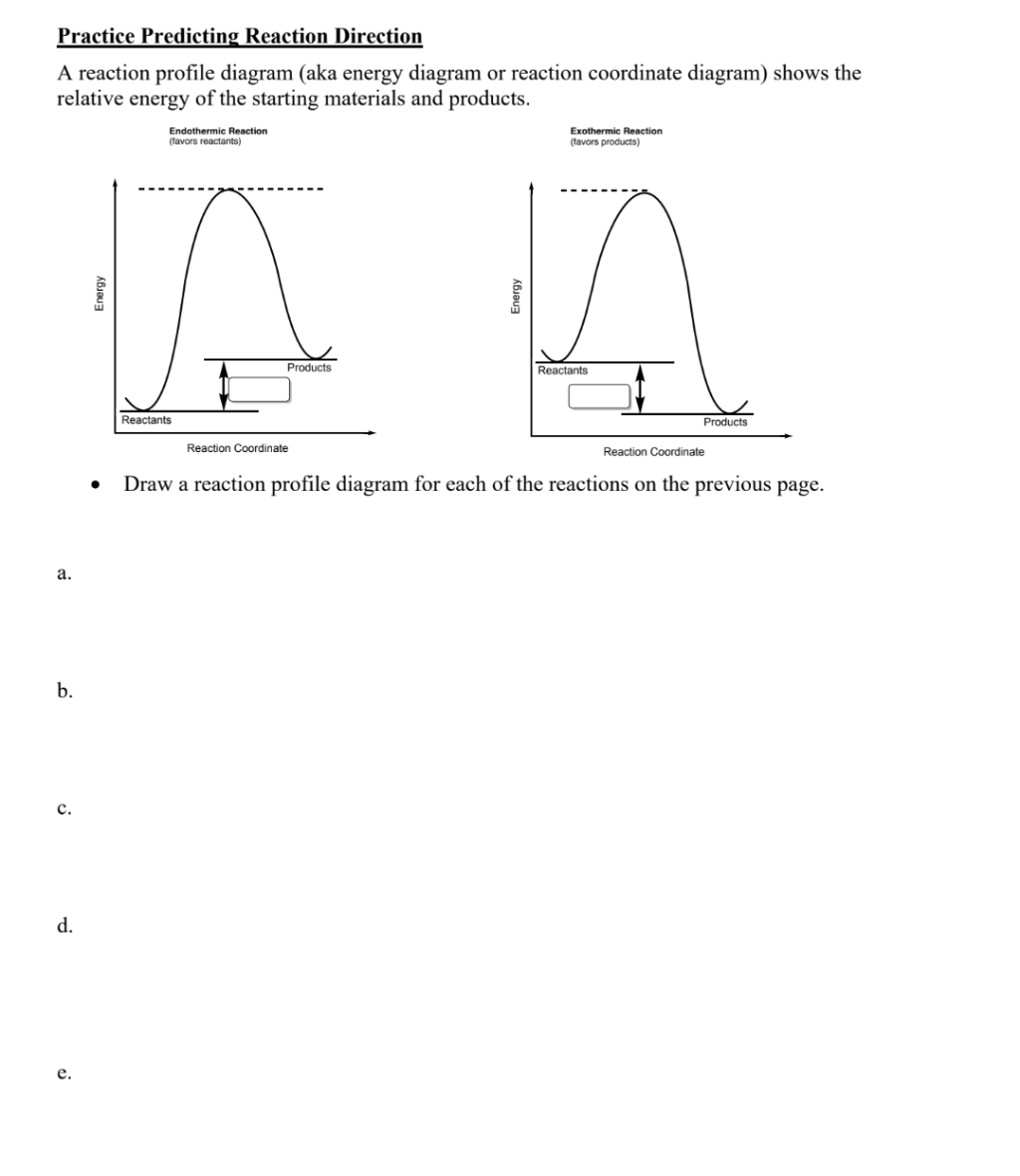 Practice Predicting Reaction Direction
A reaction profile diagram (aka energy diagram or reaction coordinate diagram) shows the
relative energy of the starting materials and products.
Endthermic Resin Exctharmic Rescion
Favors ronan vor proces)
£ i
Products Reacants
Resciants Products
Reaction Coordnste Reaction Coordinate
e Draw a reaction profile diagram for each of the reactions on the previous page.
a.
b.
c.
d.
ec.
Practice Predicting Reaction Direction
A reaction profile diagram (aka energy diagram or reaction coordinate diagram) shows the
relative energy of the starting materials and products.
Endthermic Resin Exctharmic Rescion
Favors ronan vor proces)
£ i
Products Reacants
Resciants Products
Reaction Coordnste Reaction Coordinate
e Draw a reaction profile diagram for each of the reactions on the previous page.
a.
b.
c.
d.
ec.
This is AI generated Response.
Asked by: Rahul
Created at: 2026-03-02 04:00:56
Asked by: Rahul
Created at: 2026-03-02 04:00:56
Final Answer:
Rendered
Raw Text
Did you like this answer?
Certainly! Let’s break down the information shown in the diagrams and explain **step-by-step** how to draw a reaction profile diagram for any given reaction.
---
## Step-by-Step Solution
### **1. Understanding Reaction Profiles**
- **Endothermic Reaction (Left Diagram)**
- **Reactants** start at a lower energy.
- **Products** end at a higher energy.
- **Energy is absorbed** (ΔH > ).
- **Favors reactants** (reverse direction).
- **Exothermic Reaction (Right Diagram)**
- **Reactants** start at a higher energy.
- **Products** end at a lower energy.
- **Energy is released** (ΔH < ).
- **Favors products** (forward direction).
---
### **2. Step-by-Step for Drawing a Reaction Profile Diagram**
#### **a. Identify if the Reaction is Endothermic or Exothermic**
- If products are **lower in energy** than reactants → **Exothermic**
- If products are **higher in energy** than reactants → **Endothermic**
#### **b. Mark the Y-Axis as "Energy"**
- This shows the relative energy.
#### **c. Mark the X-Axis as "Reaction Coordinate"**
- This shows progress from reactants to products.
#### **d. Draw the Curve**
- Start at reactants’ energy level.
- Draw a curve rising to a peak (**activation energy**).
- End at products’ energy level.
#### **e. Label Reactants, Products, and Activation Energy**
- Mark the **activation energy** (difference from reactants to peak).
- Mark the **overall energy change** (difference from reactants to products).
---
## **Final Answer Example**
### **If you know the reaction is:**
#### **a. Exothermic**
- Draw the profile with **products lower** in energy than reactants.
- Arrow from reactants to products **points downward**.
#### **b. Endothermic**
- Draw the profile with **products higher** in energy than reactants.
- Arrow from reactants to products **points upward**.
---
## **Diagram Explanation**
Here’s a summary of how your diagrams would look:
| Reaction Type | Reaction Profile Diagram Description |
|-------------------|-------------------------------------|
| Exothermic | Reactants start high, curve rises, products end low. |
| Endothermic | Reactants start low, curve rises, products end high. |
---
### **Visual Example (Text-Based)**
```
Energy
│
│ .-^-.
│ / \
│ / \
│---' '---- Exothermic (products lower)
│
├─────────────────────→ Reaction Coordinate
Energy
│
│ .-^-.
│ / \
│ / \
│---' '---- Endothermic (products higher)
│
├─────────────────────→ Reaction Coordinate
```
---
## **Summary**
1. **Determine if exothermic or endothermic.**
2. **Draw reactants and products at correct energy levels.**
3. **Draw activation energy peak.**
4. **Label axes, reactants, products, and activation energy.**
---
### **If you provide the reactions for a-e, I can draw the specific diagrams for each!**
Let me know if you’d like to proceed with specific reactions, or if you need a blank template for practice.
📢 Instructions:
- Ask anything relatd to above question only.
- For new Question goto :