 VIPSolutions
Give step-by-step solution with explanation and final answer: ( give me complete answer step by step without using bullet-points)1. Assuming thermally stratified conditions within a deep reservoir subject to spatially variable tributary inflows and wind induced surface shear stresses—the three dimensional transport and fate of biochemical oxygen demand constituents require a fundamental analytical treatment incorporating anisotropic turbulent diffusion tensors and spatially distributed first order decay kinetics to characterize the temporal evolution of organic matter concentrations under non steady state boundary constraints. 1. Formulate the general three dimensional advection diffusion reaction partial differential equation governing the spatio-temporal distribution of the biochemical oxygen demand constituent accounting for non uniform velocity fields and anisotropic turbulent mixing. 2 Deduce the depth averaged wransprt cation aplicbl to the eplimac control volume by integrating th govern equation fom te previous step over the surface layer depth and applying Leibniz integral rule with appropriate kinematic boundary conditions. 3. Establish the governing equation for the hypolimnetic region incorporating the interfacial diffusive exchange flux derived from the epilimnetic analysis and benthic boundary fluxes. 4. Dette an analytical expression for hei dependent iochenical oxygen demand prof wil the metalimnon sujet 0 te sient boundary conditions established at the epilimnion and hypolimion interfaces. 2. Under conditions where benthic sediment interactions sigifanty influence the overall oxygen budget of a shallow reservoir zone through diffusive flux of dissolved oxygen into the sediment pore water coupled with microbial consumption the mathematical description of the sediment oxygen demand process demands 2 fundamental derivation based on Fickian diffusion and reaction kinetics within the porous sediment matrix accounting for porosity and tortuosity effects. J Water ow Column Cuint Cubul Sy Sediment 5 (10) seit 3 z 1. Formulate the steady state diffusion reaction differential equation governing the vertical profile of dissolved oxygen concentration within the sediment pore water. 1.1" Establish the governing second order ordinary differential equation including depth dependent effective diffusivity and a first order reac- tion term. 1.2 Define the appropriate boundary conitions at the sediment water interface and at a suficient depth within the sediment where the concen tration gradient vanishes based on physical constraints. 2 Derive the analytical olin or the or water oxygen concentation role ling th formulation om the resis ep 21 Apply a suitable analytical method to solve the governing differential equation subject to the established boundary conditions. 22 Espress the solution n terms of dimensionless parameters characterizing the balance between diffusion and reaction rates. 3. Deduce the expression for the sediment oxygen demand flux based on the derived concentration profile. 3.1 Apply Fick's first law of diffusion at the sediment water interface to determine the interfacial flux. 3.2 Formulate the final flux expression in terms of the bulk water oxygen concentration and overall mass transfer resistances representing the ‘boundary layer and sediment. 4. Establish the coupled ordinary differential equation for the temporal change in bulk water oxygen concentration incorporating the derived sediment oxygen demand flux, 41 Constuct amass balance fo rye within th verying tr coum control vlue eating he sediment us a3 boundary sok em. 42 Determine the resulting first order differential equation describing the bulk oxygen depletion rte 3. Consider a completly mised rset subjct to me ann extemal lohemial oxygen demand loning and surface reeraion where the coupled dynamics of organic matter decay and dissolved oxygen replenishment dictate the overall water quality state requiring a simultaneous solution of the governing mass balance equations. 1. Formulate the coupled system of non linear ordinary differential equations describing the temporal evolution of biochemical oxygen dem- and and dissolved oxygen deficit. 1.1 Establish the equation for biochemical oxygen demand including time dependent extemal loading and first order decay Kinetics. 122 Establish the equation for dissolved oxygen deficit incorporating deoxygenation from biochemical oxygen demand decay and reaeration across the fee surface. 2. Derive the analytical solution for the biochemical oxygen demand concentration as a function of time based on the first equation in the coupled system. or 2.1" Apply an tgratingfcor metho to sl th linear ist order ordinary ifn equation for bohenical oxygen demand. 2.2 Express the solution for a generic time dependent loading function in terms of an integral. 3. Deduce the analytical solution for the dissolved oxygen deficit using the derived biochemical oxygen demand slution from the previous step. "7 Substute the biochemical oxygen demand solution nt the dissolved oxygen deficit equation an solve the resulting ordinary differential equation. 32 Determine the integration constants based on specified inital reservoir conditions for both biochemical oxygen demand and dissolved orygen. 4. Establish the implicit condition for the critcal time at which the dissolved oxygen deficit reaches ts maximum value. 4.1" Differentiate the derived dissolved csygen deficit solution with respect to ime and set the derivative to zero. 42 Formulate the resulting algebraic equation that must be solved to find the critical time and subsequently the critical deficit.
Question:
Give step-by-step solution with explanation and final answer:
( give me complete answer step by step without using bullet-points)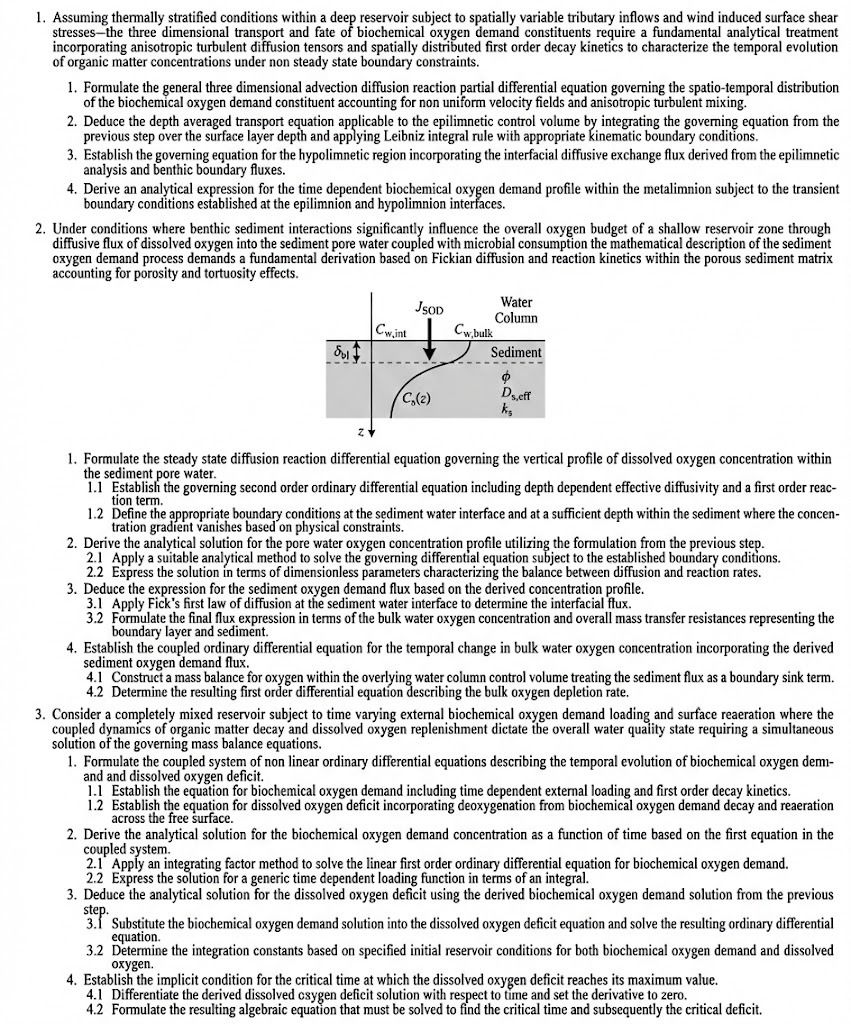 1. Assuming thermally stratified conditions within a deep reservoir subject to spatially variable tributary inflows and wind induced surface shear
stresses—the three dimensional transport and fate of biochemical oxygen demand constituents require a fundamental analytical treatment
incorporating anisotropic turbulent diffusion tensors and spatially distributed first order decay kinetics to characterize the temporal evolution
of organic matter concentrations under non steady state boundary constraints.
1. Formulate the general three dimensional advection diffusion reaction partial differential equation governing the spatio-temporal distribution
of the biochemical oxygen demand constituent accounting for non uniform velocity fields and anisotropic turbulent mixing.
2 Deduce the depth averaged wransprt cation aplicbl to the eplimac control volume by integrating th govern equation fom te
previous step over the surface layer depth and applying Leibniz integral rule with appropriate kinematic boundary conditions.
3. Establish the governing equation for the hypolimnetic region incorporating the interfacial diffusive exchange flux derived from the epilimnetic
analysis and benthic boundary fluxes.
4. Dette an analytical expression for hei dependent iochenical oxygen demand prof wil the metalimnon sujet 0 te sient
boundary conditions established at the epilimnion and hypolimion interfaces.
2. Under conditions where benthic sediment interactions sigifanty influence the overall oxygen budget of a shallow reservoir zone through
diffusive flux of dissolved oxygen into the sediment pore water coupled with microbial consumption the mathematical description of the sediment
oxygen demand process demands 2 fundamental derivation based on Fickian diffusion and reaction kinetics within the porous sediment matrix
accounting for porosity and tortuosity effects.
J Water
ow Column
Cuint Cubul
Sy Sediment
5
(10) seit
3
z
1. Formulate the steady state diffusion reaction differential equation governing the vertical profile of dissolved oxygen concentration within
the sediment pore water.
1.1" Establish the governing second order ordinary differential equation including depth dependent effective diffusivity and a first order reac-
tion term.
1.2 Define the appropriate boundary conitions at the sediment water interface and at a suficient depth within the sediment where the concen
tration gradient vanishes based on physical constraints.
2 Derive the analytical olin or the or water oxygen concentation role ling th formulation om the resis ep
21 Apply a suitable analytical method to solve the governing differential equation subject to the established boundary conditions.
22 Espress the solution n terms of dimensionless parameters characterizing the balance between diffusion and reaction rates.
3. Deduce the expression for the sediment oxygen demand flux based on the derived concentration profile.
3.1 Apply Fick's first law of diffusion at the sediment water interface to determine the interfacial flux.
3.2 Formulate the final flux expression in terms of the bulk water oxygen concentration and overall mass transfer resistances representing the
‘boundary layer and sediment.
4. Establish the coupled ordinary differential equation for the temporal change in bulk water oxygen concentration incorporating the derived
sediment oxygen demand flux,
41 Constuct amass balance fo rye within th verying tr coum control vlue eating he sediment us a3 boundary sok em.
42 Determine the resulting first order differential equation describing the bulk oxygen depletion rte
3. Consider a completly mised rset subjct to me ann extemal lohemial oxygen demand loning and surface reeraion where the
coupled dynamics of organic matter decay and dissolved oxygen replenishment dictate the overall water quality state requiring a simultaneous
solution of the governing mass balance equations.
1. Formulate the coupled system of non linear ordinary differential equations describing the temporal evolution of biochemical oxygen dem-
and and dissolved oxygen deficit.
1.1 Establish the equation for biochemical oxygen demand including time dependent extemal loading and first order decay Kinetics.
122 Establish the equation for dissolved oxygen deficit incorporating deoxygenation from biochemical oxygen demand decay and reaeration
across the fee surface.
2. Derive the analytical solution for the biochemical oxygen demand concentration as a function of time based on the first equation in the
coupled system. or
2.1" Apply an tgratingfcor metho to sl th linear ist order ordinary ifn equation for bohenical oxygen demand.
2.2 Express the solution for a generic time dependent loading function in terms of an integral.
3. Deduce the analytical solution for the dissolved oxygen deficit using the derived biochemical oxygen demand slution from the previous
step.
"7 Substute the biochemical oxygen demand solution nt the dissolved oxygen deficit equation an solve the resulting ordinary differential
equation.
32 Determine the integration constants based on specified inital reservoir conditions for both biochemical oxygen demand and dissolved
orygen.
4. Establish the implicit condition for the critcal time at which the dissolved oxygen deficit reaches ts maximum value.
4.1" Differentiate the derived dissolved csygen deficit solution with respect to ime and set the derivative to zero.
42 Formulate the resulting algebraic equation that must be solved to find the critical time and subsequently the critical deficit.
1. Assuming thermally stratified conditions within a deep reservoir subject to spatially variable tributary inflows and wind induced surface shear
stresses—the three dimensional transport and fate of biochemical oxygen demand constituents require a fundamental analytical treatment
incorporating anisotropic turbulent diffusion tensors and spatially distributed first order decay kinetics to characterize the temporal evolution
of organic matter concentrations under non steady state boundary constraints.
1. Formulate the general three dimensional advection diffusion reaction partial differential equation governing the spatio-temporal distribution
of the biochemical oxygen demand constituent accounting for non uniform velocity fields and anisotropic turbulent mixing.
2 Deduce the depth averaged wransprt cation aplicbl to the eplimac control volume by integrating th govern equation fom te
previous step over the surface layer depth and applying Leibniz integral rule with appropriate kinematic boundary conditions.
3. Establish the governing equation for the hypolimnetic region incorporating the interfacial diffusive exchange flux derived from the epilimnetic
analysis and benthic boundary fluxes.
4. Dette an analytical expression for hei dependent iochenical oxygen demand prof wil the metalimnon sujet 0 te sient
boundary conditions established at the epilimnion and hypolimion interfaces.
2. Under conditions where benthic sediment interactions sigifanty influence the overall oxygen budget of a shallow reservoir zone through
diffusive flux of dissolved oxygen into the sediment pore water coupled with microbial consumption the mathematical description of the sediment
oxygen demand process demands 2 fundamental derivation based on Fickian diffusion and reaction kinetics within the porous sediment matrix
accounting for porosity and tortuosity effects.
J Water
ow Column
Cuint Cubul
Sy Sediment
5
(10) seit
3
z
1. Formulate the steady state diffusion reaction differential equation governing the vertical profile of dissolved oxygen concentration within
the sediment pore water.
1.1" Establish the governing second order ordinary differential equation including depth dependent effective diffusivity and a first order reac-
tion term.
1.2 Define the appropriate boundary conitions at the sediment water interface and at a suficient depth within the sediment where the concen
tration gradient vanishes based on physical constraints.
2 Derive the analytical olin or the or water oxygen concentation role ling th formulation om the resis ep
21 Apply a suitable analytical method to solve the governing differential equation subject to the established boundary conditions.
22 Espress the solution n terms of dimensionless parameters characterizing the balance between diffusion and reaction rates.
3. Deduce the expression for the sediment oxygen demand flux based on the derived concentration profile.
3.1 Apply Fick's first law of diffusion at the sediment water interface to determine the interfacial flux.
3.2 Formulate the final flux expression in terms of the bulk water oxygen concentration and overall mass transfer resistances representing the
‘boundary layer and sediment.
4. Establish the coupled ordinary differential equation for the temporal change in bulk water oxygen concentration incorporating the derived
sediment oxygen demand flux,
41 Constuct amass balance fo rye within th verying tr coum control vlue eating he sediment us a3 boundary sok em.
42 Determine the resulting first order differential equation describing the bulk oxygen depletion rte
3. Consider a completly mised rset subjct to me ann extemal lohemial oxygen demand loning and surface reeraion where the
coupled dynamics of organic matter decay and dissolved oxygen replenishment dictate the overall water quality state requiring a simultaneous
solution of the governing mass balance equations.
1. Formulate the coupled system of non linear ordinary differential equations describing the temporal evolution of biochemical oxygen dem-
and and dissolved oxygen deficit.
1.1 Establish the equation for biochemical oxygen demand including time dependent extemal loading and first order decay Kinetics.
122 Establish the equation for dissolved oxygen deficit incorporating deoxygenation from biochemical oxygen demand decay and reaeration
across the fee surface.
2. Derive the analytical solution for the biochemical oxygen demand concentration as a function of time based on the first equation in the
coupled system. or
2.1" Apply an tgratingfcor metho to sl th linear ist order ordinary ifn equation for bohenical oxygen demand.
2.2 Express the solution for a generic time dependent loading function in terms of an integral.
3. Deduce the analytical solution for the dissolved oxygen deficit using the derived biochemical oxygen demand slution from the previous
step.
"7 Substute the biochemical oxygen demand solution nt the dissolved oxygen deficit equation an solve the resulting ordinary differential
equation.
32 Determine the integration constants based on specified inital reservoir conditions for both biochemical oxygen demand and dissolved
orygen.
4. Establish the implicit condition for the critcal time at which the dissolved oxygen deficit reaches ts maximum value.
4.1" Differentiate the derived dissolved csygen deficit solution with respect to ime and set the derivative to zero.
42 Formulate the resulting algebraic equation that must be solved to find the critical time and subsequently the critical deficit.
Asked by: Francis
Created at: 2026-03-02 15:19:22
Final Answer:
Question:
give me answer without blanks oe empty values.
Asked by: Francis
Created at: 2026-03-02 15:22:59
Final Answer:
📢 Instructions:
- Ask anything relatd to above question only.
- For new Question goto :