 VIPSolutions
Give step-by-step solution with explanation and final answer: (give me answer with out using bullet-points)1. Assuming non isothermal operating conditions within a continuous stirred tank reactor experiencing an exothermic irreversible second order reaction coupled with an external cooling jacket under steady state flow a complete mathematical formulation incorporating energy and mass balances to characterize the effluent concentration and reactor temperature is strictly necessary. Fas Chien Tin ~T Fo Toon J ) FoTeia Fou Cu T A. Formulate the steady state component mass balance algebraic equation for the reactant species accounting for the reaction rate expression. « Establish the explicit reaction rate term as a function of concentration and temperature following the Arrhenius law. « Define the inlet and outlet mass flow tems in terms of volumetric flow rate and concentration. B. Deduce the steady state overall energy balance algebraic equation for the reactor contents incorporating the heat of reaction and heat removal by the cooling jacket. + Express the heat removal ate in terms of an overall heat transfer coefficient and the log mean temperature difference. + Formulate the enthalpy change terms for the input and output streams based on heat capacities and temperatures. C. Establish the condition for multiplicity of steady states by analyzing the heat generation and heat removal curves derived from the balance equations. « Identify the critical parameters that determine the number of possible steady state solutions. « Determine the stability of each steady state solution using linearization techniques 2. Given two continuous stired tank reactors arranged in a series configuration with a recycle stream from the second reactor back to the frst under constant density and isothermal conditions a complete derivation of the overall conversion expression as. function ofthe residence fimes and recycle ratio for a first order reaction demands algebraic establishment. A. Formulate the component mass balance algebraic equation for the first reactor accounting for the fresh feed, the recycle stream, and the reaction term. « Express the ilet concentration to the first reactor as a weighted average of th fresh feed and recycle stream concentrations. « Define the net volumetric flow rate through the first reactor in terms of the fresh feed and recycle flow rates. B. Deduce the component mass balance algebraic equation for the second reactor accounting for the inlet from the fist reactor and the reaction term. « Express the outlet concentration from the second reactor in terms of its inlet concentration and residence time. + Substitute the expression fo the intermediate concentration from the first reactor's balance into ths equation C. Establish the final analytical expression for the overall system conversion in terms of the individual reactor space times and the recycle ratio. « Combine the balance equations from the previous steps to eliminate intermediate concentrations. « Solve for the rato of the final outlet concentration to the fresh feed concentration and relate t to the overall conversion. 3. Under transient startup conditions for a continuous stirred tank reactor initially filled with inert solvent and subjected to a step change inthe lt fe concentration ofa reactant undergoing frst order rection, governing ordinary ifrental equation describing the time dependent effluent concentration profile requires precise derivation. A. Formulate the unsteady state component mass balance differential equation for the reactor contents accounting for the accumulation, input, output, and reaction terms. « Express the accumulation term as the time derivative of the total mass or moles of the reactant in the reactor. « Define the input and output terms based on the constant volumetric flow rate and the instantaneous concentrations. B. Deduce the analytical solution for the time dependent effluent concentration profile by integrating the first order linear ordinary differential equation with constant coefficients. « Apply the integrating factor method or separation of variables to solve the differential equation. « Use the intial condition of zero reactant concentration i the reactor at time zero to determine the integration constant. C- Establish the xpress for he me required reach a secfed fsction ofthe nl steady sate concentration based on the derived analytical solution. « Define the steady state concentration by taking the limit of the analytical solution as time approaches infinity. + Set up an equation equating the concentration at a specific time to the desired fraction of the steady state value and solve for time.
Question:
Give step-by-step solution with explanation and final answer:
(give me answer with out using bullet-points)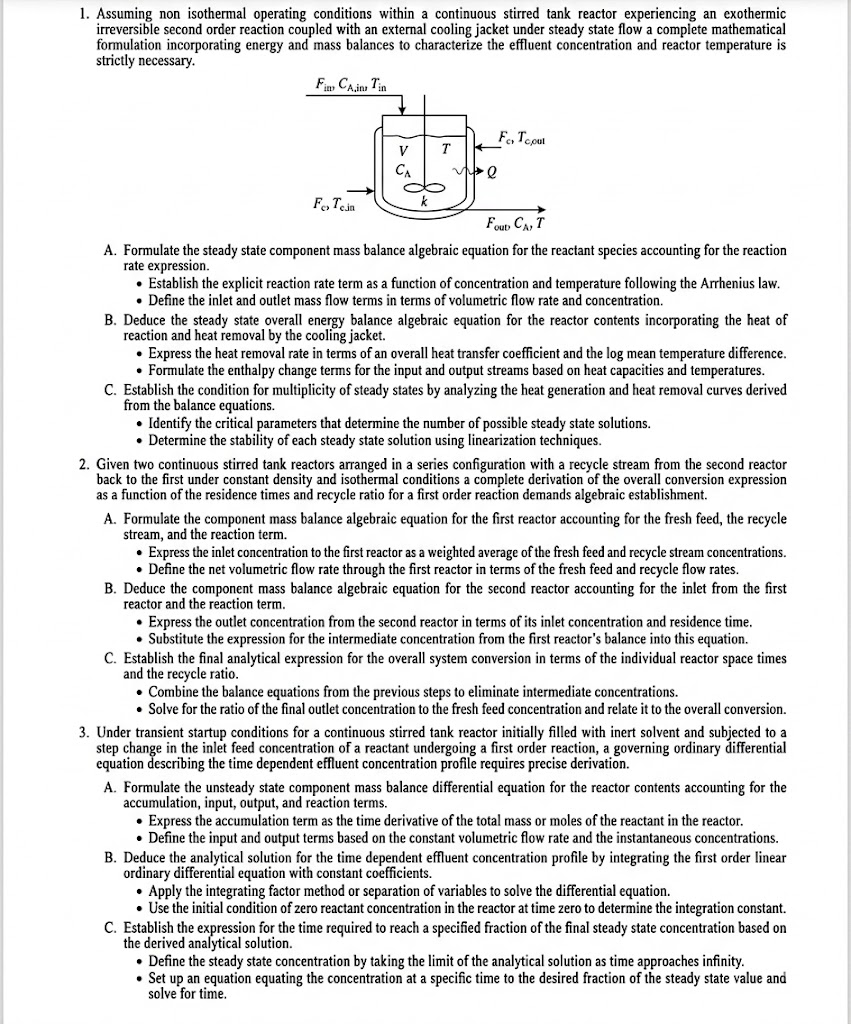 1. Assuming non isothermal operating conditions within a continuous stirred tank reactor experiencing an exothermic
irreversible second order reaction coupled with an external cooling jacket under steady state flow a complete mathematical
formulation incorporating energy and mass balances to characterize the effluent concentration and reactor temperature is
strictly necessary.
Fas Chien Tin
~T Fo Toon
J )
FoTeia
Fou Cu T
A. Formulate the steady state component mass balance algebraic equation for the reactant species accounting for the reaction
rate expression.
« Establish the explicit reaction rate term as a function of concentration and temperature following the Arrhenius law.
« Define the inlet and outlet mass flow tems in terms of volumetric flow rate and concentration.
B. Deduce the steady state overall energy balance algebraic equation for the reactor contents incorporating the heat of
reaction and heat removal by the cooling jacket.
+ Express the heat removal ate in terms of an overall heat transfer coefficient and the log mean temperature difference.
+ Formulate the enthalpy change terms for the input and output streams based on heat capacities and temperatures.
C. Establish the condition for multiplicity of steady states by analyzing the heat generation and heat removal curves derived
from the balance equations.
« Identify the critical parameters that determine the number of possible steady state solutions.
« Determine the stability of each steady state solution using linearization techniques
2. Given two continuous stired tank reactors arranged in a series configuration with a recycle stream from the second reactor
back to the frst under constant density and isothermal conditions a complete derivation of the overall conversion expression
as. function ofthe residence fimes and recycle ratio for a first order reaction demands algebraic establishment.
A. Formulate the component mass balance algebraic equation for the first reactor accounting for the fresh feed, the recycle
stream, and the reaction term.
« Express the ilet concentration to the first reactor as a weighted average of th fresh feed and recycle stream concentrations.
« Define the net volumetric flow rate through the first reactor in terms of the fresh feed and recycle flow rates.
B. Deduce the component mass balance algebraic equation for the second reactor accounting for the inlet from the fist
reactor and the reaction term.
« Express the outlet concentration from the second reactor in terms of its inlet concentration and residence time.
+ Substitute the expression fo the intermediate concentration from the first reactor's balance into ths equation
C. Establish the final analytical expression for the overall system conversion in terms of the individual reactor space times
and the recycle ratio.
« Combine the balance equations from the previous steps to eliminate intermediate concentrations.
« Solve for the rato of the final outlet concentration to the fresh feed concentration and relate t to the overall conversion.
3. Under transient startup conditions for a continuous stirred tank reactor initially filled with inert solvent and subjected to a
step change inthe lt fe concentration ofa reactant undergoing frst order rection, governing ordinary ifrental
equation describing the time dependent effluent concentration profile requires precise derivation.
A. Formulate the unsteady state component mass balance differential equation for the reactor contents accounting for the
accumulation, input, output, and reaction terms.
« Express the accumulation term as the time derivative of the total mass or moles of the reactant in the reactor.
« Define the input and output terms based on the constant volumetric flow rate and the instantaneous concentrations.
B. Deduce the analytical solution for the time dependent effluent concentration profile by integrating the first order linear
ordinary differential equation with constant coefficients.
« Apply the integrating factor method or separation of variables to solve the differential equation.
« Use the intial condition of zero reactant concentration i the reactor at time zero to determine the integration constant.
C- Establish the xpress for he me required reach a secfed fsction ofthe nl steady sate concentration based on
the derived analytical solution.
« Define the steady state concentration by taking the limit of the analytical solution as time approaches infinity.
+ Set up an equation equating the concentration at a specific time to the desired fraction of the steady state value and
solve for time.
1. Assuming non isothermal operating conditions within a continuous stirred tank reactor experiencing an exothermic
irreversible second order reaction coupled with an external cooling jacket under steady state flow a complete mathematical
formulation incorporating energy and mass balances to characterize the effluent concentration and reactor temperature is
strictly necessary.
Fas Chien Tin
~T Fo Toon
J )
FoTeia
Fou Cu T
A. Formulate the steady state component mass balance algebraic equation for the reactant species accounting for the reaction
rate expression.
« Establish the explicit reaction rate term as a function of concentration and temperature following the Arrhenius law.
« Define the inlet and outlet mass flow tems in terms of volumetric flow rate and concentration.
B. Deduce the steady state overall energy balance algebraic equation for the reactor contents incorporating the heat of
reaction and heat removal by the cooling jacket.
+ Express the heat removal ate in terms of an overall heat transfer coefficient and the log mean temperature difference.
+ Formulate the enthalpy change terms for the input and output streams based on heat capacities and temperatures.
C. Establish the condition for multiplicity of steady states by analyzing the heat generation and heat removal curves derived
from the balance equations.
« Identify the critical parameters that determine the number of possible steady state solutions.
« Determine the stability of each steady state solution using linearization techniques
2. Given two continuous stired tank reactors arranged in a series configuration with a recycle stream from the second reactor
back to the frst under constant density and isothermal conditions a complete derivation of the overall conversion expression
as. function ofthe residence fimes and recycle ratio for a first order reaction demands algebraic establishment.
A. Formulate the component mass balance algebraic equation for the first reactor accounting for the fresh feed, the recycle
stream, and the reaction term.
« Express the ilet concentration to the first reactor as a weighted average of th fresh feed and recycle stream concentrations.
« Define the net volumetric flow rate through the first reactor in terms of the fresh feed and recycle flow rates.
B. Deduce the component mass balance algebraic equation for the second reactor accounting for the inlet from the fist
reactor and the reaction term.
« Express the outlet concentration from the second reactor in terms of its inlet concentration and residence time.
+ Substitute the expression fo the intermediate concentration from the first reactor's balance into ths equation
C. Establish the final analytical expression for the overall system conversion in terms of the individual reactor space times
and the recycle ratio.
« Combine the balance equations from the previous steps to eliminate intermediate concentrations.
« Solve for the rato of the final outlet concentration to the fresh feed concentration and relate t to the overall conversion.
3. Under transient startup conditions for a continuous stirred tank reactor initially filled with inert solvent and subjected to a
step change inthe lt fe concentration ofa reactant undergoing frst order rection, governing ordinary ifrental
equation describing the time dependent effluent concentration profile requires precise derivation.
A. Formulate the unsteady state component mass balance differential equation for the reactor contents accounting for the
accumulation, input, output, and reaction terms.
« Express the accumulation term as the time derivative of the total mass or moles of the reactant in the reactor.
« Define the input and output terms based on the constant volumetric flow rate and the instantaneous concentrations.
B. Deduce the analytical solution for the time dependent effluent concentration profile by integrating the first order linear
ordinary differential equation with constant coefficients.
« Apply the integrating factor method or separation of variables to solve the differential equation.
« Use the intial condition of zero reactant concentration i the reactor at time zero to determine the integration constant.
C- Establish the xpress for he me required reach a secfed fsction ofthe nl steady sate concentration based on
the derived analytical solution.
« Define the steady state concentration by taking the limit of the analytical solution as time approaches infinity.
+ Set up an equation equating the concentration at a specific time to the desired fraction of the steady state value and
solve for time.
Asked by: francis
Created at: 2026-03-03 11:04:32
Final Answer:
Question:
give me answer only for first question without any empty blanks or gaps.
Asked by: francis
Created at: 2026-03-03 11:11:35
Final Answer:
📢 Instructions:
- Ask anything relatd to above question only.
- For new Question goto :