 VIPSolutions
Give step-by-step solution with explanation and final answer: (Give me answer without using bullet-points).4. A continuous strip footing is designed to transmit substantial superstructure loads into a profound stratum of cohesive- frictional sol. The structural foundation must be rigorously evaluated against catastrophic bearing failure under disparate groundwater table elevations, The internal fiction angle is precisely twenty-five degrees, the effective cohesion is thirty kiopascals, and the fundamental uit weight s uniformly eighteen Klonewtons per cubic meter. The foundation rests precisely one and a half meters beneath the ground surface. Compute the ultimate bearing capacity utiizing strictly the classical formulation for both prescribed environment scenarios. Case I: The phreatic surface coincides exactly with the existing ground elevation, fully saturating the entire subterranean domain, Case I The phreatic surface plunges dramatically, establishing equilibrium precisely at the foundation! bearing plane. 4,=¢N, + aN, + 05¥BN, 5. A profound deposit of normally consolidated highly plastic clay undergoes substantial volumetric compression resulting from the construction of a massive commercial edifice. The virgin compression index has been empirically determined as zero point four five, while the fftial void rato stands exactly at one point two. The preexisting effective overburden pressure at the volumetric center of the compressible layer equals one hundred and fifty Kiopascals. f the superimposed structural loading induces an additional uniform vertical stress of exactly seventy-five kiopascals, calculate the ultimate primary consolidation settlement fo a stratum thickness of precisely eight meters. S., — Slog, (22) 6. A towering vertical retaining structure, completely devoid of interfacial wall fiction, laterally supports a horizontal backfill composed exclusively of granular material. The back is entirely submerged and inherently cohesianless. Employing strictly the fundamental principles of plastic equiibrium, formulate the comprehensive expressions governing the laters! earth pressures exerted upon the retaining interface 2) Derive the continuous slgebraic function characterizing the active effective lateral stress distribution from the uppermost surface down to the foundational base. a, — Ko, b) Establish the explicit analytical formulation for the resultant active hydrostatic thrust
Question:
Give step-by-step solution with explanation and final answer:
(Give me answer without using bullet-points).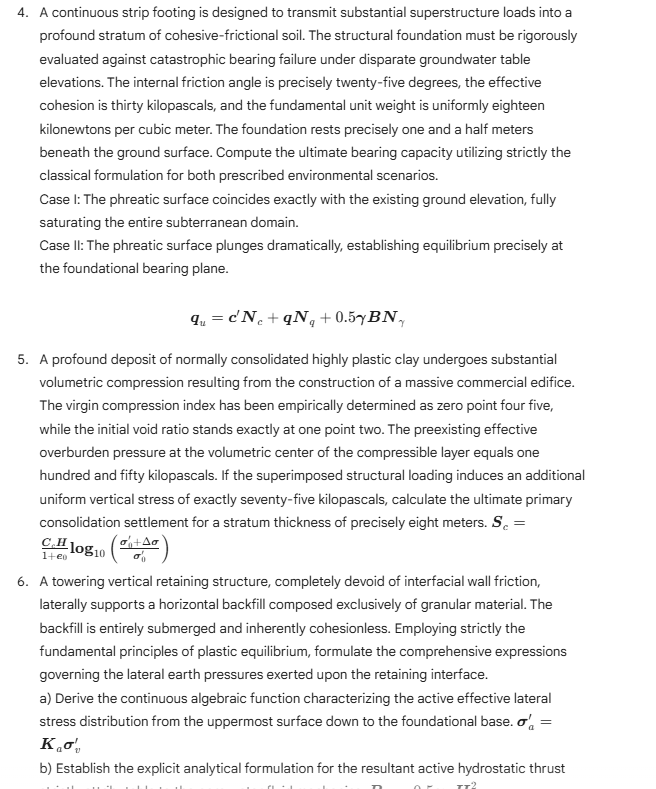 4. A continuous strip footing is designed to transmit substantial superstructure loads into a
profound stratum of cohesive- frictional sol. The structural foundation must be rigorously
evaluated against catastrophic bearing failure under disparate groundwater table
elevations, The internal fiction angle is precisely twenty-five degrees, the effective
cohesion is thirty kiopascals, and the fundamental uit weight s uniformly eighteen
Klonewtons per cubic meter. The foundation rests precisely one and a half meters
beneath the ground surface. Compute the ultimate bearing capacity utiizing strictly the
classical formulation for both prescribed environment scenarios.
Case I: The phreatic surface coincides exactly with the existing ground elevation, fully
saturating the entire subterranean domain,
Case I The phreatic surface plunges dramatically, establishing equilibrium precisely at
the foundation! bearing plane.
4,=¢N, + aN, + 05¥BN,
5. A profound deposit of normally consolidated highly plastic clay undergoes substantial
volumetric compression resulting from the construction of a massive commercial edifice.
The virgin compression index has been empirically determined as zero point four five,
while the fftial void rato stands exactly at one point two. The preexisting effective
overburden pressure at the volumetric center of the compressible layer equals one
hundred and fifty Kiopascals. f the superimposed structural loading induces an additional
uniform vertical stress of exactly seventy-five kiopascals, calculate the ultimate primary
consolidation settlement fo a stratum thickness of precisely eight meters. S., —
Slog, (22)
6. A towering vertical retaining structure, completely devoid of interfacial wall fiction,
laterally supports a horizontal backfill composed exclusively of granular material. The
back is entirely submerged and inherently cohesianless. Employing strictly the
fundamental principles of plastic equiibrium, formulate the comprehensive expressions
governing the laters! earth pressures exerted upon the retaining interface
2) Derive the continuous slgebraic function characterizing the active effective lateral
stress distribution from the uppermost surface down to the foundational base. a, —
Ko,
b) Establish the explicit analytical formulation for the resultant active hydrostatic thrust
4. A continuous strip footing is designed to transmit substantial superstructure loads into a
profound stratum of cohesive- frictional sol. The structural foundation must be rigorously
evaluated against catastrophic bearing failure under disparate groundwater table
elevations, The internal fiction angle is precisely twenty-five degrees, the effective
cohesion is thirty kiopascals, and the fundamental uit weight s uniformly eighteen
Klonewtons per cubic meter. The foundation rests precisely one and a half meters
beneath the ground surface. Compute the ultimate bearing capacity utiizing strictly the
classical formulation for both prescribed environment scenarios.
Case I: The phreatic surface coincides exactly with the existing ground elevation, fully
saturating the entire subterranean domain,
Case I The phreatic surface plunges dramatically, establishing equilibrium precisely at
the foundation! bearing plane.
4,=¢N, + aN, + 05¥BN,
5. A profound deposit of normally consolidated highly plastic clay undergoes substantial
volumetric compression resulting from the construction of a massive commercial edifice.
The virgin compression index has been empirically determined as zero point four five,
while the fftial void rato stands exactly at one point two. The preexisting effective
overburden pressure at the volumetric center of the compressible layer equals one
hundred and fifty Kiopascals. f the superimposed structural loading induces an additional
uniform vertical stress of exactly seventy-five kiopascals, calculate the ultimate primary
consolidation settlement fo a stratum thickness of precisely eight meters. S., —
Slog, (22)
6. A towering vertical retaining structure, completely devoid of interfacial wall fiction,
laterally supports a horizontal backfill composed exclusively of granular material. The
back is entirely submerged and inherently cohesianless. Employing strictly the
fundamental principles of plastic equiibrium, formulate the comprehensive expressions
governing the laters! earth pressures exerted upon the retaining interface
2) Derive the continuous slgebraic function characterizing the active effective lateral
stress distribution from the uppermost surface down to the foundational base. a, —
Ko,
b) Establish the explicit analytical formulation for the resultant active hydrostatic thrust
Asked by: Francis
Created at: 2026-03-05 07:44:54
Final Answer:
📢 Instructions:
- Ask anything relatd to above question only.
- For new Question goto :