 VIPSolutions
Give step-by-step solution with explanation and final answer:Question 3 (10 Points out of 45 points): The figure below provides the schematic description of an isothermal continuously stirred tank reactor. It is assumed that the following reaction mechanism takes place in the reactor: kik qCs A> 8-C ks Q 24—-D The process dynamics of the system are described by the following Ce. system of differential equations: co ° ac, gq VC, Cy ar ~yCn— Co) = kiCq— ky oe Cig Cad i= Cs + HaCy~ deCy = Outputs: cA, cB 4 Inputs; g, cAi ; eS eT EE WV Be pe TB}
Question:
Give step-by-step solution with explanation and final answer: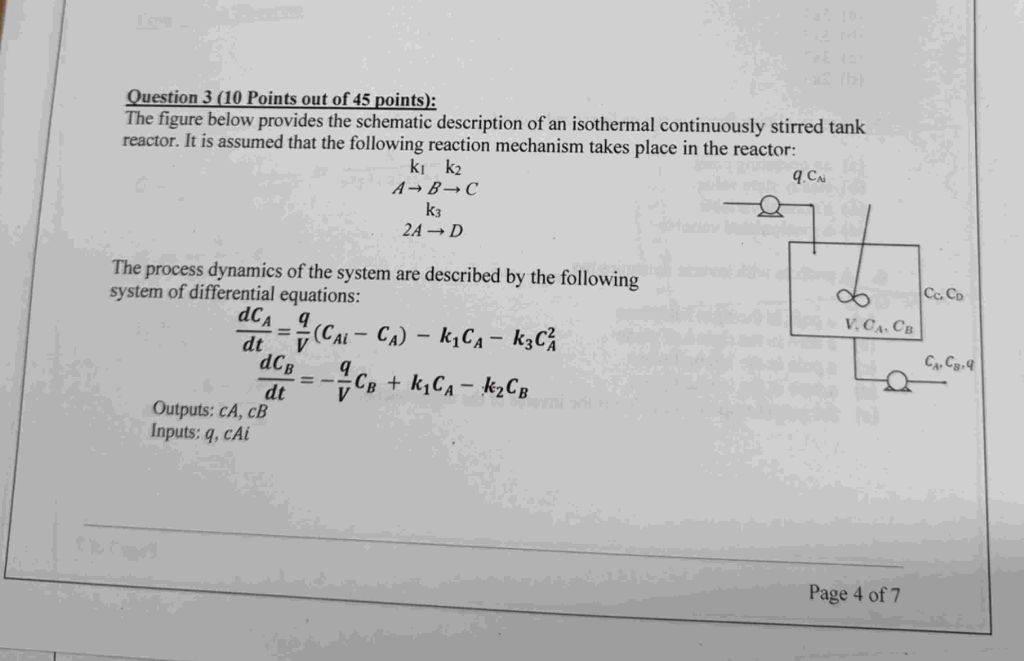 Question 3 (10 Points out of 45 points):
The figure below provides the schematic description of an isothermal continuously stirred tank
reactor. It is assumed that the following reaction mechanism takes place in the reactor:
kik qCs
A> 8-C
ks Q
24—-D
The process dynamics of the system are described by the following Ce.
system of differential equations: co °
ac, gq VC, Cy
ar ~yCn— Co) = kiCq— ky oe
Cig Cad
i= Cs + HaCy~ deCy =
Outputs: cA, cB
4 Inputs; g, cAi ;
eS eT EE WV Be pe TB}
Question 3 (10 Points out of 45 points):
The figure below provides the schematic description of an isothermal continuously stirred tank
reactor. It is assumed that the following reaction mechanism takes place in the reactor:
kik qCs
A> 8-C
ks Q
24—-D
The process dynamics of the system are described by the following Ce.
system of differential equations: co °
ac, gq VC, Cy
ar ~yCn— Co) = kiCq— ky oe
Cig Cad
i= Cs + HaCy~ deCy =
Outputs: cA, cB
4 Inputs; g, cAi ;
eS eT EE WV Be pe TB}
This is AI generated Response.
Asked by: Francis
Created at: 2026-03-05 23:19:24
Asked by: Francis
Created at: 2026-03-05 23:19:24
Final Answer:
Rendered
Raw Text
Did you like this answer?
Let's solve the problem step-by-step.
---
## **Given Data**
**Reactions:**
- \( A \xrightarrow{k_1} B \xrightarrow{k_2} C \)
- \( 2A \xrightarrow{k_3} D \)
**Differential Equations:**
\[
\frac{dC_A}{dt} = \frac{q}{V}(C_{A\text{I}} - C_A) - k_1C_A - k_3C_A^2
\]
\[
\frac{dC_B}{dt} = -\frac{q}{V}C_B + k_1C_A - k_2C_B
\]
**Outputs:** \( C_A, C_B \)
**Inputs:** \( q, C_{A\text{I}} \)
---
## **Step 1: Steady-State Solution**
At steady state, \( \frac{dC_A}{dt} = \) and \( \frac{dC_B}{dt} = \).
### **Equation 1: \( C_A \) at Steady State**
\[
= \frac{q}{V}(C_{A\text{I}} - C_A) - k_1C_A - k_3C_A^2
\]
\[
\frac{q}{V}C_{A\text{I}} = \frac{q}{V}C_A + k_1C_A + k_3C_A^2
\]
\[
\frac{q}{V}C_{A\text{I}} = \left(\frac{q}{V} + k_1\right)C_A + k_3C_A^2
\]
\[
k_3C_A^2 + \left(\frac{q}{V} + k_1\right)C_A - \frac{q}{V}C_{A\text{I}} =
\]
This is a quadratic equation in \( C_A \):
\[
k_3C_A^2 + \left(\frac{q}{V} + k_1\right)C_A - \frac{q}{V}C_{A\text{I}} =
\]
#### **General Solution for \( C_A \):**
\[
C_A = \frac{ -\left(\frac{q}{V} + k_1\right) + \sqrt{\left(\frac{q}{V} + k_1\right)^2 + 4k_3\frac{q}{V}C_{A\text{I}}} }{2k_3}
\]
(We take the positive root because concentration must be positive.)
---
### **Equation 2: \( C_B \) at Steady State**
\[
= -\frac{q}{V}C_B + k_1C_A - k_2C_B
\]
\[
\frac{q}{V}C_B + k_2C_B = k_1C_A
\]
\[
C_B \left(\frac{q}{V} + k_2\right) = k_1C_A
\]
\[
C_B = \frac{k_1C_A}{\frac{q}{V} + k_2}
\]
---
## **Step 2: Final Answers**
### **a) Steady-State Concentration of \( \mathbf{A} \):**
\[
\boxed{
C_A = \frac{ -\left(\frac{q}{V} + k_1\right) + \sqrt{\left(\frac{q}{V} + k_1\right)^2 + 4k_3\frac{q}{V}C_{A\text{I}}} }{2k_3}
}
\]
### **b) Steady-State Concentration of \( \mathbf{B} \):**
\[
\boxed{
C_B = \frac{k_1C_A}{\frac{q}{V} + k_2}
}
\]
---
## **Step 3: Summary Table**
| Quantity | Formula |
|----------|---------|
| \( C_A \) | \( \frac{ -(\frac{q}{V} + k_1) + \sqrt{(\frac{q}{V} + k_1)^2 + 4k_3 (\frac{q}{V}) C_{A\text{I}}} }{2k_3} \) |
| \( C_B \) | \( \frac{k_1C_A}{\frac{q}{V} + k_2} \) |
---
If you have specific numbers for the parameters, plug them into the above formulas to get the final steady-state concentrations.
📢 Instructions:
- Ask anything relatd to above question only.
- For new Question goto :