 VIPSolutions
Give step-by-step solution with explanation and final answer:(b) (10 points) Calculate the standard cell voltage of the PEMFC at 80°C using the temperature dependence of the Gibbs free energy: AS ET) = E°(298) — — (T — 298 (T) = E9(298) — ~2(T — 298) AS = Entropy change of reaction (-163.2 J/mol-K for PEMFC reaction). (c) (15 points) Determine the actual cell potential. Assume that water is in liquid form.
Question:
Give step-by-step solution with explanation and final answer: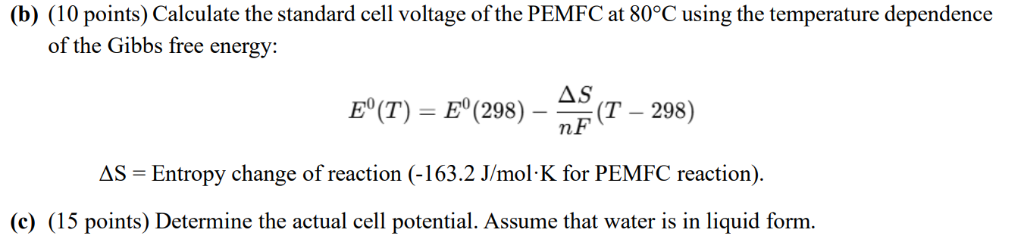 (b) (10 points) Calculate the standard cell voltage of the PEMFC at 80°C using the temperature dependence
of the Gibbs free energy:
AS
ET) = E°(298) — — (T — 298
(T) = E9(298) — ~2(T — 298)
AS = Entropy change of reaction (-163.2 J/mol-K for PEMFC reaction).
(c) (15 points) Determine the actual cell potential. Assume that water is in liquid form.
(b) (10 points) Calculate the standard cell voltage of the PEMFC at 80°C using the temperature dependence
of the Gibbs free energy:
AS
ET) = E°(298) — — (T — 298
(T) = E9(298) — ~2(T — 298)
AS = Entropy change of reaction (-163.2 J/mol-K for PEMFC reaction).
(c) (15 points) Determine the actual cell potential. Assume that water is in liquid form.
This is AI generated Response.
Asked by: Francis
Created at: 2026-03-06 21:42:10
Asked by: Francis
Created at: 2026-03-06 21:42:10
Final Answer:
Rendered
Raw Text
Did you like this answer?
Let's break down and solve each part step by step.
---
## (b) **Calculate the Standard Cell Voltage at 80°C**
###Given:**
- **Equation:**
\[
E^(T) = E^(298) - \frac{\Delta S}{nF}(T - 298)
\]
- \(\Delta S = -163.2 \text{ J/mol·K}\)
- Standard temperature = \(298\,\text{K}\)
- \(T = 80^\circ \text{C} = 353\,\text{K}\)
- Number of electrons, \(n = 2\) (for PEMFC: \(2H_2 + O_2 \to 2H_2O\))
- Faraday's constant, \(F = 96485\,\text{C/mol}\)
- \(E^(298) = 1.229\,\text{V}\) (Standard cell potential for PEMFC at \(25^\circ\text{C}\))
---
### **Step 1: Substitute Values into the Equation**
\[
E^(353) = 1.229 - \frac{-163.2}{2 \times 96485}(353 - 298)
\]
---
### **Step 2: Calculate the Fraction**
- Numerator: \(-163.2\)
- Denominator: \(2 \times 96485 = 192970\)
- \((T-298) = 353 - 298 = 55\)
\[
\frac{-163.2}{192970} = -.000846\,\text{V/K}
\]
---
### **Step 3: Multiply by \((T-298)\)**
\[
-.000846 \times 55 = -.04653
\]
---
### **Step 4: Plug Back into the Equation**
\[
E^(353) = 1.229 - (-.04653)
\]
\[
E^(353) = 1.229 + .04653 = 1.2755\,\text{V}
\]
---
### **Final Answer for (b):**
\[
\boxed{E^(80^\circ\text{C}) = 1.28\,\text{V} \quad (\text{rounded to two decimals})}
\]
---
## (c) **Determine the Actual Cell Potential (with liquid water)**
### **Approach:**
- Use the Nernst equation:
\[
E = E^(T) + \frac{RT}{nF} \ln Q
\]
- For **PEMFC**: \(2H_2(g) + O_2(g) \to 2H_2O(l)\)
- For liquid water, \(a_{H_2O} = 1\)
- Assume gases at 1 atm: \(P_{H_2} = P_{O_2} = 1\,\text{atm}\) (standard conditions, so \(Q = 1\))
- \(R = 8.314\,\text{J/mol·K}\)
- \(T = 353\,\text{K}\)
- \(n = 2\)
- \(F = 96485\,\text{C/mol}\)
---
### **Step 1: Reaction Quotient, \(Q\)**
\[
Q = \frac{a_{H_2O}^2}{a_{H_2}^2 \cdot a_{O_2}} = \frac{1^2}{1^2 \cdot 1} = 1
\]
\[
\ln Q = \ln 1 =
\]
---
### **Step 2: Nernst Equation**
\[
E = E^(T) + \frac{RT}{nF} \ln Q
\]
\[
E = 1.28 + \implies E = 1.28\,\text{V}
\]
---
### **Final Answer for (c):**
\[
\boxed{E_{\text{cell, actual}} = 1.28\,\text{V} \quad (\text{for liquid water, gases at 1 atm)}}
\]
---
## **Summary Table**
| Part | Step | Value |
|------|--------------------------------------------|-----------------|
| (b) | Standard cell voltage at 80°C | \(1.28\,\text{V}\) |
| (c) | Actual cell potential (liquid water, std) | \(1.28\,\text{V}\) |
---
**Note:**
If partial pressures for H\(_2\) or O\(_2\) are not 1 atm, you would need to calculate \(Q\) accordingly, but with standard conditions and liquid water, \(E_{cell}\) equals the standard cell voltage at the given temperature.
📢 Instructions:
- Ask anything relatd to above question only.
- For new Question goto :