Give step-by-step solution with explanation and final answer:* Formulate the fundamental relationship for the rate of change of volumetric strain of a
saturated soil element in terms of the coefficient of volume compressibility m, and the
rate of change of effective stress, assuming the total stress remains constant and soil
grains and water are incompressible.
o Apply Darcy's law for fluid flow through porous media and the principle of conservation
of mass to derive the net rate of pore fluid outflow from a differential soil volume element
of thickness dz.
o Equate the rate of volume change of the soil skeleton to the net rate of pore fluid out-
flow to establish the governing partial differential equation for the one-dimensional
dissipation of excess pore water pressure u(z, f) over time 7.
do’
LLL 222 2 2 2 22 222 22
i u(z, t)
Low
i
1 T7317
TT
|
z Gout,
| k, m,
7.
o Introduce non-dimensional variables for depth Z = z/H and time factor T,, = ¢,t/H? to
transform the governing partial differential equation into a dimensionless form, thereby
defining the the coefficient of consolidation c, in terms of k, m,, and the unit weight
of water 7.
* Based on the general analytical solution to the consolidation equation, express the local
degree of consolidation is U, at a specific depth z and time ¢ as a ratio involving the
initial excess pore pressure ug and the remaining excess pore pressure u(z, t).
® Determine the average degree of consolidation Us, for the entire soil layer by inte-
grating the local degree of consolidation U, over the total depth H, resulting in an
expression that is solely a function of the dimensionless time factor 7.
Question:
Give step-by-step solution with explanation and final answer:* Formulate the fundamental relationship for the rate of change of volumetric strain of a
saturated soil element in terms of the coefficient of volume compressibility m, and the
rate of change of effective stress, assuming the total stress remains constant and soil
grains and water are incompressible.
o Apply Darcy's law for fluid flow through porous media and the principle of conservation
of mass to derive the net rate of pore fluid outflow from a differential soil volume element
of thickness dz.
o Equate the rate of volume change of the soil skeleton to the net rate of pore fluid out-
flow to establish the governing partial differential equation for the one-dimensional
dissipation of excess pore water pressure u(z, f) over time 7.
do’
LLL 222 2 2 2 22 222 22
i u(z, t)
Low
i
1 T7317
TT
|
z Gout,
| k, m,
7.
o Introduce non-dimensional variables for depth Z = z/H and time factor T,, = ¢,t/H? to
transform the governing partial differential equation into a dimensionless form, thereby
defining the the coefficient of consolidation c, in terms of k, m,, and the unit weight
of water 7.
* Based on the general analytical solution to the consolidation equation, express the local
degree of consolidation is U, at a specific depth z and time ¢ as a ratio involving the
initial excess pore pressure ug and the remaining excess pore pressure u(z, t).
® Determine the average degree of consolidation Us, for the entire soil layer by inte-
grating the local degree of consolidation U, over the total depth H, resulting in an
expression that is solely a function of the dimensionless time factor 7.
This is AI generated Response.
Asked by: francis
Created at: 2026-03-09 09:39:12
Final Answer:
RenderedRaw Text
Did you like this answer?
Let's solve the steps systematically as described in the problem. The task is to derive and explain **Terzaghi's 1D consolidation equation** and related concepts.
---
## **Step 1: Volumetric Strain and Effective Stress**
#### **Fundamental Relationship**
For a saturated soil element:
- **Total Stress**: \(\sigma\) (constant)
- **Pore Water Pressure**: \(u\)
- **Effective Stress**: \(\sigma' = \sigma - u\)
Assume incompressible grains and water, so volume change is due to soil skeleton only.
**Volumetric strain** (\(\epsilon_v\)) is related to the change in effective stress by the coefficient of volume compressibility (\(m_v\)):
\[
\epsilon_v = m_v \Delta \sigma'
\]
**Rate of change**:
\[
\frac{\partial \epsilon_v}{\partial t} = m_v \frac{\partial \sigma'}{\partial t}
\]
But since \(\sigma\) is constant:
\[
\frac{\partial \sigma'}{\partial t} = -\frac{\partial u}{\partial t}
\]
So:
\[
\frac{\partial \epsilon_v}{\partial t} = -m_v \frac{\partial u}{\partial t}
\]
---
## **Step 2: Darcy's Law and Conservation of Mass**
For a soil slice of thickness \(dz\):
- **Inflow**: \(q_{in}\)
- **Outflow**: \(q_{out}\)
- **Rate of change of volume of water in element**: \(q_{in} - q_{out}\)
Darcy's law for vertical flow:
\[
q = -k \frac{\partial h}{\partial z}
\]
where \(k\) is the permeability, \(h\) is the hydraulic head.
In consolidation, change in head is due to change in excess pore water pressure \(u\):
\[
q = -k \frac{1}{\gamma_w} \frac{\partial u}{\partial z}
\]
**Net outflow** from element:
\[
q_{in} - q_{out} = - \frac{\partial q}{\partial z} dz
\]
---
## **Step 3: Equate Soil Skeleton Volume Change to Net Outflow**
Volume change per unit volume per unit time is:
\[
\frac{\partial \epsilon_v}{\partial t} dz
\]
But this must equal the net outflow per unit volume:
\[
\frac{\partial \epsilon_v}{\partial t} dz = - \frac{\partial q}{\partial z} dz
\]
\[
\frac{\partial \epsilon_v}{\partial t} = - \frac{\partial q}{\partial z}
\]
Substitute for \(q\):
\[
\frac{\partial \epsilon_v}{\partial t} = - \frac{\partial}{\partial z} \left( -k \frac{1}{\gamma_w} \frac{\partial u}{\partial z} \right)
\]
\[
\frac{\partial \epsilon_v}{\partial t} = \frac{\partial}{\partial z} \left( k \frac{1}{\gamma_w} \frac{\partial u}{\partial z} \right)
\]
If \(k\) is constant:
\[
\frac{\partial \epsilon_v}{\partial t} = k \frac{1}{\gamma_w} \frac{\partial^2 u}{\partial z^2}
\]
Recall from Step 1:
\[
\frac{\partial \epsilon_v}{\partial t} = -m_v \frac{\partial u}{\partial t}
\]
So:
\[
-m_v \frac{\partial u}{\partial t} = k \frac{1}{\gamma_w} \frac{\partial^2 u}{\partial z^2}
\]
\[
\frac{\partial u}{\partial t} = \frac{k}{m_v \gamma_w} \frac{\partial^2 u}{\partial z^2}
\]
---
## **Step 4: Coefficient of Consolidation**
Define **coefficient of consolidation** \(c_v\):
\[
c_v = \frac{k}{m_v \gamma_w}
\]
So the partial differential equation becomes:
\[
\frac{\partial u}{\partial t} = c_v \frac{\partial^2 u}{\partial z^2}
\]
---
## **Step 5: Non-Dimensional Variables**
Let:
- \(Z = \frac{z}{H}\) (Depth ratio)
- \(T_v = \frac{c_v t}{H^2}\) (Time factor)
Transform the equation:
\[
\frac{\partial u}{\partial t} = c_v \frac{\partial^2 u}{\partial z^2}
\]
to:
\[
\frac{\partial u}{\partial T_v} = \frac{\partial^2 u}{\partial Z^2}
\]
---
## **Step 6: Analytical Solution and Degree of Consolidation**
The general analytical solution (for double drainage, zero initial excess pressure at boundaries):
\[
u(z, t) = u_ \sum_{n=1}^{\infty} \frac{2}{n\pi} \sin\left(\frac{n\pi z}{H}\right) \exp\left(-c_v \left(\frac{n\pi}{H}\right)^2 t\right)
\]
**Local degree of consolidation** at depth \(z\):
\[
U_z = \frac{u_ - u(z, t)}{u_}
\]
---
## **Step 7: Average Degree of Consolidation**
\[
U_{avg} = \frac{1}{H} \int_^H U_z \, dz
\]
This results in:
\[
U_{avg} = 1 - \sum_{n=1,3,5,...}^{\infty} \frac{2}{n\pi} \exp\left(-n^2 \pi^2 T_v\right)
\]
where the sum is over odd values of \(n\).
---
## **Summary Table**
| Step | Equation/Concept | Final Formula/Explanation |
|------|------------------|--------------------------|
| 1 | Volumetric strain & \(\frac{\partial \epsilon_v}{\partial t} = -m_v \frac{\partial u}{\partial t}\) |
| 2 | Darcy's Law | \(q = -k \frac{1}{\gamma_w} \frac{\partial u}{\partial z}\) |
| 3 | Mass conservation | \(\frac{\partial \epsilon_v}{\partial t} = - \frac{\partial q}{\partial z}\) |
| 4 | Consolidation eqn | \(\frac{\partial u}{\partial t} = c_v \frac{\partial^2 u}{\partial z^2}\) |
| 5 | Non-dimensional | \(Z = \frac{z}{H}, \; T_v = \frac{c_v t}{H^2}\) |
| 6 | Solution | \(u(z, t) = u_ \sum ...\), \(U_z = \frac{u_ - u(z, t)}{u_}\) |
| 7 | \(U_{avg}\) | \(U_{avg} = 1 - \sum_{n=1,3,5,...}^{\infty} \frac{2}{n\pi} \exp(-n^2 \pi^2 T_v)\) |
---
## **Final Answers**
**Governing PDE (Terzaghi’s 1D consolidation equation):**
\[
\frac{\partial u}{\partial t} = c_v \frac{\partial^2 u}{\partial z^2}
\]
**Coefficient of consolidation:**
\[
c_v = \frac{k}{m_v \gamma_w}
\]
**Dimensionless variables:**
\[
Z = \frac{z}{H}, \quad T_v = \frac{c_v t}{H^2}
\]
**Average degree of consolidation:**
\[
U_{avg} = 1 - \sum_{n=1,3,5,...}^{\infty} \frac{2}{n\pi} \exp(-n^2 \pi^2 T_v)
\]
---
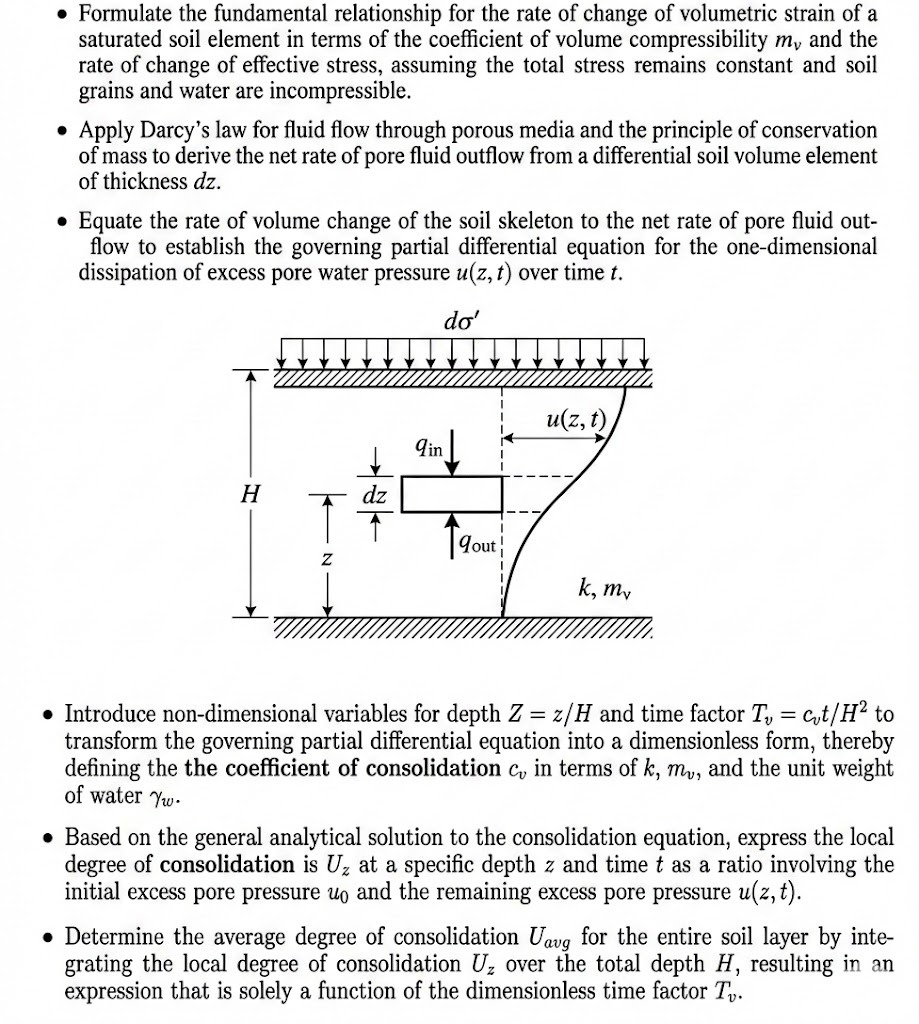
### **Diagram Explanation**
- The diagram shows a soil layer of thickness \(H\) under load.
- \(u(z,t)\): excess pore pressure at depth \(z\) and time \(t\).
- \(q_{in}\) and \(q_{out}\): flow in and out of an element \(dz\).
- \(k\): permeability, \(m_v\): compressibility.
---
**Let me know if you need the step-by-step derivation for a particular part or further clarification!**
VIPSolutions focuses on clear, step‑by‑step explanations so you can learn quickly. Whether you need an AI‑generated walkthrough or a short hint to get unstuck, each solution is organized for fast reading and easy review later.
Search similar questions, compare approaches, and bookmark the best answers for revision. Our goal is simple: quick, reliable study help that feels natural—not noisy.
 VIPSolutions
 * Formulate the fundamental relationship for the rate of change of volumetric strain of a
saturated soil element in terms of the coefficient of volume compressibility m, and the
rate of change of effective stress, assuming the total stress remains constant and soil
grains and water are incompressible.
o Apply Darcy's law for fluid flow through porous media and the principle of conservation
of mass to derive the net rate of pore fluid outflow from a differential soil volume element
of thickness dz.
o Equate the rate of volume change of the soil skeleton to the net rate of pore fluid out-
flow to establish the governing partial differential equation for the one-dimensional
dissipation of excess pore water pressure u(z, f) over time 7.
do’
LLL 222 2 2 2 22 222 22
i u(z, t)
Low
i
1 T7317
TT
|
z Gout,
| k, m,
7.
o Introduce non-dimensional variables for depth Z = z/H and time factor T,, = ¢,t/H? to
transform the governing partial differential equation into a dimensionless form, thereby
defining the the coefficient of consolidation c, in terms of k, m,, and the unit weight
of water 7.
* Based on the general analytical solution to the consolidation equation, express the local
degree of consolidation is U, at a specific depth z and time ¢ as a ratio involving the
initial excess pore pressure ug and the remaining excess pore pressure u(z, t).
® Determine the average degree of consolidation Us, for the entire soil layer by inte-
grating the local degree of consolidation U, over the total depth H, resulting in an
expression that is solely a function of the dimensionless time factor 7.
* Formulate the fundamental relationship for the rate of change of volumetric strain of a
saturated soil element in terms of the coefficient of volume compressibility m, and the
rate of change of effective stress, assuming the total stress remains constant and soil
grains and water are incompressible.
o Apply Darcy's law for fluid flow through porous media and the principle of conservation
of mass to derive the net rate of pore fluid outflow from a differential soil volume element
of thickness dz.
o Equate the rate of volume change of the soil skeleton to the net rate of pore fluid out-
flow to establish the governing partial differential equation for the one-dimensional
dissipation of excess pore water pressure u(z, f) over time 7.
do’
LLL 222 2 2 2 22 222 22
i u(z, t)
Low
i
1 T7317
TT
|
z Gout,
| k, m,
7.
o Introduce non-dimensional variables for depth Z = z/H and time factor T,, = ¢,t/H? to
transform the governing partial differential equation into a dimensionless form, thereby
defining the the coefficient of consolidation c, in terms of k, m,, and the unit weight
of water 7.
* Based on the general analytical solution to the consolidation equation, express the local
degree of consolidation is U, at a specific depth z and time ¢ as a ratio involving the
initial excess pore pressure ug and the remaining excess pore pressure u(z, t).
® Determine the average degree of consolidation Us, for the entire soil layer by inte-
grating the local degree of consolidation U, over the total depth H, resulting in an
expression that is solely a function of the dimensionless time factor 7.