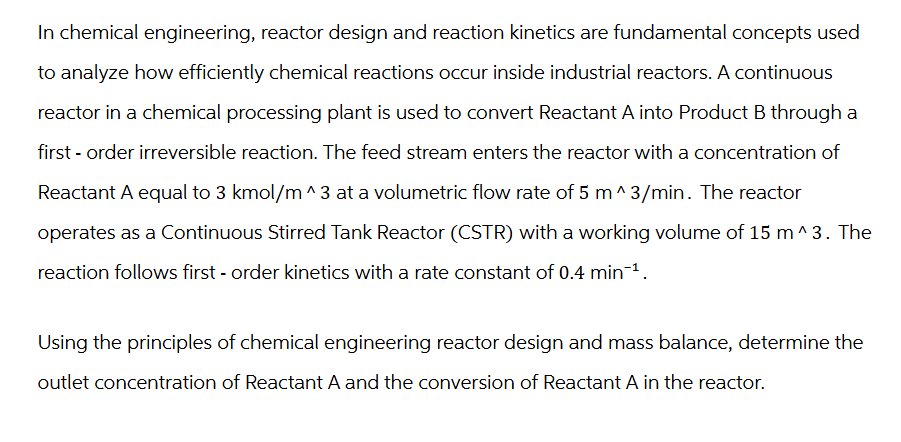
Give step-by-step solution with explanation and final answer:In chemical engineering, reactor design and reaction kinetics are fundamental concepts used
to analyze how efficiently chemical reactions occur inside industrial reactors. A continuous
reactor in a chemical processing plant is used to convert Reactant A into Product B through a
first - order irreversible reaction. The feed stream enters the reactor with a concentration of
Reactant A equal to 3 kmol/m # 3 at a volumetric flow rate of 5 m* 3/min. The reactor
operates as a Continuous Stirred Tank Reactor (CSTR) with a working volume of 15 m* 3. The
reaction follows first - order kinetics with a rate constant of 0.4 min™*.
Using the principles of chemical engineering reactor design and mass balance, determine the
outlet concentration of Reactant A and the conversion of Reactant A in the reactor.
Question:
Give step-by-step solution with explanation and final answer:In chemical engineering, reactor design and reaction kinetics are fundamental concepts used
to analyze how efficiently chemical reactions occur inside industrial reactors. A continuous
reactor in a chemical processing plant is used to convert Reactant A into Product B through a
first - order irreversible reaction. The feed stream enters the reactor with a concentration of
Reactant A equal to 3 kmol/m # 3 at a volumetric flow rate of 5 m* 3/min. The reactor
operates as a Continuous Stirred Tank Reactor (CSTR) with a working volume of 15 m* 3. The
reaction follows first - order kinetics with a rate constant of 0.4 min™*.
Using the principles of chemical engineering reactor design and mass balance, determine the
outlet concentration of Reactant A and the conversion of Reactant A in the reactor.
This is AI generated Response.
Asked by: Francis
Created at: 2026-03-09 16:25:34
Final Answer:
RenderedRaw Text
Did you like this answer?
## Step-by-Step Solution
### **Given Data**
- **Initial concentration of A (\( C_{A} \)):** 3 kmol/m³
- **Volumetric flow rate (\( Q \)):** 5 m³/min
- **Reactor volume (\( V \)):** 15 m³
- **Rate constant (\( k \)):** .4 min⁻¹
- **Type of reactor:** CSTR (Continuous Stirred Tank Reactor)
- **Reaction order:** First order (irreversible)
---
### **1. Mass Balance for CSTR**
For a **CSTR** at steady state:
\[
\text{In} - \text{Out} + \text{Generation} =
\]
For Reactant A:
\[
Q C_{A} - Q C_{A} - r_A V =
\]
Where \( r_A \) is the rate of disappearance of A.
---
### **2. Reaction Rate Expression**
For a **first-order** reaction:
\[
r_A = k C_A
\]
---
### **3. Substitute and Rearrange**
Substitute \( r_A \) into the mass balance:
\[
Q C_{A} - Q C_{A} - k C_A V =
\]
\[
Q C_{A} = Q C_A + k C_A V
\]
\[
Q C_{A} = C_A (Q + k V)
\]
\[
C_A = \frac{Q C_{A}}{Q + kV}
\]
---
### **4. Plug in the Given Values**
- \( Q = 5 \) m³/min
- \( C_{A} = 3 \) kmol/m³
- \( k = .4 \) min⁻¹
- \( V = 15 \) m³
\[
C_A = \frac{5 \times 3}{5 + .4 \times 15}
\]
\[
C_A = \frac{15}{5 + 6}
\]
\[
C_A = \frac{15}{11}
\]
\[
C_A = 1.364 \text{ kmol/m}^3
\]
---
### **5. Calculate Conversion of A (\( X \))**
\[
X = \frac{C_{A} - C_A}{C_{A}}
\]
\[
X = \frac{3 - 1.364}{3}
\]
\[
X = \frac{1.636}{3}
\]
\[
X = .545
\]
\[
X = 54.5\%
\]
---
## **Final Answers**
### **Outlet concentration of Reactant A:**
\[
\boxed{1.36 \text{ kmol/m}^3}
\]
### **Conversion of Reactant A in the reactor:**
\[
\boxed{54.5\%}
\]
---
#### **Summary Table**
| Quantity | Value |
|---------------------------|------------------------|
| Outlet concentration (\(C_A\)) | 1.36 kmol/m³ |
| Conversion (\(X\)) | 54.5% |
Question:
give me answer without any spaces or empty values.
This is AI generated Response.
Asked by: Francis
Created at: 2026-03-09 16:32:47
Final Answer:
RenderedRaw Text
Did you like this answer?
## Step-by-Step Solution
### **Given Data**
- **Initial concentration of A (\( C_{A} \)):** 3 kmol/m³
- **Volumetric flow rate (\( Q \)):** 5 m³/min
- **Reactor volume (\( V \)):** 15 m³
- **Rate constant (\( k \)):** 0.4 min⁻¹
- **Type of reactor:** CSTR
- **Reaction order:** First order (irreversible)
### **1. Mass Balance for CSTR**
For a CSTR at steady state:
\[
Q C_{A} - Q C_{A} - r_A V = 0
\]
Where \( r_A \) is the rate of disappearance of A.
### **2. Reaction Rate Expression**
For a first-order reaction:
\[
r_A = k C_A
\]
### **3. Substitute and Rearrange**
Substituting \( r_A \):
\[
Q C_{A} = C_A (Q + k V)
\]
\[
C_A = \frac{Q C_{A}}{Q + k V}
\]
### **4. Plug in the Given Values**
\[
C_A = \frac{5 \times 3}{5 + 0.4 \times 15}
\]
\[
C_A = \frac{15}{5 + 6}
\]
\[
C_A = \frac{15}{11} \approx 1.364 \text{ kmol/m}^3
\]
### **5. Calculate Conversion of A (\( X \))**
\[
X = \frac{C_{A} - C_A}{C_{A}} = \frac{3 - 1.364}{3} \approx 0.545
\]
\[
X \approx 54.5\%
\]
## **Final Answers**
### **Outlet concentration of Reactant A:**
\[
\boxed{1.36 \text{ kmol/m}^3}
\]
### **Conversion of Reactant A in the reactor:**
\[
\boxed{54.5\%}
\]
### **Summary Table**
| Quantity | Value |
|---------------------------|------------------------|
| Outlet concentration (\(C_A\)) | 1.36 kmol/m³ |
| Conversion (\(X\)) | 54.5% |
VIPSolutions focuses on clear, step‑by‑step explanations so you can learn quickly. Whether you need an AI‑generated walkthrough or a short hint to get unstuck, each solution is organized for fast reading and easy review later.
Search similar questions, compare approaches, and bookmark the best answers for revision. Our goal is simple: quick, reliable study help that feels natural—not noisy.
 VIPSolutions
 In chemical engineering, reactor design and reaction kinetics are fundamental concepts used
to analyze how efficiently chemical reactions occur inside industrial reactors. A continuous
reactor in a chemical processing plant is used to convert Reactant A into Product B through a
first - order irreversible reaction. The feed stream enters the reactor with a concentration of
Reactant A equal to 3 kmol/m # 3 at a volumetric flow rate of 5 m* 3/min. The reactor
operates as a Continuous Stirred Tank Reactor (CSTR) with a working volume of 15 m* 3. The
reaction follows first - order kinetics with a rate constant of 0.4 min™*.
Using the principles of chemical engineering reactor design and mass balance, determine the
outlet concentration of Reactant A and the conversion of Reactant A in the reactor.
In chemical engineering, reactor design and reaction kinetics are fundamental concepts used
to analyze how efficiently chemical reactions occur inside industrial reactors. A continuous
reactor in a chemical processing plant is used to convert Reactant A into Product B through a
first - order irreversible reaction. The feed stream enters the reactor with a concentration of
Reactant A equal to 3 kmol/m # 3 at a volumetric flow rate of 5 m* 3/min. The reactor
operates as a Continuous Stirred Tank Reactor (CSTR) with a working volume of 15 m* 3. The
reaction follows first - order kinetics with a rate constant of 0.4 min™*.
Using the principles of chemical engineering reactor design and mass balance, determine the
outlet concentration of Reactant A and the conversion of Reactant A in the reactor.