This is AI generated Response.
Asked by: gvr
Created at: 2025-06-15 16:24:51
Final Answer:
RenderedRaw Text
Did you like this answer?
Let's solve **Problem 6.1** step by step, as requested.
---
### **Step 1: Discretized Analog of the Continuous String**
#### **Continuous Case Recap**
From the provided text:
- For a continuous string fixed at \( x = 0 \) and \( x = \ell \), the displacement can be written as:
\[
\psi(x) = \sum_{n=1}^\infty c_n \sin\left(\frac{n\pi x}{\ell}\right)
\]
where
\[
c_n = \frac{2}{\ell} \int_0^\ell \psi(x) \sin\left(\frac{n\pi x}{\ell}\right) dx
\]
---
#### **Discrete (Beaded String) Case**
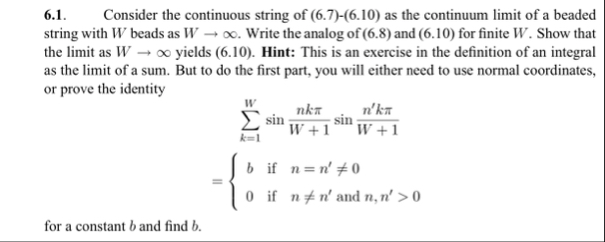
For a string with \( W \) beads (mass points) and \( W+1 \) points (including the endpoints), the allowed positions are:
\[
x_k = k a, \quad k = 0, 1, \ldots, W+1
\]
where \( a = \ell/(W+1) \).
Since the ends are fixed, we only consider \( k = 1 \) to \( W \) (interior beads).
Let the displacement at bead \( k \) be \( \psi_k \).
The normal modes for the discrete case are:
\[
\psi_k = \sum_{n=1}^W c_n \sin\left(\frac{n\pi k}{W+1}\right)
\]
This is the **finite analog of equation (6.8)**.
---
#### **Finding the Coefficients \( c_n \) (Discrete Analog of 6.10)**
To find \( c_n \), use orthogonality of sine functions:
\[
\sum_{k=1}^{W} \sin\left(\frac{n\pi k}{W+1}\right) \sin\left(\frac{n'\pi k}{W+1}\right) =
\begin{cases}
b & \text{if } n = n' \\
0 & \text{if } n \neq n'
\end{cases}
\]
where \( b \) is a constant to be determined.
Multiply both sides by \( \sin\left(\frac{n\pi k}{W+1}\right) \) and sum over \( k \):
\[
\sum_{k=1}^{W} \psi_k \sin\left(\frac{n\pi k}{W+1}\right) = c_n \sum_{k=1}^{W} \sin^2\left(\frac{n\pi k}{W+1}\right)
\]
So,
\[
c_n = \frac{1}{b} \sum_{k=1}^{W} \psi_k \sin\left(\frac{n\pi k}{W+1}\right)
\]
---
### **Step 2: Find the Value of \( b \)**
Recall the sum:
\[
b = \sum_{k=1}^W \sin^2\left(\frac{n\pi k}{W+1}\right)
\]
This sum is independent of \( n \) (for \( n \neq 0 \)), and is a standard result (see discrete orthogonality of sines):
\[
\sum_{k=1}^W \sin^2\left(\frac{n\pi k}{W+1}\right) = \frac{W+1}{2}
\]
You can verify this result using trigonometric identities or see it in standard references on Fourier series on discrete grids.
---
### **Step 3: Taking the Limit \( W \to \infty \)**
As \( W \to \infty \), \( a = \ell/(W+1) \to 0 \). The sum
\[
\sum_{k=1}^W f(x_k) a \to \int_0^\ell f(x) dx
\]
and the argument of the sine becomes continuous:
\[
\frac{n\pi k}{W+1} = \frac{n\pi x_k}{\ell}
\]
So,
\[
c_n = \frac{2}{\ell} \int_0^\ell \psi(x) \sin\left(\frac{n\pi x}{\ell}\right) dx
\]
matching equation (6.10).
---
### **Summary of Answers**
#### **Discrete Analog (for finite \( W \)):**
\[
\boxed{
\psi_k = \sum_{n=1}^W c_n \sin\left(\frac{n\pi k}{W+1}\right), \qquad
c_n = \frac{2}{W+1} \sum_{k=1}^W \psi_k \sin\left(\frac{n\pi k}{W+1}\right)
}
\]
#### **Value of \( b \):**
\[
\boxed{b = \frac{W+1}{2}}
\]
#### **Continuous Limit (\( W \to \infty \)):**
\[
\psi(x) = \sum_{n=1}^\infty c_n \sin\left(\frac{n\pi x}{\ell}\right),
\qquad
c_n = \frac{2}{\ell} \int_0^\ell \psi(x) \sin\left(\frac{n\pi x}{\ell}\right) dx
\]
---
**If you need the derivation for the sum for \( b \), let me know!**
VIPSolutions focuses on clear, step‑by‑step explanations so you can learn quickly. Whether you need an AI‑generated walkthrough or a short hint to get unstuck, each solution is organized for fast reading and easy review later.
Search similar questions, compare approaches, and bookmark the best answers for revision. Our goal is simple: quick, reliable study help that feels natural—not noisy.
 VIPSolutions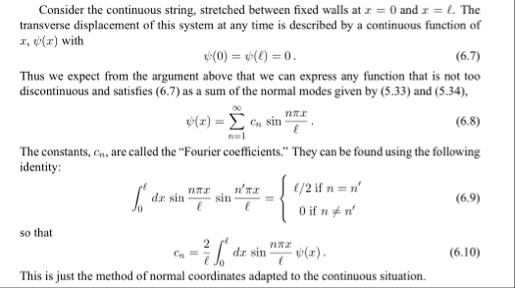
 Consider the continuous string. stretched between fixed walls at = = 0 and x = £. The
transverse displacement ofthis system at any time i described by a continuous function of
x, v(x) with
¥(0) = (0 =0. ©)
Thus we expect from the argument above that we can express any function that is pot 100
discontinuous and satisfies (6.7) as & sum of the normal modes given by (5.33) and (5.34),
lr) = py Gu sin" ©8)
‘The constants, c,, are called the “Fourier coefficients.” They can be found using the following.
identity
¢ nmr on'mx 2 n=n"
J dein" in EE = 2 ©9
dd ¢ ¢ 0if nn’
sothat yo
w=} / dr sin "7 g(x) (6.10)
“This is just the method of normal coordinates adapted to the continuous situation.
61. Consider the continuous string of (6.76.10) as the continuum limit of a beaded
string with IW beads as W" — oc. Write the analog of 6.8) and (6.10) for finite IW. Show that
the limit as IV — oo yields (6.10). Hint: This is an exercise in the definition of an integral
as the limit of a sum. But to do the first part, you will cither need to use normal coordinates,
or prove the identity
3 tie, 0,
PE ha
bf n=n'£0
“loi ngaandnn so
for a constant band find b.
Consider the continuous string. stretched between fixed walls at = = 0 and x = £. The
transverse displacement ofthis system at any time i described by a continuous function of
x, v(x) with
¥(0) = (0 =0. ©)
Thus we expect from the argument above that we can express any function that is pot 100
discontinuous and satisfies (6.7) as & sum of the normal modes given by (5.33) and (5.34),
lr) = py Gu sin" ©8)
‘The constants, c,, are called the “Fourier coefficients.” They can be found using the following.
identity
¢ nmr on'mx 2 n=n"
J dein" in EE = 2 ©9
dd ¢ ¢ 0if nn’
sothat yo
w=} / dr sin "7 g(x) (6.10)
“This is just the method of normal coordinates adapted to the continuous situation.
61. Consider the continuous string of (6.76.10) as the continuum limit of a beaded
string with IW beads as W" — oc. Write the analog of 6.8) and (6.10) for finite IW. Show that
the limit as IV — oo yields (6.10). Hint: This is an exercise in the definition of an integral
as the limit of a sum. But to do the first part, you will cither need to use normal coordinates,
or prove the identity
3 tie, 0,
PE ha
bf n=n'£0
“loi ngaandnn so
for a constant band find b.