 VIPSolutions
Give step-by-step solution with explanation and final answer:
Question:
Give step-by-step solution with explanation and final answer: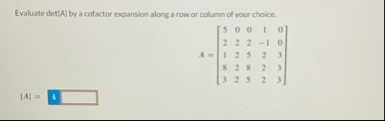
This is AI generated Response.
Asked by: gvr
Created at: 2025-06-15 16:30:52
Asked by: gvr
Created at: 2025-06-15 16:30:52
Final Answer:
Rendered
Raw Text
Did you like this answer?
Let's evaluate the determinant of the given \( 4 \times 4 \) matrix \( A \) using cofactor expansion along the **first row** (since it contains zeros, which simplifies calculations).
The matrix is:
\[
A = \begin{pmatrix}
5 & 0 & 1 & 0 \\
2 & 2 & -1 & 0 \\
1 & 5 & 2 & 3 \\
3 & 2 & 5 & 3 \\
\end{pmatrix}
\]
### Step 1: Write the Cofactor Expansion for Row 1
\[
\det(A) = 5 \cdot C_{11} + 0 \cdot C_{12} + 1 \cdot C_{13} + 0 \cdot C_{14}
\]
Terms with 0 coefficients can be ignored:
\[
\det(A) = 5 \cdot C_{11} + 1 \cdot C_{13}
\]
Where \( C_{ij} \) is the cofactor of the element in row \( i \), column \( j \).
---
### Step 2: Calculate \( C_{11} \) and \( C_{13} \)
#### 2.1: \( C_{11} \) (Remove row 1 and column 1)
\[
M_{11} = \begin{pmatrix}
2 & -1 & 0 \\
5 & 2 & 3 \\
2 & 5 & 3 \\
\end{pmatrix}
\]
\[
C_{11} = (-1)^{1+1} \cdot \det(M_{11}) = 1 \cdot \det(M_{11})
\]
#### 2.2: \( C_{13} \) (Remove row 1 and column 3)
\[
M_{13} = \begin{pmatrix}
2 & 2 & 0 \\
1 & 5 & 3 \\
3 & 2 & 3 \\
\end{pmatrix}
\]
\[
C_{13} = (-1)^{1+3} \cdot \det(M_{13}) = 1 \cdot \det(M_{13})
\]
---
### Step 3: Find the Determinants of the \( 3 \times 3 \) Matrices
#### 3.1: Compute \( \det(M_{11}) \)
\[
M_{11} =
\begin{pmatrix}
2 & -1 & 0 \\
5 & 2 & 3 \\
2 & 5 & 3 \\
\end{pmatrix}
\]
Use the first row for expansion:
\[
\det(M_{11}) = 2 \begin{vmatrix} 2 & 3 \\ 5 & 3 \end{vmatrix} - (-1) \begin{vmatrix} 5 & 3 \\ 2 & 3 \end{vmatrix} + 0
\]
Calculate minors:
- \( \begin{vmatrix} 2 & 3 \\ 5 & 3 \end{vmatrix} = (2)(3) - (3)(5) = 6 - 15 = -9 \)
- \( \begin{vmatrix} 5 & 3 \\ 2 & 3 \end{vmatrix} = (5)(3) - (3)(2) = 15 - 6 = 9 \)
So,
\[
\det(M_{11}) = 2(-9) + 1(9) = -18 + 9 = -9
\]
---
#### 3.2: Compute \( \det(M_{13}) \)
\[
M_{13} =
\begin{pmatrix}
2 & 2 & 0 \\
1 & 5 & 3 \\
3 & 2 & 3 \\
\end{pmatrix}
\]
Expand along the first row:
\[
\det(M_{13}) = 2 \begin{vmatrix} 5 & 3 \\ 2 & 3 \end{vmatrix} - 2 \begin{vmatrix} 1 & 3 \\ 3 & 3 \end{vmatrix} + 0
\]
Calculate minors:
- \( \begin{vmatrix} 5 & 3 \\ 2 & 3 \end{vmatrix} = (5)(3) - (3)(2) = 15 - 6 = 9 \)
- \( \begin{vmatrix} 1 & 3 \\ 3 & 3 \end{vmatrix} = (1)(3) - (3)(3) = 3 - 9 = -6 \)
So,
\[
\det(M_{13}) = 2(9) - 2(-6) = 18 + 12 = 30
\]
---
### Step 4: Substitute Back
\[
\det(A) = 5 \cdot (-9) + 1 \cdot (30) = -45 + 30 = -15
\]
---
## **Final Answer**
\[
\boxed{-15}
\]
Question:
i need detailed calculations along with the final Answers
This is AI generated Response.
Asked by: gvr
Created at: 2025-06-15 16:32:11
Asked by: gvr
Created at: 2025-06-15 16:32:11
Final Answer:
Rendered
Raw Text
Did you like this answer?
Let's evaluate the determinant of the given \( 4 \times 4 \) matrix \( A \):
\[
A = \begin{pmatrix}
5 & 0 & 1 & 0 \\
2 & 2 & -1 & 0 \\
1 & 5 & 2 & 3 \\
3 & 2 & 5 & 3 \\
\end{pmatrix}
\]
### Step 1: Expand along the first row
The determinant of \( A \) using cofactor expansion along the first row:
\[
\det(A) = a_{11} C_{11} + a_{12} C_{12} + a_{13} C_{13} + a_{14} C_{14}
\]
Given the first row: \( (5, 0, 1, 0) \), the terms with zero coefficients will vanish:
\[
\det(A) = 5 \cdot C_{11} + 1 \cdot C_{13}
\]
where:
\[
C_{ij} = (-1)^{i+j} \cdot \det(M_{ij})
\]
and \( M_{ij} \) is the minor matrix obtained by deleting row \( i \) and column \( j \).
---
### Step 2: Compute minors \( M_{11} \) and \( M_{13} \)
#### Minor \( M_{11} \): delete row 1, column 1
\[
M_{11} =
\begin{pmatrix}
2 & -1 & 0 \\
5 & 2 & 3 \\
2 & 5 & 3 \\
\end{pmatrix}
\]
#### Minor \( M_{13} \): delete row 1, column 3
\[
M_{13} =
\begin{pmatrix}
2 & 2 & 0 \\
1 & 5 & 3 \\
3 & 2 & 3 \\
\end{pmatrix}
\]
---
### Step 3: Calculate \( \det(M_{11}) \)
Using the first row for expansion:
\[
\det(M_{11}) = 2 \cdot \det \begin{pmatrix} 2 & 3 \\ 5 & 3 \end{pmatrix} - (-1) \cdot \det \begin{pmatrix} 5 & 3 \\ 2 & 3 \end{pmatrix} + 0 \cdot (\text{something})
\]
Calculate the minors:
- \( \det \begin{pmatrix} 2 & 3 \\ 5 & 3 \end{pmatrix} = (2)(3) - (3)(5) = 6 - 15 = -9 \)
- \( \det \begin{pmatrix} 5 & 3 \\ 2 & 3 \end{pmatrix} = (5)(3) - (3)(2) = 15 - 6 = 9 \)
Now substitute back:
\[
\det(M_{11}) = 2 \times (-9) + 1 \times 9 = -18 + 9 = -9
\]
### Step 4: Calculate \( \det(M_{13}) \)
Using the first row:
\[
\det(M_{13}) = 2 \cdot \det \begin{pmatrix} 5 & 3 \\ 2 & 3 \end{pmatrix} - 2 \cdot \det \begin{pmatrix} 1 & 3 \\ 3 & 3 \end{pmatrix} + 0 \cdot (\text{something})
\]
Calculate minors:
- \( \det \begin{pmatrix} 5 & 3 \\ 2 & 3 \end{pmatrix} = 15 - 6 = 9 \)
- \( \det \begin{pmatrix} 1 & 3 \\ 3 & 3 \end{pmatrix} = (1)(3) - (3)(3) = 3 - 9 = -6 \)
Substitute:
\[
\det(M_{13}) = 2 \times 9 - 2 \times (-6) = 18 + 12 = 30
\]
---
### Step 5: Calculate cofactors and final determinant
Recall:
\[
C_{11} = (-1)^{1+1} \cdot \det(M_{11}) = 1 \times (-9) = -9
\]
\[
C_{13} = (-1)^{1+3} \cdot \det(M_{13}) = 1 \times 30 = 30
\]
Therefore:
\[
\det(A) = 5 \times C_{11} + 1 \times C_{13} = 5 \times (-9) + 1 \times 30 = -45 + 30 = -15
\]
---
## **Final Answer:**
\[
\boxed{-15}
\]
The determinant of the matrix \( A \) is **\(-15\)**.
📢 Instructions:
- Ask anything relatd to above question only.
- For new Question goto :