 VIPSolutions
Give step-by-step solution with explanation and final answer:\section*{Problem 8} An electrostatic potential is given by \[ V(\mathbf{r}) \; = \; \frac{1}{4\pi\varepsilon_O]\, \frac{\mathbf(p}\cdot\mathbf{r}}{r » 3}, \] where S \mathbf(p}S is a constant vector. \beginfenumerate} \item Calculate the electric field S\mathbf{E}(\mathbf{r})$ in Cartesian coordinates. \item Calculate the electric field S\mathbf(E}(r, theta, \phi)$ in spherical coordinates by choosing the Sz5-axis along the direction of S\mathbf{p}S (ie. \ S\mathbf{p}\cdot\mathbf(r } = pr\cos\thetaS). \end{enumerate}
Question:
Give step-by-step solution with explanation and final answer: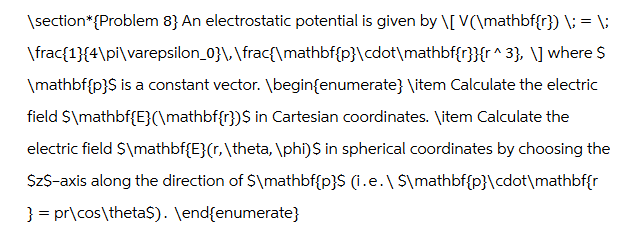 \section*{Problem 8} An electrostatic potential is given by \[ V(\mathbf{r}) \; = \;
\frac{1}{4\pi\varepsilon_O]\, \frac{\mathbf(p}\cdot\mathbf{r}}{r » 3}, \] where S
\mathbf(p}S is a constant vector. \beginfenumerate} \item Calculate the electric
field S\mathbf{E}(\mathbf{r})$ in Cartesian coordinates. \item Calculate the
electric field S\mathbf(E}(r, theta, \phi)$ in spherical coordinates by choosing the
Sz5-axis along the direction of S\mathbf{p}S (ie. \ S\mathbf{p}\cdot\mathbf(r
} = pr\cos\thetaS). \end{enumerate}
\section*{Problem 8} An electrostatic potential is given by \[ V(\mathbf{r}) \; = \;
\frac{1}{4\pi\varepsilon_O]\, \frac{\mathbf(p}\cdot\mathbf{r}}{r » 3}, \] where S
\mathbf(p}S is a constant vector. \beginfenumerate} \item Calculate the electric
field S\mathbf{E}(\mathbf{r})$ in Cartesian coordinates. \item Calculate the
electric field S\mathbf(E}(r, theta, \phi)$ in spherical coordinates by choosing the
Sz5-axis along the direction of S\mathbf{p}S (ie. \ S\mathbf{p}\cdot\mathbf(r
} = pr\cos\thetaS). \end{enumerate}
This is AI generated Response.
Asked by: gvr
Created at: 2025-06-16 03:54:52
Asked by: gvr
Created at: 2025-06-16 03:54:52
Final Answer:
Rendered
Raw Text
Did you like this answer?
Let's solve the problem step by step:
## **Given:**
The electrostatic potential is
\[
V(\mathbf{r}) = \frac{1}{4\pi\varepsilon_0} \frac{\mathbf{p} \cdot \mathbf{r}}{r^3}
\]
where \(\mathbf{p}\) is a constant vector.
---
## **(1) Electric Field in Cartesian Coordinates**
The electric field is given by:
\[
\mathbf{E}(\mathbf{r}) = -\nabla V(\mathbf{r})
\]
### **Step 1: Compute the Gradient**
Let \(\mathbf{p} \cdot \mathbf{r} = p_x x + p_y y + p_z z\) and \(r = |\mathbf{r}| = \sqrt{x^2 + y^2 + z^2}\).
So,
\[
V(\mathbf{r}) = \frac{1}{4\pi\varepsilon_0} \frac{\mathbf{p} \cdot \mathbf{r}}{r^3}
\]
Take the gradient in Cartesian coordinates:
\[
\nabla V = \frac{1}{4\pi\varepsilon_0} \nabla \left( \frac{\mathbf{p} \cdot \mathbf{r}}{r^3} \right)
\]
Let’s use the product rule:
\[
\nabla [f(\mathbf{r})g(\mathbf{r})] = f \nabla g + g \nabla f
\]
Here,
- \(f(\mathbf{r}) = \mathbf{p} \cdot \mathbf{r}\), so \(\nabla f = \mathbf{p}\)
- \(g(\mathbf{r}) = 1/r^3\), so \(\nabla g = -3 r^{-4} \nabla r\), and \(\nabla r = \frac{\mathbf{r}}{r}\). Thus,
\[
\nabla \left( \frac{1}{r^3} \right) = -3 r^{-4} \frac{\mathbf{r}}{r} = -3 \frac{\mathbf{r}}{r^5}
\]
So,
\[
\nabla V = \frac{1}{4\pi\varepsilon_0} \left[ (\mathbf{p} \cdot \mathbf{r}) \left(-3 \frac{\mathbf{r}}{r^5}\right) + \frac{1}{r^3} \mathbf{p} \right]
\]
\[
= \frac{1}{4\pi\varepsilon_0} \left[ \frac{\mathbf{p}}{r^3} - 3 \frac{(\mathbf{p} \cdot \mathbf{r}) \mathbf{r}}{r^5} \right]
\]
### **Step 2: Electric Field**
\[
\mathbf{E}(\mathbf{r}) = -\nabla V(\mathbf{r}) = -\frac{1}{4\pi\varepsilon_0} \left[ \frac{\mathbf{p}}{r^3} - 3 \frac{(\mathbf{p} \cdot \mathbf{r}) \mathbf{r}}{r^5} \right]
\]
Or,
\[
\boxed{
\mathbf{E}(\mathbf{r}) = \frac{1}{4\pi\varepsilon_0} \left[ 3 \frac{(\mathbf{p} \cdot \mathbf{r}) \mathbf{r}}{r^5} - \frac{\mathbf{p}}{r^3} \right]
}
\]
This is the electric field of a point dipole in Cartesian form.
---
## **(2) Electric Field in Spherical Coordinates**
Let’s choose the \(z\)-axis along the direction of \(\mathbf{p}\).
- Then \(\mathbf{p} \cdot \mathbf{r} = p r \cos\theta\), where \(p = |\mathbf{p}|\).
### **Step 1: Express in Spherical Coordinates**
- \(r = r\)
- \(\cos\theta\) is the angle between \(\mathbf{p}\) and \(\mathbf{r}\).
- \(\hat{r}\) and \(\hat{\theta}\) are the standard spherical unit vectors.
The electric field in spherical coordinates:
\[
\mathbf{E}(r, \theta) = \frac{1}{4\pi\varepsilon_0} \left[ 3 \frac{(\mathbf{p} \cdot \mathbf{r}) \mathbf{r}}{r^5} - \frac{\mathbf{p}}{r^3} \right]
\]
Let’s write both terms:
- \(\mathbf{p} \cdot \mathbf{r} = p r \cos\theta\)
- \(\mathbf{r} = r \hat{r}\)
- \(\mathbf{p} = p \hat{z}\)
Express \(\hat{z}\) in spherical coordinates:
\[
\hat{z} = \cos\theta\,\hat{r} - \sin\theta\,\hat{\theta}
\]
So,
\[
\mathbf{p} = p(\cos\theta\,\hat{r} - \sin\theta\,\hat{\theta})
\]
The first term:
\[
3 \frac{(\mathbf{p} \cdot \mathbf{r}) \mathbf{r}}{r^5} = 3 \frac{p r \cos\theta \cdot r \hat{r}}{r^5} = 3p \frac{\cos\theta}{r^3} \hat{r}
\]
The second term:
\[
\frac{\mathbf{p}}{r^3} = \frac{p}{r^3} (\cos\theta\,\hat{r} - \sin\theta\,\hat{\theta})
\]
So,
\[
\mathbf{E}(r, \theta) = \frac{1}{4\pi\varepsilon_0} \left[ 3p \frac{\cos\theta}{r^3} \hat{r} - \frac{p}{r^3} (\cos\theta\,\hat{r} - \sin\theta\,\hat{\theta}) \right]
\]
Expand:
\[
= \frac{1}{4\pi\varepsilon_0} \left[ (3\cos\theta - \cos\theta) \frac{p}{r^3} \hat{r} + \sin\theta \frac{p}{r^3} \hat{\theta} \right]
\]
\[
= \frac{p}{4\pi\varepsilon_0 r^3} \left[ 2\cos\theta \hat{r} + \sin\theta \hat{\theta} \right]
\]
### **Final Answer in Spherical Coordinates**
\[
\boxed{
\mathbf{E}(r, \theta) = \frac{p}{4\pi\varepsilon_0 r^3} \left( 2\cos\theta\,\hat{r} + \sin\theta\,\hat{\theta} \right)
}
\]
---
### **Summary**
**(1) Cartesian coordinates:**
\[
\boxed{
\mathbf{E}(\mathbf{r}) = \frac{1}{4\pi\varepsilon_0} \left[ 3 \frac{(\mathbf{p} \cdot \mathbf{r}) \mathbf{r}}{r^5} - \frac{\mathbf{p}}{r^3} \right]
}
\]
**(2) Spherical coordinates (with \(\mathbf{p}\) along \(z\)-axis):**
\[
\boxed{
\mathbf{E}(r, \theta) = \frac{p}{4\pi\varepsilon_0 r^3} \left( 2\cos\theta\,\hat{r} + \sin\theta\,\hat{\theta} \right)
}
\]
Question:
i need 2 line pure theory for explanation
This is AI generated Response.
Asked by: gvr
Created at: 2025-06-16 04:01:27
Asked by: gvr
Created at: 2025-06-16 04:01:27
Final Answer:
Rendered
Raw Text
Did you like this answer?
The electric field of a dipole is derived from the potential by taking its gradient, resulting in a field that depends on the orientation and magnitude of the dipole moment. In spherical coordinates aligned along the dipole axis, the field exhibits a characteristic angular dependence, with radial and angular components proportional to \(\cos\theta\) and \(\sin\theta\), respectively.
📢 Instructions:
- Ask anything relatd to above question only.
- For new Question goto :