 VIPSolutions
Give step-by-step solution with explanation and final answer:> 5. Apply the operator ¥ 10 products of smooth scalar feds @, ¥, vector elds, 2 and tensor fields A, B. Establish the important identities oH > div(®u) = @divu + u-gradd a8 : div(®A) = GdivA + Agrad® , (1.289) 3 div(ATu) = divA w+ A: gradu , (1.290 > div(AB) = gradA : B+ AdivB , 129 > div(uxv) = v-curlu—u- curly ,
Question:
Give step-by-step solution with explanation and final answer: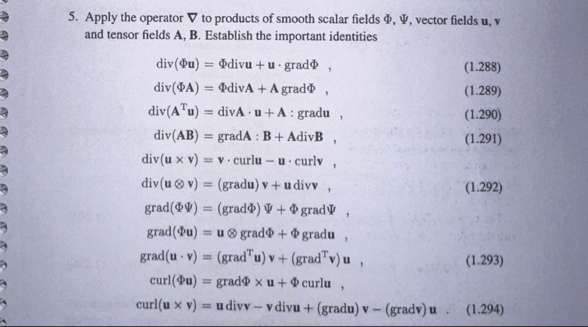 > 5. Apply the operator ¥ 10 products of smooth scalar feds @, ¥, vector elds,
2 and tensor fields A, B. Establish the important identities oH
> div(®u) = @divu + u-gradd a8
: div(®A) = GdivA + Agrad® , (1.289)
3 div(ATu) = divA w+ A: gradu , (1.290
> div(AB) = gradA : B+ AdivB , 129
> div(uxv) = v-curlu—u- curly ,
> 5. Apply the operator ¥ 10 products of smooth scalar feds @, ¥, vector elds,
2 and tensor fields A, B. Establish the important identities oH
> div(®u) = @divu + u-gradd a8
: div(®A) = GdivA + Agrad® , (1.289)
3 div(ATu) = divA w+ A: gradu , (1.290
> div(AB) = gradA : B+ AdivB , 129
> div(uxv) = v-curlu—u- curly ,
This is AI generated Response.
Asked by: gvr
Created at: 2025-06-16 04:11:04
Asked by: gvr
Created at: 2025-06-16 04:11:04
Final Answer:
Rendered
Raw Text
Did you like this answer?
Certainly! Let's go through the step-by-step derivation and explanation of each identity from the list. I'll focus on clarity and show the reasoning using vector calculus rules.
---
### 1. **\(\text{div}(\Phi \mathbf{u}) = \Phi\, \text{div}\,\mathbf{u} + \mathbf{u} \cdot \nabla \Phi\)**
**Explanation:**
Apply the **product rule** for divergence (Leibniz rule):
\[
\text{div}(\Phi \mathbf{u}) = \nabla \cdot (\Phi \mathbf{u})
\]
Expand using the product rule for divergence:
\[
= (\nabla \Phi) \cdot \mathbf{u} + \Phi (\nabla \cdot \mathbf{u})
\]
Or, rearranged:
\[
= \Phi\, \text{div}\,\mathbf{u} + \mathbf{u} \cdot \nabla \Phi
\]
**This is the identity (1.288).**
---
### 2. **\(\text{div}(\Phi \mathbf{A}) = \Phi\, \text{div}\,\mathbf{A} + \mathbf{A} \cdot \nabla \Phi\)**
**Explanation:**
\(\mathbf{A}\) is a tensor, but the rule is similar:
\[
\text{div}(\Phi \mathbf{A}) = \nabla \cdot (\Phi \mathbf{A}) = (\nabla \Phi) \cdot \mathbf{A} + \Phi (\nabla \cdot \mathbf{A})
\]
Which is:
\[
= \Phi\, \text{div}\,\mathbf{A} + \mathbf{A} \cdot \nabla \Phi
\]
**This is identity (1.289).**
---
### 3. **\(\text{div}(\mathbf{A}^T \mathbf{u}) = \text{div}\,\mathbf{A} \cdot \mathbf{u} + \mathbf{A} : \text{grad}\, \mathbf{u}\)**
**Explanation:**
Let \(\mathbf{A}\) be a tensor and \(\mathbf{u}\) a vector.
Recall: \(\text{div}(\mathbf{A}^T \mathbf{u}) = \nabla \cdot (\mathbf{A}^T \mathbf{u})\).
By product rule for tensors and vectors:
\[
\text{div}(\mathbf{A}^T \mathbf{u}) = (\nabla \cdot \mathbf{A}) \cdot \mathbf{u} + \mathbf{A} : \nabla \mathbf{u}
\]
**This is identity (1.290).**
---
### 4. **\(\text{div}(\mathbf{A}\mathbf{B}) = \text{grad} \mathbf{A} : \mathbf{B} + \mathbf{A} \cdot \text{div} \mathbf{B}\)**
**Explanation:**
Product rule for divergence of tensor product:
\[
\text{div}(\mathbf{A}\mathbf{B}) = (\nabla \mathbf{A}) : \mathbf{B} + \mathbf{A} \cdot (\nabla \cdot \mathbf{B})
\]
**This is identity (1.291).**
---
### 5. **\(\text{div}(\mathbf{u} \times \mathbf{v}) = \mathbf{v} \cdot \text{curl} \mathbf{u} - \mathbf{u} \cdot \text{curl} \mathbf{v}\)**
**Explanation:**
Use vector calculus identity:
\[
\nabla \cdot (\mathbf{u} \times \mathbf{v}) = \mathbf{v} \cdot (\nabla \times \mathbf{u}) - \mathbf{u} \cdot (\nabla \times \mathbf{v})
\]
**This is identity (1.292).**
---
### 6. **\(\text{div}(\mathbf{u} \otimes \mathbf{v}) = (\nabla \mathbf{u}) \mathbf{v} + \mathbf{u} (\nabla \cdot \mathbf{v})\)**
**Explanation:**
The divergence of an outer product:
\[
\nabla \cdot (\mathbf{u} \otimes \mathbf{v}) = (\nabla \mathbf{u}) \mathbf{v} + \mathbf{u} (\nabla \cdot \mathbf{v})
\]
**This is identity (1.292).**
---
### 7. **\(\nabla (\Psi \Phi) = (\nabla \Phi) \Psi + \Phi \nabla \Psi\)**
**Explanation:**
This is the standard product rule for gradients:
\[
\nabla (\Psi \Phi) = (\nabla \Psi) \Phi + \Psi (\nabla \Phi)
\]
So, as written:
\[
= (\nabla \Phi) \Psi + \Phi \nabla \Psi
\]
**This is identity (1.293).**
---
### 8. **\(\nabla (\Phi \mathbf{u}) = \mathbf{u} \otimes \nabla \Phi + \Phi \nabla \mathbf{u}\)**
**Explanation:**
Product rule for gradients of vector fields:
\[
\nabla (\Phi \mathbf{u}) = \mathbf{u} \otimes \nabla \Phi + \Phi \nabla \mathbf{u}
\]
**This is identity (1.293).**
---
### 9. **\(\nabla (\mathbf{u} \cdot \mathbf{v}) = (\nabla \mathbf{u})^T \mathbf{v} + (\nabla \mathbf{v})^T \mathbf{u}\)**
**Explanation:**
Gradient of a dot product:
\[
\nabla (\mathbf{u} \cdot \mathbf{v}) = (\nabla \mathbf{u})^T \mathbf{v} + (\nabla \mathbf{v})^T \mathbf{u}
\]
**This is identity (1.293).**
---
### 10. **\(\text{curl}(\Phi \mathbf{u}) = (\nabla \Phi) \times \mathbf{u} + \Phi \nabla \times \mathbf{u}\)**
**Explanation:**
Product rule for curl:
\[
\nabla \times (\Phi \mathbf{u}) = (\nabla \Phi) \times \mathbf{u} + \Phi (\nabla \times \mathbf{u})
\]
**This is identity (1.294).**
---
### 11. **\(\text{curl}(\mathbf{u} \times \mathbf{v}) = \mathbf{u}\, \text{div}\,\mathbf{v} - \mathbf{v}\, \text{div}\,\mathbf{u} + (\mathbf{v} \cdot \nabla) \mathbf{u} - (\mathbf{u} \cdot \nabla) \mathbf{v}\)**
**Explanation:**
Curl of a cross product:
\[
\nabla \times (\mathbf{u} \times \mathbf{v}) = \mathbf{u} (\nabla \cdot \mathbf{v}) - \mathbf{v} (\nabla \cdot \mathbf{u}) + (\mathbf{v} \cdot \nabla) \mathbf{u} - (\mathbf{u} \cdot \nabla) \mathbf{v}
\]
**This is identity (1.294).**
---
## **Summary Table**
| Identity | Step/Explanation | Formula |
|---|---|---|
| 1 | Product rule, scalar & vector | \(\text{div}(\Phi \mathbf{u}) = \Phi\, \text{div}\,\mathbf{u} + \mathbf{u} \cdot \nabla \Phi\) |
| 2 | Product rule, scalar & tensor | \(\text{div}(\Phi \mathbf{A}) = \Phi\, \text{div}\,\mathbf{A} + \mathbf{A} \cdot \nabla \Phi\) |
| 3 | Product rule, tensor transpose & vector | \(\text{div}(\mathbf{A}^T \mathbf{u}) = \text{div}\,\mathbf{A} \cdot \mathbf{u} + \mathbf{A} : \text{grad}\, \mathbf{u}\) |
| 4 | Product rule, tensors | \(\text{div}(\mathbf{A}\mathbf{B}) = \text{grad} \mathbf{A} : \mathbf{B} + \mathbf{A} \cdot \text{div} \mathbf{B}\) |
| 5 | Divergence of cross product | \(\text{div}(\mathbf{u} \times \mathbf{v}) = \mathbf{v} \cdot \text{curl} \mathbf{u} - \mathbf{u} \cdot \text{curl} \mathbf{v}\) |
| 6 | Divergence of tensor (outer) product | \(\text{div}(\mathbf{u} \otimes \mathbf{v}) = (\text{grad} \mathbf{u}) \mathbf{v} + \mathbf{u} \text{div} \mathbf{v}\) |
| 7 | Gradient of scalar product | \(\nabla (\Psi \Phi) = (\nabla \Phi) \Psi + \Phi \nabla \Psi\) |
| 8 | Gradient of scalar and vector | \(\nabla (\Phi \mathbf{u}) = \mathbf{u} \otimes \nabla \Phi + \Phi \nabla \mathbf{u}\) |
| 9 | Gradient of dot product | \(\nabla (\mathbf{u} \cdot \mathbf{v}) = (\nabla \mathbf{u})^T \mathbf{v} + (\nabla \mathbf{v})^T \mathbf{u}\) |
| 10 | Curl of scalar times vector | \(\text{curl}(\Phi \mathbf{u}) = (\nabla \Phi) \times \mathbf{u} + \Phi \text{curl} \mathbf{u}\) |
| 11 | Curl of cross product | \(\text{curl}(\mathbf{u} \times \mathbf{v}) = \mathbf{u}\, \text{div}\,\mathbf{v} - \mathbf{v}\, \text{div}\,\mathbf{u} + (\mathbf{v} \cdot \nabla) \mathbf{u} - (\mathbf{u} \cdot \nabla) \mathbf{v}\) |
---
If you'd like a full step-by-step breakdown for a specific one, let me know which one!
📢 Instructions:
- Ask anything relatd to above question only.
- For new Question goto :