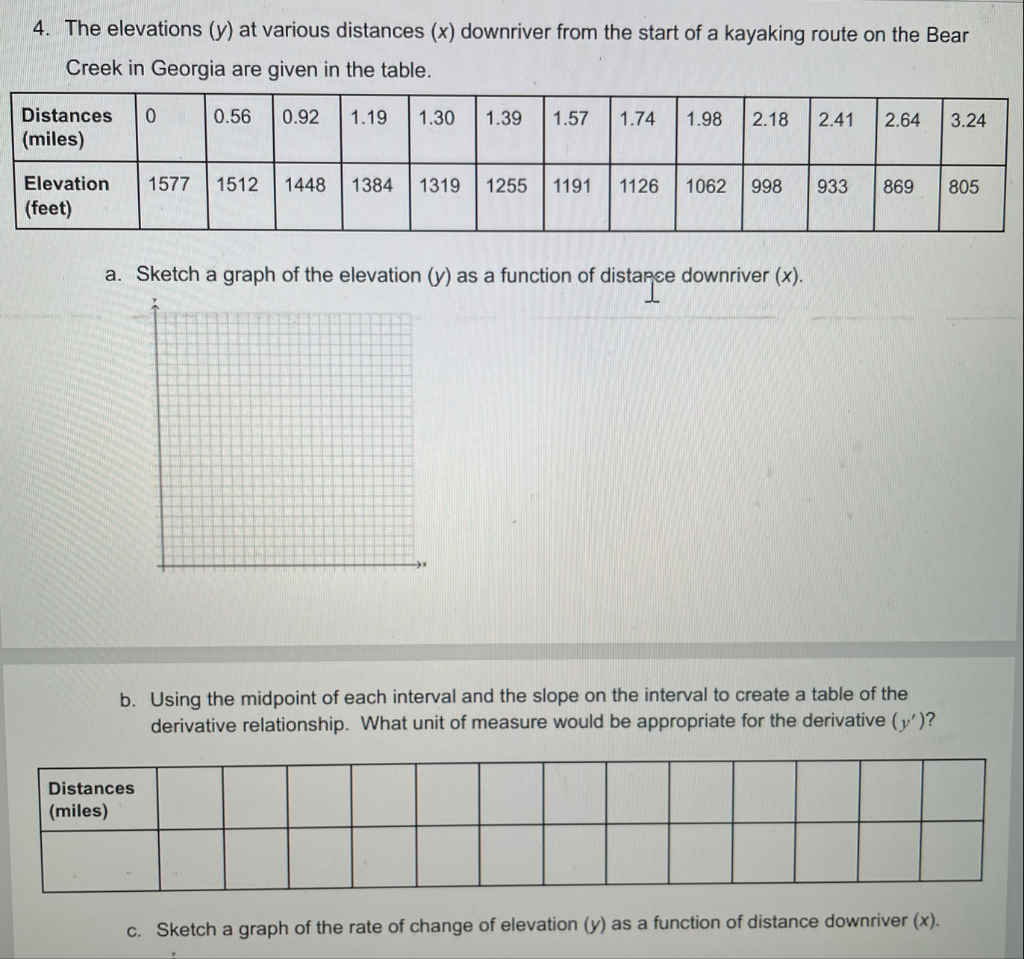
Give step-by-step solution with explanation and final answer:4. The elevations (y) at various distances (x) downriver from the start of a kayaking route on the Bear
Creek in Georgia are given in the table.
Distances 0.92 130 [1.39 |1.57 |1.74 218 |241 |264 |3.24
(miles)
Elevation 1577 1512 | 1448 [1384 | 1319 [1255 | 1191 [1126 | 1062 (998 [933 [869
(feet)
a. Sketch a graph of the elevation (y) as a function of deny downriver (x).
la THT
b. Using the midpoint of each interval and the slope on the interval to create a table of the
derivative relationship. What unit of measure would be appropriate for the derivative (*)?
Gi BERR |
(miles)
c. Sketch a graph of the rate of change of elevation (y) as a function of distance downriver (x). wl
Question:
Give step-by-step solution with explanation and final answer:4. The elevations (y) at various distances (x) downriver from the start of a kayaking route on the Bear
Creek in Georgia are given in the table.
Distances 0.92 130 [1.39 |1.57 |1.74 218 |241 |264 |3.24
(miles)
Elevation 1577 1512 | 1448 [1384 | 1319 [1255 | 1191 [1126 | 1062 (998 [933 [869
(feet)
a. Sketch a graph of the elevation (y) as a function of deny downriver (x).
la THT
b. Using the midpoint of each interval and the slope on the interval to create a table of the
derivative relationship. What unit of measure would be appropriate for the derivative (*)?
Gi BERR |
(miles)
c. Sketch a graph of the rate of change of elevation (y) as a function of distance downriver (x). wl
This is AI generated Response.
Asked by: gvr
Created at: 2025-06-16 17:05:46
Final Answer:
RenderedRaw Text
Did you like this answer?
Let's solve each part step by step:
---
### **a. Sketch a graph of the elevation \( y \) as a function of distance downriver \( x \).**
**Table Data:**
| Distances (miles) | 0 | 0.56 | 0.92 | 1.19 | 1.30 | 1.39 | 1.57 | 1.74 | 1.98 | 2.18 | 2.41 | 2.64 | 3.24 |
|-------------------|------|------|------|------|------|------|------|------|------|------|------|------|------|
| Elevation (feet) | 1577 | 1512 | 1448 | 1384 | 1319 | 1255 | 1191 | 1126 | 1062 | 998 | 933 | 869 | 805 |
To **sketch the graph**, plot each pair \((x, y)\) on the axes. The points should show a decreasing trend since elevation drops as you move downriver.
---
### **b. Using the midpoint of each interval and the slope on the interval to create a table of the derivative relationship.**
#### **Step 1: Find the midpoint of each interval.**
The midpoint for each interval is the average of the two \( x \)-values:
\[
\text{Midpoint} = \frac{x_1 + x_2}{2}
\]
#### **Step 2: Find the slope (rate of change) for each interval.**
The slope (approximate derivative) is:
\[
\text{Slope} = \frac{y_2 - y_1}{x_2 - x_1}
\]
#### **Step 3: Fill out the table.**
Let's calculate the first few as an example, then show the rest in a table:
| Interval | \( x_1 \) | \( x_2 \) | \( y_1 \) | \( y_2 \) | Midpoint (\( x \)) | Slope (\( \frac{\Delta y}{\Delta x} \)) |
|----------|-----------|-----------|-----------|-----------|--------------------|-----------------------------------------|
| 1 | 0 | 0.56 | 1577 | 1512 | 0.28 | \( \frac{1512-1577}{0.56-0} = \frac{-65}{0.56} \approx -116.1 \) |
| 2 | 0.56 | 0.92 | 1512 | 1448 | 0.74 | \( \frac{1448-1512}{0.92-0.56} = \frac{-64}{0.36} \approx -177.8 \) |
| 3 | 0.92 | 1.19 | 1448 | 1384 | 1.055 | \( \frac{1384-1448}{1.19-0.92} = \frac{-64}{0.27} \approx -237.0 \) |
| 4 | 1.19 | 1.30 | 1384 | 1319 | 1.245 | \( \frac{1319-1384}{1.30-1.19} = \frac{-65}{0.11} \approx -590.9 \) |
| ... | ... | ... | ... | ... | ... | ... |
Let's do the rest quickly:
| \( x_1 \) | \( x_2 \) | \( y_1 \) | \( y_2 \) | Midpoint (\( x \)) | Slope (\( \frac{\Delta y}{\Delta x} \)) |
|-----------|-----------|-----------|-----------|--------------------|-----------------------------------------|
| 1.30 | 1.39 | 1319 | 1255 | 1.345 | \( (1255-1319)/(1.39-1.30) = -64/0.09 \approx -711.1 \) |
| 1.39 | 1.57 | 1255 | 1191 | 1.48 | \( (1191-1255)/(1.57-1.39) = -64/0.18 \approx -355.6 \) |
| 1.57 | 1.74 | 1191 | 1126 | 1.655 | \( (1126-1191)/(1.74-1.57) = -65/0.17 \approx -382.4 \) |
| 1.74 | 1.98 | 1126 | 1062 | 1.86 | \( (1062-1126)/(1.98-1.74) = -64/0.24 \approx -266.7 \) |
| 1.98 | 2.18 | 1062 | 998 | 2.08 | \( (998-1062)/(2.18-1.98) = -64/0.20 \approx -320.0 \) |
| 2.18 | 2.41 | 998 | 933 | 2.295 | \( (933-998)/(2.41-2.18) = -65/0.23 \approx -282.6 \) |
| 2.41 | 2.64 | 933 | 869 | 2.525 | \( (869-933)/(2.64-2.41) = -64/0.23 \approx -278.3 \) |
| 2.64 | 3.24 | 869 | 805 | 2.94 | \( (805-869)/(3.24-2.64) = -64/0.60 \approx -106.7 \) |
**Unit of measure:**
The derivative \( y' \) is the change in elevation per change in distance, so its unit is **feet per mile**.
---
### **c. Sketch a graph of the rate of change of elevation (\( y' \)) as a function of distance downriver (\( x \)).**
Plot the midpoints of each interval on the \( x \)-axis, and the corresponding slopes (calculated above) on the \( y \)-axis. The graph should reflect how the rate of elevation drop changes along the route.
---
## **Summary Table for (b):**
| Midpoint Distance (miles) | Slope (feet per mile) |
|--------------------------|-----------------------|
| 0.28 | -116.1 |
| 0.74 | -177.8 |
| 1.055 | -237.0 |
| 1.245 | -590.9 |
| 1.345 | -711.1 |
| 1.48 | -355.6 |
| 1.655 | -382.4 |
| 1.86 | -266.7 |
| 2.08 | -320.0 |
| 2.295 | -282.6 |
| 2.525 | -278.3 |
| 2.94 | -106.7 |
---
### **Final Answers**
- **(a):** Plot the given data points (\( x, y \)) on a graph.
- **(b):** Use the table above for midpoints and slopes. **Unit:** feet per mile.
- **(c):** Plot the midpoints from (b) on \( x \)-axis, slopes on \( y \)-axis. This shows how quickly elevation drops at various points.
If you need the graphs sketched or want a digital plot, let me know!
Question:
i need detailed calculations of along with the final Answer without tables
This is AI generated Response.
Asked by: gvr
Created at: 2025-06-16 17:07:29
Final Answer:
RenderedRaw Text
Did you like this answer?
Let's go through each part step-by-step with detailed calculations, explanations, and final answers, without using tables.
---
### **Part (a): Sketch a graph of elevation \( y \) as a function of distance \( x \).**
**Given Data:**
| \( x \) (miles) | \( y \) (feet) |
|----------------|----------------|
| 0.00 | 1577 |
| 0.56 | 1512 |
| 0.92 | 1448 |
| 1.19 | 1384 |
| 1.30 | 1319 |
| 1.39 | 1255 |
| 1.57 | 1191 |
| 1.74 | 1126 |
| 1.98 | 1062 |
| 2.18 | 998 |
| 2.41 | 933 |
| 2.64 | 869 |
| 3.24 | 805 |
**Approach:**
- Plot these points with \( x \) on the horizontal axis and \( y \) on the vertical axis.
- The points will show a generally decreasing trend, indicating the elevation drops as you move downstream.
- Connect the points smoothly to visualize how elevation decreases along the route.
**Final note:** Since this is a rough sketch, just plot the points and connect them with a smooth curve to see the trend.
---
### **Part (b): Calculate the approximate derivative (rate of change of elevation) at midpoints of each interval.**
**Step 1: Find the midpoints of each interval**
For a segment between \( x_1 \) and \( x_2 \), the midpoint \( x_m \):
\[
x_m = \frac{x_1 + x_2}{2}
\]
**Step 2: Calculate the slope between each pair of points**
The slope (approximate derivative) between two points:
\[
\text{Slope} = \frac{y_2 - y_1}{x_2 - x_1}
\]
---
**Calculations:**
1. For the segment from \( x=0.00 \) to \( x=0.56 \):
- \( y_1 = 1577 \), \( y_2=1512 \)
- Slope: \( \frac{1512 - 1577}{0.56 - 0.00} = \frac{-65}{0.56} \approx -116.07 \) feet per mile
- Midpoint \( x_m = \frac{0+0.56}{2} = 0.28 \) miles
---
2. Between \( x=0.56 \) and \( x=0.92 \):
- \( y_1=1512 \), \( y_2=1448 \)
- Slope: \( \frac{1448 - 1512}{0.92 - 0.56} = \frac{-64}{0.36} \approx -177.78 \)
- Midpoint: \( \frac{0.56 + 0.92}{2} = 0.74 \) miles
---
3. Between \( x=0.92 \) and \( x=1.19 \):
- \( y_1=1448 \), \( y_2=1384 \)
- Slope: \( \frac{-64}{0.27} \approx -237.04 \)
- Midpoint: \( 1.055 \) miles
---
4. Between \( x=1.19 \) and \( x=1.30 \):
- \( y_1=1384 \), \( y_2=1319 \)
- Slope: \( \frac{-65}{0.11} \approx -590.91 \)
- Midpoint: \( 1.245 \) miles
---
5. Between \( x=1.30 \) and \( x=1.39 \):
- \( y_1=1319 \), \( y_2=1255 \)
- Slope: \( \frac{-64}{0.09} \approx -711.11 \)
- Midpoint: \( 1.345 \) miles
---
6. Between \( x=1.39 \) and \( x=1.57 \):
- \( y_1=1255 \), \( y_2=1191 \)
- Slope: \( \frac{-64}{0.18} \approx -355.56 \)
- Midpoint: \( 1.48 \) miles
---
7. Between \( x=1.57 \) and \( x=1.74 \):
- \( y_1=1191 \), \( y_2=1126 \)
- Slope: \( \frac{-65}{0.17} \approx -382.35 \)
- Midpoint: \( 1.655 \) miles
---
8. Between \( x=1.74 \) and \( x=1.98 \):
- \( y_1=1126 \), \( y_2=1062 \)
- Slope: \( \frac{-64}{0.24} \approx -266.67 \)
- Midpoint: \( 1.86 \) miles
---
9. Between \( x=1.98 \) and \( x=2.18 \):
- \( y_1=1062 \), \( y_2=998 \)
- Slope: \( \frac{-64}{0.20} = -320.00 \)
- Midpoint: \( 2.08 \) miles
---
10. Between \( x=2.18 \) and \( x=2.41 \):
- \( y_1=998 \), \( y_2=933 \)
- Slope: \( \frac{-65}{0.23} \approx -282.61 \)
- Midpoint: \( 2.295 \) miles
---
11. Between \( x=2.41 \) and \( x=2.64 \):
- \( y_1=933 \), \( y_2=869 \)
- Slope: \( \frac{-64}{0.23} \approx -278.26 \)
- Midpoint: \( 2.525 \) miles
---
12. Between \( x=2.64 \) and \( x=3.24 \):
- \( y_1=869 \), \( y_2=805 \)
- Slope: \( \frac{-64}{0.60} \approx -106.67 \)
- Midpoint: \( 2.94 \) miles
---
### **Final Result for Part (b):**
The approximate derivatives (rate of change of elevation) at midpoints are:
- 0.28 miles: **-116.07 ft/mile**
- 0.74 miles: **-177.78 ft/mile**
- 1.055 miles: **-237.04 ft/mile**
- 1.245 miles: **-590.91 ft/mile**
- 1.345 miles: **-711.11 ft/mile**
- 1.48 miles: **-355.56 ft/mile**
- 1.655 miles: **-382.35 ft/mile**
- 1.86 miles: **-266.67 ft/mile**
- 2.08 miles: **-320.00 ft/mile**
- 2.295 miles: **-282.61 ft/mile**
- 2.525 miles: **-278.26 ft/mile**
- 2.94 miles: **-106.67 ft/mile**
---
### **Part (c): Sketch a graph of the rate of change of elevation \( y' \) versus distance \( x \).**
- Plot the midpoints on the \( x \)-axis.
- Plot the corresponding slope values on the \( y \)-axis.
- Connect these points smoothly to observe how the rate of elevation change varies along the route.
---
### **Summary:**
- **(a)** Graph shows elevation decreasing from 1577 ft to 805 ft over about 3.24 miles.
- **(b)** The approximate rate of elevation change (feet per mile) varies from about \(-711\) to \(-107\) ft/mile, indicating the steepest drop occurs around 1.3 miles.
- **(c)** The graph of \( y' \) versus \( x \) illustrates how the slope (rate of elevation change) increases sharply near 1.3 miles and then decreases again.
**Note:** The units for the derivative are **feet per mile**.
Question:
i need part b detailed calculations along with the final Answer
This is AI generated Response.
Asked by: gvr
Created at: 2025-06-16 17:09:48
VIPSolutions focuses on clear, step‑by‑step explanations so you can learn quickly. Whether you need an AI‑generated walkthrough or a short hint to get unstuck, each solution is organized for fast reading and easy review later.
Search similar questions, compare approaches, and bookmark the best answers for revision. Our goal is simple: quick, reliable study help that feels natural—not noisy.
 VIPSolutions
 4. The elevations (y) at various distances (x) downriver from the start of a kayaking route on the Bear
Creek in Georgia are given in the table.
Distances 0.92 130 [1.39 |1.57 |1.74 218 |241 |264 |3.24
(miles)
Elevation 1577 1512 | 1448 [1384 | 1319 [1255 | 1191 [1126 | 1062 (998 [933 [869
(feet)
a. Sketch a graph of the elevation (y) as a function of deny downriver (x).
la THT
b. Using the midpoint of each interval and the slope on the interval to create a table of the
derivative relationship. What unit of measure would be appropriate for the derivative (*)?
Gi BERR |
(miles)
c. Sketch a graph of the rate of change of elevation (y) as a function of distance downriver (x). wl
4. The elevations (y) at various distances (x) downriver from the start of a kayaking route on the Bear
Creek in Georgia are given in the table.
Distances 0.92 130 [1.39 |1.57 |1.74 218 |241 |264 |3.24
(miles)
Elevation 1577 1512 | 1448 [1384 | 1319 [1255 | 1191 [1126 | 1062 (998 [933 [869
(feet)
a. Sketch a graph of the elevation (y) as a function of deny downriver (x).
la THT
b. Using the midpoint of each interval and the slope on the interval to create a table of the
derivative relationship. What unit of measure would be appropriate for the derivative (*)?
Gi BERR |
(miles)
c. Sketch a graph of the rate of change of elevation (y) as a function of distance downriver (x). wl