 VIPSolutions
Give step-by-step solution with explanation and final answer:o If f has a continuous second derivative on [a, b], then the error E in approximating JA f(x) dx by the a Trapezoidal Rule is _ a)3 IE] = LL=8 max |F7(x)]], a
Question:
Give step-by-step solution with explanation and final answer: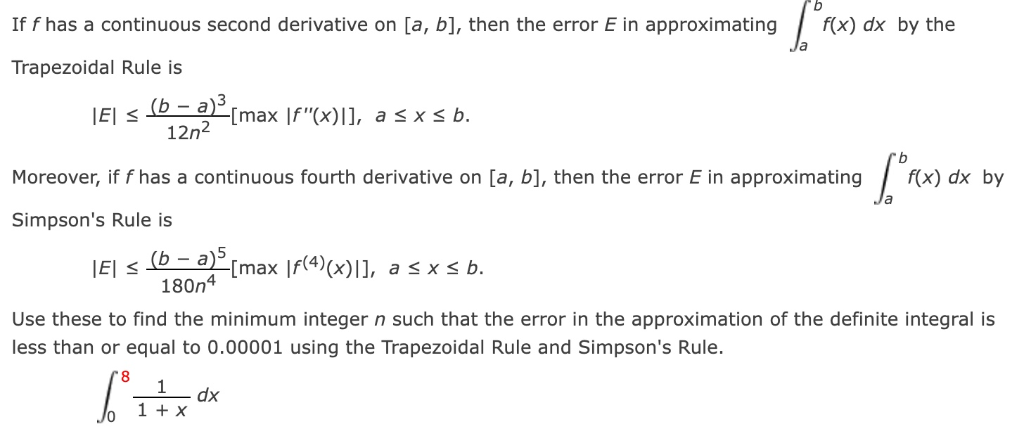 o
If f has a continuous second derivative on [a, b], then the error E in approximating JA f(x) dx by the
a
Trapezoidal Rule is
_ a)3
IE] = LL=8 max |F7(x)]], a
o
If f has a continuous second derivative on [a, b], then the error E in approximating JA f(x) dx by the
a
Trapezoidal Rule is
_ a)3
IE] = LL=8 max |F7(x)]], a
This is AI generated Response.
Asked by: gvr
Created at: 2025-06-17 05:55:04
Asked by: gvr
Created at: 2025-06-17 05:55:04
Final Answer:
Rendered
Raw Text
Did you like this answer?
Let's solve the problem step by step for both the Trapezoidal Rule and Simpson's Rule.
---
## **Given Integral**
\[
\int_{0}^{8} \frac{1}{1+x} \, dx
\]
Let \( f(x) = \frac{1}{1+x} \).
- \( a = 0 \), \( b = 8 \)
- We want the error \( |E| \leq 0.00001 \).
---
## **Step 1: Compute Necessary Derivatives**
### For the **Trapezoidal Rule** (needs \( |f''(x)| \)):
\[
f(x) = (1+x)^{-1}
\]
\[
f'(x) = - (1+x)^{-2}
\]
\[
f''(x) = 2(1+x)^{-3}
\]
- The error bound uses \( \max |f''(x)| \) on \( [0, 8] \).
- \( f''(x) \) is **maximized at \( x = 0 \)** (since denominator increases as \( x \) increases).
So,
\[
|f''(0)| = 2
\]
\[
|f''(x)| = \frac{2}{(1+x)^3}
\]
So, \( \max |f''(x)| = 2 \) on \( [0, 8] \).
---
### For the **Simpson's Rule** (needs \( |f^{(4)}(x)| \)):
\[
f'''(x) = -6(1+x)^{-4}
\]
\[
f^{(4)}(x) = 24(1+x)^{-5}
\]
- Maximum at \( x = 0 \): \( |f^{(4)}(0)| = 24 \)
- \( \max |f^{(4)}(x)| = 24 \) on \( [0, 8] \)
---
## **Step 2: Error Formulas**
### **Trapezoidal Rule:**
\[
|E| \leq \frac{(b-a)^3}{12n^2} \max|f''(x)|
\]
Plug values in:
\[
|E| \leq \frac{(8-0)^3}{12n^2} \cdot 2 = \frac{512}{12n^2} \cdot 2 = \frac{1024}{12n^2} = \frac{256}{3n^2}
\]
We want \( |E| \leq 0.00001 \):
\[
\frac{256}{3n^2} \leq 0.00001
\]
\[
256 \leq 0.00001 \times 3n^2
\]
\[
256 \leq 0.00003 n^2
\]
\[
n^2 \geq \frac{256}{0.00003}
\]
\[
n^2 \geq 8,533,333.33
\]
\[
n \geq \sqrt{8,533,333.33} \approx 2,922
\]
### **Minimum integer \( n \) for Trapezoidal Rule:**
\[
\boxed{n = 2,922}
\]
---
### **Simpson's Rule:**
\[
|E| \leq \frac{(b-a)^5}{180n^4} \max|f^{(4)}(x)|
\]
Plug values in:
\[
|E| \leq \frac{(8-0)^5}{180n^4} \cdot 24 = \frac{32768}{180n^4} \cdot 24 = \frac{786432}{180n^4} = \frac{4369.0667}{n^4}
\]
We want \( |E| \leq 0.00001 \):
\[
\frac{4369.0667}{n^4} \leq 0.00001
\]
\[
4369.0667 \leq 0.00001 n^4
\]
\[
n^4 \geq \frac{4369.0667}{0.00001}
\]
\[
n^4 \geq 436,906,670
\]
\[
n \geq (436,906,670)^{1/4}
\]
\[
n \geq 144.5
\]
### **Minimum integer \( n \) for Simpson's Rule:**
*Simpson's Rule requires \( n \) to be **even**:*
\[
\boxed{n = 146}
\]
(where 146 is the next even integer after 144.5)
---
## **Final Answers**
### **Minimum \( n \) such that error \( \leq 0.00001 \):**
- **Trapezoidal Rule:** \(\boxed{2,922}\)
- **Simpson's Rule (even \( n \)):** \(\boxed{146}\)
---
If you need the approximated values of the integrals or more explanation, let me know!
📢 Instructions:
- Ask anything relatd to above question only.
- For new Question goto :