 VIPSolutions
Give step-by-step solution with explanation and final answer:(a) Find constants a,b, c,d such that the quadrature formula 1 [ 1@r = af-1) +b) + ef (1) +47) -1 has degree of precision 3. (b) Assume Q(f) = >I, w;f(x;) is a quadrature based on polynomial interpolation on the interval [0,1]. Is it true that >, w; = 17 Justify your answer. (c) Consider the problem of numerical integration IN f(z)dx with twice continuously differentiable integrand, and f”(z) > 0 on [a,b]. Let My(f) be the value produced by the composite midpoint rule that uses k subintervals, and T(f) be the value produced by the composite trapezoid rule with the same number of subintervals k£ > 0. Prove that b Mh) < [faye < Th).
Question:
Give step-by-step solution with explanation and final answer: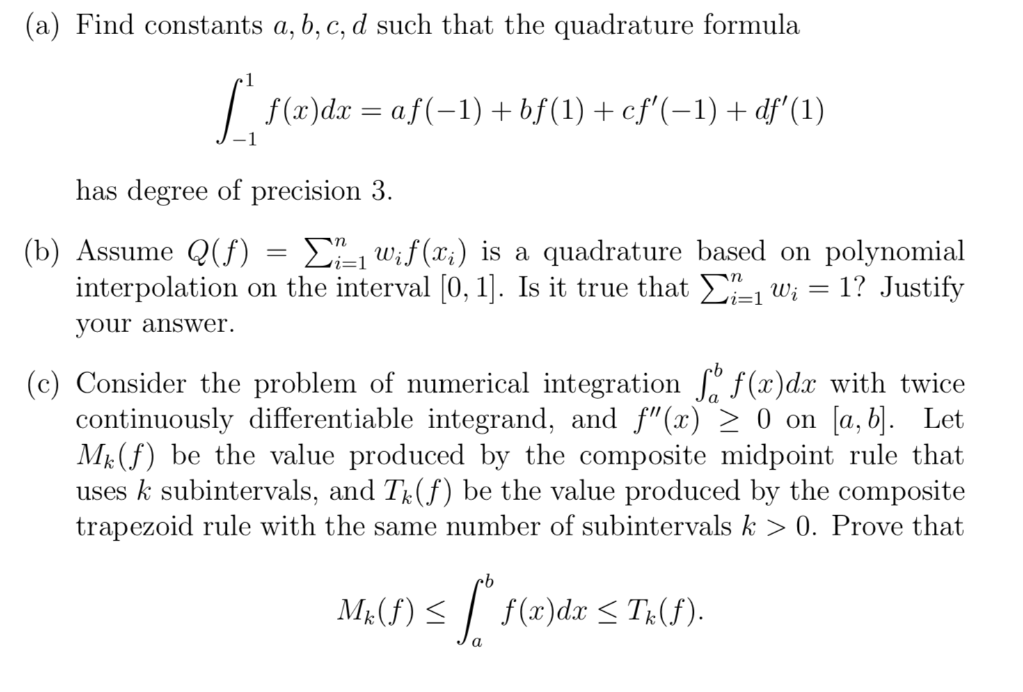 (a) Find constants a,b, c,d such that the quadrature formula
1
[ 1@r = af-1) +b) + ef (1) +47)
-1
has degree of precision 3.
(b) Assume Q(f) = >I, w;f(x;) is a quadrature based on polynomial
interpolation on the interval [0,1]. Is it true that >, w; = 17 Justify
your answer.
(c) Consider the problem of numerical integration IN f(z)dx with twice
continuously differentiable integrand, and f”(z) > 0 on [a,b]. Let
My(f) be the value produced by the composite midpoint rule that
uses k subintervals, and T(f) be the value produced by the composite
trapezoid rule with the same number of subintervals k£ > 0. Prove that
b
Mh) < [faye < Th).
(a) Find constants a,b, c,d such that the quadrature formula
1
[ 1@r = af-1) +b) + ef (1) +47)
-1
has degree of precision 3.
(b) Assume Q(f) = >I, w;f(x;) is a quadrature based on polynomial
interpolation on the interval [0,1]. Is it true that >, w; = 17 Justify
your answer.
(c) Consider the problem of numerical integration IN f(z)dx with twice
continuously differentiable integrand, and f”(z) > 0 on [a,b]. Let
My(f) be the value produced by the composite midpoint rule that
uses k subintervals, and T(f) be the value produced by the composite
trapezoid rule with the same number of subintervals k£ > 0. Prove that
b
Mh) < [faye < Th).
This is AI generated Response.
Asked by: gvr
Created at: 2025-06-17 06:49:54
Asked by: gvr
Created at: 2025-06-17 06:49:54
Final Answer:
Rendered
Raw Text
Did you like this answer?
Let's go through the problems step by step:
---
### (a) Find \(a, b, c, d\) so the quadrature formula has degree of precision 3
The formula is:
\[
\int_{-1}^1 f(x)dx = a f(-1) + b f(1) + c f'(-1) + d f'(1)
\]
It should be **exact for all polynomials of degree ≤ 3**.
#### Let's impose exactness for \(f(x) = 1, x, x^2, x^3\):
---
#### 1. For \(f(x) = 1\):
\[
\int_{-1}^1 1\,dx = 2
\]
\[
a \cdot 1 + b \cdot 1 + c \cdot 0 + d \cdot 0 = a + b
\]
So,
\[
a + b = 2
\]
---
#### 2. For \(f(x) = x\):
\[
\int_{-1}^1 x\,dx = 0
\]
\[
a(-1) + b(1) + c \cdot 0 + d \cdot 0 = -a + b
\]
So,
\[
-a + b = 0 \implies b = a
\]
---
#### 3. For \(f(x) = x^2\):
\[
\int_{-1}^1 x^2\,dx = \frac{2}{3}
\]
\[
f(-1) = 1,\, f(1) = 1,\, f'(-1) = -2,\, f'(1) = 2
\]
So,
\[
a \cdot 1 + b \cdot 1 + c(-2) + d(2) = a + b - 2c + 2d = \frac{2}{3}
\]
---
#### 4. For \(f(x) = x^3\):
\[
\int_{-1}^1 x^3\,dx = 0
\]
\[
f(-1) = -1,\, f(1) = 1,\, f'(-1) = 3(-1)^2 = 3,\, f'(1) = 3(1)^2 = 3
\]
So,
\[
a(-1) + b(1) + c(3) + d(3) = -a + b + 3c + 3d = 0
\]
---
Now, let's collect all equations:
1. \(a + b = 2\)
2. \(-a + b = 0\)
3. \(a + b - 2c + 2d = \frac{2}{3}\)
4. \(-a + b + 3c + 3d = 0\)
From (2): \(b = a\)
Plug into (1): \(2a = 2 \implies a = 1, b = 1\)
Now substitute \(a = b = 1\) into (3) and (4):
(3): \(1 + 1 - 2c + 2d = \frac{2}{3} \implies 2 - 2c + 2d = \frac{2}{3}\)
\[
-2c + 2d = \frac{2}{3} - 2 = -\frac{4}{3}
\]
\[
-c + d = -\frac{2}{3}
\]
(4): \(-1 + 1 + 3c + 3d = 0 \implies 3c + 3d = 0 \implies c + d = 0\)
Now solve:
- \(c + d = 0 \implies d = -c\)
- \(-c + d = -\frac{2}{3}\)
Substitute \(d = -c\) into the second equation:
\[
-c + (-c) = -\frac{2}{3} \implies -2c = -\frac{2}{3} \implies c = \frac{1}{3}
\]
\[
d = -c = -\frac{1}{3}
\]
**Final answer:**
\[
\boxed{
a = 1,\quad b = 1,\quad c = \frac{1}{3},\quad d = -\frac{1}{3}
}
\]
---
### (b) Is it true that \(\sum_{i=1}^{n} w_i = 1\) for quadrature on \([0,1]\)?
**No, not always.**
**Justification:**
If the quadrature rule integrates the constant function \(f(x) = 1\) exactly on \([0,1]\), then:
\[
\int_0^1 1\,dx = 1 = \sum_{i=1}^n w_i \cdot 1 = \sum_{i=1}^n w_i
\]
So if the quadrature rule has at least degree of precision 0 (i.e., is exact for constants), then \(\sum w_i = 1\).
However, for some quadrature formulas (such as some that include derivatives, or are not based on interpolating polynomials through points in \([0,1]\)), this may not be true.
But **for standard polynomial interpolation quadrature formulas on \([0,1]\), yes, \(\sum_{i=1}^n w_i = 1\)**.
---
### (c) Prove \(M_k(f) \leq \int_a^b f(x)dx \leq T_k(f)\) for \(f''(x) \geq 0\) (convex function).
#### **Proof:**
- The **midpoint rule** underestimates the integral for convex functions (\(f'' \geq 0\)).
- The **trapezoidal rule** overestimates it.
For a single interval \([x_0, x_1]\):
- Midpoint: \(M = h f\left(\frac{x_0 + x_1}{2}\right)\)
- Trapezoid: \(T = \frac{h}{2}[f(x_0) + f(x_1)]\)
- Actual integral: \(I = \int_{x_0}^{x_1} f(x)dx\)
For convex \(f\), by **Jensen's inequality**:
\[
f\left(\frac{x_0 + x_1}{2}\right) \leq \frac{f(x_0) + f(x_1)}{2}
\]
So,
\[
M \leq T
\]
And using the properties of the midpoint and trapezoid rule error terms (since \(f'' \geq 0\)), the error for the midpoint rule is negative (underestimate), and for the trapezoid rule is positive (overestimate):
\[
M \leq I \leq T
\]
For **composite rules** (sum over all subintervals), the same inequalities hold by linearity, so:
\[
M_k(f) \leq \int_a^b f(x)dx \leq T_k(f)
\]
---
### **Summary of Answers**
**(a)**
\[
\boxed{a = 1,\quad b = 1,\quad c = \frac{1}{3},\quad d = -\frac{1}{3}}
\]
**(b)**
Yes, \(\sum w_i = 1\) for quadrature based on polynomial interpolation on \([0,1]\), because the rule is exact for constants.
**(c)**
For convex \(f\) (\(f'' \geq 0\)), the composite midpoint rule underestimates, and the composite trapezoid rule overestimates the integral:
\[
M_k(f) \leq \int_a^b f(x)dx \leq T_k(f)
\]
📢 Instructions:
- Ask anything relatd to above question only.
- For new Question goto :