Give step-by-step solution with explanation and final answer:Application - Epidemiology
Note: For the integrals in this section, make sure you
use the formulas in our course resources, not another
method you find somewhere else, to help me assess
your ability to compute this using the formulas you
have been given, rather than your ability to find
another method of computing it.
A team of public health epidemiologists is tracking a
growing outbreak of a new virus in a community of about
100,000 people. They track the number of new
symptomatic cases reported each day over the last 30
days and find that this can be modeled by f (t) = e®%
where t is number of days since the first reported case in
the community, and f (t) is the number of symptomatic
cases reported that day. Suppose it is known that
patients are contagious for seven days after they first
develop symptoms and (luckily) asymptomatic cases are
non-contagious.
1. Use integrals to estimate the total number of reported
cases up to Day 10, and up to Day 30. (You can check this
computation using technology, but please also compute
it by hand to show your process.)
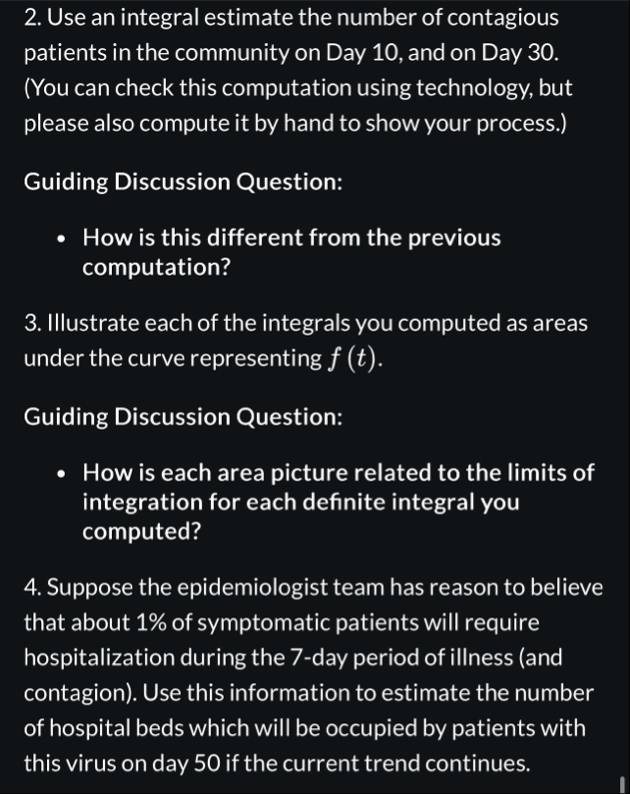
2. Use an integral estimate the number of contagious
patients in the community on Day 10, and on Day 30.
(You can check this computation using technology, but
please also compute it by hand to show your process.)
Guiding Discussion Question:
+ How is this different from the previous
computation?
3. Illustrate each of the integrals you computed as areas
under the curve representing f (t).
Guiding Discussion Question:
+ How is each area picture related to the limits of
integration for each definite integral you
computed?
4. Suppose the epidemiologist team has reason to believe
that about 1% of symptomatic patients will require
hospitalization during the 7-day period of illness (and
contagion). Use this information to estimate the number
of hospital beds which will be occupied by patients with
this virus on day 50 if the current trend continues.
1
Question:
Give step-by-step solution with explanation and final answer:Application - Epidemiology
Note: For the integrals in this section, make sure you
use the formulas in our course resources, not another
method you find somewhere else, to help me assess
your ability to compute this using the formulas you
have been given, rather than your ability to find
another method of computing it.
A team of public health epidemiologists is tracking a
growing outbreak of a new virus in a community of about
100,000 people. They track the number of new
symptomatic cases reported each day over the last 30
days and find that this can be modeled by f (t) = e®%
where t is number of days since the first reported case in
the community, and f (t) is the number of symptomatic
cases reported that day. Suppose it is known that
patients are contagious for seven days after they first
develop symptoms and (luckily) asymptomatic cases are
non-contagious.
1. Use integrals to estimate the total number of reported
cases up to Day 10, and up to Day 30. (You can check this
computation using technology, but please also compute
it by hand to show your process.)
2. Use an integral estimate the number of contagious
patients in the community on Day 10, and on Day 30.
(You can check this computation using technology, but
please also compute it by hand to show your process.)
Guiding Discussion Question:
+ How is this different from the previous
computation?
3. Illustrate each of the integrals you computed as areas
under the curve representing f (t).
Guiding Discussion Question:
+ How is each area picture related to the limits of
integration for each definite integral you
computed?
4. Suppose the epidemiologist team has reason to believe
that about 1% of symptomatic patients will require
hospitalization during the 7-day period of illness (and
contagion). Use this information to estimate the number
of hospital beds which will be occupied by patients with
this virus on day 50 if the current trend continues.
1
This is AI generated Response.
Asked by: gvr
Created at: 2025-06-17 20:02:50
Final Answer:
RenderedRaw Text
Did you like this answer?
Let's solve each part step by step using the given function \( f(t) = e^{0.2t} \).
---
### **1. Estimate total number of reported cases up to Day 10 and Day 30**
The total number of reported cases up to day \( T \) is the integral:
\[
N(T) = \int_0^T f(t)\, dt = \int_0^T e^{0.2t}\, dt
\]
The integral of \( e^{kt} \) with respect to \( t \) is \( \frac{1}{k}e^{kt} \), so:
\[
\int e^{0.2t}\, dt = \frac{1}{0.2}e^{0.2t} = 5e^{0.2t}
\]
Calculating definite integrals:
#### **Up to Day 10:**
\[
N(10) = \left[ 5e^{0.2t} \right]_0^{10} = 5e^{2} - 5e^{0}
\]
\[
N(10) = 5(e^2 - 1)
\]
\( e^2 \approx 7.389 \)
\[
N(10) \approx 5(7.389 - 1) = 5(6.389) = 31.945
\]
#### **Up to Day 30:**
\[
N(30) = \left[ 5e^{0.2t} \right]_0^{30} = 5e^{6} - 5e^{0}
\]
\[
N(30) = 5(e^6 - 1)
\]
\( e^6 \approx 403.429 \)
\[
N(30) \approx 5(403.429 - 1) = 5(402.429) = 2012.145
\]
**Final answers:**
- **Day 10:** ~31.95 cases
- **Day 30:** ~2012.15 cases
---
### **2. Estimate the number of contagious patients on Day 10 and Day 30**
**Contagious patients** on day \( T \) is the sum of new cases from day \( T-7 \) to day \( T \):
\[
C(T) = \int_{T-7}^T f(t)\, dt
\]
\[
= \left[ 5e^{0.2t} \right]_{T-7}^{T} = 5e^{0.2T} - 5e^{0.2(T-7)}
\]
#### **On Day 10:**
\[
C(10) = 5e^{0.2 \times 10} - 5e^{0.2 \times 3}
\]
\[
= 5e^{2} - 5e^{0.6}
\]
\( e^2 \approx 7.389, e^{0.6} \approx 1.822 \)
\[
C(10) = 5(7.389 - 1.822) = 5(5.567) = 27.835
\]
#### **On Day 30:**
\[
C(30) = 5e^{0.2 \times 30} - 5e^{0.2 \times 23}
\]
\[
= 5e^{6} - 5e^{4.6}
\]
\( e^6 \approx 403.429, e^{4.6} \approx 99.484 \)
\[
C(30) = 5(403.429 - 99.484) = 5(303.945) = 1519.725
\]
**Final answers:**
- **Day 10:** ~27.84 contagious patients
- **Day 30:** ~1519.73 contagious patients
---
### **Guiding question for 2:**
This is different from the previous computation because the previous integral sums all cases since the start, while this sums only cases from the most recent 7 days (those still contagious).
---
### **3. Illustrate as areas under the curve**
- The total reported cases up to day \( T \) is the area under \( f(t) \) from 0 to \( T \).
- The number of contagious patients on day \( T \) is the area under \( f(t) \) from \( T-7 \) to \( T \).
Each area corresponds to the definite integral’s limits.
---
### **4. Estimate hospital beds needed on day 50**
1% of contagious patients will require hospitalization.
First, find the number of contagious patients on day 50:
\[
C(50) = \int_{43}^{50} e^{0.2t} dt = 5e^{0.2 \times 50} - 5e^{0.2 \times 43}
\]
\[
= 5e^{10} - 5e^{8.6}
\]
\( e^{10} \approx 22026.47, \; e^{8.6} \approx 5439.83 \)
\[
C(50) = 5(22026.47 - 5439.83) = 5(16586.64) = 82,933.2
\]
1% of these require beds:
\[
0.01 \times 82,933.2 = 829.33
\]
**Final answer:**
**Estimated hospital beds needed on Day 50: ~829**
---
## **Summary Table**
| Item | Formula | Approximate Value |
|---------------------------|---------------------------------------|-------------------|
| Total cases by Day 10 | \( 5(e^2-1) \) | 31.95 |
| Total cases by Day 30 | \( 5(e^6-1) \) | 2012.15 |
| Contagious on Day 10 | \( 5(e^2-e^{0.6}) \) | 27.84 |
| Contagious on Day 30 | \( 5(e^6-e^{4.6}) \) | 1519.73 |
| Hospital beds on Day 50 | \( 0.01 \times 5(e^{10}-e^{8.6}) \) | 829 |
Let me know if you want the graphical illustration for part 3!
Question:
i need only final answers
This is AI generated Response.
Asked by: gvr
Created at: 2025-06-17 20:04:00
Final Answer:
RenderedRaw Text
Did you like this answer?
Certainly! Here are the final answers:
1. **Total reported cases up to Day 10:** approximately **31.95** cases
**Total reported cases up to Day 30:** approximately **2012.15** cases
2. **Number of contagious patients on Day 10:** approximately **27.84** patients
**Number of contagious patients on Day 30:** approximately **1519.73** patients
3. **Estimated hospital beds needed on Day 50:** approximately **829** beds
VIPSolutions focuses on clear, step‑by‑step explanations so you can learn quickly. Whether you need an AI‑generated walkthrough or a short hint to get unstuck, each solution is organized for fast reading and easy review later.
Search similar questions, compare approaches, and bookmark the best answers for revision. Our goal is simple: quick, reliable study help that feels natural—not noisy.
 VIPSolutions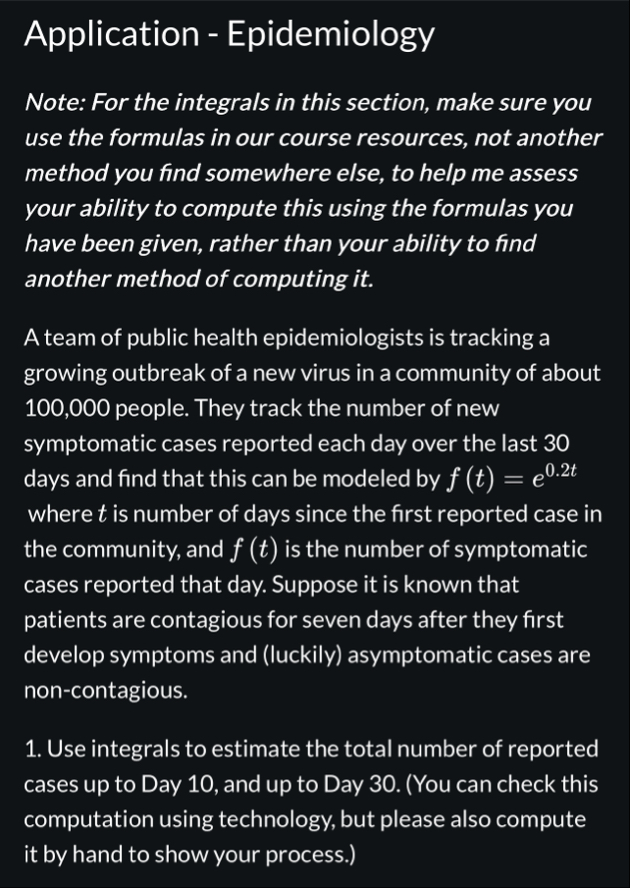
 Application - Epidemiology
Note: For the integrals in this section, make sure you
use the formulas in our course resources, not another
method you find somewhere else, to help me assess
your ability to compute this using the formulas you
have been given, rather than your ability to find
another method of computing it.
A team of public health epidemiologists is tracking a
growing outbreak of a new virus in a community of about
100,000 people. They track the number of new
symptomatic cases reported each day over the last 30
days and find that this can be modeled by f (t) = e®%
where t is number of days since the first reported case in
the community, and f (t) is the number of symptomatic
cases reported that day. Suppose it is known that
patients are contagious for seven days after they first
develop symptoms and (luckily) asymptomatic cases are
non-contagious.
1. Use integrals to estimate the total number of reported
cases up to Day 10, and up to Day 30. (You can check this
computation using technology, but please also compute
it by hand to show your process.)
2. Use an integral estimate the number of contagious
patients in the community on Day 10, and on Day 30.
(You can check this computation using technology, but
please also compute it by hand to show your process.)
Guiding Discussion Question:
+ How is this different from the previous
computation?
3. Illustrate each of the integrals you computed as areas
under the curve representing f (t).
Guiding Discussion Question:
+ How is each area picture related to the limits of
integration for each definite integral you
computed?
4. Suppose the epidemiologist team has reason to believe
that about 1% of symptomatic patients will require
hospitalization during the 7-day period of illness (and
contagion). Use this information to estimate the number
of hospital beds which will be occupied by patients with
this virus on day 50 if the current trend continues.
1
Application - Epidemiology
Note: For the integrals in this section, make sure you
use the formulas in our course resources, not another
method you find somewhere else, to help me assess
your ability to compute this using the formulas you
have been given, rather than your ability to find
another method of computing it.
A team of public health epidemiologists is tracking a
growing outbreak of a new virus in a community of about
100,000 people. They track the number of new
symptomatic cases reported each day over the last 30
days and find that this can be modeled by f (t) = e®%
where t is number of days since the first reported case in
the community, and f (t) is the number of symptomatic
cases reported that day. Suppose it is known that
patients are contagious for seven days after they first
develop symptoms and (luckily) asymptomatic cases are
non-contagious.
1. Use integrals to estimate the total number of reported
cases up to Day 10, and up to Day 30. (You can check this
computation using technology, but please also compute
it by hand to show your process.)
2. Use an integral estimate the number of contagious
patients in the community on Day 10, and on Day 30.
(You can check this computation using technology, but
please also compute it by hand to show your process.)
Guiding Discussion Question:
+ How is this different from the previous
computation?
3. Illustrate each of the integrals you computed as areas
under the curve representing f (t).
Guiding Discussion Question:
+ How is each area picture related to the limits of
integration for each definite integral you
computed?
4. Suppose the epidemiologist team has reason to believe
that about 1% of symptomatic patients will require
hospitalization during the 7-day period of illness (and
contagion). Use this information to estimate the number
of hospital beds which will be occupied by patients with
this virus on day 50 if the current trend continues.
1