 VIPSolutions
Give step-by-step solution with explanation and final answer:Afarm produces cheese and sells it by weight. ’ a The corresponding revenue function® is RG) = 91x and the daily cost function® is C(x) = 45 + 127x088 where R(x) and C(x) are in euros and x denotes the weight of cheese sold, in kilograms. For practical reasons (milk supply, storage and display space), the maximum amount of cheese that the farm can produce and sell daily is 31.1 kilograms. 1) Find an interval with length at most 10 grams that contains a break-even® point for the sales of cheese, where the break-even point is expressed in kilograms. 2) Prove that the sale of cheese will produce a maximum profit. Hence, find how many kilograms of cheese should be sold to maximise profit. In addition, in order to avoid the worst possible financial situation, the farmers would also like to know selling how many kilograms of cheese will result in the greatest loss. In order to answer this question, find how many kilograms of cheese sold will minimise profit’. The revenue function of a product describes the amount of money generated by the sales of a certain quantity of the product. It is obtained by multiplying the quantity of product sold by the price function. For instance, the most common revenue function is y = bx, where y is the total revenue, b is the selling price per unit of sales, and x is the number of units sold. Note that the revenue function does not take into account the costs (but the profit does, see below). The cost function of a product measures the amount of money required to be spent to sell a certain amount of the product. It is obtained by adding the fixed cost (for instance: store rental, utility bills), and the variable cost (for instance: the supplies needed to make the product). ©The break-even point occurs when the revenue is equal to the cost of a product. When a company breaks even, it neither wins nor loses money as the revenue exactly balances the cost associated to that product. 9 Profitis the difference between Revenue and Cost, namely P(x) = R(x) — C(x).A negative profit corresponds to a financial loss. The questions below his line are for you to make some checks to ensure you are on the right track with your calculations and explanations. 1) 8) The theorem we will be using for question 1.a) is. he maxcin theorom ho mermediato value theorem ne mean valu theorem b) Enter your interval using standard notation with round or square brackets e.g. (a,b) of [a, b] : The break-even point x, expressed in kilograms, is in the following interval of length at most 10 grams |: J] Hints for writing your solution: State the assumptions of the theorem you are planning to use, and verify that they hold true. 2) a) The theorem we will be using for question 2) is he main theorem no nermedate vale theorem 10 mean valu theorem “The weight of cheese which should be sold fo maximise profits Number Kiograms, rounded to the nearest gram. The sale of cheese which wil result in the lowest profit is Number kilograms, rounded to the nearest gram. Hints for writing your solution: i. State the assumptions of the max-min theorem, and verify that they hold true on the interval [0, 31.1]. i Find 92. where P i he prof. iii. Remember that we want to find the values of x that correspond respectively to the maximum of and minimum of P.
Question:
Give step-by-step solution with explanation and final answer: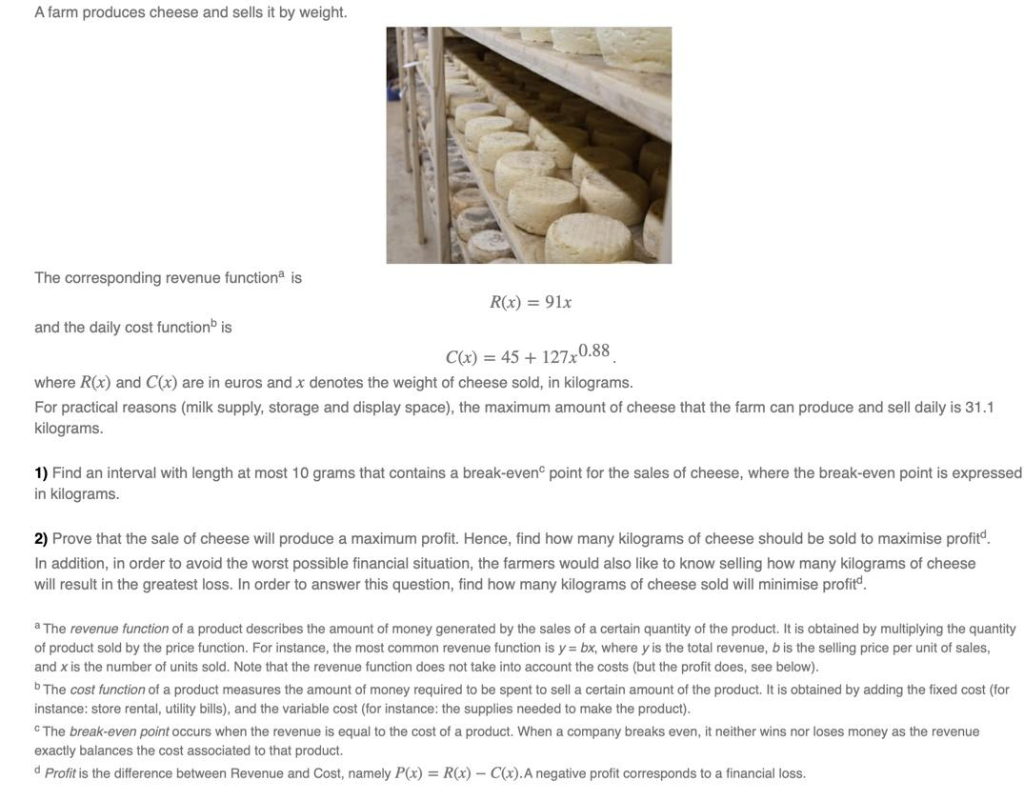
 Afarm produces cheese and sells it by weight.
’ a
The corresponding revenue function® is
RG) = 91x
and the daily cost function® is
C(x) = 45 + 127x088
where R(x) and C(x) are in euros and x denotes the weight of cheese sold, in kilograms.
For practical reasons (milk supply, storage and display space), the maximum amount of cheese that the farm can produce and sell daily is 31.1
kilograms.
1) Find an interval with length at most 10 grams that contains a break-even® point for the sales of cheese, where the break-even point is expressed
in kilograms.
2) Prove that the sale of cheese will produce a maximum profit. Hence, find how many kilograms of cheese should be sold to maximise profit.
In addition, in order to avoid the worst possible financial situation, the farmers would also like to know selling how many kilograms of cheese
will result in the greatest loss. In order to answer this question, find how many kilograms of cheese sold will minimise profit’.
The revenue function of a product describes the amount of money generated by the sales of a certain quantity of the product. It is obtained by multiplying the quantity
of product sold by the price function. For instance, the most common revenue function is y = bx, where y is the total revenue, b is the selling price per unit of sales,
and x is the number of units sold. Note that the revenue function does not take into account the costs (but the profit does, see below).
The cost function of a product measures the amount of money required to be spent to sell a certain amount of the product. It is obtained by adding the fixed cost (for
instance: store rental, utility bills), and the variable cost (for instance: the supplies needed to make the product).
©The break-even point occurs when the revenue is equal to the cost of a product. When a company breaks even, it neither wins nor loses money as the revenue
exactly balances the cost associated to that product.
9 Profitis the difference between Revenue and Cost, namely P(x) = R(x) — C(x).A negative profit corresponds to a financial loss.
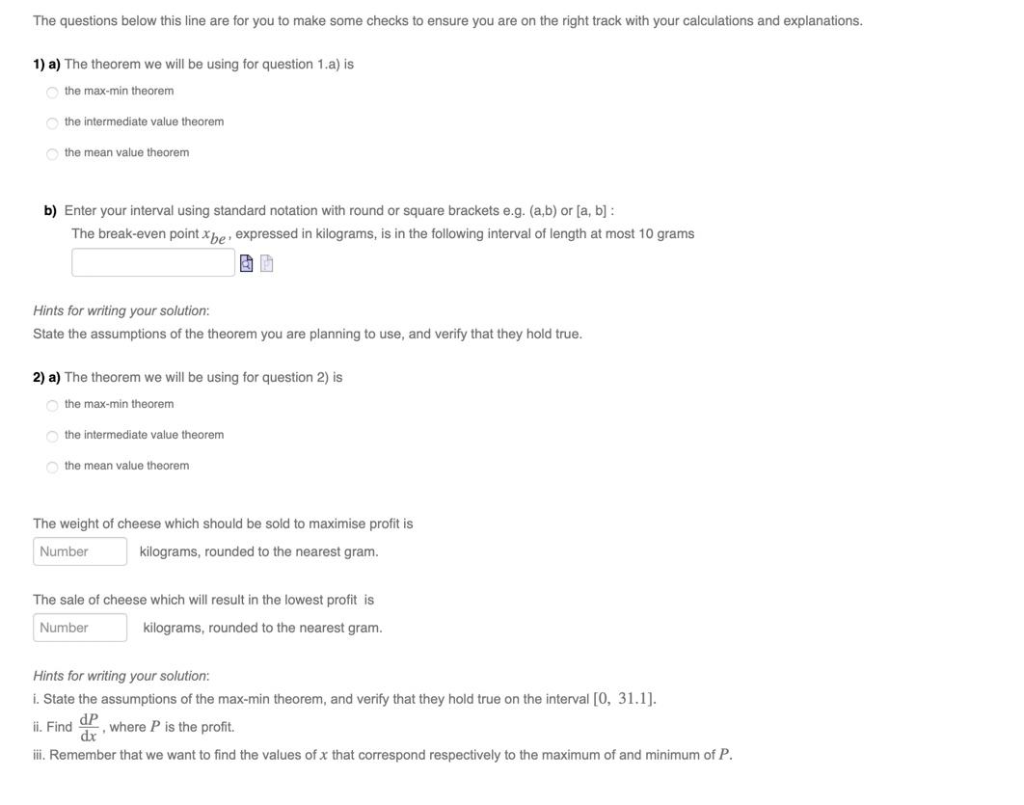
The questions below his line are for you to make some checks to ensure you are on the right track with your calculations and explanations.
1) 8) The theorem we will be using for question 1.a) is.
he maxcin theorom
ho mermediato value theorem
ne mean valu theorem
b) Enter your interval using standard notation with round or square brackets e.g. (a,b) of [a, b] :
The break-even point x, expressed in kilograms, is in the following interval of length at most 10 grams
|: J]
Hints for writing your solution:
State the assumptions of the theorem you are planning to use, and verify that they hold true.
2) a) The theorem we will be using for question 2) is
he main theorem
no nermedate vale theorem
10 mean valu theorem
“The weight of cheese which should be sold fo maximise profits
Number Kiograms, rounded to the nearest gram.
The sale of cheese which wil result in the lowest profit is
Number kilograms, rounded to the nearest gram.
Hints for writing your solution:
i. State the assumptions of the max-min theorem, and verify that they hold true on the interval [0, 31.1].
i Find 92. where P i he prof.
iii. Remember that we want to find the values of x that correspond respectively to the maximum of and minimum of P.
Afarm produces cheese and sells it by weight.
’ a
The corresponding revenue function® is
RG) = 91x
and the daily cost function® is
C(x) = 45 + 127x088
where R(x) and C(x) are in euros and x denotes the weight of cheese sold, in kilograms.
For practical reasons (milk supply, storage and display space), the maximum amount of cheese that the farm can produce and sell daily is 31.1
kilograms.
1) Find an interval with length at most 10 grams that contains a break-even® point for the sales of cheese, where the break-even point is expressed
in kilograms.
2) Prove that the sale of cheese will produce a maximum profit. Hence, find how many kilograms of cheese should be sold to maximise profit.
In addition, in order to avoid the worst possible financial situation, the farmers would also like to know selling how many kilograms of cheese
will result in the greatest loss. In order to answer this question, find how many kilograms of cheese sold will minimise profit’.
The revenue function of a product describes the amount of money generated by the sales of a certain quantity of the product. It is obtained by multiplying the quantity
of product sold by the price function. For instance, the most common revenue function is y = bx, where y is the total revenue, b is the selling price per unit of sales,
and x is the number of units sold. Note that the revenue function does not take into account the costs (but the profit does, see below).
The cost function of a product measures the amount of money required to be spent to sell a certain amount of the product. It is obtained by adding the fixed cost (for
instance: store rental, utility bills), and the variable cost (for instance: the supplies needed to make the product).
©The break-even point occurs when the revenue is equal to the cost of a product. When a company breaks even, it neither wins nor loses money as the revenue
exactly balances the cost associated to that product.
9 Profitis the difference between Revenue and Cost, namely P(x) = R(x) — C(x).A negative profit corresponds to a financial loss.
The questions below his line are for you to make some checks to ensure you are on the right track with your calculations and explanations.
1) 8) The theorem we will be using for question 1.a) is.
he maxcin theorom
ho mermediato value theorem
ne mean valu theorem
b) Enter your interval using standard notation with round or square brackets e.g. (a,b) of [a, b] :
The break-even point x, expressed in kilograms, is in the following interval of length at most 10 grams
|: J]
Hints for writing your solution:
State the assumptions of the theorem you are planning to use, and verify that they hold true.
2) a) The theorem we will be using for question 2) is
he main theorem
no nermedate vale theorem
10 mean valu theorem
“The weight of cheese which should be sold fo maximise profits
Number Kiograms, rounded to the nearest gram.
The sale of cheese which wil result in the lowest profit is
Number kilograms, rounded to the nearest gram.
Hints for writing your solution:
i. State the assumptions of the max-min theorem, and verify that they hold true on the interval [0, 31.1].
i Find 92. where P i he prof.
iii. Remember that we want to find the values of x that correspond respectively to the maximum of and minimum of P.
Asked by: gvr
Created at: 2025-06-19 23:40:50
Final Answer:
📢 Instructions:
- Ask anything relatd to above question only.
- For new Question goto :