Question:
Give step-by-step solution with explanation and final answer:
Did you like this answer?
👍 0
👎 0
Let’s solve the problem step by step:
---
### **Given:**
- Cost in 1962 = $0.05
- Cost in 2010 = $0.45
- Exponential growth: \( S(t) = S_0 e^{kt} \), where \( S_0 \) is the initial value, and \( k \) is the growth rate.
- Let \( t = 0 \) at 1964.
---
### **a) Write the function \( S \) for the cost of a stamp \( t \) years after 1964**
#### **Step 1: Find \( S_0 \) for 1964**
Since we have 1962 and 2010, but \( t=0 \) is 1964, we need to get the value for 1964.
Let’s assume the cost in 1964 is \( x \).
From 1962 to 2010 is 48 years, cost increases from $0.05 to $0.45.
Let’s use the exponential formula:
\[
S(t) = S_0 e^{kt}
\]
Let’s set **1962 as \( t = -2 \)** and **2010 as \( t = 46 \)** (since 1964 is \( t = 0 \)).
So:
- \( S(-2) = 0.05 \)
- \( S(46) = 0.45 \)
Assume \( S(t) = S_0 e^{kt} \).
We have:
\[
\begin{align*}
S(-2) &= S_0 e^{-2k} = 0.05 \\
S(46) &= S_0 e^{46k} = 0.45 \\
\end{align*}
\]
Divide these equations:
\[
\frac{S(46)}{S(-2)} = \frac{S_0 e^{46k}}{S_0 e^{-2k}} = e^{48k} = \frac{0.45}{0.05} = 9
\]
\[
e^{48k} = 9
\]
\[
48k = \ln(9)
\]
\[
k = \frac{\ln(9)}{48}
\]
Now, plug back to find \( S_0 \) (the cost in 1964):
\[
S(-2) = S_0 e^{-2k} = 0.05 \implies S_0 = 0.05 e^{2k}
\]
---
### **b) What was the growth rate in the cost?**
\[
k = \frac{\ln(9)}{48} = \frac{2.1972}{48} \approx 0.04577
\]
So, **growth rate** = \( \boxed{0.0458} \) per year (rounded to 4 decimal places).
---
### **a, continued: Write function \( S(t) \) fully**
\[
S_0 = 0.05 e^{2k} = 0.05 e^{2 \times 0.04577} = 0.05 e^{0.09154} \approx 0.05 \times 1.0958 \approx 0.0548
\]
So,
\[
\boxed{S(t) = 0.0548 \, e^{0.0458 t}}
\]
where \( t \) is years after 1964.
---
### **c) Predict the cost in 2017, 2020, and 2023**
- \( t_{2017} = 2017 - 1964 = 53 \)
- \( t_{2020} = 2020 - 1964 = 56 \)
- \( t_{2023} = 2023 - 1964 = 59 \)
Calculate each:
#### **For 2017:**
\[
S(53) = 0.0548 \times e^{0.0458 \times 53} = 0.0548 \times e^{2.4274}
\]
\[
e^{2.4274} \approx 11.33
\]
\[
S(53) \approx 0.0548 \times 11.33 \approx 0.620 \text{ dollars } = 62.0 \text{ cents}
\]
#### **For 2020:**
\[
S(56) = 0.0548 \times e^{0.0458 \times 56} = 0.0548 \times e^{2.5648}
\]
\[
e^{2.5648} \approx 12.99
\]
\[
S(56) \approx 0.0548 \times 12.99 \approx 0.713 \text{ dollars } = 71.3 \text{ cents}
\]
#### **For 2023:**
\[
S(59) = 0.0548 \times e^{0.0458 \times 59} = 0.0548 \times e^{2.7022}
\]
\[
e^{2.7022} \approx 14.92
\]
\[
S(59) \approx 0.0548 \times 14.92 \approx 0.817 \text{ dollars } = 81.7 \text{ cents}
\]
---
### **d) How much will the firm save by buying Forever stamps in 2010?**
- In 2010, firm buys 10,000 Forever Stamps for $4,500 (i.e., $0.45 each).
- Needs 10,000 first-class stamps each year from 2010 to 2024 (15 years).
- If buying yearly, would pay the price predicted for each year.
**We need to find the total cost if bought yearly, using the predicted prices (including the jumps in 2017, 2020, and 2023):**
Let’s calculate the cost for each year, round to nearest cent per stamp, multiply by 10,000, and sum for 2010–2024.
#### **Stamps' Predicted Costs (rounded to nearest cent):**
- 2010: \( t = 46 \)
\( S(46) = 0.0548 \times e^{0.0458 \times 46} = 0.0548 \times e^{2.1068} \approx 0.0548 \times 8.217 \approx 0.451 \) → **$0.45**
- 2011: \( t = 47 \)
\( S(47) = 0.0548 \times e^{0.0458 \times 47} \approx 0.471 \) → **$0.47**
- 2012: \( S(48) \approx 0.493 \) → **$0.49**
- 2013: \( S(49) \approx 0.515 \) → **$0.52**
- 2014: \( S(50) \approx 0.539 \) → **$0.54**
- 2015: \( S(51) \approx 0.564 \) → **$0.56**
- 2016: \( S(52) \approx 0.590 \) → **$0.59**
- 2017: \( S(53) \approx 0.620 \) → **$0.62**
- 2018: \( S(54) \approx 0.646 \) → **$0.65**
- 2019: \( S(55) \approx 0.679 \) → **$0.68**
- 2020: \( S(56) \approx 0.713 \) → **$0.71**
- 2021: \( S(57) \approx 0.747 \) → **$0.75**
- 2022: \( S(58) \approx 0.781 \) → **$0.78**
- 2023: \( S(59) \approx 0.817 \) → **$0.82**
- 2024: \( S(60) \approx 0.855 \) → **$0.86**
#### **Total cost if bought yearly:**
\[
\begin{align*}
2010: & \ 10,000 \times 0.45 = 4,500 \\
2011: & \ 10,000 \times 0.47 = 4,700 \\
2012: & \ 10,000 \times 0.49 = 4,900 \\
2013: & \ 10,000 \times 0.52 = 5,200 \\
2014: & \ 10,000 \times 0.54 = 5,400 \\
2015: & \ 10,000 \times 0.56 = 5,600 \\
2016: & \ 10,000 \times 0.59 = 5,900 \\
2017: & \ 10,000 \times 0.62 = 6,200 \\
2018: & \ 10,000 \times 0.65 = 6,500 \\
2019: & \ 10,000 \times 0.68 = 6,800 \\
2020: & \ 10,000 \times 0.71 = 7,100 \\
2021: & \ 10,000 \times 0.75 = 7,500 \\
2022: & \ 10,000 \times 0.78 = 7,800 \\
2023: & \ 10,000 \times 0.82 = 8,200 \\
2024: & \ 10,000 \times 0.86 = 8,600 \\
\end{align*}
\]
Sum up:
\[
\begin{align*}
4,500 + 4,700 + 4,900 + 5,200 + 5,400 + 5,600 + 5,900 + 6,200 + 6,500 + 6,800 \\
+ 7,100 + 7,500 + 7,800 + 8,200 + 8,600 = 99,900
\end{align*}
\]
#### **Total cost if buy Forever Stamps in 2010:**
\[
15 \text{ years} \times 10,000 \times \$0.45 = 150,000 \times 0.45 = \$67,500
\]
But according to the question, the firm spends **$4,500 for 10,000 stamps** in 2010, and uses them for each year (so for each year, it would have paid $4,500 instead of the higher price).
#### **How much does the firm save?**
\[
\text{Total savings} = \$99,900 - (\$4,500 \times 15) = \$99,900 - \$67,500 = \$32,400
\]
---
### **Final Answers:**
**a)**
\[
\boxed{S(t) = 0.0548 \, e^{0.0458 t}}
\]
**b)**
\[
\boxed{\text{Growth rate} = 0.0458 \text{ per year } (4.58\%)}
\]
**c)**
\[
\begin{align*}
2017: & \quad \boxed{\$0.62} \\
2020: & \quad \boxed{\$0.71} \\
2023: & \quad \boxed{\$0.82}
\end{align*}
\]
**d)**
\[
\boxed{\$32,400}
\]
**(The firm saves $32,400 by buying Forever Stamps at the start of 2010 rather than paying the predicted yearly prices from 2010 to 2024.)**
 VIPSolutions
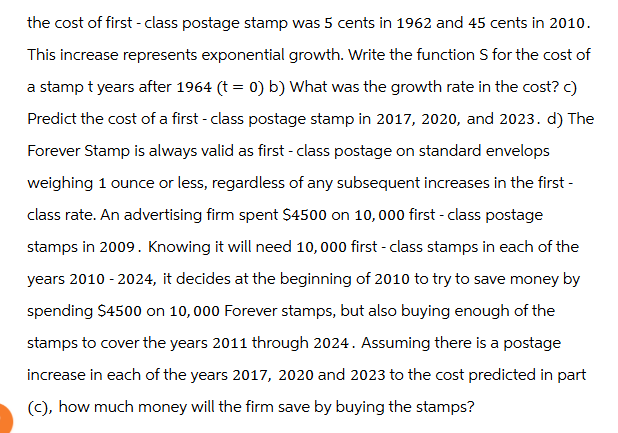 the cost of first - class postage stamp was 5 cents in 1962 and 45 cents in 2010.
This increase represents exponential growth. Write the function S for the cost of
a stamp t years after 1964 (t = 0) b) What was the growth rate in the cost? ¢)
Predict the cost of a first - class postage stamp in 2017, 2020, and 2023. d) The
Forever Stamp is always valid as first - class postage on standard envelops
weighing 1 ounce or less, regardless of any subsequent increases in the first -
class rate. An advertising firm spent $4500 on 10, 000 first - class postage
stamps in 2009. Knowing it will need 10,000 first - class stamps in each of the
years 2010 - 2024, it decides at the beginning of 2010 to try to save money by
spending $4500 on 10,000 Forever stamps, but also buying enough of the
stamps to cover the years 2011 through 2024. Assuming there is a postage
increase in each of the years 2017, 2020 and 2023 to the cost predicted in part
) (©), how much money wil the firm save by buying the stamps?
the cost of first - class postage stamp was 5 cents in 1962 and 45 cents in 2010.
This increase represents exponential growth. Write the function S for the cost of
a stamp t years after 1964 (t = 0) b) What was the growth rate in the cost? ¢)
Predict the cost of a first - class postage stamp in 2017, 2020, and 2023. d) The
Forever Stamp is always valid as first - class postage on standard envelops
weighing 1 ounce or less, regardless of any subsequent increases in the first -
class rate. An advertising firm spent $4500 on 10, 000 first - class postage
stamps in 2009. Knowing it will need 10,000 first - class stamps in each of the
years 2010 - 2024, it decides at the beginning of 2010 to try to save money by
spending $4500 on 10,000 Forever stamps, but also buying enough of the
stamps to cover the years 2011 through 2024. Assuming there is a postage
increase in each of the years 2017, 2020 and 2023 to the cost predicted in part
) (©), how much money wil the firm save by buying the stamps?