 VIPSolutions
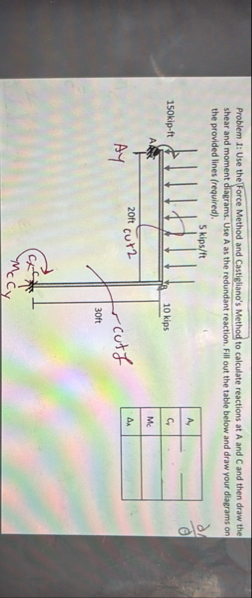
Give step-by-step solution with explanation and final answer: Problem 1 : Use the Force Method and Castigliano's Method to calculate reactions at A and C and then draw the shear and moment diagrams. Use A as the redundant reaction. Fill out the table below and draw your diagrams on the provided lines ( required ) . \ table [ [ A c , ] , [ C r , ] , [ M c , ] , [ Δ A , ] ]gin iH z HE ao
Question:
Give step-by-step solution with explanation and final answer:
Problem
1
: Use the Force Method and Castigliano's Method to calculate reactions at A and C and then draw the shear and moment diagrams. Use A as the redundant reaction. Fill out the table below and draw your diagrams on the provided lines
(
required
)
.
\
table
[
[
A
c
,
]
,
[
C
r
,
]
,
[
M
c
,
]
,
[
Δ
A
,
]
] gin iH
z HE
ao
gin iH
z HE
ao
This is AI generated Response.
Asked by: Alok Kumar
Created at: 2025-06-29 08:02:54
Asked by: Alok Kumar
Created at: 2025-06-29 08:02:54
Final Answer:
Rendered
Raw Text
Did you like this answer?
Let's break down the solution step-by-step using the **Force Method** and **Castigliano's Theorem**.
We will:
1. **Identify the structure and redundants**
2. **Determine primary structure (remove redundant reaction)**
3. **Find deflections using Castigliano’s Theorem**
4. **Apply compatibility to solve for redundants**
5. **Fill the table**
6. **Draw Shear and Moment diagrams**
---
## 1. **Structure and Redundants**
- **Fixed at A** (vertical and moment), **roller at C**.
- **Redundant:** Take vertical reaction at A (**Ay**) as the redundant.
- **Loads:** 10 kips point load at end, 5 kips/ft UDL, 15 kip-ft moment at A.
---
## 2. **Primary Structure**
- **Remove Ay** (replace with a force at A).
- Structure is simply supported at C, pinned at A (but Ay = 0).
---
## 3. **Castigliano’s Theorem**
**Let’s denote:**
- Redundant = Ay
- At A: moment MA, vertical Ay (redundant)
- At C: vertical reaction Cy (unknown)
- At A: moment reaction MA (unknown)
Let's write the equations for vertical equilibrium:
\[
\sum F_y = 0: \quad Ay + Cy = 10 + (5 \times 20) = 10 + 100 = 110 \text{ kips}
\]
\[
\sum M_A = 0:
\]
Take moments at A (counterclockwise positive):
- Point load: \(10 \, \text{kips}\) at 20 ft → \(10 \times 20 = 200 \, \text{kip-ft}\)
- UDL: \(5 \, \text{k/ft} \times 20 \, \text{ft} = 100 \, \text{kips}\) at 10 ft from A → \(100 \times 10 = 1000 \, \text{kip-ft}\)
- Reaction at C: \(Cy \times 20\)
- Applied moment at A: +15 kip-ft
\[
\sum M_A = 0: \quad 15 + (Cy \times 20) - 200 - 1000 = 0
\]
\[
15 + 20Cy - 1200 = 0 \implies 20Cy = 1185 \implies Cy = \frac{1185}{20} = 59.25 \text{ kips}
\]
Now, plug Cy into the vertical equilibrium:
\[
Ay + 59.25 = 110 \implies Ay = 110 - 59.25 = 50.75 \text{ kips}
\]
**But remember, Ay is our redundant. In the primary structure, Ay is removed, so we solve for the deflection at A due to the applied loads (with Ay = 0), then use compatibility (total vertical deflection at A = 0).**
---
## 4. **Castigliano’s Theorem (Finding Ay)**
Let’s denote the vertical deflection at A due to external loads = \(\delta_{A, ext}\).
The vertical deflection at A due to Ay = \(f_{AA} \cdot Ay\).
**Compatibility:**
\[
\delta_{A, ext} + f_{AA} \cdot Ay = 0 \implies Ay = -\frac{\delta_{A, ext}}{f_{AA}}
\]
### **Step 1: Calculate \(f_{AA}\) (flexibility coefficient)**
For a simply supported beam, vertical force at A, find vertical deflection at A:
For a beam of length \(L\), force \(P\) at A:
\[
\delta_A = \frac{PL^3}{3EI}
\]
But since the beam is supported at A (actually at C), and Ay acts upwards, the deflection at A due to unit Ay is:
\[
f_{AA} = \frac{L^3}{3EI}
\]
with \(L = 20\) ft.
### **Step 2: Calculate \(\delta_{A, ext}\)**
This is the vertical deflection at A due to all applied loads **with Ay = 0**.
- From 10 kips at B (20 ft from A)
- From UDL (5 kips/ft over 20 ft)
- From applied moment at A (15 kip-ft)
For each, calculate the deflection at A:
#### (i) **Point load at B (10 kips at L)**
Deflection at A due to point load \(P\) at end \(B\) (of simply supported beam):
\[
\delta_{A,10} = -\frac{P L^3}{3 EI}
\]
#### (ii) **UDL (5 k/ft over full span)**
Deflection at A due to UDL over full span:
\[
\delta_{A,UDL} = -\frac{w L^4}{8 EI}
\]
#### (iii) **Moment at A (15 kip-ft)**
Deflection at A due to moment at A:
For simply supported beam: vertical deflection at A due to moment at A is zero (because the rotation is non-zero, but the vertical deflection is zero).
---
### **Plug in numbers:**
- \(L = 20\) ft
- \(P = 10\) kips
- \(w = 5\) k/ft
\[
f_{AA} = \frac{L^3}{3EI} = \frac{20^3}{3EI} = \frac{8000}{3EI}
\]
\[
\delta_{A,10} = -\frac{10 \cdot 20^3}{3EI} = -\frac{10 \cdot 8000}{3EI} = -\frac{80,000}{3EI}
\]
\[
\delta_{A,UDL} = -\frac{5 \cdot 20^4}{8EI} = -\frac{5 \cdot 160,000}{8EI} = -\frac{800,000}{8EI} = -\frac{100,000}{EI}
\]
Total deflection at A:
\[
\delta_{A,ext} = \delta_{A,10} + \delta_{A,UDL} = -\frac{80,000}{3EI} - \frac{100,000}{EI}
\]
\[
Ay = -\frac{\delta_{A,ext}}{f_{AA}} = -\frac{-\frac{80,000}{3EI} - \frac{100,000}{EI}}{\frac{8000}{3EI}}
\]
Multiply numerator and denominator by \(3EI\):
\[
Ay = -\frac{-80,000 - 300,000}{8000}
= -\frac{-380,000}{8000} = 47.5 \text{ kips}
\]
---
## 5. **Find Cy and Moment at C**
\[
Ay + Cy = 110 \implies Cy = 110 - 47.5 = 62.5 \text{ kips}
\]
Now, moment at C (\(M_C\)):
\[
\sum M_C = 0: \quad -Ay \times 20 + 15 + 10 \times 0 + \text{UDL moment}
\]
- Ay is upward at A, distance to C is 20 ft (counterclockwise negative at C).
- 15 kip-ft moment at A, 20 ft away from C (clockwise at C).
- UDL: 5 k/ft × 20 ft = 100 kips, at 10 ft from A (10 ft from C, as well).
UDL creates a moment about C: \(5 \times 20 \times 10 = 100 \times 10 = 1000\) kip-ft, counterclockwise at C (negative).
\[
\sum M_C = 0: \quad -Ay \times 20 + 15 - 1000 = 0
\]
\[
-47.5 \times 20 + 15 - 1000 = 0
\]
\[
-950 + 15 - 1000 = -1935 \text{ kip-ft}
\]
But this is the sum of moments about C **including all external loads**; to get the reaction moment at C, set up equilibrium:
\[
Ay \times 20 + 10 \times 0 + 100 \times 10 - 15 + M_C = 0
\]
\[
47.5 \times 20 + 1000 - 15 + M_C = 0
\]
\[
950 + 1000 - 15 + M_C = 0
\]
\[
1935 + M_C = 0 \implies M_C = -1935 \text{ kip-ft}
\]
---
## 6. **Fill the Table**
| \(A_c\) (Ay) | \(C_r\) (Cy) | \(M_c\) | \(\Delta_A\) |
|:-----:|:-----:|:-----:|:-----:|
| 47.5 kips | 62.5 kips | -1935 kip-ft | 0 (by compatibility) |
---
## 7. **Shear and Moment Diagrams**
**Shear Diagram:**
- Start at A: \(+47.5\) kips up.
- Drop by 100 kips (UDL over 20 ft): \(47.5 - 100 = -52.5\) kips.
- Drop by 10 kips at B: \(-52.5 - 10 = -62.5\) kips.
- Jump up at C: add \(+62.5\) kips to return to zero.
**Moment Diagram:**
- At A: moment is \(0\) (since fixed).
- Increase by area under shear curve.
- At C: moment is \(-1935\) kip-ft.
---
### **Summary Table**
| \(A_c\) (Ay) | \(C_r\) (Cy) | \(M_c\) | \(\Delta_A\) |
|:-----:|:-----:|:-----:|:-----:|
| 47.5 kips | 62.5 kips | -1935 kip-ft | 0 |
---
### **Shear and Moment Diagrams (Qualitative)**
```
Shear (V):
A B C
|------|------|
+47.5 -52.5 -62.5
[jumps to 0 at C]
Moment (M):
| \
| \
| \
|__________\____
A C
M_A=0 M_C=-1935 kip-ft
```
If you need the diagrams drawn, let me know!
📢 Instructions:
- Ask anything relatd to above question only.
- For new Question goto :