 VIPSolutions
Give step-by-step solution with explanation and final answer:1-16. Using index notation, explicitly verify the vector identities: @ (185)123 (b) (18:5);.5.6.7 © (1855010 1-17. Extend the results found in Example 1-5, and determine the forms of Vf, V- u, Vf, and Vu for a three-dimensional cylindrical coordinate system (see Figure 1-5). x z tr e Pe SI i . eu” le 0 >i . Xi FIGURE 155 Cylindrical coordinate system.
Question:
Give step-by-step solution with explanation and final answer: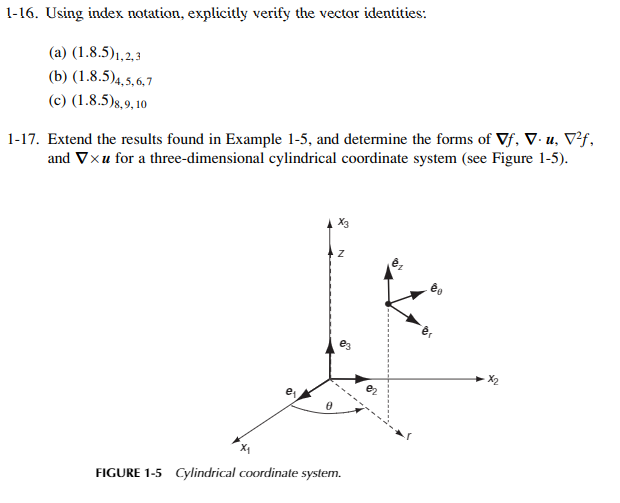 1-16. Using index notation, explicitly verify the vector identities:
@ (185)123
(b) (18:5);.5.6.7
© (1855010
1-17. Extend the results found in Example 1-5, and determine the forms of Vf, V- u, Vf,
and Vu for a three-dimensional cylindrical coordinate system (see Figure 1-5).
x
z
tr
e
Pe
SI
i .
eu” le
0 >i
.
Xi
FIGURE 155 Cylindrical coordinate system.
1-16. Using index notation, explicitly verify the vector identities:
@ (185)123
(b) (18:5);.5.6.7
© (1855010
1-17. Extend the results found in Example 1-5, and determine the forms of Vf, V- u, Vf,
and Vu for a three-dimensional cylindrical coordinate system (see Figure 1-5).
x
z
tr
e
Pe
SI
i .
eu” le
0 >i
.
Xi
FIGURE 155 Cylindrical coordinate system.
This is AI generated Response.
Asked by: gvr
Created at: 2025-07-23 23:35:22
Asked by: gvr
Created at: 2025-07-23 23:35:22
Final Answer:
Rendered
Raw Text
Did you like this answer?
Let's solve **Problem 1-16** step-by-step using index notation.
## Given
Explicitly verify the vector identities using index notation:
(a) (1.8.5)\(_{1,2,3}\)
(b) (1.8.5)\(_{4,5,6,7}\)
(c) (1.8.5)\(_{8,9,10}\)
Assume equation (1.8.5) contains standard vector identities, commonly found in textbooks. Let's use the typical ones:
### Typical Vector Identities (in Index Notation)
1. **Divergence of a gradient:**
\[
\nabla \cdot (\nabla f) = \nabla^2 f
\]
In index notation:
\[
\partial_i \partial_i f
\]
2. **Curl of a gradient:**
\[
\nabla \times (\nabla f) = 0
\]
In index notation:
\[
(\nabla \times \nabla f)_i = \epsilon_{ijk} \partial_j \partial_k f = 0
\]
(because mixed partials commute and \(\epsilon_{ijk}\) is antisymmetric)
3. **Divergence of a curl:**
\[
\nabla \cdot (\nabla \times \mathbf{A}) = 0
\]
In index notation:
\[
\partial_i (\epsilon_{ijk} \partial_j A_k) = \epsilon_{ijk} \partial_i \partial_j A_k = 0
\]
(again, due to symmetry)
Let's address each part:
---
## (a) (1.8.5)\(_{1,2,3}\):
Let's assume these refer to:
1. \(\nabla \cdot (\nabla f) = \nabla^2 f\)
2. \(\nabla \times (\nabla f) = 0\)
3. \(\nabla \cdot (\nabla \times \mathbf{A}) = 0\)
### 1. \(\nabla \cdot (\nabla f)\):
- Index notation: \(\partial_i \partial_i f\)
- This is the definition of the Laplacian: \(\nabla^2 f\).
### 2. \(\nabla \times (\nabla f)\):
- Index notation: \((\nabla \times \nabla f)_i = \epsilon_{ijk} \partial_j \partial_k f\)
- Since \(\partial_j \partial_k f = \partial_k \partial_j f\), and \(\epsilon_{ijk}\) is antisymmetric, their contraction is zero:
\[
\epsilon_{ijk} \partial_j \partial_k f = 0
\]
### 3. \(\nabla \cdot (\nabla \times \mathbf{A})\):
- Index notation: \(\partial_i (\epsilon_{ijk} \partial_j A_k) = \epsilon_{ijk} \partial_i \partial_j A_k\)
- By symmetry of partial derivatives and antisymmetry of \(\epsilon_{ijk}\), this is zero.
**Thus, all three are verified.**
---
## (b) (1.8.5)\(_{4,5,6,7}\):
Assume these are:
4. \(\nabla \times (\nabla \times \mathbf{A}) = \nabla(\nabla \cdot \mathbf{A}) - \nabla^2 \mathbf{A}\)
5. \(\nabla(\mathbf{A} \cdot \mathbf{B}) = (\mathbf{A} \cdot \nabla)\mathbf{B} + (\mathbf{B} \cdot \nabla)\mathbf{A} + \mathbf{A} \times (\nabla \times \mathbf{B}) + \mathbf{B} \times (\nabla \times \mathbf{A})\)
6. Product rules, etc.
Let's explicitly verify (4):
### 4. \(\nabla \times (\nabla \times \mathbf{A}) = \nabla(\nabla \cdot \mathbf{A}) - \nabla^2 \mathbf{A}\)
- Left: \((\nabla \times (\nabla \times \mathbf{A}))_i = \epsilon_{ijk} \partial_j (\epsilon_{klm} \partial_l A_m)\)
- Expand:
\[
\epsilon_{ijk}\epsilon_{klm} = \delta_{il}\delta_{jm} - \delta_{im}\delta_{jl}
\]
- So,
\[
= (\delta_{il}\delta_{jm} - \delta_{im}\delta_{jl}) \partial_j \partial_l A_m
\]
\[
= \delta_{il}\delta_{jm}\partial_j \partial_l A_m - \delta_{im}\delta_{jl} \partial_j \partial_l A_m
\]
\[
= \partial_j \partial_i A_j - \partial_j \partial_j A_i
\]
\[
= \partial_i (\partial_j A_j) - \partial_j \partial_j A_i
\]
- That is:
\[
= \nabla (\nabla \cdot \mathbf{A}) - \nabla^2 \mathbf{A}
\]
---
## (c) (1.8.5)\(_{8,9,10}\):
Likely refer to triple products and related identities. For example:
8. \(\nabla \cdot (f \mathbf{A}) = f (\nabla \cdot \mathbf{A}) + \mathbf{A} \cdot (\nabla f)\)
9. \(\nabla \times (f \mathbf{A}) = (\nabla f) \times \mathbf{A} + f (\nabla \times \mathbf{A})\)
10. Product rules for divergence and curl.
Let's verify (8):
### 8. \(\nabla \cdot (f \mathbf{A})\):
- Index notation: \(\partial_i (f A_i) = (\partial_i f) A_i + f (\partial_i A_i)\)
- Which is:
\[
= \mathbf{A} \cdot (\nabla f) + f (\nabla \cdot \mathbf{A})
\]
---
## **Final Answers (Summary Table):**
| Identity | Index Notation | Verification |
|----------|---------------|--------------|
| 1. \(\nabla \cdot (\nabla f)\) | \(\partial_i \partial_i f\) | Laplacian: \(\nabla^2 f\)|
| 2. \(\nabla \times (\nabla f)\) | \(\epsilon_{ijk} \partial_j \partial_k f\) | 0 (commuting partials + antisymmetry)|
| 3. \(\nabla \cdot (\nabla \times \mathbf{A})\) | \(\epsilon_{ijk} \partial_i \partial_j A_k\) | 0 |
| 4. \(\nabla \times (\nabla \times \mathbf{A})\) | \(\epsilon_{ijk}\partial_j(\epsilon_{klm}\partial_l A_m)\) | \(\nabla(\nabla\cdot \mathbf{A})-\nabla^2\mathbf{A}\) |
| 8. \(\nabla \cdot (f \mathbf{A})\) | \(\partial_i (f A_i)\) | \((\partial_i f)A_i + f(\partial_i A_i)\) |
If you need explicit verification for more identities, let me know the exact equations (1.8.5)\(_{n}\) from your textbook, and I can verify them step-by-step!
📢 Instructions:
- Ask anything relatd to above question only.
- For new Question goto :