 VIPSolutions
Give step-by-step solution with explanation and final answer:1 Gazelle with a few questions added Gazelle produces two bicycle models, a standard (STD) model and a deluxe (DEL) model. Gazelle needs to delermine the number of STD and DEL bicycies to produce so as to maximize the total profit contribution. For the time being we assume it possible to produce not whole’ numbers, e.g. 2.5, number of bicycles. Resource Quantity Required Quantity Available so DEL. Frames (Unts) 1 1 1400 Add-ons (Hours) 1.0 20 2000 STD controls 1 0 1000 DEL controls [3] 1 800 Assembly (Hours) 0.33 (20 minutes) 1.0 200 Nett profit 100 125 (EURO per uni) Questions 1. Formulate an LP modsi for the problem. Give objective function and constraints. 2. State and discuss the assumptions made in this case. 3. Solve the problem graphically. provide the optimal valuss of STD and DEL and calculate the corresponding profi. 4. Determine the amount of each of the resources used. ‘Which are the siack constraints? How much of the corresponding resources are left? Which are the tight constraints? 5. Solve the problem using the Excel Solver. 6 How much of corresponding resources of the tight constraints can be profitably used to increase profit - take one resource at the tee. What is the extra profit ‘eamed? What aro the shadow prices? 7. How will you answers be different when the STDs provide a net profit of 75 EURO per ‘unit? When they provide a net prof of only 50 EURO per unit? And 40 EURO per unt? 8 Retum to the stuation where we wil receive 100 EURO for an STD bicycle ‘Assume further thatthe supply chain capac also imposes a imitation. The supply ‘chain capacity is large enough for not more than 1400 STD bicycles. The supply chain ‘capacity of 4 STD bicycles is quivalent to the supply chain capacity of 3 DEL bicycles. Solve the problem using the Excel Solver. Note: only whole numbers can be produced. this translates {0 a requirement n the Solver constraints and the in the Solver Method Options. 9. Mustrate the situation in 8. graphically.
Question:
Give step-by-step solution with explanation and final answer: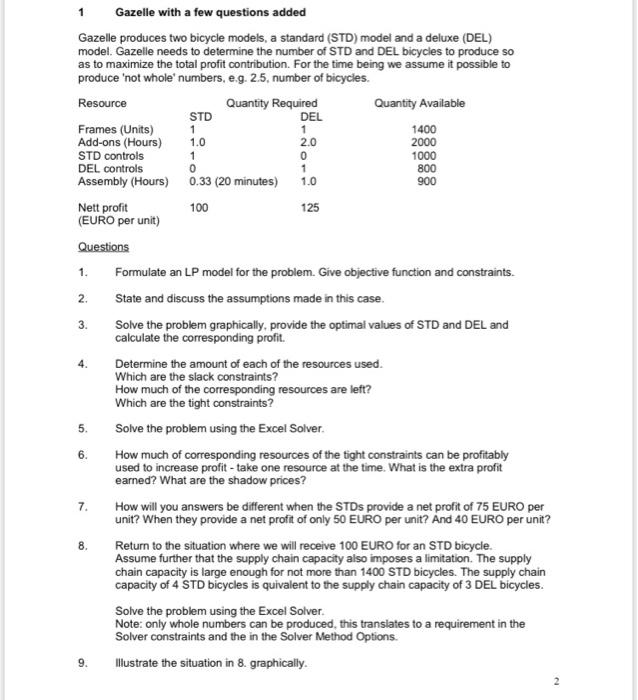 1 Gazelle with a few questions added
Gazelle produces two bicycle models, a standard (STD) model and a deluxe (DEL)
model. Gazelle needs to delermine the number of STD and DEL bicycies to produce so
as to maximize the total profit contribution. For the time being we assume it possible to
produce not whole’ numbers, e.g. 2.5, number of bicycles.
Resource Quantity Required Quantity Available
so DEL.
Frames (Unts) 1 1 1400
Add-ons (Hours) 1.0 20 2000
STD controls 1 0 1000
DEL controls [3] 1 800
Assembly (Hours) 0.33 (20 minutes) 1.0 200
Nett profit 100 125
(EURO per uni)
Questions
1. Formulate an LP modsi for the problem. Give objective function and constraints.
2. State and discuss the assumptions made in this case.
3. Solve the problem graphically. provide the optimal valuss of STD and DEL and
calculate the corresponding profi.
4. Determine the amount of each of the resources used.
‘Which are the siack constraints?
How much of the corresponding resources are left?
Which are the tight constraints?
5. Solve the problem using the Excel Solver.
6 How much of corresponding resources of the tight constraints can be profitably
used to increase profit - take one resource at the tee. What is the extra profit
‘eamed? What aro the shadow prices?
7. How will you answers be different when the STDs provide a net profit of 75 EURO per
‘unit? When they provide a net prof of only 50 EURO per unit? And 40 EURO per unt?
8 Retum to the stuation where we wil receive 100 EURO for an STD bicycle
‘Assume further thatthe supply chain capac also imposes a imitation. The supply
‘chain capacity is large enough for not more than 1400 STD bicycles. The supply chain
‘capacity of 4 STD bicycles is quivalent to the supply chain capacity of 3 DEL bicycles.
Solve the problem using the Excel Solver.
Note: only whole numbers can be produced. this translates {0 a requirement n the
Solver constraints and the in the Solver Method Options.
9. Mustrate the situation in 8. graphically.
1 Gazelle with a few questions added
Gazelle produces two bicycle models, a standard (STD) model and a deluxe (DEL)
model. Gazelle needs to delermine the number of STD and DEL bicycies to produce so
as to maximize the total profit contribution. For the time being we assume it possible to
produce not whole’ numbers, e.g. 2.5, number of bicycles.
Resource Quantity Required Quantity Available
so DEL.
Frames (Unts) 1 1 1400
Add-ons (Hours) 1.0 20 2000
STD controls 1 0 1000
DEL controls [3] 1 800
Assembly (Hours) 0.33 (20 minutes) 1.0 200
Nett profit 100 125
(EURO per uni)
Questions
1. Formulate an LP modsi for the problem. Give objective function and constraints.
2. State and discuss the assumptions made in this case.
3. Solve the problem graphically. provide the optimal valuss of STD and DEL and
calculate the corresponding profi.
4. Determine the amount of each of the resources used.
‘Which are the siack constraints?
How much of the corresponding resources are left?
Which are the tight constraints?
5. Solve the problem using the Excel Solver.
6 How much of corresponding resources of the tight constraints can be profitably
used to increase profit - take one resource at the tee. What is the extra profit
‘eamed? What aro the shadow prices?
7. How will you answers be different when the STDs provide a net profit of 75 EURO per
‘unit? When they provide a net prof of only 50 EURO per unit? And 40 EURO per unt?
8 Retum to the stuation where we wil receive 100 EURO for an STD bicycle
‘Assume further thatthe supply chain capac also imposes a imitation. The supply
‘chain capacity is large enough for not more than 1400 STD bicycles. The supply chain
‘capacity of 4 STD bicycles is quivalent to the supply chain capacity of 3 DEL bicycles.
Solve the problem using the Excel Solver.
Note: only whole numbers can be produced. this translates {0 a requirement n the
Solver constraints and the in the Solver Method Options.
9. Mustrate the situation in 8. graphically.
Asked by: gvr
Created at: 2025-07-27 15:14:13
Final Answer:
📢 Instructions:
- Ask anything relatd to above question only.
- For new Question goto :