Give step-by-step solution with explanation and final answer:30® Qo 0 0 Sul
11:30 ® © 0: IE Sal G2)
o— . . °
23 solutioninn.com/tutor :
Solutionfpn ~~ Tebook Questions My Answers ®.
Question in Modern Physics
Question Description Skill Required:
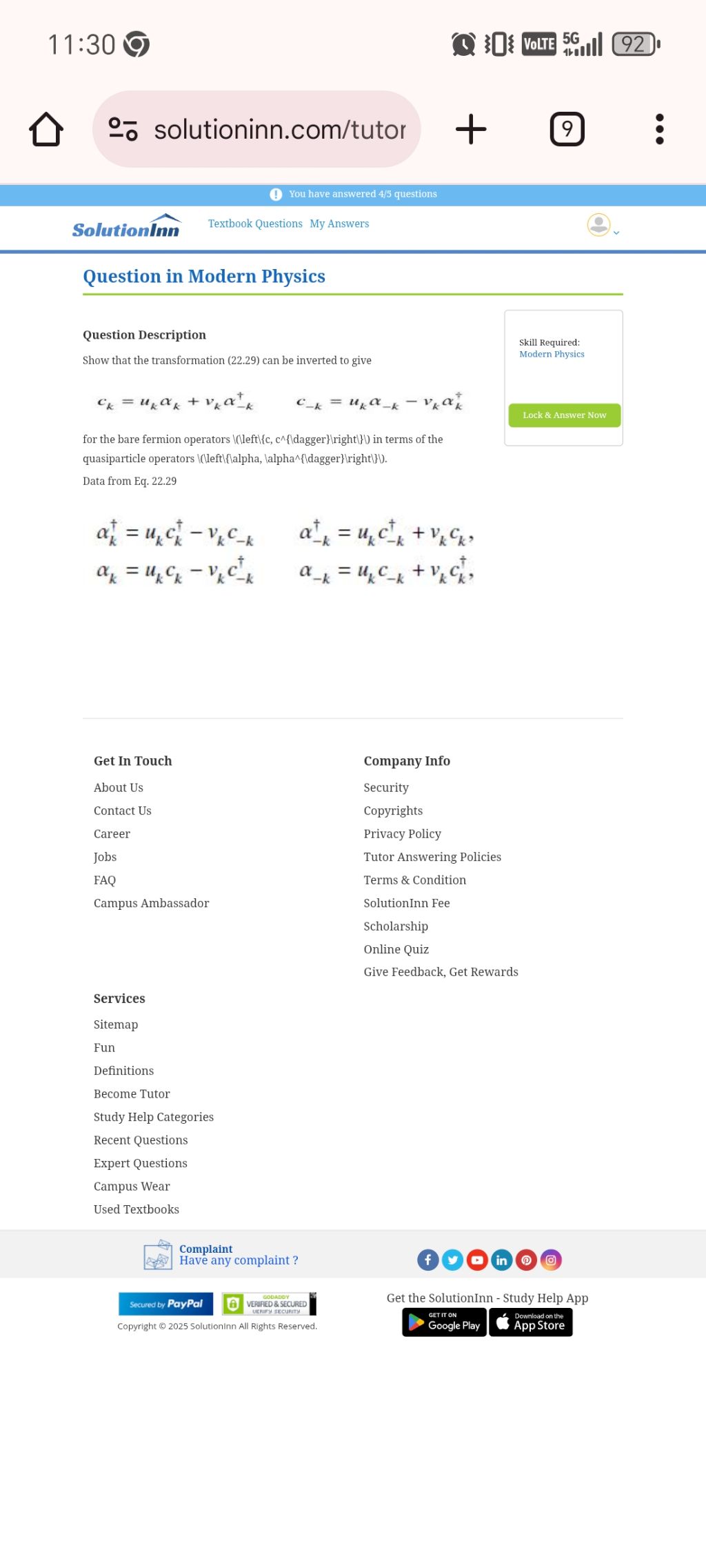
Show that the transformation (22.29) can be inverted to give hg
Cp = ug, +a, Cx =U _y — Vay io ssid
for the bare fermion operators \(left{c, c*{\dagger}irighti}) in terms of the
quasiparticle operators \(left\(\alpha, \alpha/{\dagger}right}\).
Data from Eq. 22.29
t 1 + +
= ay = ,
a =u cp —ve a, =uc, +v,q,
a, =u,c, vc a_,=uc +v.c
A i kk -k — "kk f a 3
Get In Touch Company Info
About Us Security
Contact Us Copyrights
Career Privacy Policy
Jobs Tutor Answering Policies
FAQ Terms & Condition
Campus Ambassador SolutionInn Fee
Scholarship
Online Quiz
Give Feedback, Get Rewards
Services
sitemap
Fun
Definitions
Become Tutor
Study Help Categories
Recent Questions
Expert Questions
Campus Wear
Used Texthooks
“5 complaint
ERE compo 000000
(or | Get the SolutionInn - Study Help App
Question:
Give step-by-step solution with explanation and final answer:
This is AI generated Response. Asked by: Kota Swarupa Rani Created at: 2025-07-28 11:31:47
Did you like this answer?
👍 0
👎 0
Let's walk through the step-by-step inversion of the Bogoliubov transformation given in the image.
### **Given transformations (Eq. 22.29):**
\[
\begin{align*}
\alpha_k^\dagger &= u_k c_k^\dagger - v_k c_{-k} \\
\alpha_{-k}^\dagger &= u_k c_{-k}^\dagger + v_k c_k \\
\alpha_k &= u_k c_k - v_k c_{-k}^\dagger \\
\alpha_{-k} &= u_k c_{-k} + v_k c_k^\dagger
\end{align*}
\]
We are to **invert** these equations to write \( c_k \) and \( c_{-k} \) in terms of \( \alpha \) and \( \alpha^\dagger \):
\[
\boxed{
c_k = u_k \alpha_k + v_k \alpha_{-k}^\dagger \\
c_{-k} = u_k \alpha_{-k} - v_k \alpha_k^\dagger
}
\]
---
### **Step 1: Write the equations for \( \alpha_k \) and \( \alpha_{-k}^\dagger \)**
From above:
\[
\alpha_k = u_k c_k - v_k c_{-k}^\dagger \tag{1}
\]
\[
\alpha_{-k}^\dagger = u_k c_{-k}^\dagger + v_k c_k \tag{2}
\]
---
### **Step 2: Solve for \( c_k \) and \( c_{-k}^\dagger \)**
Let's treat (1) and (2) as two equations for \( c_k \) and \( c_{-k}^\dagger \):
Write them as:
\[
\begin{align*}
\alpha_k &= u_k c_k - v_k c_{-k}^\dagger \\
\alpha_{-k}^\dagger &= v_k c_k + u_k c_{-k}^\dagger
\end{align*}
\]
---
### **Step 3: Express in matrix form**
\[
\begin{pmatrix}
\alpha_k \\
\alpha_{-k}^\dagger
\end{pmatrix}
=
\begin{pmatrix}
u_k & -v_k \\
v_k & u_k
\end{pmatrix}
\begin{pmatrix}
c_k \\
c_{-k}^\dagger
\end{pmatrix}
\]
---
### **Step 4: Invert the matrix**
The inverse of
\(
\begin{pmatrix}
u_k & -v_k \\
v_k & u_k
\end{pmatrix}
\)
is (since \( u_k^2 + v_k^2 = 1 \) for Bogoliubov coefficients):
\[
\frac{1}{u_k^2 + v_k^2}
\begin{pmatrix}
u_k & v_k \\
- v_k & u_k
\end{pmatrix}
=
\begin{pmatrix}
u_k & v_k \\
- v_k & u_k
\end{pmatrix}
\]
if \( u_k^2 + v_k^2 = 1 \).
So,
\[
\begin{pmatrix}
c_k \\
c_{-k}^\dagger
\end{pmatrix}
=
\begin{pmatrix}
u_k & v_k \\
- v_k & u_k
\end{pmatrix}
\begin{pmatrix}
\alpha_k \\
\alpha_{-k}^\dagger
\end{pmatrix}
\]
So,
\[
\boxed{
c_k = u_k \alpha_k + v_k \alpha_{-k}^\dagger
}
\]
\[
c_{-k}^\dagger = -v_k \alpha_k + u_k \alpha_{-k}^\dagger
\]
---
### **Step 5: Now for \( c_{-k} \) and \( c_k^\dagger \)**
From the other pair:
\[
\alpha_{-k} = u_k c_{-k} + v_k c_k^\dagger
\]
\[
\alpha_k^\dagger = u_k c_k^\dagger - v_k c_{-k}
\]
Similarly, write
\[
\begin{pmatrix}
\alpha_{-k} \\
\alpha_k^\dagger
\end{pmatrix}
=
\begin{pmatrix}
u_k & v_k \\
- v_k & u_k
\end{pmatrix}
\begin{pmatrix}
c_{-k} \\
c_k^\dagger
\end{pmatrix}
\]
Invert:
\[
\begin{pmatrix}
c_{-k} \\
c_k^\dagger
\end{pmatrix}
=
\begin{pmatrix}
u_k & -v_k \\
v_k & u_k
\end{pmatrix}
\begin{pmatrix}
\alpha_{-k} \\
\alpha_k^\dagger
\end{pmatrix}
\]
So,
\[
\boxed{
c_{-k} = u_k \alpha_{-k} - v_k \alpha_k^\dagger
}
\]
\[
c_k^\dagger = v_k \alpha_{-k} + u_k \alpha_k^\dagger
\]
---
## **Final Answers**
\[
\boxed{
\begin{aligned}
c_k &= u_k \alpha_k + v_k \alpha_{-k}^\dagger \\
c_{-k} &= u_k \alpha_{-k} - v_k \alpha_k^\dagger
\end{aligned}
}
\]
These are the inverted relations for the bare fermion operators in terms of the quasiparticle operators.
📢 Instructions:
Ask anything relatd to above question only.
For new Question goto :
🚀 Submit (-0.25 Credits🪙)
Study Help, Fast Answers
VIPSolutions focuses on clear, step‑by‑step explanations so you can learn quickly. Whether you need an AI‑generated walkthrough or a short hint to get unstuck, each solution is organized for fast reading and easy review later.
Search similar questions, compare approaches, and bookmark the best answers for revision. Our goal is simple: quick, reliable study help that feels natural—not noisy.
 VIPSolutions
 30® Qo 0 0 Sul
11:30 ® © 0: IE Sal G2)
o— . . °
23 solutioninn.com/tutor :
Solutionfpn ~~ Tebook Questions My Answers ®.
Question in Modern Physics
Question Description Skill Required:
Show that the transformation (22.29) can be inverted to give hg
Cp = ug, +a, Cx =U _y — Vay io ssid
for the bare fermion operators \(left{c, c*{\dagger}irighti}) in terms of the
quasiparticle operators \(left\(\alpha, \alpha/{\dagger}right}\).
Data from Eq. 22.29
t 1 + +
= ay = ,
a =u cp —ve a, =uc, +v,q,
a, =u,c, vc a_,=uc +v.c
A i kk -k — "kk f a 3
Get In Touch Company Info
About Us Security
Contact Us Copyrights
Career Privacy Policy
Jobs Tutor Answering Policies
FAQ Terms & Condition
Campus Ambassador SolutionInn Fee
Scholarship
Online Quiz
Give Feedback, Get Rewards
Services
sitemap
Fun
Definitions
Become Tutor
Study Help Categories
Recent Questions
Expert Questions
Campus Wear
Used Texthooks
“5 complaint
ERE compo 000000
(or | Get the SolutionInn - Study Help App
30® Qo 0 0 Sul
11:30 ® © 0: IE Sal G2)
o— . . °
23 solutioninn.com/tutor :
Solutionfpn ~~ Tebook Questions My Answers ®.
Question in Modern Physics
Question Description Skill Required:
Show that the transformation (22.29) can be inverted to give hg
Cp = ug, +a, Cx =U _y — Vay io ssid
for the bare fermion operators \(left{c, c*{\dagger}irighti}) in terms of the
quasiparticle operators \(left\(\alpha, \alpha/{\dagger}right}\).
Data from Eq. 22.29
t 1 + +
= ay = ,
a =u cp —ve a, =uc, +v,q,
a, =u,c, vc a_,=uc +v.c
A i kk -k — "kk f a 3
Get In Touch Company Info
About Us Security
Contact Us Copyrights
Career Privacy Policy
Jobs Tutor Answering Policies
FAQ Terms & Condition
Campus Ambassador SolutionInn Fee
Scholarship
Online Quiz
Give Feedback, Get Rewards
Services
sitemap
Fun
Definitions
Become Tutor
Study Help Categories
Recent Questions
Expert Questions
Campus Wear
Used Texthooks
“5 complaint
ERE compo 000000
(or | Get the SolutionInn - Study Help App