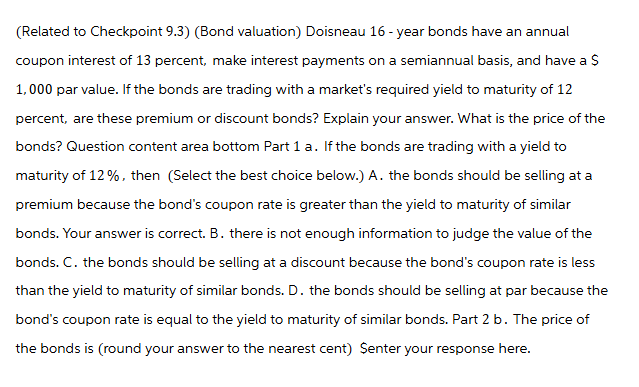
Give step-by-step solution with explanation and final answer:(Related to Checkpoint 9.3) (Bond valuation) Doisneau 16 - year bonds have an annual
coupon interest of 13 percent, make interest payments on a semiannual basis, and have a
1,000 par value. If the bonds are trading with a market's required yield to maturity of 12
percent, are these premium or discount bonds? Explain your answer. What is the price of the
bonds? Question content area bottom Part 1 a. Ifthe bonds are trading with a yield to
maturity of 12%. then (Select the best choice below.) A. the bonds should be selling at a
premium because the bond's coupon rate is greater than the yield to maturity of similar
bonds. Your answer is correct. B. there is not enough information to judge the value of the
bonds. C. the bonds should be selling at a discount because the bond's coupon rate is less.
than the yield to maturity of similar bonds. D. the bonds should be selling at par because the
bond's coupon rate is equal to the yield to maturity of similar bonds. Part 2 b. The price of
the bonds is (round your answer to the nearest cent) Senter your response here.
Question:
Give step-by-step solution with explanation and final answer:(Related to Checkpoint 9.3) (Bond valuation) Doisneau 16 - year bonds have an annual
coupon interest of 13 percent, make interest payments on a semiannual basis, and have a
1,000 par value. If the bonds are trading with a market's required yield to maturity of 12
percent, are these premium or discount bonds? Explain your answer. What is the price of the
bonds? Question content area bottom Part 1 a. Ifthe bonds are trading with a yield to
maturity of 12%. then (Select the best choice below.) A. the bonds should be selling at a
premium because the bond's coupon rate is greater than the yield to maturity of similar
bonds. Your answer is correct. B. there is not enough information to judge the value of the
bonds. C. the bonds should be selling at a discount because the bond's coupon rate is less.
than the yield to maturity of similar bonds. D. the bonds should be selling at par because the
bond's coupon rate is equal to the yield to maturity of similar bonds. Part 2 b. The price of
the bonds is (round your answer to the nearest cent) Senter your response here.
This is AI generated Response.
Asked by: gvr
Created at: 2025-07-28 23:02:58
Final Answer:
RenderedRaw Text
Did you like this answer?
Let's break down and solve each part step by step:
---
### **Part 1a: Premium or Discount?**
#### **Given:**
- **Coupon Rate:** 13% (annual, paid semiannually)
- **Market Yield (YTM):** 12% (annual, paid semiannually)
- **Par Value:** $1,000
- **Years to Maturity:** 16 years
**Question:** Are these premium or discount bonds?
#### **Solution:**
- **If the coupon rate is greater than the yield to maturity, the bond sells at a premium.**
- Here, **Coupon Rate (13%) > YTM (12%)**.
**Best answer:**
**A. The bonds should be selling at a premium because the bond's coupon rate is greater than the yield to maturity of similar bonds.**
---
### **Part 1b: Price of the Bonds**
#### **Step 1: Convert to Semiannual Periods and Rates**
- **Semiannual coupon payment = (13% of $1,000) / 2 = $130 / 2 = $65**
- **Number of semiannual periods = 16 years × 2 = 32**
- **Semiannual market yield = 12% / 2 = 6%**
#### **Step 2: Plug Into the Bond Price Formula**
The price of the bond is the present value of all future cash flows:
\[
\text{Bond Price} = \sum_{t=1}^{n} \frac{C}{(1+r)^t} + \frac{F}{(1+r)^n}
\]
Where:
- \( C \) = semiannual coupon = $65
- \( r \) = semiannual yield = 0.06
- \( n \) = total periods = 32
- \( F \) = face value = $1,000
#### **Step 3: Calculate Present Value of Coupons**
\[
PV_{\text{coupons}} = C \times \left[1 - (1+r)^{-n}\right] / r
\]
\[
PV_{\text{coupons}} = 65 \times \left[1 - (1+0.06)^{-32}\right] / 0.06
\]
First, calculate \((1+0.06)^{-32}\):
\[
(1+0.06)^{-32} = (1.06)^{-32} \approx 0.1581
\]
So,
\[
PV_{\text{coupons}} = 65 \times \frac{1 - 0.1581}{0.06}
\]
\[
= 65 \times \frac{0.8419}{0.06}
\]
\[
= 65 \times 14.0317
\]
\[
= 912.06
\]
#### **Step 4: Calculate Present Value of Par Value**
\[
PV_{\text{par}} = \frac{1000}{(1.06)^{32}}
\]
\[
= \frac{1000}{6.3266}
\]
\[
= 158.08
\]
#### **Step 5: Add Both Parts**
\[
\text{Bond Price} = PV_{\text{coupons}} + PV_{\text{par}}
\]
\[
= 912.06 + 158.08
\]
\[
= \$1,070.14
\]
---
## **Final Answers:**
### **Part 1a:**
**A. The bonds should be selling at a premium because the bond's coupon rate is greater than the yield to maturity of similar bonds.**
### **Part 1b:**
**The price of the bond is: \(\boxed{\$1,070.14}\)**
Let me know if you need further explanation!
VIPSolutions focuses on clear, step‑by‑step explanations so you can learn quickly. Whether you need an AI‑generated walkthrough or a short hint to get unstuck, each solution is organized for fast reading and easy review later.
Search similar questions, compare approaches, and bookmark the best answers for revision. Our goal is simple: quick, reliable study help that feels natural—not noisy.
 VIPSolutions
 (Related to Checkpoint 9.3) (Bond valuation) Doisneau 16 - year bonds have an annual
coupon interest of 13 percent, make interest payments on a semiannual basis, and have a
1,000 par value. If the bonds are trading with a market's required yield to maturity of 12
percent, are these premium or discount bonds? Explain your answer. What is the price of the
bonds? Question content area bottom Part 1 a. Ifthe bonds are trading with a yield to
maturity of 12%. then (Select the best choice below.) A. the bonds should be selling at a
premium because the bond's coupon rate is greater than the yield to maturity of similar
bonds. Your answer is correct. B. there is not enough information to judge the value of the
bonds. C. the bonds should be selling at a discount because the bond's coupon rate is less.
than the yield to maturity of similar bonds. D. the bonds should be selling at par because the
bond's coupon rate is equal to the yield to maturity of similar bonds. Part 2 b. The price of
the bonds is (round your answer to the nearest cent) Senter your response here.
(Related to Checkpoint 9.3) (Bond valuation) Doisneau 16 - year bonds have an annual
coupon interest of 13 percent, make interest payments on a semiannual basis, and have a
1,000 par value. If the bonds are trading with a market's required yield to maturity of 12
percent, are these premium or discount bonds? Explain your answer. What is the price of the
bonds? Question content area bottom Part 1 a. Ifthe bonds are trading with a yield to
maturity of 12%. then (Select the best choice below.) A. the bonds should be selling at a
premium because the bond's coupon rate is greater than the yield to maturity of similar
bonds. Your answer is correct. B. there is not enough information to judge the value of the
bonds. C. the bonds should be selling at a discount because the bond's coupon rate is less.
than the yield to maturity of similar bonds. D. the bonds should be selling at par because the
bond's coupon rate is equal to the yield to maturity of similar bonds. Part 2 b. The price of
the bonds is (round your answer to the nearest cent) Senter your response here.