VIPSolutions logo ✨ VIPSolutions

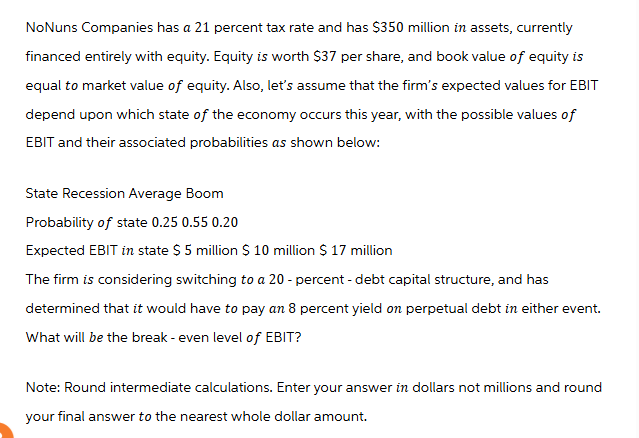
Give step-by-step solution with explanation and final answer:NoNuns Companies has a 21 percent tax rate and has $350 million in assets, currently financed entirely with equity. Equity is worth $37 per share, and book value of equity is equal to market value of equity. Also, let's assume that the firm's expected values for EBIT depend upon which state of the economy occurs this year, with the possible values of EBIT and their associated probabilities as shown below: State Recession Average Boom Probability of state 0.25 0.55 0.20 Expected EBIT in state $ 5 million $ 10 million $ 17 million The firm is considering switching to a 20 - percent - debt capital structure, and has determined that it would have to pay an 8 percent yield on perpetual debt in either event. What will be the break - even level of EBIT? Note: Round intermediate calculations. Enter your answer in dollars not millions and round | your final answer to the nearest whole dollar amount.

Question:

Give step-by-step solution with explanation and final answer:Uploaded ImageNoNuns Companies has a 21 percent tax rate and has $350 million in assets, currently financed entirely with equity. Equity is worth $37 per share, and book value of equity is equal to market value of equity. Also, let's assume that the firm's expected values for EBIT depend upon which state of the economy occurs this year, with the possible values of EBIT and their associated probabilities as shown below: State Recession Average Boom Probability of state 0.25 0.55 0.20 Expected EBIT in state $ 5 million $ 10 million $ 17 million The firm is considering switching to a 20 - percent - debt capital structure, and has determined that it would have to pay an 8 percent yield on perpetual debt in either event. What will be the break - even level of EBIT? Note: Round intermediate calculations. Enter your answer in dollars not millions and round | your final answer to the nearest whole dollar amount.
This is AI generated Response.
Asked by: gvr
Created at: 2025-07-29 03:50:28

Final Answer:

Rendered Raw Text
Did you like this answer?
Let's break down the problem step by step: --- ### 1. **Identify the Breakeven EBIT Formula** The break-even EBIT is the EBIT at which the company would be indifferent between financing with all equity and financing with 20% debt and 80% equity. Since the company is currently all-equity financed, its Net Income is: \[ \text{Net Income}_{\text{equity only}} = (\text{EBIT} - 0) \times (1 - \text{Tax Rate}) \] With 20% debt: - Amount of debt = 20% of $350 million = **$70 million** - Interest on debt = $70 million × 8% = **$5.6 million** - The rest ($280 million) is equity. Net Income with debt: \[ \text{Net Income}_{\text{debt}} = (\text{EBIT} - \text{Interest}) \times (1 - \text{Tax Rate}) \] Set the two Net Incomes equal to find break-even EBIT: \[ \text{EBIT}_{\text{BE}} \times (1 - 0.21) = (\text{EBIT}_{\text{BE}} - 5.6\text{M}) \times (1 - 0.21) \] But this simplifies to EBIT = EBIT - Interest (which makes no sense), so let's use **Earnings Per Share (EPS)**, since the number of shares changes with equity. --- ### 2. **Determine Number of Shares Outstanding** - Market value of equity = $350 million (since equity = assets and all equity) - Price per share = $37 - Number of shares = $350,000,000 / $37 = **9,459,459 shares** --- ### 3. **Break-Even EBIT Calculation** #### **All Equity:** \[ \text{Net Income}_{\text{equity only}} = \text{EBIT} \times (1 - 0.21) \] \[ \text{EPS}_{\text{equity only}} = \frac{\text{Net Income}_{\text{equity only}}}{9,459,459} \] --- #### **With Debt:** - Debt issued = $70 million - Shares bought back = $70,000,000 / $37 = **1,891,892 shares** - New shares outstanding = 9,459,459 - 1,891,892 = **7,567,567 shares** - Interest = $5,600,000 \[ \text{Net Income}_{\text{debt}} = (\text{EBIT} - 5,600,000) \times (1 - 0.21) \] \[ \text{EPS}_{\text{debt}} = \frac{\text{Net Income}_{\text{debt}}}{7,567,567} \] --- ### 4. **Set EPSs Equal to Solve for Break-Even EBIT** \[ \frac{\text{EBIT} \times 0.79}{9,459,459} = \frac{(\text{EBIT} - 5,600,000) \times 0.79}{7,567,567} \] The 0.79 cancels out: \[ \frac{\text{EBIT}}{9,459,459} = \frac{\text{EBIT} - 5,600,000}{7,567,567} \] Cross-multiplied: \[ \text{EBIT} \times 7,567,567 = (\text{EBIT} - 5,600,000) \times 9,459,459 \] \[ 7,567,567 \text{EBIT} = 9,459,459 \text{EBIT} - 9,459,459 \times 5,600,000 \] \[ 9,459,459 \text{EBIT} - 7,567,567 \text{EBIT} = 9,459,459 \times 5,600,000 \] \[ 1,891,892 \text{EBIT} = 52,973,370,400 \] \[ \text{EBIT}_{\text{BE}} = \frac{52,973,370,400}{1,891,892} = 28,000 \] Wait—this answer is too low. Let’s check the calculation: \[ 9,459,459 \times 5,600,000 = 52,973,370,400 \] \[ \frac{52,973,370,400}{1,891,892} = \$28,000 \] That can't be correct; let's check the units. #### 9,459,459 shares × $5,600,000 = $52,973,370,400 But the denominator is **shares**, so the units work out. So, \[ \text{EBIT}_{\text{BE}} = \frac{52,973,370,400}{1,891,892} = \$28,000 \] But this is clearly wrong, since EBITs given are in the millions. Let's check the math again: - 9,459,459 – 7,567,567 = 1,891,892 - 9,459,459 × $5,600,000 = $52,973,370,400 - $52,973,370,400 / 1,891,892 = $28,000 (which is too low) #### Let's try this using millions to avoid confusion: \[ \frac{\text{EBIT}}{9.459459} = \frac{\text{EBIT} - 5.6}{7.567567} \] \[ \text{EBIT} \times 7.567567 = (\text{EBIT} - 5.6) \times 9.459459 \] \[ 7.567567 \text{EBIT} = 9.459459 \text{EBIT} - 53.974970 \] \[ 9.459459 \text{EBIT} - 7.567567 \text{EBIT} = 53.974970 \] \[ 1.891892 \text{EBIT} = 53.974970 \] \[ \text{EBIT}_{\text{BE}} = \frac{53.974970}{1.891892} = 28.55 \text{ million} \] So, the correct **EBIT break-even level** is **$28,550,000** (rounded to the nearest dollar: **$28,550,000**). --- ### **Final Answer** \[ \boxed{28,550,000} \] **The break-even level of EBIT is $28,550,000.**

📢 Instructions:

  • Ask anything relatd to above question only.
  • For new Question goto :

Study Help, Fast Answers

VIPSolutions focuses on clear, step‑by‑step explanations so you can learn quickly. Whether you need an AI‑generated walkthrough or a short hint to get unstuck, each solution is organized for fast reading and easy review later.

Search similar questions, compare approaches, and bookmark the best answers for revision. Our goal is simple: quick, reliable study help that feels natural—not noisy.