 VIPSolutions
Give step-by-step solution with explanation and final answer:| Sketch the solid whose volume is given by the iterated integral. | 8 I x ie -8z dy dz dx | o Jo 0 | Describe your sketch. | The solid has a trapezoidal base in the xy-plane. The solid has a triangular face @ ¢ in the xz-plane. | The solid has a triangular face « inthe yz-plane. The solid has a triangular face « intheplanez=1 — X. | The solid has a triangular face @ «7 inthe planey = 8 — 8z. | As X increases, the top of the region decreases B8v . i As y increases, the top of the region decreases &
Question:
Give step-by-step solution with explanation and final answer: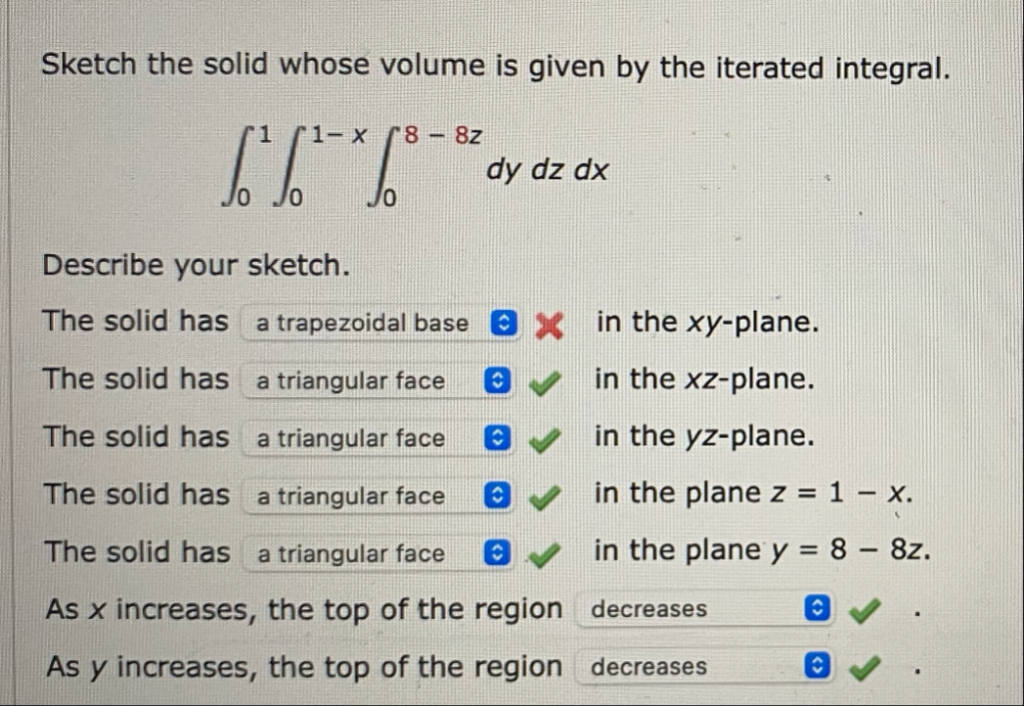 | Sketch the solid whose volume is given by the iterated integral.
| 8 I x ie -8z
dy dz dx
| o Jo 0 |
Describe your sketch.
| The solid has a trapezoidal base in the xy-plane.
The solid has a triangular face @ ¢ in the xz-plane.
| The solid has a triangular face « inthe yz-plane.
The solid has a triangular face « intheplanez=1 — X.
| The solid has a triangular face @ «7 inthe planey = 8 — 8z.
| As X increases, the top of the region decreases B8v .
i As y increases, the top of the region decreases &
| Sketch the solid whose volume is given by the iterated integral.
| 8 I x ie -8z
dy dz dx
| o Jo 0 |
Describe your sketch.
| The solid has a trapezoidal base in the xy-plane.
The solid has a triangular face @ ¢ in the xz-plane.
| The solid has a triangular face « inthe yz-plane.
The solid has a triangular face « intheplanez=1 — X.
| The solid has a triangular face @ «7 inthe planey = 8 — 8z.
| As X increases, the top of the region decreases B8v .
i As y increases, the top of the region decreases &
This is AI generated Response.
Asked by: gvr
Created at: 2025-07-29 07:12:20
Asked by: gvr
Created at: 2025-07-29 07:12:20
Final Answer:
Rendered
Raw Text
Did you like this answer?
Let's break down the problem step by step:
### **Step 1: Understanding the Integral**
The given iterated integral is:
\[
\int_0^1 \int_0^{1-x} \int_0^{8-8z} dy \, dz \, dx
\]
- The **outer integral** is over \( x \) from 0 to 1.
- The **middle integral** is over \( z \) from 0 to \( 1-x \).
- The **inner integral** is over \( y \) from 0 to \( 8-8z \).
### **Step 2: Region Description**
#### **Bounds:**
- \( 0 \leq x \leq 1 \)
- \( 0 \leq z \leq 1-x \)
- \( 0 \leq y \leq 8 - 8z \)
#### **Geometric Interpretation:**
- For a fixed \( x \), \( z \) ranges from 0 to \( 1-x \), so the region in the \( xz \)-plane is a right triangle with corners at \((0,0), (1,0), (0,1)\).
- For a fixed \( z \), \( y \) ranges from 0 to \( 8-8z \), so as \( z \) increases, the upper bound for \( y \) decreases linearly.
### **Step 3: Faces and Base**
- The **base in the xy-plane**: When \( z=0 \), \( x \) runs from 0 to 1, and for each \( x \), \( y \) runs from 0 to \( 8 \), forming a rectangle. But the actual base projection in the \( xy \)-plane is not a **trapezoid**.
- The **face in the xz-plane**: Set \( y=0 \). The bounds are \( 0 \leq x \leq 1 \), \( 0 \leq z \leq 1-x \). That’s a triangle.
- The **face in the yz-plane**: Set \( x=0 \). \( 0 \leq z \leq 1 \), \( 0 \leq y \leq 8-8z \). That’s also a triangle.
- The **face in \( z=1-x \)**: Substitute in the bounds for \( z \), gives a triangle.
- The **face in \( y = 8-8z \)**: Rearranged as \( z = 1 - \frac{y}{8} \); again, a triangle.
### **Step 4: Effect of Increasing Variables**
- As \( x \) increases, the upper bound for \( z \) (**top of the region**) decreases, since \( z \leq 1-x \).
- As \( y \) increases, for a fixed \( z \), the allowable \( z \) decreases, since \( y \leq 8-8z \Rightarrow z \leq 1-\frac{y}{8} \).
---
## **Final Answers (Based on the Options Given):**
**Correct answers highlighted with ✓:**
- The solid has **a trapezoidal base** in the xy-plane. (**✗**)
- The solid has **a triangular face** in the xz-plane. (**✓**)
- The solid has **a triangular face** in the yz-plane. (**✓**)
- The solid has **a triangular face** in the plane \( z = 1 - x \). (**✓**)
- The solid has **a triangular face** in the plane \( y = 8 - 8z \). (**✓**)
- As \( x \) increases, the top of the region **decreases**. (**✓**)
- As \( y \) increases, the top of the region **decreases**. (**✓**)
---
## **Summary Table (Copy of your selections with correct answers):**
| Description | Answer | Correct? |
|--------------------------------------------------------|------------------------ |:--------:|
| The solid has a trapezoidal base in the xy-plane. | ✗ | |
| The solid has a triangular face in the xz-plane. | ✓ | ✓ |
| The solid has a triangular face in the yz-plane. | ✓ | ✓ |
| The solid has a triangular face in \( z = 1-x \). | ✓ | ✓ |
| The solid has a triangular face in \( y = 8-8z \). | ✓ | ✓ |
| As \( x \) increases, the top of the region decreases. | ✓ | ✓ |
| As \( y \) increases, the top of the region decreases. | ✓ | ✓ |
---
### **Explanation**
The solid is a triangular prism-like region bounded by planes in the \( x, y, z \) axes, specifically defined by the given bounds in the iterated integral. The faces are triangular, and as \( x \) or \( y \) increases, the "top" of the region (in terms of \( z \)) decreases.
Question:
please correct the sentence which is wrong
This is AI generated Response.
Asked by: gvr
Created at: 2025-07-29 07:14:27
Asked by: gvr
Created at: 2025-07-29 07:14:27
Final Answer:
Rendered
Raw Text
Did you like this answer?
The statement **"The solid has a trapezoidal base in the xy-plane."** is incorrect based on the integral bounds.
**Corrected sentence:**
*The solid has a triangular base in the xy-plane.*
Question:
i need step by step detailed calculations of each part along with the final answer without table
This is AI generated Response.
Asked by: gvr
Created at: 2025-07-29 07:17:10
Asked by: gvr
Created at: 2025-07-29 07:17:10
Final Answer:
Rendered
Raw Text
Did you like this answer?
Let's analyze the given problem carefully and provide a detailed, step-by-step solution, including the interpretation of the integral, the region it describes, and the corresponding sketch description.
---
### Given Integral:
\[
\iiint_{V} dy\, dz\, dx = \int_{x=0}^{1} \int_{z=0}^{1 - x} \int_{y=0}^{8 - 8z} dy\, dz\, dx
\]
---
### Step 1: Understand the order of integration
- **Innermost integral:** \( y \) from 0 to \( 8 - 8z \)
- **Middle integral:** \( z \) from 0 to \( 1 - x \)
- **Outer integral:** \( x \) from 0 to 1
---
### Step 2: Interpret the bounds to find the region \(V\)
**1. Bounds on \( y \):**
\[
0 \leq y \leq 8 - 8z
\]
This describes a region in the \( y - z \) plane, for each fixed \( z \). The upper bound for \( y \) depends linearly on \( z \). When:
- \( z=0 \), \( y \leq 8 \),
- \( z=1 \), \( y \leq 0 \).
**2. Bounds on \( z \):**
\[
0 \leq z \leq 1 - x
\]
For each fixed \( x \), \( z \) ranges from 0 up to \( 1 - x \).
**3. Bounds on \( x \):**
\[
0 \leq x \leq 1
\]
---
### Step 3: Visualize the region
- For fixed \( x \), the \( z \)-coordinate runs from 0 to \( 1 - x \), forming a line decreasing from 1 to 0 as \( x \) increases.
- For fixed \( z \), \( y \) runs from 0 to \( 8 - 8z \). When \( z=0 \), the maximum \( y \) is 8; when \( z=1 \), \( y=0 \).
---
### Step 4: Describe the cross-sections
- **In the \( yz \)-plane** (for fixed \( x \)):
\[
0 \leq y \leq 8 - 8z, \quad 0 \leq z \leq 1 - x
\]
which describes a right triangle with vertices at:
\[
( y, z ) = (0, 0), \quad (8, 0), \quad (0, 1 - x)
\]
- **In the \( xz \)-plane** (for fixed \( y \)):
The bounds are \( 0 \leq z \leq 1 - x \), with \( x \) from 0 to 1, forming a triangular region in the \( xz \)-plane bounded by \( x=0 \), \( z=0 \), and \( z=1-x \).
---
### Step 5: Interpret the shape of the solid
- The base in the \( xy \)-plane:
At \( z=0 \), \( y \) ranges from 0 to 8. For each \( x \), the \( z \)-range depends on \( x \), so the projection in the \( xy \)-plane is a rectangle extending from \( (0,0) \) to \( (1,8) \).
- The top surface in \( z \):
Given \( z \leq 1 - x \), as \( x \) increases, the maximum value of \( z \) decreases, meaning the "top" surface slopes downward along the \( x \)-axis.
- The \( y \)-bound depends on \( z \), decreasing linearly as \( z \) increases.
---
### **Summary of the Region:**
- In the \( xy \)-plane, the projection is a rectangle \( 0 \leq x \leq 1 \), \( 0 \leq y \leq 8 \).
- The upper surface in the \( z \)-direction is sloped from \( z=1 \) at \( x=0 \) to \( z=0 \) at \( x=1 \).
- For each fixed \( z \), the \( y \)-coordinate runs from 0 up to \( 8 - 8z \), which is a line decreasing from 8 to 0 as \( z \) increases.
---
### **Sketch description:**
- The base in the \( xy \)-plane is a rectangle with vertices at \((0,0), (1,0), (1,8), (0,8)\).
- The top surface is a triangular plane sloping downward from \((x,z) = (0,1)\) to \((1,0)\).
- The surface in \( y \) extends from 0 up to the line \( y=8 -8z \), which decreases as \( z \) increases.
---
### **Final conclusion about the shape:**
The solid is bounded:
- **In \( x \):** from 0 to 1.
- **In \( z \):** from 0 to \( 1 - x \), decreasing linearly as \( x \) increases.
- **In \( y \):** from 0 to \( 8 - 8z \), decreasing linearly as \( z \) increases.
---
### **Answer to the description options:**
- The base in the \( xy \)-plane is a **rectangle** (not trapezoid).
- The face in the \( xz \)-plane is a **triangle** with vertices at \((0,0)\), \((1,0)\), \((0,1)\).
- The face in the \( yz \)-plane (at \( x=0 \)) is also a **triangle** with vertices at \((0,0)\), \((0,8)\), \((0,0)\).
- The face in the plane \( z = 1 - x \) is a **triangle** connecting the points \((0,1)\), \((1,0)\), and \((0,0)\).
- The face in \( y = 8 - 8z \) is a **triangle** in the \( y-z \) plane.
- As \( x \) increases, the maximum \( z \) decreases, so the top "slopes downward" in the \( x \)-direction.
- As \( y \) increases, the maximum \( z \) decreases, indicating the top surface slopes downward in \( y \)-direction as well.
---
### **Summary:**
- The **solid** is bounded above by the plane \( z = 1 - x \), which slopes downward from \( z=1 \) at \( x=0 \) to \( z=0 \) at \( x=1 \).
- Its **base** in the \( xy \)-plane is a rectangle from \((0,0)\) to \((1,8)\).
- The **side faces** are triangles in planes \( x=0 \), \( y=0 \), and the sloped planes \( z=1-x \) and \( y=8 - 8z \).
---
**Note:** The initial statement about a trapezoidal base is **incorrect**; the base is rectangular.
---
**Final answer:**
**The solid has a rectangular base in the xy-plane, with triangular faces in the xz- and yz-planes, bounded above by the sloped plane \( z=1 - x \), and the top sloping downward as \( x \) increases.**
📢 Instructions:
- Ask anything relatd to above question only.
- For new Question goto :