Give step-by-step solution with explanation and final answer:Executive Overview [Author]: Write a brief paragraph that summarizes specific information required for
the executives reading the document. This brief profile states what the project is, what you intend to do
+ and how. This summary will convey a lasting impression of you and your company, and lets others
‘assess your chances of success. Remember, you want to entice customers to consider your plan and
show your skill at being effective in managing a project Itis also important to be innovative, especially
in situations where the projects need does not it within the traditional guidelines of project
management (outlined in the PMBOK® Guide). The following information should be included.
Summary overview of project descriptionProject planned start and end datesBusiness need and
benefitsProject stakeholdersProject milestonesPlanned overall budget Background: Research the
internet or other sources to identify the background information on the client and/or product. Provide
any historical information available on the project that might be helpful for the project stakeholders’
knowledge (for example, type of business, client customers, product and service offerings, etc).
Discuss any subtle nuances that are different and need to be addressed by the project team, specifically
if 2 new way of managing the project is required for the industry selected Objective: Must be a
‘quantifiable statement, establishing the criteria that must be met for the project to be considered
successful The objective should be stated as: To. ... do something... by month xx, year. Scope.
Statement [Author]: Create a project scope statement that provides the scope for the project This is
based on the requirements, deliverables, assumptions, and constraints identified by the
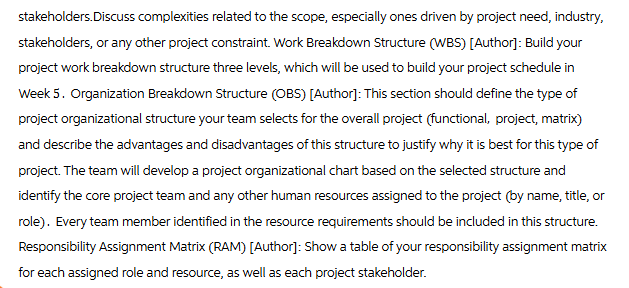
stakeholders Discuss complexities related to the scope, especially ones driven by project need, industry,
stakeholders, or any other project constraint. Work Breakdown Structure (WBS) [Author]: Build your
project work breakdown structure three levels, which will be used to build your project schedule in
‘Week 5. Organization Breakdown Structure (OBS) [Author]: This section should define the type of
project organizational structure your team selects for the overall project (functional, project, matrix)
‘and describe the advantages and disadvantages of this structure to justify why its best for this type of
project. The team will develop a project organizational chart based on the selected structure and
identify the core project team and any other human resources assigned to the project (by name, ttle, or
ole). Every team member identified in the resource requirements should be included in this structure.
Responsibility Assignment Matrix (RAM) [Author]: Show a table of your responsibilty assignment matrix
for each assigned role and resource, as well as each project stakeholder.
Question:
Give step-by-step solution with explanation and final answer:Executive Overview [Author]: Write a brief paragraph that summarizes specific information required for
the executives reading the document. This brief profile states what the project is, what you intend to do
+ and how. This summary will convey a lasting impression of you and your company, and lets others
‘assess your chances of success. Remember, you want to entice customers to consider your plan and
show your skill at being effective in managing a project Itis also important to be innovative, especially
in situations where the projects need does not it within the traditional guidelines of project
management (outlined in the PMBOK® Guide). The following information should be included.
Summary overview of project descriptionProject planned start and end datesBusiness need and
benefitsProject stakeholdersProject milestonesPlanned overall budget Background: Research the
internet or other sources to identify the background information on the client and/or product. Provide
any historical information available on the project that might be helpful for the project stakeholders’
knowledge (for example, type of business, client customers, product and service offerings, etc).
Discuss any subtle nuances that are different and need to be addressed by the project team, specifically
if 2 new way of managing the project is required for the industry selected Objective: Must be a
‘quantifiable statement, establishing the criteria that must be met for the project to be considered
successful The objective should be stated as: To. ... do something... by month xx, year. Scope.
Statement [Author]: Create a project scope statement that provides the scope for the project This is
based on the requirements, deliverables, assumptions, and constraints identified by the
stakeholders Discuss complexities related to the scope, especially ones driven by project need, industry,
stakeholders, or any other project constraint. Work Breakdown Structure (WBS) [Author]: Build your
project work breakdown structure three levels, which will be used to build your project schedule in
‘Week 5. Organization Breakdown Structure (OBS) [Author]: This section should define the type of
project organizational structure your team selects for the overall project (functional, project, matrix)
‘and describe the advantages and disadvantages of this structure to justify why its best for this type of
project. The team will develop a project organizational chart based on the selected structure and
identify the core project team and any other human resources assigned to the project (by name, ttle, or
ole). Every team member identified in the resource requirements should be included in this structure.
Responsibility Assignment Matrix (RAM) [Author]: Show a table of your responsibilty assignment matrix
for each assigned role and resource, as well as each project stakeholder.
This is AI generated Response.
Asked by: gvr
Created at: 2025-07-29 08:03:52
Final Answer:
RenderedRaw Text
Did you like this answer?
Certainly! Let's break down the steps required based on the instructions in the image. This is not a math problem, but rather a **project management assignment** guideline. Here’s a step-by-step solution and explanation for completing the assignment described:
---
### **Step-by-Step Solution and Explanation**
#### **Step 1: Write the Executive Overview**
- **What to do:** Write a brief paragraph summarizing the project.
- **What to include:**
- What the project is
- What you intend to do
- How you intend to do it
- **Purpose:** To leave a strong impression, entice stakeholders, and showcase your project management skills.
#### **Step 2: Provide a Summary Overview**
- **What to include:**
- Project description
- Planned start and end dates
- Business need and benefits
- Stakeholders
- Project milestones
- Planned overall budget
#### **Step 3: Write the Background**
- **What to do:** Research and summarize background information on the client and/or product.
- **What to include:**
- Type of business
- Client customers
- Product and service offerings
- Any relevant historical or contextual information
- Any nuances or special considerations for this project
#### **Step 4: Define the Objective**
- **What to do:** Create a quantifiable project objective.
- **How to write it:**
- State the objective as: "To [do something] by [month xx, year]."
- The objective must be measurable and define success criteria.
#### **Step 5: Create the Scope Statement**
- **What to do:** Describe the project scope.
- **What to include:**
- Requirements
- Deliverables
- Assumptions
- Constraints
- **Discuss:** Any scope-related complexities arising from industry, stakeholders, constraints, etc.
#### **Step 6: Develop the Work Breakdown Structure (WBS)**
- **What to do:** Build a WBS with at least three levels.
- **Purpose:** This will be used later to create the project schedule.
- **Format:** Typically shown as a hierarchical chart or outline.
#### **Step 7: Define the Organization Breakdown Structure (OBS)**
- **What to do:** Define and justify the project’s organizational structure.
- **Types:** Functional, project, matrix.
- **Include:**
- Advantages and disadvantages of the chosen structure
- Organizational chart showing core team and resource assignments
- Every team member identified in the resource requirements
#### **Step 8: Create the Responsibility Assignment Matrix (RAM)**
- **What to do:** Make a table showing which roles/resources are responsible for each task and stakeholder.
- **Typical format:** A matrix/table with tasks on one axis and people/roles on the other, using codes like R (Responsible), A (Accountable), C (Consulted), I (Informed).
---
### **Final Answer (Summary Table):**
| **Step** | **Action** | **Key Content** |
|-------------------|-------------------------------------------------------------------------------|---------------------------------------------------------------------------------------------------------|
| 1. Executive Overview | Brief summary of project, goals, and approach | What, why, how |
| 2. Summary Overview | Project description, dates, business need, benefits, stakeholders, milestones | High-level project info |
| 3. Background | Research client/product, context, history, nuances | Client/product details, industry context |
| 4. Objective | Quantifiable statement of success criteria | "To ___ by ___ (date)" |
| 5. Scope Statement | Scope, requirements, deliverables, assumptions, constraints | Define scope, note complexities |
| 6. Work Breakdown Structure| Hierarchical decomposition of project (3 levels) | WBS chart/outline |
| 7. Organization Breakdown | Define & justify structure, org chart, resource assignments | Structure type, advantages, team roles |
| 8. Responsibility Matrix | Table of roles/resources vs. tasks/stakeholders | RAM table (RACI format) |
---
### **Conclusion**
Follow these steps to structure your project management assignment. Each section should be clearly labeled and address the required aspects as outlined above. This method ensures you meet all requirements stated in the guideline.
**If you need an example for any specific section (like WBS or RAM), let me know!**
Question:
i need step by step detailed explanations of each part along with the final answer
This is AI generated Response.
Asked by: gvr
Created at: 2025-07-29 08:05:56
Final Answer:
RenderedRaw Text
Did you like this answer?
Certainly! Below is a **detailed step-by-step explanation** of each part of the project management assignment, including **what to do, how to do it, and why it is important**. This will help you understand each component thoroughly and craft a comprehensive project plan.
---
### **1. Executive Overview**
**What to do:**
Write a brief, compelling paragraph summarizing the entire project.
**How to do it:**
- **Identify what the project is:** Clearly state the purpose or nature of the project (e.g., launching a new product, implementing a new system).
- **Describe what you intend to do:** Summarize the main activities or goals.
- **Explain how you will do it:** Mention key strategies, innovative approaches, or methodologies.
- **Make it concise but impactful:** The goal is to leave a positive, lasting impression that entices stakeholders.
**Why it's important:**
This overview sets the tone, highlights your understanding, and persuades stakeholders of your competence.
**Example:**
*"This project involves developing a cutting-edge mobile application to enhance customer engagement for XYZ Retail. We plan to leverage agile methodologies and innovative UI/UX design to deliver a user-friendly platform by Q4 2024, ensuring increased customer retention and sales."*
---
### **2. Summary Overview of Project**
**What to do:**
Create a snapshot of the project’s key details.
**How to do it:**
- **Project description:** Briefly describe what the project will deliver.
- **Planned start and end dates:** Specify the timeline.
- **Business need and benefits:** Explain the problem being solved and the value added.
- **Stakeholders:** List primary stakeholders, like clients, team members, sponsors.
- **Milestones:** Identify key phases or deliverables.
- **Overall budget:** Provide an estimate or range.
**Why it's important:**
Provides stakeholders with high-level clarity and expectations.
**Example:**
*"The project aims to develop a new online portal for ABC Bank, starting January 2024 and completing by December 2024. It addresses the need for digital banking solutions, offering increased accessibility and customer satisfaction, with a budget estimated at $2 million. Key milestones include design completion, beta testing, and launch."*
---
### **3. Background**
**What to do:**
Research and summarize relevant background information.
**How to do it:**
- **Identify the client/business context:** Industry type, history, size.
- **Product/Service details:** What the client offers, unique features.
- **Historical info:** Past projects, successes, challenges.
- **Nuances & industry considerations:** Any regulations, standards, or industry-specific needs.
- **Subtle nuances:** Identify special requirements that might influence project management (e.g., regulatory compliance, industry norms).
**Why it's important:**
Helps stakeholders understand the environment, risks, and special considerations.
**Example:**
*"XYZ Retail has been a leader in e-commerce for 10 years, serving a diverse customer base. The project involves integrating AI-driven chatbots into their existing platform, requiring adherence to data privacy laws and innovative customer service approaches."*
---
### **4. Objective**
**What to do:**
Craft a measurable, specific goal.
**How to do it:**
- Use the format:
*"To [achieve a specific result] by [month, year]."*
- Ensure it is quantifiable, e.g., sales increase, system performance metrics, customer satisfaction scores.
**Why it's important:**
Defines success criteria and provides a target for the project team.
**Example:**
*"To increase customer onboarding efficiency by 30% through automation by December 2024."*
---
### **5. Scope Statement**
**What to do:**
Define what the project will and will not include.
**How to do it:**
- List **requirements** (what must be delivered).
- Specify **deliverables** (products, reports, systems).
- State **assumptions** (e.g., resource availability).
- Note **constraints** (budget, time, technology).
- Discuss **complexities**: Industry-specific regulations, stakeholder expectations, technical challenges, or constraints that impact scope.
**Why it's important:**
Prevents scope creep and clarifies boundaries.
**Example:**
*"The scope includes designing, developing, and testing the new mobile app for XYZ Retail. It excludes ongoing maintenance post-launch. Assumptions include availability of UI/UX designers; constraints include a fixed deadline of Q4 2024."*
---
### **6. Work Breakdown Structure (WBS)**
**What to do:**
Break down the project into manageable sections, at least three levels deep.
**How to do it:**
- Start with the **main deliverable** (Level 1).
- Decompose into **sub-deliverables or phases** (Level 2).
- Further break down into **tasks or work packages** (Level 3).
- Use hierarchical outline or chart format.
**Why it's important:**
Facilitates detailed planning, resource allocation, and schedule creation.
**Example (for a software project):**
- Level 1: Mobile App Development
- Level 2: Design Phase, Development Phase, Testing Phase
- Level 3 under Design: Wireframing, UI Design, Prototype Creation
---
### **7. Organization Breakdown Structure (OBS)**
**What to do:**
Define how the project team is organized.
**How to do it:**
- Choose an organizational structure:
- **Functional:** Teams based on functions (e.g., design, development).
- **Project:** Dedicated team for this project only.
- **Matrix:** Hybrid, with team members reporting to both functional managers and project managers.
- Justify your choice based on project needs (e.g., flexibility, control).
- Create an org chart showing roles and relationships.
**Why it's important:**
Clarifies authority, responsibility, and communication pathways.
**Example:**
*"A matrix structure is chosen to leverage both functional expertise and project focus, allowing for flexible resource sharing across design and development teams."*
---
### **8. Responsibility Assignment Matrix (RAM)**
**What to do:**
Map roles and resources to project tasks and stakeholders.
**How to do it:**
- List all tasks from the WBS.
- List all roles/resources involved.
- For each task, assign responsibility levels, typically using RACI codes:
- **R:** Responsible (does the work)
- **A:** Accountable (approves, signs off)
- **C:** Consulted (provides input)
- **I:** Informed (kept updated)
- Fill the matrix accordingly.
**Why it's important:**
Ensures everyone knows their responsibilities, reduces confusion, and improves accountability.
**Example:**
| Tasks | Project Manager | Designer | Developer | Tester | Stakeholder |
|------------------------|------------------|----------|-----------|--------|-------------|
| Requirements Gathering | A | C | I | I | C |
| UI Design | I | R | C | I | I |
| Coding | I | C | R | I | I |
| Testing | I | C | C | R | I |
| Deployment | R | I | I | C | A |
---
### **Final Summary:**
| **Part** | **What to Do** | **Key Points** |
|------------------------------|--------------------------------------------------------------------------------|---------------------------------------------------------------------------------------------------|
| Executive Overview | Summarize project in a compelling paragraph | Purpose, goals, approach |
| Summary Overview | High-level project details (dates, benefits, milestones, budget) | Clear, concise snapshot |
| Background | Research and describe context, history, nuances | Industry specifics, client profile, unique challenges |
| Objective | Quantifiable success criteria | "To achieve X by Y date" |
| Scope Statement | Define what is included/excluded, constraints, complexities | Prevent scope creep, clarify boundaries |
| Work Breakdown Structure | Hierarchical breakdown of work (3 levels) | Facilitates planning and scheduling |
| Organization Breakdown Structure| Define team structure, justify choice, org chart | Clarifies roles, responsibilities, authority |
| Responsibility Assignment Matrix| Map tasks to roles/responsibilities (RACI) | Ensures clarity, accountability |
---
### **In conclusion:**
Following these detailed steps will help you craft a comprehensive and well-structured project management plan that aligns with stakeholder expectations and industry needs. If you need specific examples or templates for any part, I can provide those as well!
Question:
i dont need tables please generate the now
This is AI generated Response.
Asked by: gvr
Created at: 2025-07-29 08:06:44
Final Answer:
RenderedRaw Text
Did you like this answer?
Certainly! Below is a detailed, step-by-step explanation of each part of the project management assignment, including what to do, how to do it, and why it is important, all presented in a narrative format without tables.
---
### 1. Executive Overview
Begin by writing a brief, compelling paragraph that summarizes the entire project. This paragraph should clearly state what the project is about, what your main objectives are, and the approach you plan to take. For example, you might describe the development of a new product, the implementation of a system, or a service enhancement. Be concise but impactful to capture the attention of stakeholders. Emphasize your understanding of the project's purpose, the innovative strategies you plan to employ, and how your approach aligns with the company's goals. This overview sets the tone for the entire document and leaves a positive, lasting impression, showcasing your ability to manage projects effectively.
### 2. Summary Overview of the Project
Create a high-level snapshot of the key details of the project. Start by describing what the project aims to deliver or achieve. Clearly specify the planned start and end dates to establish the timeline. Explain the underlying business need that the project addresses, along with the benefits it is expected to bring, such as increased efficiency, revenue, customer satisfaction, or competitive advantage. Identify the primary stakeholders involved, including clients, project team members, sponsors, and end-users. Highlight the major milestones that mark significant phases or deliverables within the project lifecycle. Finally, provide an overall budget estimate or range to give stakeholders an idea of the financial scope. This summary provides clarity and sets expectations for all involved parties.
### 3. Background
Research and gather background information relevant to the client or product involved in the project. Summarize the industry context, the history of the client or product, and any pertinent details such as the company's size, market position, and customer base. Include information about existing products or services, past projects, successes, and challenges that may influence the current initiative. Pay attention to any subtle nuances or industry-specific considerations, such as regulatory requirements, technological standards, or market trends, that may impact how the project is managed. Highlighting these details helps stakeholders understand the environment in which the project operates, the risks involved, and any unique aspects that require special attention.
### 4. Objective
Formulate a clear, measurable objective for the project. This statement should specify what you aim to accomplish and by when. For example, you might state, "To develop a new mobile application that increases customer engagement by 20% by December 2024." The objective must be quantifiable, providing criteria against which success can be measured. This clarity helps guide project planning, resource allocation, and performance evaluation, ensuring that all stakeholders understand what success looks like and when it should be achieved.
### 5. Scope Statement
Define the boundaries of the project by specifying what is included and what is excluded. Describe the key requirements and deliverables that the project must produce. Mention any assumptions you are making, such as resource availability or technological capabilities, and list constraints like budget limits, fixed deadlines, or specific industry regulations. Discuss any complexities related to the scope, such as industry-specific challenges, stakeholder expectations, or technical difficulties that could influence project execution. Clearly articulating the scope ensures that all stakeholders have a shared understanding of what the project will deliver and helps prevent scope creep or misunderstandings during execution.
### 6. Work Breakdown Structure (WBS)
Develop a hierarchical decomposition of the project into manageable components, at least three levels deep. Start with the main deliverable or project phase as the top level. Break this down into sub-deliverables or phases, and further decompose each into smaller work packages or tasks. For example, if the project involves developing a software application, the top level might be "Software Development," with sub-levels like "Design," "Development," and "Testing," each further broken down into specific tasks such as wireframing, coding, and quality assurance. This structured breakdown helps in detailed planning, resource allocation, and scheduling, providing a clear roadmap of what needs to be accomplished.
### 7. Organization Breakdown Structure (OBS)
Define the project's organizational structure and justify your choice. Decide whether a functional, project, or matrix structure best suits your project’s needs. For example, a functional structure groups team members by their specialties, while a project structure assigns dedicated teams to the project, and a matrix combines both approaches. Explain the advantages and disadvantages of your chosen structure in terms of flexibility, control, communication, and resource utilization. Create an organizational chart that illustrates roles and reporting relationships. Clearly identify the core project team, including key roles and responsibilities, along with any additional human resources assigned to the project. This clarity ensures effective communication and decision-making throughout the project.
### 8. Responsibility Assignment Matrix (RAM)
Create a responsibility assignment matrix that maps each task or work package from the WBS to specific roles or resources, using responsibility codes such as Responsible, Accountable, Consulted, and Informed (RACI). For each task, specify who is responsible for executing the work, who is accountable for final approval, who needs to be consulted during the process, and who should be kept informed of progress. This matrix ensures clarity in responsibilities, helps prevent overlaps or gaps, and enhances accountability. It also facilitates communication planning and resource management by clearly delineating each stakeholder’s role in the project.
---
### Final Remarks:
Following these detailed steps will help you develop a comprehensive project management plan that clearly articulates the project's purpose, scope, organizational structure, and responsibilities. Each component builds upon the previous, ensuring that stakeholders understand the project from high-level intent to detailed execution responsibilities. Remember to tailor each part to the specific project context and industry requirements, and to include any relevant nuances or special considerations that may influence project success.
If you need help with specific examples or templates for any section, feel free to ask!
VIPSolutions focuses on clear, step‑by‑step explanations so you can learn quickly. Whether you need an AI‑generated walkthrough or a short hint to get unstuck, each solution is organized for fast reading and easy review later.
Search similar questions, compare approaches, and bookmark the best answers for revision. Our goal is simple: quick, reliable study help that feels natural—not noisy.
 VIPSolutions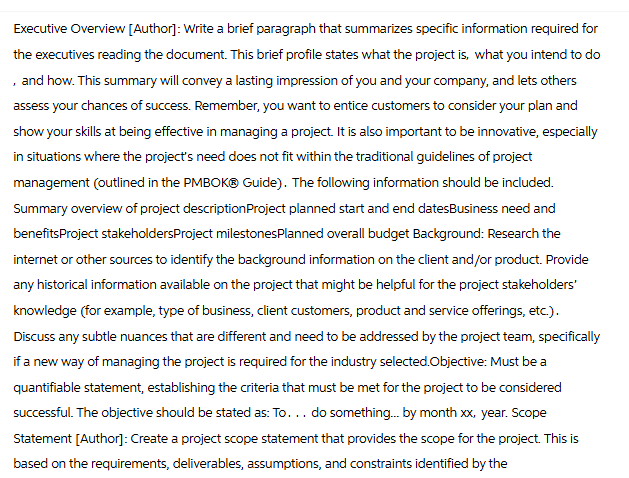
 Executive Overview [Author]: Write a brief paragraph that summarizes specific information required for
the executives reading the document. This brief profile states what the project is, what you intend to do
+ and how. This summary will convey a lasting impression of you and your company, and lets others
‘assess your chances of success. Remember, you want to entice customers to consider your plan and
show your skill at being effective in managing a project Itis also important to be innovative, especially
in situations where the projects need does not it within the traditional guidelines of project
management (outlined in the PMBOK® Guide). The following information should be included.
Summary overview of project descriptionProject planned start and end datesBusiness need and
benefitsProject stakeholdersProject milestonesPlanned overall budget Background: Research the
internet or other sources to identify the background information on the client and/or product. Provide
any historical information available on the project that might be helpful for the project stakeholders’
knowledge (for example, type of business, client customers, product and service offerings, etc).
Discuss any subtle nuances that are different and need to be addressed by the project team, specifically
if 2 new way of managing the project is required for the industry selected Objective: Must be a
‘quantifiable statement, establishing the criteria that must be met for the project to be considered
successful The objective should be stated as: To. ... do something... by month xx, year. Scope.
Statement [Author]: Create a project scope statement that provides the scope for the project This is
based on the requirements, deliverables, assumptions, and constraints identified by the
stakeholders Discuss complexities related to the scope, especially ones driven by project need, industry,
stakeholders, or any other project constraint. Work Breakdown Structure (WBS) [Author]: Build your
project work breakdown structure three levels, which will be used to build your project schedule in
‘Week 5. Organization Breakdown Structure (OBS) [Author]: This section should define the type of
project organizational structure your team selects for the overall project (functional, project, matrix)
‘and describe the advantages and disadvantages of this structure to justify why its best for this type of
project. The team will develop a project organizational chart based on the selected structure and
identify the core project team and any other human resources assigned to the project (by name, ttle, or
ole). Every team member identified in the resource requirements should be included in this structure.
Responsibility Assignment Matrix (RAM) [Author]: Show a table of your responsibilty assignment matrix
for each assigned role and resource, as well as each project stakeholder.
Executive Overview [Author]: Write a brief paragraph that summarizes specific information required for
the executives reading the document. This brief profile states what the project is, what you intend to do
+ and how. This summary will convey a lasting impression of you and your company, and lets others
‘assess your chances of success. Remember, you want to entice customers to consider your plan and
show your skill at being effective in managing a project Itis also important to be innovative, especially
in situations where the projects need does not it within the traditional guidelines of project
management (outlined in the PMBOK® Guide). The following information should be included.
Summary overview of project descriptionProject planned start and end datesBusiness need and
benefitsProject stakeholdersProject milestonesPlanned overall budget Background: Research the
internet or other sources to identify the background information on the client and/or product. Provide
any historical information available on the project that might be helpful for the project stakeholders’
knowledge (for example, type of business, client customers, product and service offerings, etc).
Discuss any subtle nuances that are different and need to be addressed by the project team, specifically
if 2 new way of managing the project is required for the industry selected Objective: Must be a
‘quantifiable statement, establishing the criteria that must be met for the project to be considered
successful The objective should be stated as: To. ... do something... by month xx, year. Scope.
Statement [Author]: Create a project scope statement that provides the scope for the project This is
based on the requirements, deliverables, assumptions, and constraints identified by the
stakeholders Discuss complexities related to the scope, especially ones driven by project need, industry,
stakeholders, or any other project constraint. Work Breakdown Structure (WBS) [Author]: Build your
project work breakdown structure three levels, which will be used to build your project schedule in
‘Week 5. Organization Breakdown Structure (OBS) [Author]: This section should define the type of
project organizational structure your team selects for the overall project (functional, project, matrix)
‘and describe the advantages and disadvantages of this structure to justify why its best for this type of
project. The team will develop a project organizational chart based on the selected structure and
identify the core project team and any other human resources assigned to the project (by name, ttle, or
ole). Every team member identified in the resource requirements should be included in this structure.
Responsibility Assignment Matrix (RAM) [Author]: Show a table of your responsibilty assignment matrix
for each assigned role and resource, as well as each project stakeholder.