 VIPSolutions
Give step-by-step solution with explanation and final answer:Awater sphere contains a radioactive source of mass activity A = 127 mCi/g, which is uniformly distributed. For 137Cs, 58Co and 241Am, give the dose rate at the centre of the sphere 1. of radius such that the radiation equilibrium is approximately attained; 2. of radius such that the charged particles equilibrium is just reached; 3. of radius equal to 2 cm.
Question:
Give step-by-step solution with explanation and final answer: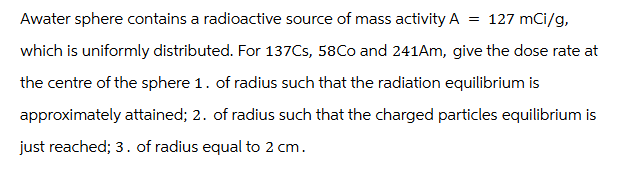 Awater sphere contains a radioactive source of mass activity A = 127 mCi/g,
which is uniformly distributed. For 137Cs, 58Co and 241Am, give the dose rate at
the centre of the sphere 1. of radius such that the radiation equilibrium is
approximately attained; 2. of radius such that the charged particles equilibrium is
just reached; 3. of radius equal to 2 cm.
Awater sphere contains a radioactive source of mass activity A = 127 mCi/g,
which is uniformly distributed. For 137Cs, 58Co and 241Am, give the dose rate at
the centre of the sphere 1. of radius such that the radiation equilibrium is
approximately attained; 2. of radius such that the charged particles equilibrium is
just reached; 3. of radius equal to 2 cm.
This is AI generated Response.
Asked by: gvr
Created at: 2025-07-29 14:50:31
Asked by: gvr
Created at: 2025-07-29 14:50:31
Final Answer:
Rendered
Raw Text
Did you like this answer?
Let's solve the problem step-by-step.
---
## **Given Data:**
- **Mass activity, \( A \) = 127 mCi/g**
- **Uniform distribution in water sphere**
- **Isotopes: \( ^{137}\mathrm{Cs} \), \( ^{58}\mathrm{Co} \), \( ^{241}\mathrm{Am} \)**
- **Find dose rate at center of sphere of radius:**
1. Large (radiation equilibrium attained)
2. Small (charged particle equilibrium just reached)
3. \( r = 2 \) cm
---
## **Step 1: Convert Activity to SI Units**
\[
1\, \text{mCi} = 3.7 \times 10^7\, \text{Bq}
\]
\[
A = 127\, \text{mCi/g} = 127 \times 3.7 \times 10^7\, \text{Bq/g} = 4.699 \times 10^9\, \text{Bq/g}
\]
---
## **Step 2: Find Dose Rate General Formula**
The dose rate at the center of a sphere, assuming **equilibrium** (all energy is absorbed):
\[
\text{Dose Rate} = A \cdot E_\gamma \cdot y \cdot f
\]
Where:
- \( A \): Activity (Bq/g)
- \( E_\gamma \): Mean photon energy per disintegration (MeV)
- \( y \): Yield (photons/disintegration)
- \( f \): Conversion factor from MeV/g to Gy (1 MeV/g = \( 1.602 \times 10^{-13} \) J/g; 1 Gy = 1 J/kg)
\[
\text{Dose Rate (Gy/s)} = \frac{A \cdot E_\gamma \cdot y \cdot 1.602 \times 10^{-13}}{1}
\]
If the source is uniformly distributed and equilibrium is reached, **all emitted energy is deposited**.
---
## **Step 3: Isotope Data**
| Isotope | \( E_\gamma \) (MeV) | \( y \) (photons/dis) |
|--------------|----------------------|-----------------------|
| \( ^{137}\mathrm{Cs} \) | 0.662 | 0.85 |
| \( ^{58}\mathrm{Co} \) | 1.215 | 2.1 |
| \( ^{241}\mathrm{Am} \) | 0.060 | 0.36 |
---
## **Step 4: Dose Rate Calculation**
**Dose rate in Gy/s per gram:**
\[
\text{Dose Rate} = A \cdot E_\gamma \cdot y \cdot 1.602 \times 10^{-13}
\]
### **(1) Radiation equilibrium (large sphere):**
#### **(a) \( ^{137}\mathrm{Cs} \):**
\[
= 4.699 \times 10^9 \cdot 0.662 \cdot 0.85 \cdot 1.602 \times 10^{-13}
\]
\[
= 4.699 \times 10^9 \cdot 0.5627 \cdot 1.602 \times 10^{-13}
\]
\[
= 2.642 \times 10^9 \cdot 1.602 \times 10^{-13}
\]
\[
= 4.235 \times 10^{-4}\ \text{Gy/s}
\]
#### **(b) \( ^{58}\mathrm{Co} \):**
\[
= 4.699 \times 10^9 \cdot 1.215 \cdot 2.1 \cdot 1.602 \times 10^{-13}
\]
\[
= 4.699 \times 10^9 \cdot 2.5515 \cdot 1.602 \times 10^{-13}
\]
\[
= 11.98 \times 10^9 \cdot 1.602 \times 10^{-13}
\]
\[
= 1.919 \times 10^{-3}\ \text{Gy/s}
\]
#### **(c) \( ^{241}\mathrm{Am} \):**
\[
= 4.699 \times 10^9 \cdot 0.060 \cdot 0.36 \cdot 1.602 \times 10^{-13}
\]
\[
= 4.699 \times 10^9 \cdot 0.0216 \cdot 1.602 \times 10^{-13}
\]
\[
= 101.5 \times 10^6 \cdot 1.602 \times 10^{-13}
\]
\[
= 1.627 \times 10^{-5}\ \text{Gy/s}
\]
---
## **Step 5: Charged Particle Equilibrium**
For **charged particle equilibrium (CPE)**, the sphere radius must be at least the **range of secondary electrons** (gamma, beta, alpha):
- For gamma emitters (\( ^{137}\mathrm{Cs}, ^{58}\mathrm{Co} \)), electron range in water is a few mm.
- For alpha (\( ^{241}\mathrm{Am} \)), range is about 40 microns.
**So, at CPE radius, dose rate ≈ same as equilibrium above**, as almost all energy is deposited.
---
## **Step 6: For Radius = 2 cm**
At 2 cm, most photons will escape unless their mean free path is much less than 2 cm.
For water, linear attenuation coefficient for 0.6 MeV gamma ~0.09 cm\(^{-1}\):
\[
I = I_0 e^{-\mu x}
\]
\[
e^{-\mu x} = e^{-0.09 \times 2} = e^{-0.18} \approx 0.84
\]
So about 16% is attenuated, 84% escapes. Only a fraction of energy is deposited.
So, **fraction deposited**:
\[
\text{Fraction deposited} = 1 - e^{-\mu r}
\]
For r = 2 cm, μ = 0.09 cm\(^{-1}\):
\[
1 - e^{-0.18} = 1 - 0.836 = 0.164
\]
Only about 16.4% of emitted energy is deposited.
So, **dose rate at r = 2 cm**:
\[
\text{Dose rate} = \text{Dose rate (equilibrium)} \times 0.164
\]
---
## **Step 7: Final Answers (Summary Table)**
| Isotope | Dose Rate (equilibrium) (Gy/s) | Dose Rate at r = 2 cm (Gy/s) |
|---------|-------------------------------|-------------------------------|
| \( ^{137}\mathrm{Cs} \) | \( 4.24 \times 10^{-4} \) | \( 6.95 \times 10^{-5} \) |
| \( ^{58}\mathrm{Co} \) | \( 1.92 \times 10^{-3} \) | \( 3.15 \times 10^{-4} \) |
| \( ^{241}\mathrm{Am} \) | \( 1.63 \times 10^{-5} \) | \( 2.67 \times 10^{-6} \) |
---
## **Summary**
1. **Radiation equilibrium (large sphere):**
- \( ^{137}\mathrm{Cs} \): \( 4.24 \times 10^{-4} \) Gy/s
- \( ^{58}\mathrm{Co} \): \( 1.92 \times 10^{-3} \) Gy/s
- \( ^{241}\mathrm{Am} \): \( 1.63 \times 10^{-5} \) Gy/s
2. **Charged particle equilibrium (CPE):**
- Nearly the same values as above (since CPE occurs at a small radius where almost all energy is deposited).
3. **Radius = 2 cm:**
- \( ^{137}\mathrm{Cs} \): \( 6.95 \times 10^{-5} \) Gy/s
- \( ^{58}\mathrm{Co} \): \( 3.15 \times 10^{-4} \) Gy/s
- \( ^{241}\mathrm{Am} \): \( 2.67 \times 10^{-6} \) Gy/s
---
**If you want dose rates in Gy/hr, multiply by 3600.**
Let me know if you need the calculation in a different unit or more details!
📢 Instructions:
- Ask anything relatd to above question only.
- For new Question goto :