This is AI generated Response.
Asked by: Kota Swarupa Rani
Created at: 2025-07-29 16:37:33
Final Answer:
RenderedRaw Text
Did you like this answer?
Let's analyze each part step-by-step, using the Phillips curve model of wage determination.
## Phillips Curve Model (Short Explanation)
The Phillips curve suggests an inverse relationship between unemployment and inflation (or wage inflation). If unemployment is at its "natural rate," expected inflation equals actual inflation, and there is no pressure for wages to accelerate or decelerate unexpectedly.
---
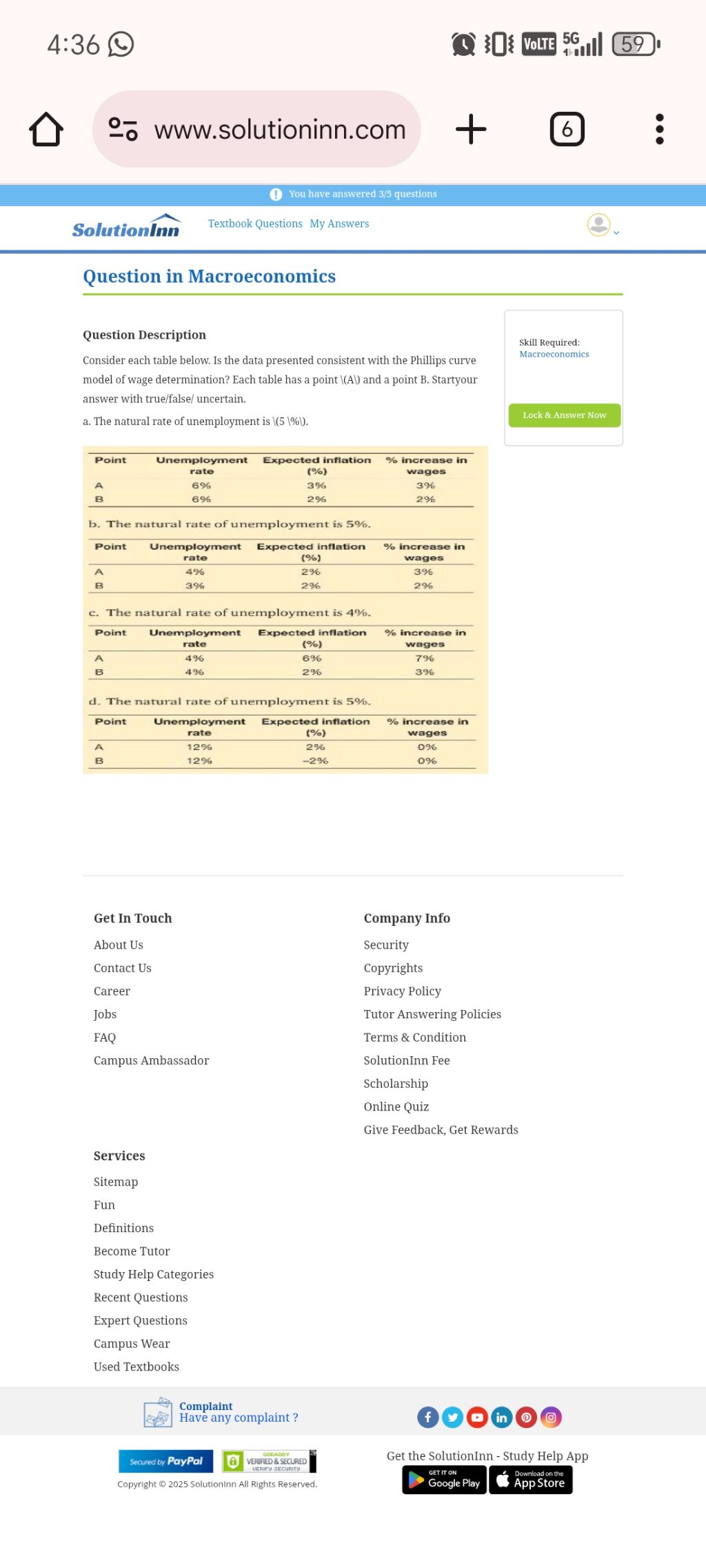
### a. The natural rate of unemployment is **5%**.
| Point | Unemployment Rate | Expected Inflation | % Increase in Wages |
|-------|------------------|-------------------|---------------------|
| A | 6% | 3% | 2% |
| B | 6% | 2% | 2% |
**Analysis:**
- At both points A and B, unemployment = 6% (higher than the supposed natural rate of 5%).
- According to the model, when unemployment is above the natural rate, actual wage growth should be **less than** expected inflation.
- In both cases, % wage increase (2%) is less than expected inflation (3% or 2%).
- This is **consistent** with the Phillips curve, but we cannot confirm that the natural rate is exactly 5% from this table alone because the unemployment rate never equals 5%.
**Answer:**
**Uncertain** (We cannot confirm the natural rate is 5% solely from this data).
---
### b. The natural rate of unemployment is **5%**.
| Point | Unemployment Rate | Expected Inflation | % Increase in Wages |
|-------|------------------|-------------------|---------------------|
| A | 8% | 6% | 2% |
| B | 3% | 2% | 6% |
**Analysis:**
- At A: Unemployment is 8% (above 5%), wage increase (2%) is less than expected inflation (6%).
- At B: Unemployment is 3% (below 5%), wage increase (6%) is more than expected inflation (2%).
- This matches the Phillips curve logic: wage increases are slower when unemployment is above the natural rate, and faster when below.
**Answer:**
**True** (Data is consistent with a natural rate of 5%).
---
### c. The natural rate of unemployment is **4%**.
| Point | Unemployment Rate | Expected Inflation | % Increase in Wages |
|-------|------------------|-------------------|---------------------|
| A | 4% | 6% | 7% |
| B | 4% | 2% | 3% |
**Analysis:**
- At both points, unemployment = 4% (supposed natural rate).
- Phillips curve implies: at the natural rate, % wage increase = expected inflation.
- Here, wage increases (7% and 3%) are higher than expected inflation (6% and 2%).
- This is **not** consistent with the Phillips curve (wage increases should equal expected inflation at the natural rate).
**Answer:**
**False** (Data is not consistent).
---
### d. The natural rate of unemployment is **5%**.
| Point | Unemployment Rate | Expected Inflation | % Increase in Wages |
|-------|------------------|-------------------|---------------------|
| A | 12% | 2% | 0% |
| B | 12% | -2% | 0% |
**Analysis:**
- At both points, unemployment = 12% (well above natural rate 5%).
- Wage increases are 0%, expected inflation is positive (2%) or negative (-2%).
- According to the Phillips curve, when unemployment is above the natural rate, wage increases should be less than expected inflation. Here, with expected inflation at 2%, wage increase is 0% (which fits), but with expected inflation at -2%, wage increase is 0% (which is higher).
- The data is **somewhat consistent** for point A, but **not consistent** for point B.
**Answer:**
**Uncertain** (Data is partially consistent but not clear for both cases).
---
## **Summary Table**
| Part | Is Data Consistent with Given Natural Rate? |
|------|--------------------------------------------|
| a | Uncertain |
| b | True |
| c | False |
| d | Uncertain |
---
### **Final Answers**
- **a. Uncertain**
- **b. True**
- **c. False**
- **d. Uncertain**
If you need a more detailed explanation for each, let me know!
Question:
Yes
This is AI generated Response.
Asked by: Kota Swarupa Rani
Created at: 2025-07-29 16:38:56
Final Answer:
RenderedRaw Text
Did you like this answer?
Let's analyze each part step-by-step, applying the Phillips curve concept of wage determination.
---
## Background on the Phillips Curve and Wage Determination
The Phillips curve suggests an inverse relationship between unemployment and inflation (or wage inflation). According to the model:
- When unemployment is at the *natural rate*, expected inflation equals actual inflation, and wages grow at the expected rate.
- When unemployment is *above* the natural rate, actual inflation and wage growth tend to be *less than* expected.
- When unemployment is *below* the natural rate, actual inflation and wage growth tend to be *greater than* expected.
---
## Part (a): Is the data consistent with a natural rate of 5%?
| Point | Unemployment | Expected Inflation (%) | Wage Increase (%) |
|--------|----------------|------------------------|------------------|
| A | 6% | 3% | 2% |
| B | 6% | 2% | 2% |
**Analysis:**
- Both points have unemployment at 6%, which is **above** the assumed natural rate of 5%.
- According to the Phillips curve, when unemployment > natural rate, wage increases should be **less than** expected inflation.
- At both points, actual wage growth (2%) is less than expected inflation (3% and 2%), consistent with the theory.
- Since unemployment is above 5% and wages are growing slower than expected, this is **consistent** with a natural rate of 5%.
**However**, because the unemployment rate is not exactly equal to 5%, and the data points are at 6%, **we cannot definitively confirm** the natural rate is 5%. It is compatible, but not conclusive.
**Conclusion:** **Uncertain**.
---
## Part (b): Is the data consistent with a natural rate of 5%?
| Point | Unemployment | Expected Inflation (%) | Wage Increase (%) |
|--------|----------------|------------------------|------------------|
| A | 8% | 6% | 2% |
| B | 3% | 2% | 6% |
**Analysis:**
- **Point A:** Unemployment at 8% (>5%), wage increase = 2%, expected inflation = 6%.
- Since unemployment > natural rate, actual wage growth should be **less than** expected inflation, which it is (2% vs. 6%). ✔️
- **Point B:** Unemployment at 3% (<5%), wage increase = 6%, expected inflation = 2%.
- Since unemployment < natural rate, actual wage growth should be **greater than** expected inflation, which it is (6% vs. 2%). ✔️
**This pattern aligns perfectly** with the Phillips curve predictions.
**Conclusion:** **True**.
---
## Part (c): Is the data consistent with a natural rate of 4%?
| Point | Unemployment | Expected Inflation (%) | Wage Increase (%) |
|--------|----------------|------------------------|------------------|
| A | 4% | 6% | 7% |
| B | 4% | 2% | 3% |
**Analysis:**
- Both points have unemployment at 4%, assumed to be the natural rate.
- At natural rate, wage growth should **equal** expected inflation.
- Here, at both points:
- Point A: Expected inflation = 6%, actual wage increase = 7%.
- Wage growth is **higher** than expected inflation.
- Point B: Expected inflation = 2%, actual wage increase = 3%.
- Wage growth again is **higher** than expected.
**This indicates** wages are growing faster than expected inflation at the natural rate, which **contradicts** the Phillips curve assumption that at the natural rate, actual equals expected.
**Conclusion:** **False**.
---
## Part (d): Is the data consistent with a natural rate of 5%?
| Point | Unemployment | Expected Inflation (%) | Wage Increase (%) |
|--------|----------------|------------------------|------------------|
| A | 12% | 2% | 0% |
| B | 12% | -2% | 0% |
**Analysis:**
- Both points at unemployment = 12%, well above 5%.
- When unemployment > natural rate, wages should grow **less than** expected inflation.
- At Point A: Expected inflation = 2%, wage increase = 0% — consistent.
- At Point B: Expected inflation = -2%, wage increase = 0% — also somewhat consistent, as negative expected inflation suggests downward pressure, and wages are not growing.
**However**, the fact that wages are stagnant (0%) despite expected inflation being positive or negative is not inconsistent. It indicates wage growth is subdued when unemployment is high, aligning with the Phillips curve.
**Conclusion:** **Uncertain** — the data is somewhat consistent but not conclusively so.
---
## **Summary of Answers:**
| Part | Conclusion |
|--------|----------------------------------------------------------|
| a | Uncertain |
| b | True |
| c | False |
| d | Uncertain |
---
## **Final Note:**
The key takeaways are that the data in part (b) clearly aligns with the Phillips curve predictions for a natural rate of 5%. Parts (a) and (d) are less conclusive, and part (c) contradicts the model.
**Hope this helps clarify the reasoning!**
VIPSolutions focuses on clear, step‑by‑step explanations so you can learn quickly. Whether you need an AI‑generated walkthrough or a short hint to get unstuck, each solution is organized for fast reading and easy review later.
Search similar questions, compare approaches, and bookmark the best answers for revision. Our goal is simple: quick, reliable study help that feels natural—not noisy.
 VIPSolutions
 . on 56
4:36 (© Q 30¢ 05 Sul GD
o— o . °
235 www.solutioninn.com :
A 6
Textbook Questions My Answers )
Solutionlnn 9 Y .
Question in Macroeconomics
Question Description Skill Required:
Consider each table below. Is the data presented consistent with the Phillips curve hrc aco
model of wage determination? Each table has a point \(A\) and a point B. Startyour
answer with true/false/ uncertain.
RA ——
Point Unemployment Expected inflation % increase in
rate 2%) wages
Aa 6% 3% 3%
8 6% 2% 2%
b. The natural rate of unemployment is 5%.
Point Unemployment Expected inflation % increase in
rate 9%) wages
a 2% 2% 3%
oR de Te Ae
©. The natural rate of unemployment is 4%.
Point Unemployment Expected inflation % increase in
rate ©) wages
A a% 6% 7%
B 4% 2% 3%
d. The natural rate of unemployment is 5%.
Point Unemployment Expected inflation % increase in
rate oe) wages
a 12% 2% 0%
8 12% 2% 0%
Get In Touch Company Info
About Us Security
Contact Us Copyrights
Career Privacy Policy
Jobs Tutor Answering Policies
FAQ Terms & Condition
Campus Ambassador SolutionInn Fee
Scholarship
Online Quiz
Give Feedback, Get Rewards
Services
Sitemap
Fun
Definitions
Become Tutor
Study Help Categories
Recent Questions
Expert Questions
Campus Wear
Used Texthooks
“9 complaint
HERE complain 2 000000
[0 Pe | Get the SolutionInn - Study Help App
. on 56
4:36 (© Q 30¢ 05 Sul GD
o— o . °
235 www.solutioninn.com :
A 6
Textbook Questions My Answers )
Solutionlnn 9 Y .
Question in Macroeconomics
Question Description Skill Required:
Consider each table below. Is the data presented consistent with the Phillips curve hrc aco
model of wage determination? Each table has a point \(A\) and a point B. Startyour
answer with true/false/ uncertain.
RA ——
Point Unemployment Expected inflation % increase in
rate 2%) wages
Aa 6% 3% 3%
8 6% 2% 2%
b. The natural rate of unemployment is 5%.
Point Unemployment Expected inflation % increase in
rate 9%) wages
a 2% 2% 3%
oR de Te Ae
©. The natural rate of unemployment is 4%.
Point Unemployment Expected inflation % increase in
rate ©) wages
A a% 6% 7%
B 4% 2% 3%
d. The natural rate of unemployment is 5%.
Point Unemployment Expected inflation % increase in
rate oe) wages
a 12% 2% 0%
8 12% 2% 0%
Get In Touch Company Info
About Us Security
Contact Us Copyrights
Career Privacy Policy
Jobs Tutor Answering Policies
FAQ Terms & Condition
Campus Ambassador SolutionInn Fee
Scholarship
Online Quiz
Give Feedback, Get Rewards
Services
Sitemap
Fun
Definitions
Become Tutor
Study Help Categories
Recent Questions
Expert Questions
Campus Wear
Used Texthooks
“9 complaint
HERE complain 2 000000
[0 Pe | Get the SolutionInn - Study Help App