 VIPSolutions
Give step-by-step solution with explanation and final answer:A243 DC243-5D Approach SQQP 5043 Third Semester 2024/2025 (A243) Group Assignment 3- System Dynamics Last submission date on: 10" August 2025 Dear students, Each group is required to search for a recent journal article (published between 2019 and 2025) focusing on the Hybrid System Dynamics (SD) approach within the specified fields. Hybrid System Dynamics (SD) refers to the integration of System Dynamics with other modelling techniques. You are required to thoroughly review the selected article and provide comprehensive answers to all assigned questions. Then submit this assignment with two files through Online Learning (OL): 1) Ms Word (filename: A243< GA3 < GROUP # < SD Answer) 2) PDF (file name: A243< GA3 < GROUP # < SD JOURNAL- chosen field e.g: Education) List of the fields: Manufacturing and Operations Management | v | Sustainability and Environmental Management «Production planning and control Climate change mitigation and adaptation EEE TEER Lean manufacturing and bottleneck analysis Sustainable urban planning Military and Defence Forensics and Criminal Justice «Strategic planning and resource allocation Crime trend analysis and prevention strategies Simulation of military operations and logistics Resource allocation for law enforcement agencies Ams race modelling and international defence Backlog reduction in forensic laboratories policy analysis ® Impact of policies on criminal justice systems ® Military training systems and personnel management Healthcare Systems Transportation and Infrastructure * Hospital resource and capacity management Urban traffic flow and congestion modelling «Spread and control of infectious diseases «Public transportation system optimization ® Healthcare policy and funding analysis Infrastructure development and maintenance «Patient flow and operational efficiency planning improvement «Electric vehicle adoption and its impact on energy ® Long-term planning for aging populations systems Airport operations and air traffic management Energy Systems Education Systems «Energy policy and renewable energy transitions «Policyimpact on enrolment and graduation rates © Fossil fuel dependency and carbon emission * Workforce development and skills planning analysis Funding allocation for educational programs ® Long-term energy demand and supply planning Curriculum development and adoption dynamics © Investment in energy infrastructure © Teacher-student ratio optimization «Energy efficiency and sustainability programs Based on the selected journal, answer the following questions: a) Explained the highlighted issues/focus topic and objectives of the study. b) Explain how the Hybrid SD approach was utilized to address the problem in the study. ¢) Identify and describe the components of the hybrid model used (e.g. integration of SD with Agent-Based Modelling, Discrete Event Simulation, or others). a) Whatis the specific software that has been used by the researchers of this study? d) Whatis the stock, inflow and outflow of the study? e) Copy and paste the causal loop diagram (CLD) of the study, identify at least TWO (2) causal loops and state whether itis a reinforcing or a balancing loop. Illustrate the key feedback loops, stock and flow diagrams, or any additional model structures. f) Discuss the implications of the findings for policymaking, management, or decision-making.
Question:
Give step-by-step solution with explanation and final answer: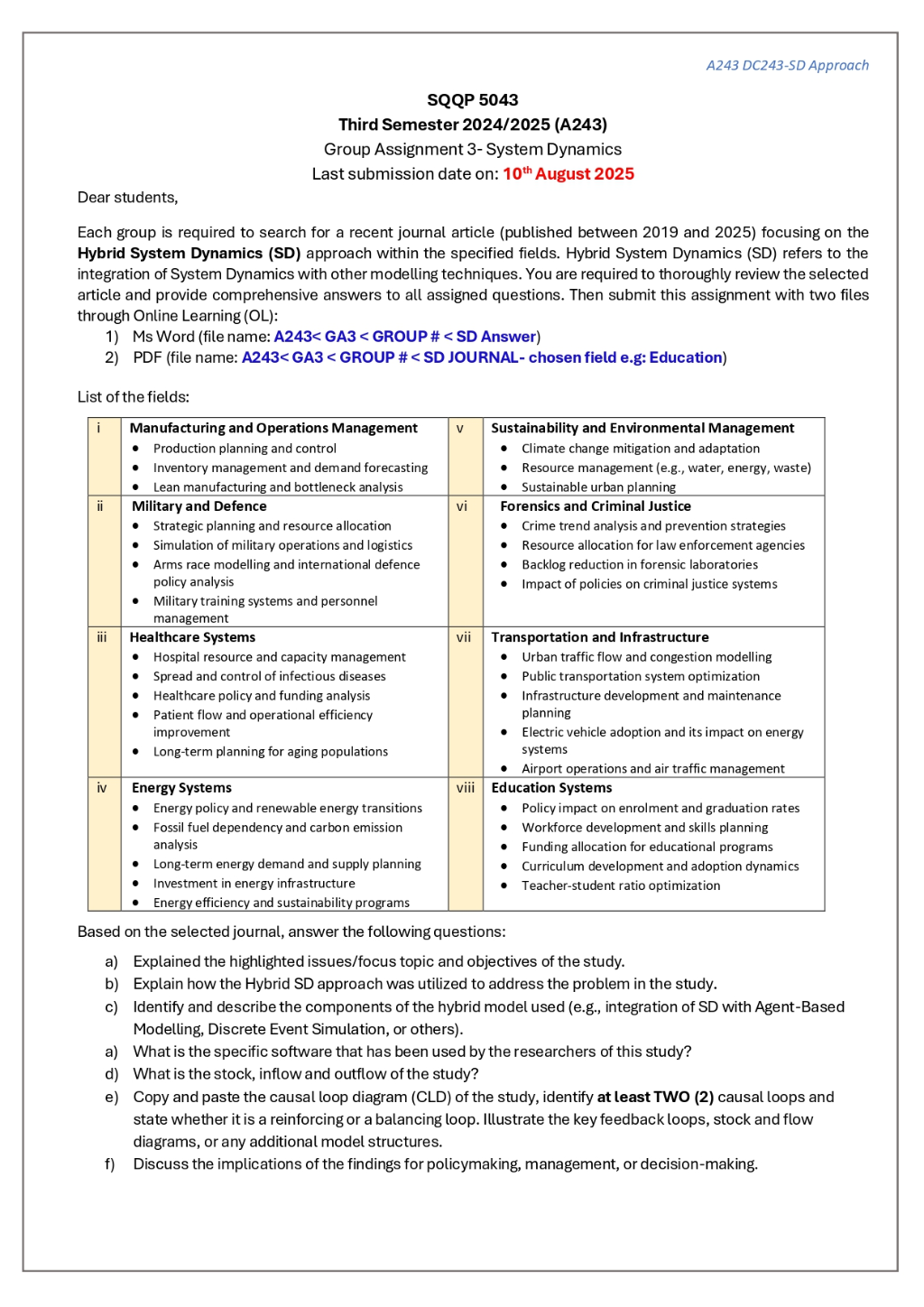 A243 DC243-5D Approach
SQQP 5043
Third Semester 2024/2025 (A243)
Group Assignment 3- System Dynamics
Last submission date on: 10" August 2025
Dear students,
Each group is required to search for a recent journal article (published between 2019 and 2025) focusing on the
Hybrid System Dynamics (SD) approach within the specified fields. Hybrid System Dynamics (SD) refers to the
integration of System Dynamics with other modelling techniques. You are required to thoroughly review the selected
article and provide comprehensive answers to all assigned questions. Then submit this assignment with two files
through Online Learning (OL):
1) Ms Word (filename: A243< GA3 < GROUP # < SD Answer)
2) PDF (file name: A243< GA3 < GROUP # < SD JOURNAL- chosen field e.g: Education)
List of the fields:
Manufacturing and Operations Management | v | Sustainability and Environmental Management
«Production planning and control Climate change mitigation and adaptation
EEE TEER
Lean manufacturing and bottleneck analysis Sustainable urban planning
Military and Defence Forensics and Criminal Justice
«Strategic planning and resource allocation Crime trend analysis and prevention strategies
Simulation of military operations and logistics Resource allocation for law enforcement agencies
Ams race modelling and international defence Backlog reduction in forensic laboratories
policy analysis ® Impact of policies on criminal justice systems
® Military training systems and personnel
management
Healthcare Systems Transportation and Infrastructure
* Hospital resource and capacity management Urban traffic flow and congestion modelling
«Spread and control of infectious diseases «Public transportation system optimization
® Healthcare policy and funding analysis Infrastructure development and maintenance
«Patient flow and operational efficiency planning
improvement «Electric vehicle adoption and its impact on energy
® Long-term planning for aging populations systems
Airport operations and air traffic management
Energy Systems Education Systems
«Energy policy and renewable energy transitions «Policyimpact on enrolment and graduation rates
© Fossil fuel dependency and carbon emission * Workforce development and skills planning
analysis Funding allocation for educational programs
® Long-term energy demand and supply planning Curriculum development and adoption dynamics
© Investment in energy infrastructure © Teacher-student ratio optimization
«Energy efficiency and sustainability programs
Based on the selected journal, answer the following questions:
a) Explained the highlighted issues/focus topic and objectives of the study.
b) Explain how the Hybrid SD approach was utilized to address the problem in the study.
¢) Identify and describe the components of the hybrid model used (e.g. integration of SD with Agent-Based
Modelling, Discrete Event Simulation, or others).
a) Whatis the specific software that has been used by the researchers of this study?
d) Whatis the stock, inflow and outflow of the study?
e) Copy and paste the causal loop diagram (CLD) of the study, identify at least TWO (2) causal loops and
state whether itis a reinforcing or a balancing loop. Illustrate the key feedback loops, stock and flow
diagrams, or any additional model structures.
f) Discuss the implications of the findings for policymaking, management, or decision-making.
A243 DC243-5D Approach
SQQP 5043
Third Semester 2024/2025 (A243)
Group Assignment 3- System Dynamics
Last submission date on: 10" August 2025
Dear students,
Each group is required to search for a recent journal article (published between 2019 and 2025) focusing on the
Hybrid System Dynamics (SD) approach within the specified fields. Hybrid System Dynamics (SD) refers to the
integration of System Dynamics with other modelling techniques. You are required to thoroughly review the selected
article and provide comprehensive answers to all assigned questions. Then submit this assignment with two files
through Online Learning (OL):
1) Ms Word (filename: A243< GA3 < GROUP # < SD Answer)
2) PDF (file name: A243< GA3 < GROUP # < SD JOURNAL- chosen field e.g: Education)
List of the fields:
Manufacturing and Operations Management | v | Sustainability and Environmental Management
«Production planning and control Climate change mitigation and adaptation
EEE TEER
Lean manufacturing and bottleneck analysis Sustainable urban planning
Military and Defence Forensics and Criminal Justice
«Strategic planning and resource allocation Crime trend analysis and prevention strategies
Simulation of military operations and logistics Resource allocation for law enforcement agencies
Ams race modelling and international defence Backlog reduction in forensic laboratories
policy analysis ® Impact of policies on criminal justice systems
® Military training systems and personnel
management
Healthcare Systems Transportation and Infrastructure
* Hospital resource and capacity management Urban traffic flow and congestion modelling
«Spread and control of infectious diseases «Public transportation system optimization
® Healthcare policy and funding analysis Infrastructure development and maintenance
«Patient flow and operational efficiency planning
improvement «Electric vehicle adoption and its impact on energy
® Long-term planning for aging populations systems
Airport operations and air traffic management
Energy Systems Education Systems
«Energy policy and renewable energy transitions «Policyimpact on enrolment and graduation rates
© Fossil fuel dependency and carbon emission * Workforce development and skills planning
analysis Funding allocation for educational programs
® Long-term energy demand and supply planning Curriculum development and adoption dynamics
© Investment in energy infrastructure © Teacher-student ratio optimization
«Energy efficiency and sustainability programs
Based on the selected journal, answer the following questions:
a) Explained the highlighted issues/focus topic and objectives of the study.
b) Explain how the Hybrid SD approach was utilized to address the problem in the study.
¢) Identify and describe the components of the hybrid model used (e.g. integration of SD with Agent-Based
Modelling, Discrete Event Simulation, or others).
a) Whatis the specific software that has been used by the researchers of this study?
d) Whatis the stock, inflow and outflow of the study?
e) Copy and paste the causal loop diagram (CLD) of the study, identify at least TWO (2) causal loops and
state whether itis a reinforcing or a balancing loop. Illustrate the key feedback loops, stock and flow
diagrams, or any additional model structures.
f) Discuss the implications of the findings for policymaking, management, or decision-making.
Asked by: gvr
Created at: 2025-07-30 10:16:56
Final Answer:
📢 Instructions:
- Ask anything relatd to above question only.
- For new Question goto :