VIPSolutions logo ✨ VIPSolutions

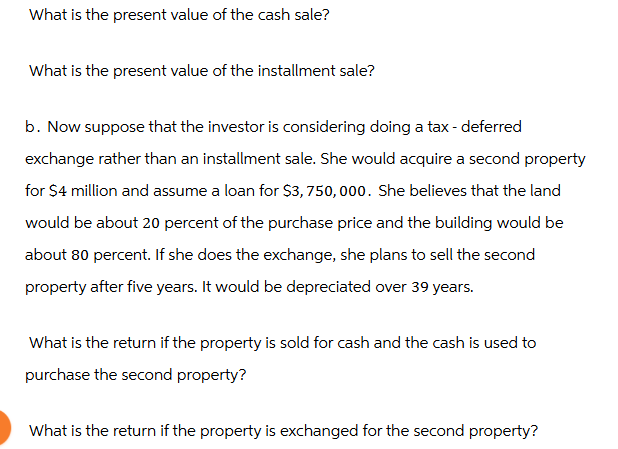
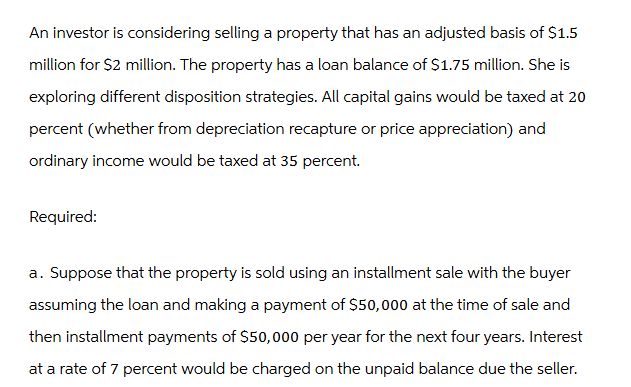
Give step-by-step solution with explanation and final answer:An investor is considering selling a property that has an adjusted basis of $1.5 million for $2 million. The property has a loan balance of $1.75 million. She is. exploring different disposition strategies. All capital gains would be taxed at 20 percent (whether from depreciation recapture or price appreciation) and ordinary income would be taxed at 35 percent. Required: a. Suppose that the property is sold using an installment sale with the buyer assuming the loan and making a payment of $50,000 at the time of sale and then installment payments of $50,000 per year for the next four years. Interest ata rate of 7 percent would be charged on the unpaid balance due the seller. What s the present value of the cash sale? ‘What is the present value of the installment sale? b. Now suppose that the investor is considering doing a tax - deferred exchange rather than an installment sale. She would acquire a second property for $4 million and assume a loan for $3,750,000. She believes that the land would be about 20 percent of the purchase price and the building would be about 80 percent. If she does the exchange, she plans to sell the second property after five years. It would be depreciated over 39 years. Whatis the return if the property is sold for cash and the cash is used to purchase the second property? ) What is the return if the property is exchanged for the second property?

Question:

Give step-by-step solution with explanation and final answer:Uploaded ImageUploaded ImageAn investor is considering selling a property that has an adjusted basis of $1.5 million for $2 million. The property has a loan balance of $1.75 million. She is. exploring different disposition strategies. All capital gains would be taxed at 20 percent (whether from depreciation recapture or price appreciation) and ordinary income would be taxed at 35 percent. Required: a. Suppose that the property is sold using an installment sale with the buyer assuming the loan and making a payment of $50,000 at the time of sale and then installment payments of $50,000 per year for the next four years. Interest ata rate of 7 percent would be charged on the unpaid balance due the seller. What s the present value of the cash sale? ‘What is the present value of the installment sale? b. Now suppose that the investor is considering doing a tax - deferred exchange rather than an installment sale. She would acquire a second property for $4 million and assume a loan for $3,750,000. She believes that the land would be about 20 percent of the purchase price and the building would be about 80 percent. If she does the exchange, she plans to sell the second property after five years. It would be depreciated over 39 years. Whatis the return if the property is sold for cash and the cash is used to purchase the second property? ) What is the return if the property is exchanged for the second property?
This is AI generated Response.
Asked by: gvr
Created at: 2025-07-31 08:56:43

Final Answer:

Rendered Raw Text
Did you like this answer?
Let's break down the questions step by step, starting with part (a). --- ## Part (a) **Given:** - Adjusted basis of property: **$1,500,000** - Sale price: **$2,000,000** - Loan balance: **$1,750,000** - Tax rates: **Capital gains = 20%**, **Ordinary income = 35%** - Installment details: - Buyer assumes the loan - Payment at sale: **$50,000** cash - **$50,000/year** for 4 years - **7% interest** on unpaid balance Let's answer the two sub-questions: --- ### 1. Present Value of the Cash Sale #### **Step 1: Find the Net Proceeds** Since the buyer assumes the loan, the seller receives: - **Cash received:** $2,000,000 (sale price) - **Less loan paid off by buyer:** $1,750,000 - **Net cash received at sale:** $2,000,000 - $1,750,000 = **$250,000** But the question says "cash sale," so typically, the seller would get the full amount and pay off the loan themselves: - **Cash received:** $2,000,000 - **Pay off loan:** –$1,750,000 - **Net cash:** $250,000 #### **Step 2: Calculate Tax Owed** - **Capital Gain:** Sale price ($2,000,000) – Adjusted basis ($1,500,000) = **$500,000** - **Tax on capital gain:** $500,000 × 20% = **$100,000** #### **Step 3: Net Cash After Tax** - **Net cash after tax:** $250,000 – $100,000 = **$150,000** #### **Step 4: Present Value** Since all cash is received at once, **Present Value (PV) = $150,000**. --- ### 2. Present Value of the Installment Sale #### **Step 1: Determine Payments** - **At sale:** $50,000 (cash) (plus assumption of $1,750,000 loan) - **Installment payments:** $50,000/year for next 4 years - **Interest:** 7% charged on unpaid balance (applies to principal portion of installments) #### **Step 2: Calculate Gain Proportion in Each Payment** - **Total gain:** $500,000 - **Total contract price:** $2,000,000 – loan assumed ($1,750,000) = **$250,000** (installment sale contract price) - **Gross profit ratio:** $500,000 (gain) / $250,000 (contract price) = **2.0** (i.e., every $1 received is fully gain, which is not typical; this suggests an error in the contract price calculation) But, for installment sales, contract price = cash received + note received + liabilities assumed **not in excess of basis**. **Liability assumed by buyer exceeds basis ($1,750,000 > $1,500,000):** - Excess of liability over basis: $1,750,000 – $1,500,000 = $250,000 (deemed payment at closing) - Initial cash received: $50,000 + $250,000 (deemed) = $300,000 - Remaining payments: $50,000 × 4 = $200,000 #### **Step 3: Taxation on Excess Debt Relief** - **At closing, seller is taxed on $250,000 of gain** (excess debt relief). - **Gross profit ratio:** $500,000 gain / $500,000 total payments ($250,000 excess debt relief + $50,000 cash + $200,000 installments) So, each $1 received is 100% gain. #### **Step 4: Tax Timing** - At closing: $250,000 (debt relief) + $50,000 cash = $300,000 - Tax: $300,000 × 20% = $60,000 - Each subsequent year: $50,000 × 20% = $10,000 tax per year (for 4 years) #### **Step 5: Cash Flows** | Year | Cash Inflow | Tax | Net Cash | |------|-------------|-----|----------| | 0 | $50,000 | $10,000 | $40,000 | | 1 | $50,000 | $10,000 | $40,000 | | 2 | $50,000 | $10,000 | $40,000 | | 3 | $50,000 | $10,000 | $40,000 | | 4 | $50,000 | $10,000 | $40,000 | But at Year 0, there is also the $250,000 debt relief, which is a noncash gain but taxable. The seller must pay $50,000 tax on that (20% of $250,000), but does not get cash for it, so it must be subtracted from the initial cash flow. **Year 0:** - Cash: $50,000 - Tax on $250,000 debt relief: $50,000 - Tax on $50,000 cash: $10,000 - **Net cash: $50,000 – $50,000 – $10,000 = –$10,000** **Years 1–4:** - Each year: $50,000 – $10,000 = $40,000 #### **Step 6: Present Value Calculation** Use 7% as discount rate. \[ PV = \frac{-10,000}{(1+0.07)^0} + \frac{40,000}{(1+0.07)^1} + \frac{40,000}{(1+0.07)^2} + \frac{40,000}{(1+0.07)^3} + \frac{40,000}{(1+0.07)^4} \] Calculate each term: - Year 0: –$10,000 - Year 1: $40,000 / 1.07 = $37,383.18 - Year 2: $40,000 / (1.07^2) = $34,921.67 - Year 3: $40,000 / (1.07^3) = $32,633.34 - Year 4: $40,000 / (1.07^4) = $30,505.92 Sum: \[ PV = -10,000 + 37,383.18 + 34,921.67 + 32,633.34 + 30,505.92 = \$125,444.11 \] --- ## **Final Answers for Part (a):** 1. **Present value of the cash sale:** **$150,000** 2. **Present value of the installment sale:** **$125,444.11** --- ## Part (b): *Exchange for Second Property (1031 Exchange)* #### **Step 1: If property is sold for cash and cash is used to purchase second property** You have $150,000 after-tax cash (from part a). Use this as equity in new property, borrow the rest. The return would depend on the appreciation and income from the new property, but you start with less equity because you paid tax. #### **Step 2: If property is exchanged (tax deferred)** You defer the $100,000 tax, so you have the full $250,000 equity to invest in the new property. Your basis in the new property is reduced by the deferred gain ($1,500,000 basis in old property + $2,000,000 price paid in new property – $1,500,000 deferred gain = new basis). With more equity in the new property, your return is higher due to the tax deferral. --- ### **Summary Table:** | Scenario | After-Tax Cash for Reinvestment | Basis in New Property | Return Potential | |-------------------------|--------------------------|-----------------------|---------------------------| | Cash sale + tax paid | $150,000 | Full purchase price | Lower (you've paid tax) | | 1031 Exchange | $250,000 | Reduced by deferred gain | Higher (tax deferred) | --- ### **In Conclusion:** ### **a. Present value of the cash sale:** **$150,000** ### **a. Present value of the installment sale:** **$125,444.11** ### **b. Return is higher with a 1031 exchange due to tax deferral and increased investable equity.** If you need the exact calculations for the return on the new property, please specify appreciation/income assumptions for the new property over the holding period.

📢 Instructions:

  • Ask anything relatd to above question only.
  • For new Question goto :

Study Help, Fast Answers

VIPSolutions focuses on clear, step‑by‑step explanations so you can learn quickly. Whether you need an AI‑generated walkthrough or a short hint to get unstuck, each solution is organized for fast reading and easy review later.

Search similar questions, compare approaches, and bookmark the best answers for revision. Our goal is simple: quick, reliable study help that feels natural—not noisy.