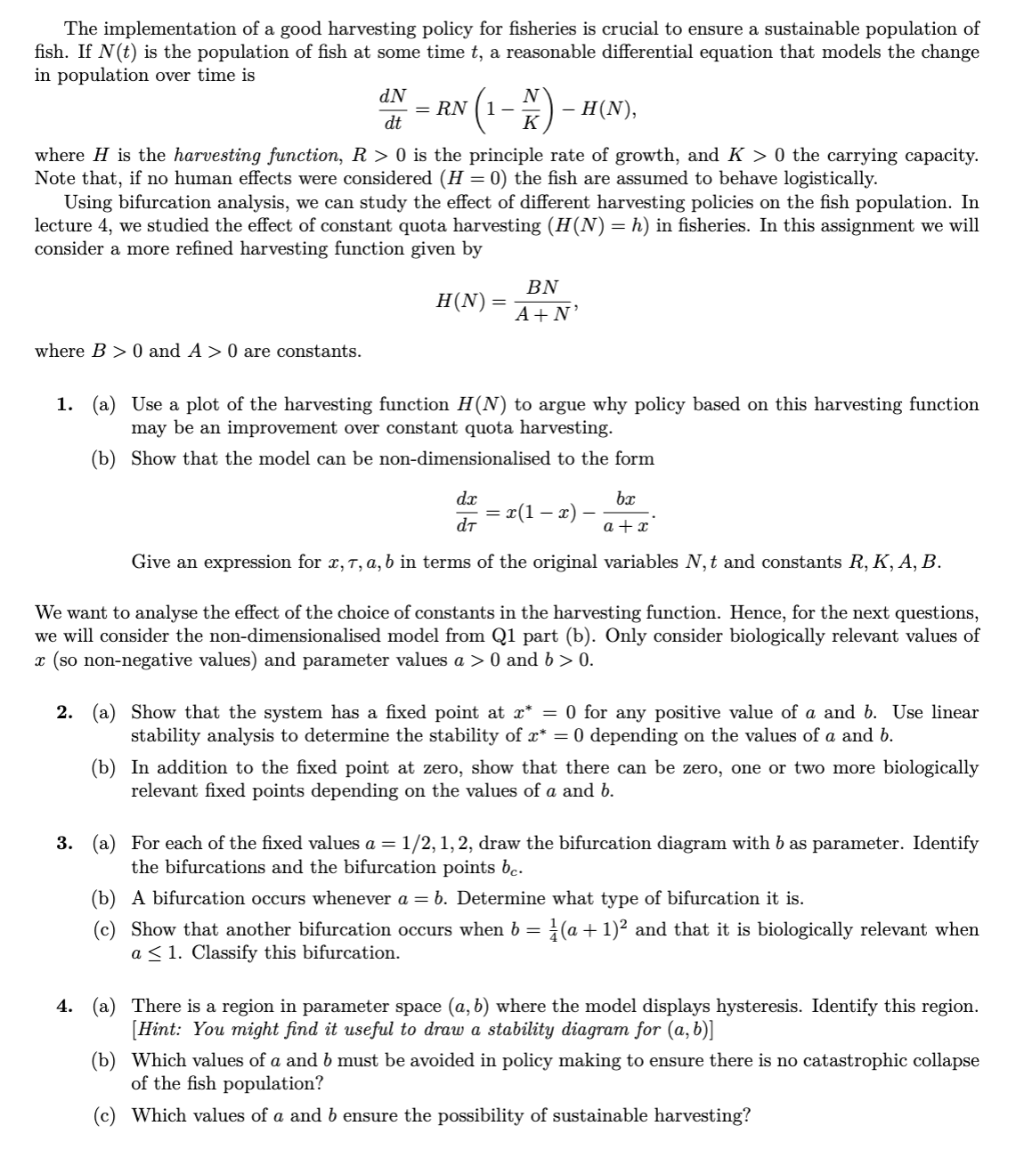
Give step-by-step solution with explanation and final answer:The implementation of a good harvesting policy for fisheries is crucial to ensure a sustainable population of
fish. If N(t) is the population of fish at some time #, a reasonable differential equation that models the change
in population over time is
dN N
RN (1-2) HN
a ( %) w),
where H is the harvesting function, R > 0 is the principle rate of growth, and K > 0 the carrying capacity.
Note that, if no human effects were considered (H = 0) the fish are assumed to behave logistically.
Using bifurcation analysis, we can study the effect of different harvesting policies on the fish population. In
lecture 4, we studied the effect of constant quota harvesting (H(N) = h) in fisheries. In this assignment we will
consider a more refined harvesting function given by
BN
H(N) =
™) A+N’
where B > 0 and A > 0 are constants.
1. (a) Use a plot of the harvesting function H(N) to argue why policy based on this harvesting function
may be an improvement over constant quota harvesting.
(b) Show that the model can be non-dimensionalised to the form
dz bx
Lozl-z)— ——.
dr (1-2) a+z
Give an expression for z,7, a,b in terms of the original variables N,t and constants R, K, A, B.
We want to analyse the effect of the choice of constants in the harvesting function. Hence, for the next questions,
we will consider the non-dimensionalised model from Q1 part (b). Only consider biologically relevant values of
z (so non-negative values) and parameter values a > 0 and b> 0.
2. (a) Show that the system has a fixed point at z* = 0 for any positive value of a and b. Use linear
stability analysis to determine the stability of z* = 0 depending on the values of a and b.
(b) In addition to the fixed point at zero, show that there can be zero, one or two more biologically
relevant fixed points depending on the values of a and b.
3. (a) For each of the fixed values a = 1/2, 1,2, draw the bifurcation diagram with b as parameter. Identify
the bifurcations and the bifurcation points b..
(b) A bifurcation occurs whenever a = b. Determine what type of bifurcation it is.
(c) Show that another bifurcation occurs when b = La +1)? and that it is biologically relevant when
a
Question:
Give step-by-step solution with explanation and final answer:The implementation of a good harvesting policy for fisheries is crucial to ensure a sustainable population of
fish. If N(t) is the population of fish at some time #, a reasonable differential equation that models the change
in population over time is
dN N
RN (1-2) HN
a ( %) w),
where H is the harvesting function, R > 0 is the principle rate of growth, and K > 0 the carrying capacity.
Note that, if no human effects were considered (H = 0) the fish are assumed to behave logistically.
Using bifurcation analysis, we can study the effect of different harvesting policies on the fish population. In
lecture 4, we studied the effect of constant quota harvesting (H(N) = h) in fisheries. In this assignment we will
consider a more refined harvesting function given by
BN
H(N) =
™) A+N’
where B > 0 and A > 0 are constants.
1. (a) Use a plot of the harvesting function H(N) to argue why policy based on this harvesting function
may be an improvement over constant quota harvesting.
(b) Show that the model can be non-dimensionalised to the form
dz bx
Lozl-z)— ——.
dr (1-2) a+z
Give an expression for z,7, a,b in terms of the original variables N,t and constants R, K, A, B.
We want to analyse the effect of the choice of constants in the harvesting function. Hence, for the next questions,
we will consider the non-dimensionalised model from Q1 part (b). Only consider biologically relevant values of
z (so non-negative values) and parameter values a > 0 and b> 0.
2. (a) Show that the system has a fixed point at z* = 0 for any positive value of a and b. Use linear
stability analysis to determine the stability of z* = 0 depending on the values of a and b.
(b) In addition to the fixed point at zero, show that there can be zero, one or two more biologically
relevant fixed points depending on the values of a and b.
3. (a) For each of the fixed values a = 1/2, 1,2, draw the bifurcation diagram with b as parameter. Identify
the bifurcations and the bifurcation points b..
(b) A bifurcation occurs whenever a = b. Determine what type of bifurcation it is.
(c) Show that another bifurcation occurs when b = La +1)? and that it is biologically relevant when
a
This is AI generated Response.
Asked by: gvr
Created at: 2025-08-03 04:31:58
Final Answer:
RenderedRaw Text
Did you like this answer?
Let's go through the problem step by step, with explanations and calculations.
---
### **1. (a) Use a plot of the harvesting function \( H(N) \) to argue why policy based on this harvesting function may be an improvement over constant quota harvesting.**
**Harvesting Function:**
\[
H(N) = \frac{BN}{A + N}
\]
- For small \( N \), \( H(N) \approx \frac{B}{A} N \) (harvesting is proportional to population, i.e., effort-based).
- For very large \( N \), \( H(N) \approx B \) (saturates to a maximum quota, i.e., quota-based).
**Plot:**
- \( H(N) \) increases quickly for small \( N \), then levels off as \( N \) grows.
- This is **better than constant quota harvesting**, which is \( H(N) = h \) (horizontal line), because:
- For small \( N \), constant quota can over-harvest, risking collapse.
- This function naturally reduces harvest when \( N \) is low, helping to prevent extinction.
**Conclusion:**
This function is a blend of proportional and quota harvesting, providing a built-in safeguard against over-exploitation at low population levels.
---
### **1. (b) Non-dimensionalization**
Original model:
\[
\frac{dN}{dt} = RN \left(1 - \frac{N}{K}\right) - H(N)
\]
with \( H(N) = \frac{BN}{A + N} \).
Let
- \( x = \frac{N}{K} \) (non-dimensional population, \( 0 \leq x \leq 1 \)),
- \( \tau = Rt \) (non-dimensional time).
Then,
\[
N = xK
\]
\[
\frac{dN}{dt} = K \frac{dx}{dt}
\]
Substitute into the equation:
\[
K \frac{dx}{dt} = R x K (1 - x) - \frac{B x K}{A + x K}
\]
\[
\frac{dx}{dt} = R x (1 - x) - \frac{B x}{A + x K}
\]
Change to non-dimensional time (\( \tau \)):
\[
\frac{dx}{d\tau} = x(1 - x) - \frac{B x}{R (A + x K)}
\]
Let
- \( a = \frac{A}{K} \)
- \( b = \frac{B}{R K} \)
So,
\[
A + x K = K(a + x)
\]
\[
\frac{B x}{R (A + x K)} = \frac{B x}{R K (a + x)} = \frac{b x}{a + x}
\]
Therefore,
\[
\boxed{
\frac{dx}{d\tau} = x(1 - x) - \frac{b x}{a + x}
}
\]
**Non-dimensional variables and parameters:**
- \( x = \frac{N}{K} \)
- \( \tau = R t \)
- \( a = \frac{A}{K} \)
- \( b = \frac{B}{R K} \)
---
### **2. (a) Fixed Point at \( x^* = 0 \) and its stability**
The equation:
\[
\frac{dx}{d\tau} = x(1 - x) - \frac{b x}{a + x}
\]
Fixed points: Set RHS to zero:
\[
x(1 - x) - \frac{b x}{a + x} = 0
\]
\[
x \left[ (1 - x) - \frac{b}{a + x} \right] = 0
\]
So, \( x^* = 0 \) is always a fixed point.
**Linear stability at \( x = 0 \):**
Let \( f(x) = x(1-x) - \frac{b x}{a + x} \).
Calculate the derivative at \( x = 0 \):
\[
f(x) = x(1-x) - \frac{b x}{a + x}
\]
\[
f'(x) = (1-x) - x - \frac{b (a + x) - b x}{(a + x)^2}
\]
At \( x = 0 \):
\[
f'(0) = 1 - \frac{b}{a}
\]
- If \( 1 - \frac{b}{a} < 0 \), i.e., \( b > a \): \( x^* = 0 \) is **stable**.
- If \( 1 - \frac{b}{a} > 0 \), i.e., \( b < a \): \( x^* = 0 \) is **unstable**.
---
### **2. (b) Other Fixed Points**
Other fixed points are found by:
\[
(1-x) - \frac{b}{a + x} = 0
\]
\[
(1-x)(a + x) - b = 0
\]
\[
a + x - a x - x^2 - b = 0
\]
\[
-x^2 - a x + x + a - b = 0
\]
\[
x^2 + (a - 1)x + (b - a) = 0
\]
This is a quadratic in \( x \):
\[
x^2 + (a - 1)x + (b - a) = 0
\]
Discriminant:
\[
\Delta = (a-1)^2 - 4(b-a)
\]
Number of (biologically relevant) fixed points depends on:
- The discriminant (\( \Delta \))
- Whether the roots are non-negative (\( x \ge 0 \))
---
### **3. (a) Bifurcation Diagrams**
For each \( a = 1/2, 1, 2 \), the bifurcation diagram plots fixed points as \( b \) varies.
\[
x^2 + (a - 1)x + (b - a) = 0
\]
Roots:
\[
x = \frac{1-a \pm \sqrt{(a-1)^2 - 4(b-a)}}{2}
\]
The number of real, non-negative roots changes as \( b \) varies.
**Bifurcation points:** Values of \( b \) where the number of real positive roots changes, i.e., discriminant \( = 0 \):
\[
(b-a) = \frac{1}{4}(a-1)^2
\implies
b = a + \frac{1}{4}(a-1)^2
\]
At \( b = a \), the fixed point at \( x = 0 \) changes stability (from 2a).
---
### **3. (b) Bifurcation at \( a = b \)**
At \( b = a \):
- Discriminant: \( (a-1)^2 \), always non-negative.
- Fixed point: \( x = 0 \) is always a root.
- Stability at \( x = 0 \) changes as shown in 2(a): this is a **transcritical bifurcation**.
---
### **3. (c) Bifurcation at \( b = \frac{1}{4}(a+1)^2 \) and its classification**
Using the quadratic equation, set discriminant to zero:
\[
(a-1)^2 - 4(b-a) = 0
\implies
4(b-a) = (a-1)^2
\implies
b = a + \frac{1}{4}(a-1)^2
\]
This is a **saddle-node bifurcation**.
It is biologically relevant when \( a \leq 1 \), as it ensures non-negative fixed points.
---
### **4. (a) Region of Hysteresis in Parameter Space \((a, b)\)**
Hysteresis occurs when the bifurcation diagram has a region where three fixed points exist (two stable, one unstable).
This happens for values of \( (a, b) \) such that the quadratic for \( x \) has two positive roots (i.e., discriminant \( > 0 \), both roots \( x > 0 \)), and the lower root is not at \( x = 0 \).
---
### **4. (b) Values of \( a \) and \( b \) to Avoid Catastrophe**
To avoid catastrophic collapse (no positive fixed point), policy should avoid:
- Large \( b \) (overharvesting).
- Values of \( b \) near where the only fixed point is \( x = 0 \) (i.e., \( b > b_{sn} \)), where \( b_{sn} \) is the saddle-node bifurcation value.
---
### **4. (c) Which values of \( a \), \( b \) ensure sustainable harvesting?**
Sustainable harvesting requires at least one positive, stable fixed point.
This occurs for:
- \( b < a + \frac{1}{4}(a-1)^2 \) (before saddle-node bifurcation).
- Also, avoid \( b > a \), where \( x = 0 \) is stable (population collapse).
---
## **Summary Table of Key Points**
| Condition | Meaning | Formula |
|----------------------------|------------------------------|-----------------------------------------|
| \( a, b > 0 \) | Physical requirement | |
| \( b < a \) | \( x = 0 \) is unstable | |
| \( b > a \) | \( x = 0 \) is stable | (collapse) |
| \( b < a + \frac{1}{4}(a-1)^2 \) | 2 positive fixed points (hysteresis region) | |
| \( b = a \) | Transcritical bifurcation | |
| \( b = a + \frac{1}{4}(a-1)^2 \) | Saddle-node bifurcation | |
---
### **Final Answers (in brief):**
**1. (a):** The function \( H(N) \) prevents overharvesting at low population, unlike constant quota harvesting.
**1. (b):** Non-dimensionalized model:
\[
\frac{dx}{d\tau} = x(1-x) - \frac{b x}{a + x}
\]
with \( x = \frac{N}{K}, \tau = R t, a = \frac{A}{K}, b = \frac{B}{RK} \).
**2. (a):** \( x^* = 0 \) is stable if \( b > a \), unstable if \( b < a \).
**2. (b):** Other fixed points from \( x^2 + (a-1)x + (b-a) = 0 \), depend on discriminant.
**3. (a-c):**
- Draw bifurcation diagrams for each \( a \).
- Bifurcation at \( b = a \) is transcritical.
- Saddle-node at \( b = a + \frac{1}{4}(a-1)^2 \).
**4. (a):** Hysteresis for \( a < 1 \) and \( a < b < a + \frac{1}{4}(a-1)^2 \).
**4. (b):** Avoid \( b > a + \frac{1}{4}(a-1)^2 \) and \( b > a \).
**4. (c):** Sustainable harvesting when \( b < a + \frac{1}{4}(a-1)^2 \) and \( a, b > 0 \).
---
**If you need detailed sketches, bifurcation diagrams, or specific algebraic steps for each part, please let me know!**
VIPSolutions focuses on clear, step‑by‑step explanations so you can learn quickly. Whether you need an AI‑generated walkthrough or a short hint to get unstuck, each solution is organized for fast reading and easy review later.
Search similar questions, compare approaches, and bookmark the best answers for revision. Our goal is simple: quick, reliable study help that feels natural—not noisy.
 VIPSolutions
 The implementation of a good harvesting policy for fisheries is crucial to ensure a sustainable population of
fish. If N(t) is the population of fish at some time #, a reasonable differential equation that models the change
in population over time is
dN N
RN (1-2) HN
a ( %) w),
where H is the harvesting function, R > 0 is the principle rate of growth, and K > 0 the carrying capacity.
Note that, if no human effects were considered (H = 0) the fish are assumed to behave logistically.
Using bifurcation analysis, we can study the effect of different harvesting policies on the fish population. In
lecture 4, we studied the effect of constant quota harvesting (H(N) = h) in fisheries. In this assignment we will
consider a more refined harvesting function given by
BN
H(N) =
™) A+N’
where B > 0 and A > 0 are constants.
1. (a) Use a plot of the harvesting function H(N) to argue why policy based on this harvesting function
may be an improvement over constant quota harvesting.
(b) Show that the model can be non-dimensionalised to the form
dz bx
Lozl-z)— ——.
dr (1-2) a+z
Give an expression for z,7, a,b in terms of the original variables N,t and constants R, K, A, B.
We want to analyse the effect of the choice of constants in the harvesting function. Hence, for the next questions,
we will consider the non-dimensionalised model from Q1 part (b). Only consider biologically relevant values of
z (so non-negative values) and parameter values a > 0 and b> 0.
2. (a) Show that the system has a fixed point at z* = 0 for any positive value of a and b. Use linear
stability analysis to determine the stability of z* = 0 depending on the values of a and b.
(b) In addition to the fixed point at zero, show that there can be zero, one or two more biologically
relevant fixed points depending on the values of a and b.
3. (a) For each of the fixed values a = 1/2, 1,2, draw the bifurcation diagram with b as parameter. Identify
the bifurcations and the bifurcation points b..
(b) A bifurcation occurs whenever a = b. Determine what type of bifurcation it is.
(c) Show that another bifurcation occurs when b = La +1)? and that it is biologically relevant when
a
The implementation of a good harvesting policy for fisheries is crucial to ensure a sustainable population of
fish. If N(t) is the population of fish at some time #, a reasonable differential equation that models the change
in population over time is
dN N
RN (1-2) HN
a ( %) w),
where H is the harvesting function, R > 0 is the principle rate of growth, and K > 0 the carrying capacity.
Note that, if no human effects were considered (H = 0) the fish are assumed to behave logistically.
Using bifurcation analysis, we can study the effect of different harvesting policies on the fish population. In
lecture 4, we studied the effect of constant quota harvesting (H(N) = h) in fisheries. In this assignment we will
consider a more refined harvesting function given by
BN
H(N) =
™) A+N’
where B > 0 and A > 0 are constants.
1. (a) Use a plot of the harvesting function H(N) to argue why policy based on this harvesting function
may be an improvement over constant quota harvesting.
(b) Show that the model can be non-dimensionalised to the form
dz bx
Lozl-z)— ——.
dr (1-2) a+z
Give an expression for z,7, a,b in terms of the original variables N,t and constants R, K, A, B.
We want to analyse the effect of the choice of constants in the harvesting function. Hence, for the next questions,
we will consider the non-dimensionalised model from Q1 part (b). Only consider biologically relevant values of
z (so non-negative values) and parameter values a > 0 and b> 0.
2. (a) Show that the system has a fixed point at z* = 0 for any positive value of a and b. Use linear
stability analysis to determine the stability of z* = 0 depending on the values of a and b.
(b) In addition to the fixed point at zero, show that there can be zero, one or two more biologically
relevant fixed points depending on the values of a and b.
3. (a) For each of the fixed values a = 1/2, 1,2, draw the bifurcation diagram with b as parameter. Identify
the bifurcations and the bifurcation points b..
(b) A bifurcation occurs whenever a = b. Determine what type of bifurcation it is.
(c) Show that another bifurcation occurs when b = La +1)? and that it is biologically relevant when
a