 VIPSolutions
Give step-by-step solution with explanation and final answer:14.7. Derive the expected mean squares for a balanced three-stage nested design, assuming that A is fixed and that B and C are random. Obtain formulas for estimating the variance components. Assume the restricted form of the mixed model.
Question:
Give step-by-step solution with explanation and final answer: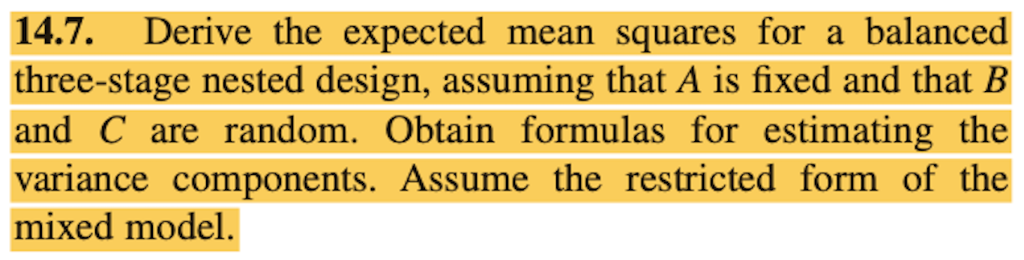 14.7. Derive the expected mean squares for a balanced
three-stage nested design, assuming that A is fixed and that B
and C are random. Obtain formulas for estimating the
variance components. Assume the restricted form of the
mixed model.
14.7. Derive the expected mean squares for a balanced
three-stage nested design, assuming that A is fixed and that B
and C are random. Obtain formulas for estimating the
variance components. Assume the restricted form of the
mixed model.
This is AI generated Response.
Asked by: Umesh
Created at: 2025-08-03 23:40:22
Asked by: Umesh
Created at: 2025-08-03 23:40:22
Final Answer:
Rendered
Raw Text
Did you like this answer?
Let's break down and solve the problem step by step:
---
### **Problem Restatement**
- **Design:** Balanced three-stage nested design.
- **Factors:**
- \(A\): Fixed effect
- \(B\) (nested in \(A\)): Random effect
- \(C\) (nested in \(B\)): Random effect
- **Objective:**
1. Derive the **expected mean squares (EMS)** for each source.
2. Obtain **formulas for estimating variance components**.
3. Assume the **restricted (reduced) form of the mixed model**.
---
## **Step 1: Model Specification**
Let:
- \( a \): Number of levels of \(A\)
- \( b \): Number of levels of \(B\) within each \(A\)
- \( c \): Number of levels of \(C\) within each \(B\)
- \( n \): Number of observations per \(C\)
The model for observation \( Y_{ijkl} \) is:
\[
Y_{ijkl} = \mu + \alpha_i + \beta_{j(i)} + \gamma_{k(ij)} + \epsilon_{l(kij)}
\]
where:
- \( \mu \): Overall mean
- \( \alpha_i \): Effect of the i-th level of \(A\) (fixed)
- \( \beta_{j(i)} \): Effect of j-th level of \(B\) within i-th \(A\) (random, variance \(\sigma^2_B\))
- \( \gamma_{k(ij)} \): Effect of k-th level of \(C\) within j-th \(B\) and i-th \(A\) (random, variance \(\sigma^2_C\))
- \( \epsilon_{l(kij)} \): Random error (variance \(\sigma^2\))
Assumptions:
- All random effects and errors are independent and have mean 0.
---
## **Step 2: ANOVA Table Sources**
| Source | df | Mean Square |
|-----------------|-----------------------|------------------|
| \(A\) | \(a-1\) | \(MS_A\) |
| \(B(A)\) | \(a(b-1)\) | \(MS_{B(A)}\) |
| \(C(B(A))\) | \(ab(c-1)\) | \(MS_{C(B(A))}\) |
| Error | \(abc(n-1)\) | \(MS_E\) |
---
## **Step 3: Expected Mean Squares (EMS)**
### **Error:**
\[
E[MS_E] = \sigma^2
\]
### **C(B(A)):**
\[
E[MS_{C(B(A))}] = \sigma^2 + n\sigma^2_C
\]
### **B(A):**
\[
E[MS_{B(A)}] = \sigma^2 + n\sigma^2_C + nc\sigma^2_B
\]
### **A:**
\[
E[MS_A] = \sigma^2 + n\sigma^2_C + nc\sigma^2_B + nbc \left[ \frac{1}{a-1} \sum_{i=1}^a \alpha_i^2 \right]
\]
Since \(A\) is fixed, the expectation involves the fixed effects. If you want the deviation from the mean, \( \sum_{i=1}^a \alpha_i^2 / (a-1) \).
---
## **Step 4: Estimation of Variance Components**
We use the method of moments (equate observed MS to their expectations and solve):
### **Solve recursively:**
#### **1. Error variance:**
\[
\hat{\sigma}^2 = MS_E
\]
#### **2. \(C(B(A))\) variance:**
\[
\hat{\sigma}_C^2 = \frac{MS_{C(B(A))} - MS_E}{n}
\]
#### **3. \(B(A)\) variance:**
\[
\hat{\sigma}_B^2 = \frac{MS_{B(A)} - MS_{C(B(A))}}{nc}
\]
#### **(No estimate for \(\sigma_A^2\) since \(A\) is fixed)**
---
## **Step 5: Final Formulas**
### **Expected Mean Squares:**
\[
\boxed{
\begin{align*}
E[MS_A] &= \sigma^2 + n\sigma^2_C + nc\sigma^2_B + nbc \left( \frac{1}{a-1} \sum_{i=1}^a \alpha_i^2 \right) \\
E[MS_{B(A)}] &= \sigma^2 + n\sigma^2_C + nc\sigma^2_B \\
E[MS_{C(B(A))}] &= \sigma^2 + n\sigma^2_C \\
E[MS_E] &= \sigma^2 \\
\end{align*}
}
\]
### **Variance Component Estimators:**
\[
\boxed{
\begin{align*}
\hat{\sigma}^2 &= MS_E \\
\hat{\sigma}_C^2 &= \frac{MS_{C(B(A))} - MS_E}{n} \\
\hat{\sigma}_B^2 &= \frac{MS_{B(A)} - MS_{C(B(A))}}{nc} \\
\end{align*}
}
\]
---
### **Summary Table**
| Source | EMS | Variance Component Estimate |
|-----------------|----------------------------------------------------------------|-------------------------------------------|
| \(A\) | \(\sigma^2 + n\sigma^2_C + nc\sigma^2_B + nbc\frac{1}{a-1}\sum_{i=1}^a \alpha_i^2\) | -- (fixed) |
| \(B(A)\) | \(\sigma^2 + n\sigma^2_C + nc\sigma^2_B\) | \(\frac{MS_{B(A)} - MS_{C(B(A))}}{nc}\) |
| \(C(B(A))\) | \(\sigma^2 + n\sigma^2_C\) | \(\frac{MS_{C(B(A))} - MS_E}{n}\) |
| Error | \(\sigma^2\) | \(MS_E\) |
---
**This completes the derivation and estimation as requested. If you need a worked example with numbers or clarification, just ask!**
📢 Instructions:
- Ask anything relatd to above question only.
- For new Question goto :