 VIPSolutions
Give step-by-step solution with explanation and final answer:Conder th alain functions Fy = xiao pk 0) = ati ot - 7k (3) Evaluate the ine integral [Foner cisahen by rts, 1
Question:
Give step-by-step solution with explanation and final answer: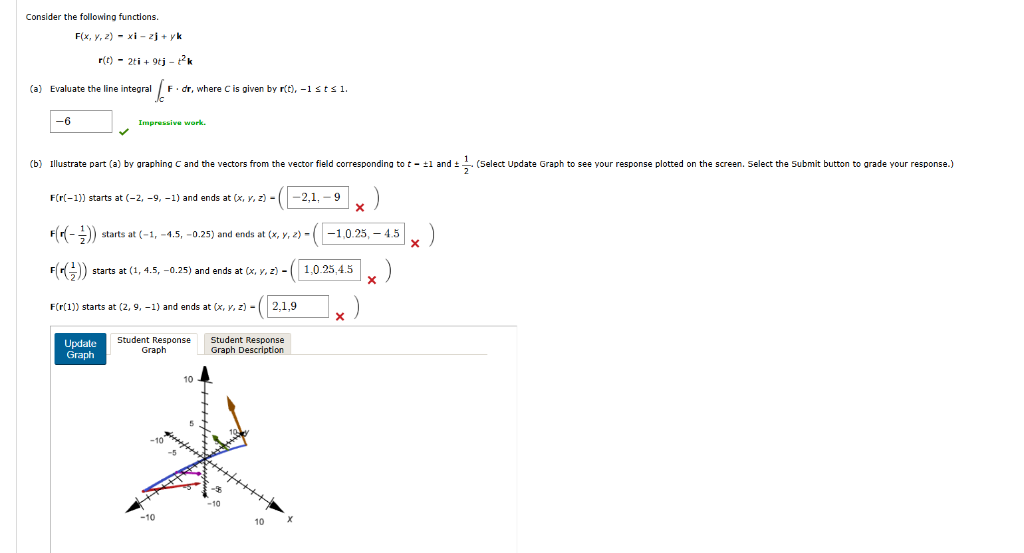 Conder th alain functions
Fy = xiao pk
0) = ati ot - 7k
(3) Evaluate the ine integral [Foner cisahen by rts, 1
Conder th alain functions
Fy = xiao pk
0) = ati ot - 7k
(3) Evaluate the ine integral [Foner cisahen by rts, 1
This is AI generated Response.
Asked by: gvr
Created at: 2025-08-05 10:17:36
Asked by: gvr
Created at: 2025-08-05 10:17:36
Final Answer:
Rendered
Raw Text
Did you like this answer?
Let's go through the step-by-step solution for part (b):
## **Given:**
- \( \vec{F}(x, y, z) = x\vec{i} - z\vec{j} + y\vec{k} \)
- \( \vec{r}(t) = 2t\vec{i} + 9t\vec{j} - t^2\vec{k} \) for \( -1 \leq t \leq 1 \)
We need to **find the value of \( \vec{F}(\vec{r}(t)) \) at \( t = -1, -\frac{1}{2}, \frac{1}{2}, 1 \)**, and **draw the vectors starting at the point \( \vec{r}(t) \) and ending at \( \vec{r}(t) + \vec{F}(\vec{r}(t)) \)**.
---
### **Step 1: Compute \( \vec{r}(t) \) for each value of \( t \)**
#### **For \( t = -1 \):**
\[
\vec{r}(-1) = 2(-1)\vec{i} + 9(-1)\vec{j} - (-1)^2\vec{k} = -2\vec{i} - 9\vec{j} - 1\vec{k}
\]
Coordinates: \( (-2, -9, -1) \)
#### **For \( t = -\frac{1}{2} \):**
\[
\vec{r}\left(-\frac{1}{2}\right) = 2\left(-\frac{1}{2}\right)\vec{i} + 9\left(-\frac{1}{2}\right)\vec{j} - \left(-\frac{1}{2}\right)^2\vec{k}
\]
\[
= -1\vec{i} - 4.5\vec{j} - 0.25\vec{k}
\]
Coordinates: \( (-1, -4.5, -0.25) \)
#### **For \( t = \frac{1}{2} \):**
\[
\vec{r}\left(\frac{1}{2}\right) = 2\left(\frac{1}{2}\right)\vec{i} + 9\left(\frac{1}{2}\right)\vec{j} - \left(\frac{1}{2}\right)^2\vec{k}
\]
\[
= 1\vec{i} + 4.5\vec{j} - 0.25\vec{k}
\]
Coordinates: \( (1, 4.5, -0.25) \)
#### **For \( t = 1 \):**
\[
\vec{r}(1) = 2(1)\vec{i} + 9(1)\vec{j} - (1)^2\vec{k} = 2\vec{i} + 9\vec{j} - 1\vec{k}
\]
Coordinates: \( (2, 9, -1) \)
---
### **Step 2: Compute \( \vec{F}(\vec{r}(t)) \) for each value of \( t \)**
Recall: \( \vec{F}(x, y, z) = x\vec{i} - z\vec{j} + y\vec{k} \)
#### **For \( t = -1 \):**
\[
x = -2, \quad y = -9, \quad z = -1
\]
\[
\vec{F}(-2, -9, -1) = -2\vec{i} - (-1)\vec{j} + (-9)\vec{k} = -2\vec{i} + 1\vec{j} - 9\vec{k}
\]
End point: \( (-2+(-2), -9+1, -1+(-9)) = (-4, -8, -10) \)
#### **For \( t = -\frac{1}{2} \):**
\[
x = -1, \quad y = -4.5, \quad z = -0.25
\]
\[
\vec{F}(-1, -4.5, -0.25) = -1\vec{i} - (-0.25)\vec{j} + (-4.5)\vec{k} = -1\vec{i} + 0.25\vec{j} - 4.5\vec{k}
\]
End point: \( (-1+(-1), -4.5+0.25, -0.25+(-4.5)) = (-2, -4.25, -4.75) \)
#### **For \( t = \frac{1}{2} \):**
\[
x = 1, \quad y = 4.5, \quad z = -0.25
\]
\[
\vec{F}(1, 4.5, -0.25) = 1\vec{i} - (-0.25)\vec{j} + 4.5\vec{k} = 1\vec{i} + 0.25\vec{j} + 4.5\vec{k}
\]
End point: \( (1+1, 4.5+0.25, -0.25+4.5) = (2, 4.75, 4.25) \)
#### **For \( t = 1 \):**
\[
x = 2, \quad y = 9, \quad z = -1
\]
\[
\vec{F}(2, 9, -1) = 2\vec{i} - (-1)\vec{j} + 9\vec{k} = 2\vec{i} + 1\vec{j} + 9\vec{k}
\]
End point: \( (2+2, 9+1, -1+9) = (4, 10, 8) \)
---
### **Step 3: Final Answers**
#### **Summary Table**
| \( t \) | Start Point \( \vec{r}(t) \) | \( \vec{F}(\vec{r}(t)) \) | End Point \( \vec{r}(t) + \vec{F}(\vec{r}(t)) \) |
|--------------|----------------------------------------|---------------------------------------|------------------------------------------------------|
| \( -1 \) | \( (-2, -9, -1) \) | \( (-2, 1, -9) \) | \( (-4, -8, -10) \) |
| \( -\frac{1}{2} \) | \( (-1, -4.5, -0.25) \) | \( (-1, 0.25, -4.5) \) | \( (-2, -4.25, -4.75) \) |
| \( \frac{1}{2} \) | \( (1, 4.5, -0.25) \) | \( (1, 0.25, 4.5) \) | \( (2, 4.75, 4.25) \) |
| \( 1 \) | \( (2, 9, -1) \) | \( (2, 1, 9) \) | \( (4, 10, 8) \) |
---
### **Step 4: Explanation for the Plot**
On your graph, **draw a vector starting at each "Start Point" and ending at the corresponding "End Point"** as calculated above. The vector itself is the value of \( \vec{F}(\vec{r}(t)) \) at that point.
---
## **Final Answers**
- For \( t = -1 \): starts at \( (-2, -9, -1) \), ends at \( (-4, -8, -10) \)
- For \( t = -\frac{1}{2} \): starts at \( (-1, -4.5, -0.25) \), ends at \( (-2, -4.25, -4.75) \)
- For \( t = \frac{1}{2} \): starts at \( (1, 4.5, -0.25) \), ends at \( (2, 4.75, 4.25) \)
- For \( t = 1 \): starts at \( (2, 9, -1) \), ends at \( (4, 10, 8) \)
You can now enter these endpoints in your system to illustrate the vectors correctly!
Question:
I NEED STEP BY STEP DETAILED CALCULATIONS OF EACH PART ALONG WITH THE FINAL ANSWER
This is AI generated Response.
Asked by: gvr
Created at: 2025-08-05 10:18:49
Asked by: gvr
Created at: 2025-08-05 10:18:49
Final Answer:
Rendered
Raw Text
Did you like this answer?
Certainly! Let's carefully walk through each step of the problem, providing detailed calculations and explanations for each part.
---
## **Given Data:**
- Vector field:
\[
\vec{F}(x, y, z) = x \mathbf{i} - z \mathbf{j} + y \mathbf{k}
\]
- Parametric curve:
\[
\vec{r}(t) = 2t \mathbf{i} + 9t \mathbf{j} - t^2 \mathbf{k}
\]
for \( t \in [-1, 1] \).
---
## **Part (b): Find \( \vec{F}(\vec{r}(t)) \) at specific \( t \)-values and draw corresponding vectors**
### **Step 1: Find the points \( \vec{r}(t) \) at \( t = -1, -\frac{1}{2}, \frac{1}{2}, 1 \).**
---
### **Calculations for \( \vec{r}(t) \):**
\[
\boxed{
\vec{r}(t) = (x(t), y(t), z(t))
}
\]
where:
\[
x(t) = 2t, \quad y(t) = 9t, \quad z(t) = -t^2
\]
---
### **At \( t = -1 \):**
\[
x(-1) = 2 \times (-1) = -2
\]
\[
y(-1) = 9 \times (-1) = -9
\]
\[
z(-1) = -(-1)^2 = -1
\]
**Point:**
\[
\boxed{
\vec{r}(-1) = (-2, -9, -1)
}
\]
---
### **At \( t = -\frac{1}{2} \):**
\[
x\left(-\frac{1}{2}\right) = 2 \times \left(-\frac{1}{2}\right) = -1
\]
\[
y\left(-\frac{1}{2}\right) = 9 \times \left(-\frac{1}{2}\right) = -4.5
\]
\[
z\left(-\frac{1}{2}\right) = - \left(-\frac{1}{2}\right)^2 = - \frac{1}{4} = -0.25
\]
**Point:**
\[
\boxed{
\vec{r}\left(-\frac{1}{2}\right) = (-1, -4.5, -0.25)
}
\]
---
### **At \( t = \frac{1}{2} \):**
\[
x\left(\frac{1}{2}\right) = 2 \times \frac{1}{2} = 1
\]
\[
y\left(\frac{1}{2}\right) = 9 \times \frac{1}{2} = 4.5
\]
\[
z\left(\frac{1}{2}\right) = - \left(\frac{1}{2}\right)^2 = - \frac{1}{4} = -0.25
\]
**Point:**
\[
\boxed{
\vec{r}\left(\frac{1}{2}\right) = (1, 4.5, -0.25)
}
\]
---
### **At \( t = 1 \):**
\[
x(1) = 2 \times 1 = 2
\]
\[
y(1) = 9 \times 1 = 9
\]
\[
z(1) = -1^2 = -1
\]
**Point:**
\[
\boxed{
\vec{r}(1) = (2, 9, -1)
}
\]
---
## **Step 2: Compute \( \vec{F}(\vec{r}(t)) \) at each \( t \).**
Recall:
\[
\vec{F}(x, y, z) = x \mathbf{i} - z \mathbf{j} + y \mathbf{k}
\]
which in component form is:
\[
\vec{F} = (x, -z, y)
\]
---
### **At \( t = -1 \):**
\[
x = -2, \quad y = -9, \quad z = -1
\]
\[
\boxed{
\vec{F}(-2, -9, -1) = (-2, -(-1), -9) = (-2, 1, -9)
}
\]
---
### **At \( t = -\frac{1}{2} \):**
\[
x = -1, \quad y = -4.5, \quad z = -0.25
\]
\[
\vec{F}(-1, -4.5, -0.25) = (-1, -(-0.25), -4.5) = (-1, 0.25, -4.5)
\]
---
### **At \( t = \frac{1}{2} \):**
\[
x = 1, \quad y = 4.5, \quad z = -0.25
\]
\[
\vec{F}(1, 4.5, -0.25) = (1, -(-0.25), 4.5) = (1, 0.25, 4.5)
\]
---
### **At \( t = 1 \):**
\[
x = 2, \quad y = 9, \quad z = -1
\]
\[
\vec{F}(2, 9, -1) = (2, -(-1), 9) = (2, 1, 9)
\]
---
## **Step 3: Determine the "end point" of each vector \( \vec{F}(\vec{r}(t)) \) starting from \( \vec{r}(t) \).**
This is simply:
\[
\text{End point} = \vec{r}(t) + \vec{F}(\vec{r}(t))
\]
---
### **At \( t = -1 \):**
\[
\vec{r}(-1) = (-2, -9, -1)
\]
\[
\vec{F} = (-2, 1, -9)
\]
\[
\text{End point} = (-2 + (-2), -9 + 1, -1 + (-9)) = (-4, -8, -10)
\]
---
### **At \( t = -\frac{1}{2} \):**
\[
\vec{r} = (-1, -4.5, -0.25)
\]
\[
\vec{F} = (-1, 0.25, -4.5)
\]
\[
\text{End point} = (-1 + (-1), -4.5 + 0.25, -0.25 + (-4.5)) = (-2, -4.25, -4.75)
\]
---
### **At \( t = \frac{1}{2} \):**
\[
\vec{r} = (1, 4.5, -0.25)
\]
\[
\vec{F} = (1, 0.25, 4.5)
\]
\[
\text{End point} = (1 + 1, 4.5 + 0.25, -0.25 + 4.5) = (2, 4.75, 4.25)
\]
---
### **At \( t = 1 \):**
\[
\vec{r} = (2, 9, -1)
\]
\[
\vec{F} = (2, 1, 9)
\]
\[
\text{End point} = (2 + 2, 9 + 1, -1 + 9) = (4, 10, 8)
\]
---
## **## **Final Summary:**
| \( t \) | Starting point \( \vec{r}(t) \) | \( \vec{F}(\vec{r}(t)) \) | End point \( \vec{r}(t) + \vec{F}(\vec{r}(t)) \) |
|---------|----------------------------------|---------------------------|--------------------------------------------|
| -1 | \((-2, -9, -1)\) | \((-2, 1, -9)\) | \((-4, -8, -10)\) |
| -½ | \((-1, -4.5, -0.25)\) | \((-1, 0.25, -4.5)\) | \((-2, -4.25, -4.75)\) |
| ½ | \((1, 4.5, -0.25)\) | \((1, 0.25, 4.5)\) | \((2, 4.75, 4.25)\) |
| 1 | \((2, 9, -1)\) | \((2, 1, 9)\) | \((4, 10, 8)\) |
---
## **How to visualize:**
- Draw the initial point \( \vec{r}(t) \).
- From that point, draw a vector to the end point \( \vec{r}(t) + \vec{F}(\vec{r}(t)) \).
- Repeat for each \( t \).
---
**This completes the detailed step-by-step solution for part (b).**
Question:
II NEED STEP BY STEP DETAILED CALCULATIONS OF EACH PART A AND PART B ALONG WITH THE FINAL ANSWER WITHOUT TABLES
This is AI generated Response.
Asked by: gvr
Created at: 2025-08-05 10:19:56
Asked by: gvr
Created at: 2025-08-05 10:19:56
Final Answer:
Rendered
Raw Text
Did you like this answer?
Certainly! Here's a detailed step-by-step solution for both parts (a) and (b), with all calculations shown explicitly and without using tables.
---
## **Given Data:**
- Vector field:
\[
\vec{F}(x, y, z) = x \mathbf{i} - z \mathbf{j} + y \mathbf{k}
\]
- Parametric curve:
\[
\vec{r}(t) = 2t \mathbf{i} + 9t \mathbf{j} - t^2 \mathbf{k}
\]
for \( t \in [-1, 1] \).
---
## **Part (a): Evaluate the line integral \( \int_C \vec{F} \cdot d\vec{r} \) along the curve \( C \).**
---
### **Step 1: Parameterize the curve**
\[
x(t) = 2t, \quad y(t) = 9t, \quad z(t) = -t^2
\]
for \( t \in [-1, 1] \).
### **Step 2: Compute derivatives \( dx/dt, dy/dt, dz/dt \)**
\[
\frac{dx}{dt} = 2
\]
\[
\frac{dy}{dt} = 9
\]
\[
\frac{dz}{dt} = -2t
\]
### **Step 3: Express \( d\vec{r} \) in terms of \( dt \)**
\[
d\vec{r} = \frac{d\vec{r}}{dt} dt = (2, 9, -2t) dt
\]
### **Step 4: Express \( \vec{F} \) along the curve**
At point \( \vec{r}(t) \):
\[
x = 2t, \quad y = 9t, \quad z = -t^2
\]
\[
\vec{F}(\vec{r}(t)) = (x, -z, y) = (2t, -(-t^2), 9t) = (2t, t^2, 9t)
\]
### **Step 5: Compute the dot product \( \vec{F}(\vec{r}(t)) \cdot \frac{d\vec{r}}{dt} \)**
\[
(2t, t^2, 9t) \cdot (2, 9, -2t) = (2t)(2) + (t^2)(9) + (9t)(-2t)
\]
Calculating each term:
- \( (2t)(2) = 4t \)
- \( (t^2)(9) = 9t^2 \)
- \( (9t)(-2t) = -18 t^2 \)
Adding these:
\[
4t + 9t^2 - 18t^2 = 4t - 9t^2
\]
---
### **Step 6: Set up the integral**
\[
\int_{t=-1}^{1} [4t - 9t^2] dt
\]
### **Step 7: Integrate**
\[
\int_{-1}^{1} 4t dt - \int_{-1}^{1} 9t^2 dt
\]
Calculate each separately:
- \( \int_{-1}^{1} 4t dt = 2t^2 \big|_{-1}^{1} \)
At \( t=1 \): \( 2(1)^2 = 2 \)
At \( t=-1 \): \( 2(-1)^2 = 2 \)
Difference: \( 2 - 2 = 0 \)
- \( \int_{-1}^{1} 9t^2 dt = 3t^3 \big|_{-1}^{1} \)
At \( t=1 \): \( 3(1)^3 = 3 \)
At \( t=-1 \): \( 3(-1)^3 = -3 \)
Difference: \( 3 - (-3) = 6 \)
### **Step 8: Final value of the line integral**
\[
0 - 6 = -6
\]
---
## **Answer for Part (a):**
\[
\boxed{
\int_C \vec{F} \cdot d\vec{r} = -6
}
\]
---
## **Part (b): Find \( \vec{F} \) at specific points \( \vec{r}(t) \) for \( t = -1, -\frac{1}{2}, \frac{1}{2}, 1 \), and determine the vectors starting at \( \vec{r}(t) \) and ending at \( \vec{r}(t) + \vec{F}(\vec{r}(t)) \).**
---
### **Step 1: Compute \( \vec{r}(t) \) at each specified \( t \).**
- For \( t = -1 \):
\[
x = 2(-1) = -2
\]
\[
y = 9(-1) = -9
\]
\[
z = -(-1)^2 = -1
\]
**Point:**
\[
\boxed{
\vec{r}(-1) = (-2, -9, -1)
}
\]
- For \( t = -\frac{1}{2} \):
\[
x = 2 \times \left(-\frac{1}{2}\right) = -1
\]
\[
y = 9 \times \left(-\frac{1}{2}\right) = -4.5
\]
\[
z = - \left(-\frac{1}{2}\right)^2 = - \frac{1}{4} = -0.25
\]
**Point:**
\[
\boxed{
\vec{r}\left(-\frac{1}{2}\right) = (-1, -4.5, -0.25)
}
\]
- For \( t = \frac{1}{2} \):
\[
x = 2 \times \frac{1}{2} = 1
\]
\[
y = 9 \times \frac{1}{2} = 4.5
\]
\[
z = - \left(\frac{1}{2}\right)^2 = - \frac{1}{4} = -0.25
\]
**Point:**
\[
\boxed{
\vec{r}\left(\frac{1}{2}\right) = (1, 4.5, -0.25)
}
\]
- For \( t=1 \):
\[
x=2(1)=2, \quad y=9(1)=9, \quad z=-(1)^2=-1
\]
**Point:**
\[
\boxed{
\vec{r}(1) = (2, 9, -1)
}
\]
---
### **Step 2: Compute \( \vec{F}(\vec{r}(t)) \) at each point**
Recall:
\[
\vec{F}(x, y, z) = (x, -z, y)
\]
- At \( t = -1 \), where \( (x, y, z) = (-2, -9, -1) \):
\[
\vec{F} = (-2, -(-1), -9) = (-2, 1, -9)
\]
- At \( t = -\frac{1}{2} \), with \( (-1, -4.5, -0.25) \):
\[
\vec{F} = (-1, -(-0.25), -4.5) = (-1, 0.25, -4.5)
\]
- At \( t=\frac{1}{2} \), with \( (1, 4.5, -0.25) \):
\[
\vec{F} = (1, -(-0.25), 4.5) = (1, 0.25, 4.5)
\]
- At \( t=1 \), with \( (2, 9, -1) \):
\[
\vec{F} = (2, -(-1), 9) = (2, 1, 9)
\]
---
### **Step 3: Determine the end points of the vectors starting at \( \vec{r}(t) \)**
Add \( \vec{F}(\vec{r}(t)) \) to \( \vec{r}(t) \):
- For \( t=-1 \):
\[
(-2, -9, -1) + (-2, 1, -9) = (-2 + (-2), -9 + 1, -1 + (-9)) = (-4, -8, -10)
\]
- For \( t=-\frac{1}{2} \):
\[
(-1, -4.5, -0.25) + (-1, 0.25, -4.5) = (-2, -4.25, -4.75)
\]
- For \( t=\frac{1}{2} \):
\[
(1, 4.5, -0.25) + (1, 0.25, 4.5) = (2, 4.75, 4.25)
\]
- For \( t=1 \):
\[
(2, 9, -1) + (2, 1, 9) = (4, 10, 8)
\]
---
## **Final summary:**
- At \( t=-1 \): start point \( (-2, -9, -1) \), vector \( (-2, 1, -9) \), end point \( (-4, -8, -10) \).
- At \( t=-\frac{1}{2} \): start point \( (-1, -4.5, -0.25) \), vector \( (-1, 0.25, -4.5) \), end point \( (-2, -4.25, -4.75) \).
- At \( t=\frac{1}{2} \): start point \( (1, 4.5, -0.25) \), vector \( (1, 0.25, 4.5) \), end point \( (2, 4.75, 4.25) \).
- At \( t=1 \): start point \( (2, 9, -1) \), vector \( (2, 1, 9) \), end point \( (4, 10, 8) \).
---
This completes the detailed step-by-step solution for both parts.
Question:
I NEED ONLY FINAL ANSWERS OF BOTH PARTS
This is AI generated Response.
Asked by: gvr
Created at: 2025-08-05 10:25:24
Asked by: gvr
Created at: 2025-08-05 10:25:24
Final Answer:
Rendered
Raw Text
Did you like this answer?
Certainly! Here are the final answers for both parts:
**Part (a):**
The value of the line integral along the curve is:
\(\boxed{-6}\)
**Part (b):**
At \( t = -1 \): start at \((-2, -9, -1)\), vector \((-2, 1, -9)\), end at \((-4, -8, -10)\)
At \( t = -\frac{1}{2} \): start at \((-1, -4.5, -0.25)\), vector \((-1, 0.25, -4.5)\), end at \((-2, -4.25, -4.75)\)
At \( t = \frac{1}{2} \): start at \((1, 4.5, -0.25)\), vector \((1, 0.25, 4.5)\), end at \((2, 4.75, 4.25)\)
At \( t = 1 \): start at \((2, 9, -1)\), vector \((2, 1, 9)\), end at \((4, 10, 8)\)
These are the final concise answers for both parts.
📢 Instructions:
- Ask anything relatd to above question only.
- For new Question goto :