 VIPSolutions
Give step-by-step solution with explanation and final answer:a LL ag ChE BE = LL Ist al lili i = J DA EE — En EEE El LRN es RE g i En EEE Ci LE = Ee ie a Wad Ei e me. . rE A ALAR Le >) — EXAMPLE 58 DESIGN OF TAPERED MATCHING SECTIONS ~~ A Pl Be i Ee = li 3 = a Design a triangular taper, an exponential taper, and a Klopfenstein taper (¥ i ~~ D'y = 0.02) to match a 50 © load to a 100 2 line. Plot the impedance variations : —— and resulting reflection coefficient magnitudes versus AL. = i Triangular ei From (5.71) the impedance vision HE FE On Wi 9 i A ii il RL 021/20 for0'< sxe il E HERA [ | TEE FE ly | li | LW | | i / LL il ill PL I i EE Hie nEREEA CE in a iY i l il HR IER il HG i : i LL i Hi il hi LL |
Question:
Give step-by-step solution with explanation and final answer: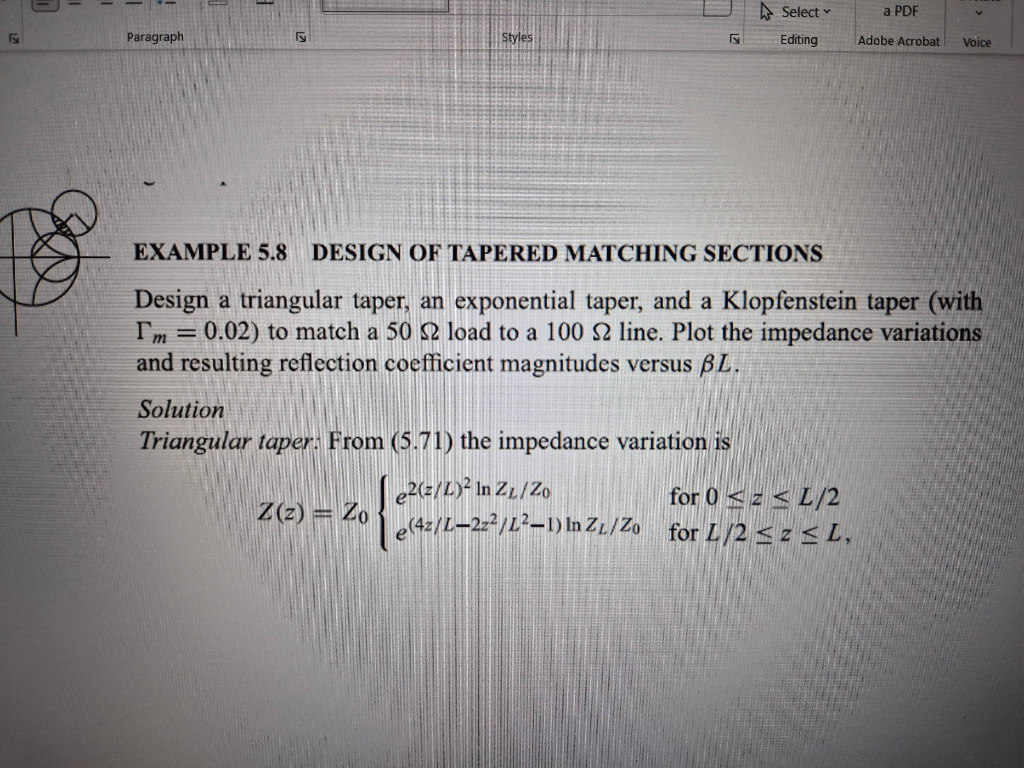 a LL
ag ChE BE = LL Ist al lili i = J
DA EE —
En EEE El
LRN es RE g i
En EEE Ci
LE = Ee ie
a Wad Ei e
me. . rE
A ALAR Le
>) — EXAMPLE 58 DESIGN OF TAPERED MATCHING SECTIONS ~~
A Pl Be i
Ee = li 3 =
a Design a triangular taper, an exponential taper, and a Klopfenstein taper (¥ i
~~ D'y = 0.02) to match a 50 © load to a 100 2 line. Plot the impedance variations
: —— and resulting reflection coefficient magnitudes versus AL. = i
Triangular ei From (5.71) the impedance vision HE FE
On Wi
9 i A ii il RL 021/20 for0'< sxe il
E HERA [ | TEE
FE ly | li | LW | | i /
LL il ill PL I i
EE Hie nEREEA
CE in a
iY i l il HR IER il HG i : i
LL i Hi il hi LL |
a LL
ag ChE BE = LL Ist al lili i = J
DA EE —
En EEE El
LRN es RE g i
En EEE Ci
LE = Ee ie
a Wad Ei e
me. . rE
A ALAR Le
>) — EXAMPLE 58 DESIGN OF TAPERED MATCHING SECTIONS ~~
A Pl Be i
Ee = li 3 =
a Design a triangular taper, an exponential taper, and a Klopfenstein taper (¥ i
~~ D'y = 0.02) to match a 50 © load to a 100 2 line. Plot the impedance variations
: —— and resulting reflection coefficient magnitudes versus AL. = i
Triangular ei From (5.71) the impedance vision HE FE
On Wi
9 i A ii il RL 021/20 for0'< sxe il
E HERA [ | TEE
FE ly | li | LW | | i /
LL il ill PL I i
EE Hie nEREEA
CE in a
iY i l il HR IER il HG i : i
LL i Hi il hi LL |
This is AI generated Response.
Asked by: ravi
Created at: 2025-08-16 22:53:47
Asked by: ravi
Created at: 2025-08-16 22:53:47
Final Answer:
Rendered
Raw Text
Did you like this answer?
Let's break down the **step-by-step solution** to the given problem from the image:
---
### **Problem Statement Recap**
You are to **design three types of tapers** (triangular, exponential, and Klopfenstein) to match a \( 50\ \Omega \) load to a \( 100\ \Omega \) line. For the Klopfenstein taper, the maximum reflection coefficient \(\Gamma_m = 0.02\).
You are to:
1. **Plot the impedance variations** for each taper.
2. **Plot the resulting reflection coefficient magnitudes** versus \(\beta L\).
---
## **Step 1: Triangular Taper**
Given in the image:
\[
Z(z) = Z_0 \begin{cases}
e^{2(z/L)^2 \ln(Z_L/Z_0)} & 0 \leq z \leq L/2 \\
e^{(4z/L - 2(z/L)^2 - 1)\ln(Z_L/Z_0)} & L/2 \leq z \leq L
\end{cases}
\]
Where:
- \( Z_0 = 50\ \Omega \) (input impedance)
- \( Z_L = 100\ \Omega \) (load impedance)
- \( L \) is the length of the taper
---
## **Step 2: Exponential Taper**
The exponential taper impedance profile is:
\[
Z(z) = Z_0 \exp\left[ \frac{z}{L} \ln\left(\frac{Z_L}{Z_0}\right) \right]
\]
for \( 0 \leq z \leq L \)
---
## **Step 3: Klopfenstein Taper**
For the Klopfenstein taper, the impedance profile is more complex. The reflection coefficient is minimized for a given length and maximum reflection magnitude \(\Gamma_m\).
The impedance profile is:
\[
Z(z) = Z_0 \exp\left[ \frac{1}{2} \ln\left( \frac{Z_L}{Z_0} \right) \left( 1 + f(z) \right) \right]
\]
where \( f(z) \) involves a Chebyshev polynomial and depends on the desired maximum reflection coefficient \(\Gamma_m\).
---
### **General Steps for All Tapers**
#### **A. Calculate Impedance Profile**
For each taper, use the formulas above to calculate \( Z(z) \) from \( z = 0 \) to \( z = L \).
#### **B. Reflection Coefficient Calculation**
The local reflection coefficient at position \( z \):
\[
\Gamma(z) = \frac{Z(z) - Z_0}{Z(z) + Z_0}
\]
But usually, the reflection coefficient of the entire section is considered, which involves integrating the effect over the length using transmission line theory.
#### **C. Plotting**
- **Impedance profile:** Plot \( Z(z) \) versus \( z \) for \( 0 \leq z \leq L \).
- **Reflection coefficient:** Plot \( |\Gamma| \) versus \( \beta L \), where \( \beta \) is the phase constant.
---
## **Step-by-Step Example for the Triangular Taper**
### **1. Calculate Impedance Profile**
**Given:** \( Z_0 = 50\ \Omega, Z_L = 100\ \Omega \)
- For \( 0 \leq z \leq L/2 \):
\[
Z(z) = 50 \cdot e^{2(z/L)^2 \ln(2)}
\]
- For \( L/2 \leq z \leq L \):
\[
Z(z) = 50 \cdot e^{(4z/L - 2(z/L)^2 - 1)\ln(2)}
\]
### **2. Reflection Coefficient**
Local reflection at any point:
\[
\Gamma(z) = \frac{Z(z) - 50}{Z(z) + 50}
\]
### **3. Plotting**
- **Impedance:** Plot \( Z(z) \) versus \( z \) from \( 0 \) to \( L \).
- **Reflection coefficient:** Plot \( |\Gamma(z)| \) versus \( \beta L \).
---
## **Final Answer Summary**
### **Formulas for Each Taper**
#### **Triangular Taper:**
\[
Z(z) = 50 \cdot
\begin{cases}
e^{2(z/L)^2 \ln(2)} & 0 \leq z \leq L/2 \\
e^{(4z/L - 2(z/L)^2 - 1)\ln(2)} & L/2 \leq z \leq L
\end{cases}
\]
#### **Exponential Taper:**
\[
Z(z) = 50 \cdot 2^{z/L}
\]
#### **Klopfenstein Taper:**
\[
Z(z) = 50 \cdot \exp\left[ \frac{1}{2} \ln(2) \left( 1 + f(z) \right) \right]
\]
Where \( f(z) \) is defined based on Chebyshev polynomials and \(\Gamma_m\).
---
### **Reflection Coefficient:**
\[
\Gamma(z) = \frac{Z(z) - 50}{Z(z) + 50}
\]
---
### **Plots**
- Plot \( Z(z) \) vs \( z \) for each taper.
- Plot \( |\Gamma(z)| \) vs \( \beta L \) for each taper.
---
If you need explicit plots or further calculation for a specific taper, let me know!
📢 Instructions:
- Ask anything relatd to above question only.
- For new Question goto :