Give step-by-step solution with explanation and final answer:Problem #2 [35 Points] Polytropic Processes
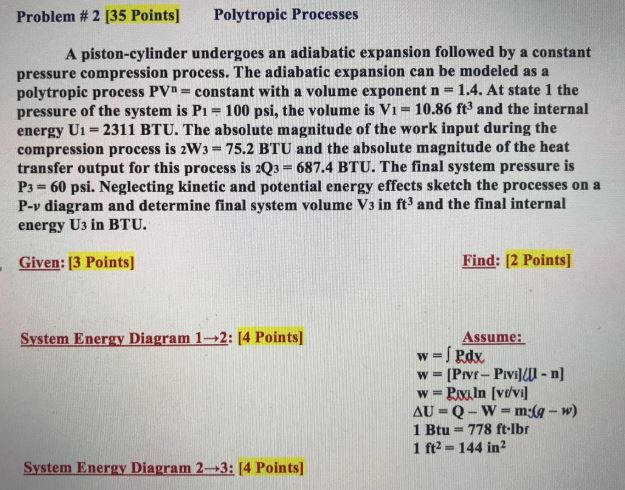
A piston-cylinder undergoes an adiabatic expansion followed by a constant
pressure compression process. The adiabatic expansion can be modeled as a
polytropic process PV® = constant with a volume exponent n = 1.4. At state 1 the
pressure of the system is P1 = 100 psi, the volume is V1 = 10.86 ft* and the internal
energy U1 = 2311 BTU. The absolute magnitude of the work input during the
compression process is 2W3 = 75.2 BTU and the absolute magnitude of the heat
transfer output for this process is 2Q3 = 687.4 BTU. The final system pressure is
P3 = 60 psi. Neglecting kinetic and potential energy effects sketch the processes on a
P-v diagram and determine final system volume V3 in ft’ and the final internal
energy Us in BTU.
Given: [3 Points] Find: [2 Points]
Svstem Energy Diagram 1-52: [4 Points] Assume:
w=/Pdy,
w= [Pve— Pwvil{ll - n]
w= Biyuln [veivi]
AU=Q-W =mg -w)
1 Btu = 778 ftlbr
+ 112 = 144 in?
Sistem Energy Dingram 2-23: [4 Points]
Question:
Give step-by-step solution with explanation and final answer:Problem #2 [35 Points] Polytropic Processes
A piston-cylinder undergoes an adiabatic expansion followed by a constant
pressure compression process. The adiabatic expansion can be modeled as a
polytropic process PV® = constant with a volume exponent n = 1.4. At state 1 the
pressure of the system is P1 = 100 psi, the volume is V1 = 10.86 ft* and the internal
energy U1 = 2311 BTU. The absolute magnitude of the work input during the
compression process is 2W3 = 75.2 BTU and the absolute magnitude of the heat
transfer output for this process is 2Q3 = 687.4 BTU. The final system pressure is
P3 = 60 psi. Neglecting kinetic and potential energy effects sketch the processes on a
P-v diagram and determine final system volume V3 in ft’ and the final internal
energy Us in BTU.
Given: [3 Points] Find: [2 Points]
Svstem Energy Diagram 1-52: [4 Points] Assume:
w=/Pdy,
w= [Pve— Pwvil{ll - n]
w= Biyuln [veivi]
AU=Q-W =mg -w)
1 Btu = 778 ftlbr
+ 112 = 144 in?
Sistem Energy Dingram 2-23: [4 Points]
This is AI generated Response.
Asked by: manish kumar
Created at: 2025-08-17 11:03:50
Final Answer:
RenderedRaw Text
Did you like this answer?
Let's break down and solve the problem step by step:
### **Given Data**
- **State 1:**
\( P_1 = 100 \) psi
\( V_1 = 10.86 \) ft³
\( U_1 = 2311 \) BTU
- **Polytropic Expansion (1→2):**
\( PV^n = \text{constant} \)
\( n = 1.4 \)
- **After Expansion, Compression (2→3):**
**Constant Pressure Compression:**
\( P_3 = 60 \) psi
- **Work and Heat Data:**
\( |W_{2\rightarrow3}| = 75.2 \) BTU (compression, so work is on the system, **W is negative**)
\( |Q_{2\rightarrow3}| = 687.4 \) BTU (**heat is out of the system, so Q is negative**)
- **Find:**
Final system volume \( V_3 \) (in ft³)
Final internal energy \( U_3 \) (in BTU)
---
## **Step 1: Find State 2 Properties**
### **A. Polytropic Expansion (1→2)**
- **Equation:**
\( P_1 V_1^n = P_2 V_2^n \)
But we don't have \( P_2 \) or \( V_2 \) yet.
However, after this process, the pressure at state 3 will be \( P_3 = 60 \) psi.
### **B. The Constant Pressure Compression (2→3):**
- \( P_2 = P_3 = 60 \) psi
---
## **Step 2: Calculate Volume at State 2**
From polytropic process \( P_1 V_1^n = P_2 V_2^n \):
\[
V_2 = \left( \frac{P_1}{P_2} \right)^{1/n} V_1
\]
- \( P_1 = 100 \) psi
- \( P_2 = 60 \) psi
- \( n = 1.4 \)
- \( V_1 = 10.86 \) ft³
\[
V_2 = \left( \frac{100}{60} \right)^{1/1.4} \times 10.86
\]
Calculate \( \frac{100}{60} = 1.6667 \)
\[
1.6667^{1/1.4} = e^{\frac{1}{1.4} \ln(1.6667)}
\]
\[
\ln(1.6667) \approx 0.5108
\]
\[
\frac{1}{1.4} \approx 0.7143
\]
\[
0.7143 \times 0.5108 \approx 0.3654
\]
\[
e^{0.3654} \approx 1.441
\]
\[
V_2 = 1.441 \times 10.86 \approx 15.66 \text{ ft}^3
\]
---
## **Step 3: Find Work Done (1→2), \( W_{1\rightarrow2} \)**
For a polytropic process:
\[
W = \frac{P_2 V_2 - P_1 V_1}{1 - n}
\]
Convert psi·ft³ to BTU:
- \( 1 \text{ BTU} = 778 \text{ ft} \cdot \text{lbf} \)
- \( 1 \text{ psi} \cdot \text{ft}^3 = 144 \text{ lbf/ft}^2 \cdot \text{ft}^3 = 144 \text{ ft} \cdot \text{lbf} \)
So, to convert psi·ft³ to BTU: divide by 778 and multiply by 144.
\[
W = \frac{P_2 V_2 - P_1 V_1}{1 - n}
\]
Plug in numbers:
\[
P_2 V_2 = 60 \times 15.66 = 939.6 \text{ psi·ft}^3
\]
\[
P_1 V_1 = 100 \times 10.86 = 1086 \text{ psi·ft}^3
\]
\[
W_{1\rightarrow2} = \frac{939.6 - 1086}{1 - 1.4} = \frac{-146.4}{-0.4} = 366 \text{ psi·ft}^3
\]
Convert to BTU:
\[
366 \times 144 = 52704 \text{ ft} \cdot \text{lbf}
\]
\[
\frac{52704}{778} \approx 67.77 \text{ BTU}
\]
---
## **Step 4: Find Internal Energy at State 2, \( U_2 \)**
For adiabatic (no heat):
\[
\Delta U_{1\rightarrow2} = Q_{1\rightarrow2} - W_{1\rightarrow2}
\]
\[
Q_{1\rightarrow2} = 0
\]
\[
\Delta U_{1\rightarrow2} = -W_{1\rightarrow2}
\]
\[
U_2 = U_1 + \Delta U_{1\rightarrow2}
\]
\[
U_2 = 2311 + (-67.77) = 2243.23 \text{ BTU}
\]
---
## **Step 5: Find Volume at State 3, \( V_3 \)**
For constant pressure:
\[
W_{2\rightarrow3} = P (V_3 - V_2)
\]
Given: **Work is done on the system, so sign is negative**
\[
W_{2\rightarrow3} = P_3 (V_3 - V_2)
\]
Given \( |W_{2\rightarrow3}| = 75.2 \) BTU (**work input, so should be negative: \( W_{2\rightarrow3} = -75.2 \) BTU**)
Convert -75.2 BTU to \( \text{psi} \cdot \text{ft}^3 \):
\[
-75.2 \text{ BTU} \times 778 = -58465.6 \text{ ft} \cdot \text{lbf}
\]
\[
\frac{-58465.6}{144} = -406 \text{ psi} \cdot \text{ft}^3
\]
So,
\[
P_3 (V_3 - V_2) = -406
\]
\[
60 (V_3 - 15.66) = -406
\]
\[
V_3 - 15.66 = \frac{-406}{60} = -6.767
\]
\[
V_3 = 15.66 - 6.767 = 8.89 \text{ ft}^3
\]
---
## **Step 6: Find Internal Energy at State 3, \( U_3 \)**
\[
\Delta U_{2\rightarrow3} = Q_{2\rightarrow3} - W_{2\rightarrow3}
\]
Given:
- \( Q_{2\rightarrow3} = -687.4 \) BTU (heat out)
- \( W_{2\rightarrow3} = -75.2 \) BTU (work input, so negative)
\[
\Delta U_{2\rightarrow3} = (-687.4) - (-75.2) = -687.4 + 75.2 = -612.2 \text{ BTU}
\]
\[
U_3 = U_2 + \Delta U_{2\rightarrow3} = 2243.23 - 612.2 = 1631.03 \text{ BTU}
\]
---
## **Final Answers**
### **Final System Volume \( V_3 \):**
\[
\boxed{8.89 \ \text{ft}^3}
\]
### **Final Internal Energy \( U_3 \):**
\[
\boxed{1631 \ \text{BTU}}
\]
---
### **Summary Table**
| State | P (psi) | V (ft³) | U (BTU) |
|-------|---------|---------|----------|
| 1 | 100 | 10.86 | 2311 |
| 2 | 60 | 15.66 | 2243 |
| 3 | 60 | 8.89 | 1631 |
---
**Let me know if you want the process plotted on a P-V diagram!**
VIPSolutions focuses on clear, step‑by‑step explanations so you can learn quickly. Whether you need an AI‑generated walkthrough or a short hint to get unstuck, each solution is organized for fast reading and easy review later.
Search similar questions, compare approaches, and bookmark the best answers for revision. Our goal is simple: quick, reliable study help that feels natural—not noisy.
 VIPSolutions
 Problem #2 [35 Points] Polytropic Processes
A piston-cylinder undergoes an adiabatic expansion followed by a constant
pressure compression process. The adiabatic expansion can be modeled as a
polytropic process PV® = constant with a volume exponent n = 1.4. At state 1 the
pressure of the system is P1 = 100 psi, the volume is V1 = 10.86 ft* and the internal
energy U1 = 2311 BTU. The absolute magnitude of the work input during the
compression process is 2W3 = 75.2 BTU and the absolute magnitude of the heat
transfer output for this process is 2Q3 = 687.4 BTU. The final system pressure is
P3 = 60 psi. Neglecting kinetic and potential energy effects sketch the processes on a
P-v diagram and determine final system volume V3 in ft’ and the final internal
energy Us in BTU.
Given: [3 Points] Find: [2 Points]
Svstem Energy Diagram 1-52: [4 Points] Assume:
w=/Pdy,
w= [Pve— Pwvil{ll - n]
w= Biyuln [veivi]
AU=Q-W =mg -w)
1 Btu = 778 ftlbr
+ 112 = 144 in?
Sistem Energy Dingram 2-23: [4 Points]
Problem #2 [35 Points] Polytropic Processes
A piston-cylinder undergoes an adiabatic expansion followed by a constant
pressure compression process. The adiabatic expansion can be modeled as a
polytropic process PV® = constant with a volume exponent n = 1.4. At state 1 the
pressure of the system is P1 = 100 psi, the volume is V1 = 10.86 ft* and the internal
energy U1 = 2311 BTU. The absolute magnitude of the work input during the
compression process is 2W3 = 75.2 BTU and the absolute magnitude of the heat
transfer output for this process is 2Q3 = 687.4 BTU. The final system pressure is
P3 = 60 psi. Neglecting kinetic and potential energy effects sketch the processes on a
P-v diagram and determine final system volume V3 in ft’ and the final internal
energy Us in BTU.
Given: [3 Points] Find: [2 Points]
Svstem Energy Diagram 1-52: [4 Points] Assume:
w=/Pdy,
w= [Pve— Pwvil{ll - n]
w= Biyuln [veivi]
AU=Q-W =mg -w)
1 Btu = 778 ftlbr
+ 112 = 144 in?
Sistem Energy Dingram 2-23: [4 Points]