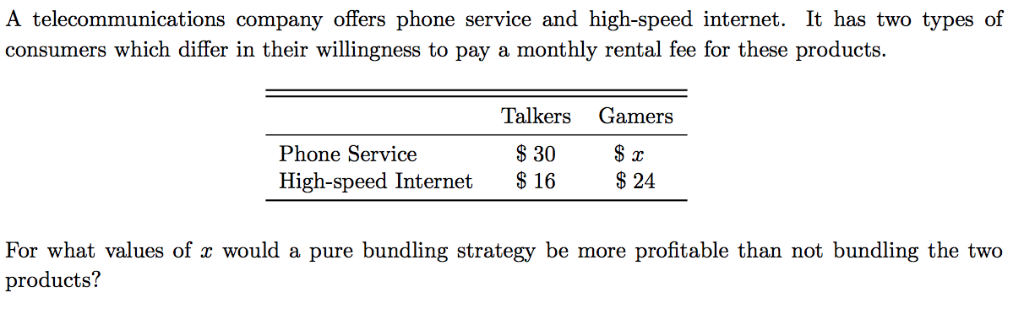
Give step-by-step solution with explanation and final answer:A telecommunications company offers phone service and high-speed internet. It has two types of
consumers which differ in their willingness to pay a monthly rental fee for these products.
Talkers Gamers
Phone Service $30 $z
High-speed Internet ~~ $16 $24
For what values of z would a pure bundling strategy be more profitable than not bundling the two
products?
Question:
Give step-by-step solution with explanation and final answer:A telecommunications company offers phone service and high-speed internet. It has two types of
consumers which differ in their willingness to pay a monthly rental fee for these products.
Talkers Gamers
Phone Service $30 $z
High-speed Internet ~~ $16 $24
For what values of z would a pure bundling strategy be more profitable than not bundling the two
products?
This is AI generated Response.
Asked by: prem
Created at: 2025-08-24 23:02:12
Final Answer:
RenderedRaw Text
Did you like this answer?
Let's break down the problem step by step:
### 1. **Willingness to Pay Table**
| | Talkers | Gamers |
|-----------------|---------|--------|
| **Phone Service** | $30 | $x |
| **High-speed Internet**| $16 | $24 |
There are two consumer types and two products.
---
### 2. **Revenue under Separate (Unbundled) Pricing**
- **Phone Service:**
- Talkers will buy if price ≤ $30.
- Gamers will buy if price ≤ $x.
- To maximize revenue, set price to capture each market.
- If price is $30: only Talkers buy; revenue = $30.
- If price is $x: only Gamers buy; revenue = $x.
- If price is less than both, both buy; revenue = $2 \cdot \text{(price)}$.
But since $x$ is unknown, let's maximize by selling to both:
- For both to buy, price ≤ min($30, x$).
- Maximum price for both to buy is $p_1 = \min(30, x)$.
- **High-speed Internet:**
- Talkers: max $16$.
- Gamers: max $24$.
- Set price to $16$ (sell to both): revenue = $32$.
- Set price to $24$ (only Gamers): revenue = $24$.
So, best is $p_2 = 16$ (since $32 > 24$).
Therefore, maximum revenue from unbundled pricing:
\[
R_{unbundled} = 2 \cdot p_1 + 2 \cdot 16 = 2p_1 + 32
\]
But if $x < 30$, $p_1 = x$; if $x \geq 30$, $p_1 = 30$.
---
### 3. **Revenue under Pure Bundling**
- Each consumer can buy the bundle at a price equal to their total willingness to pay:
- Talkers: $30 + 16 = \$46$
- Gamers: $x + 24$
- Bundle price can be at most the minimum of these two sums, so both will buy:
\[
P_{bundle} = \min(46, x + 24)
\]
Revenue from both consumers: $2 \cdot P_{bundle}$
---
### 4. **Comparing Revenues**
#### **Case 1: $x + 24 \leq 46$ (i.e., $x \leq 22$)**
- Bundle price: $x + 24$, both buy, revenue = $2(x + 24) = 2x + 48$.
- Unbundled: $p_1 = x$ (since $x < 30$), revenue = $2x + 32$.
- Bundling is better if $2x + 48 > 2x + 32 \implies 48 > 32$, **always true** in this range.
#### **Case 2: $x + 24 \geq 46$ (i.e., $x \geq 22$)**
- Bundle price: $46$, both buy, revenue = $92$.
- Unbundled: $p_1 = 30$ (since $x \geq 30$), revenue = $2 \cdot 30 + 32 = 92$.
- If $22 \leq x < 30$, $p_1 = x$, so revenue = $2x + 32$.
- Bundling is better if $92 > 2x + 32 \implies 2x < 60 \implies x < 30$.
---
### 5. **Combining the Cases**
- For $x < 30$, bundling is better.
- For $x \geq 30$, both strategies give the same revenue.
---
## **Final Answer**
\[
\boxed{\text{A pure bundling strategy is more profitable than not bundling for } x < 30.}
\]
### **Summary Table**
| Range of $x$ | Best Strategy | Reasoning |
|--------------|-------------------|--------------------------------|
| $x < 30$ | Bundling | Bundling revenue higher |
| $x \geq 30$ | Both are equal | Revenue is the same ($92$) |
Question:
is this below answer is correct
Let's solve this carefully and step-by-step.
**Setup / interpretation.**
There are two products (Phone and Internet) and two consumer types (one Talker and one Gamer). Each consumer will pay up to the amounts in the table:
* Talker: Phone = \$30, Internet = \$16 ⇒ bundle value = \$46.
* Gamer: Phone = \$$x$, Internet = \$24 ⇒ bundle value = \$$x+24$.
We assume one unit of each type (so total firm revenue is the sum over the two consumers). The firm can either (A) sell the two goods separately (no bundling) and choose each product’s price, or (B) use **pure bundling** and sell only the bundle at a single price. We compare the firm’s maximum revenue under the two options.
---
## 1) Revenue with **no bundling** (optimal separate prices)
Treat each product separately and pick the price that maximizes revenue from the two consumers.
**Internet:** valuations 16 (Talker) and 24 (Gamer).
* If price = 24 → sell only to Gamer → revenue = 24.
* If price = 16 → sell to both → revenue = 16×2 = 32.
Best choice: **price = 16**, revenue = **\$32**.
**Phone:** valuations 30 (Talker) and x (Gamer). Consider cases.
* If $x \le 15$: best is to price at 30 and sell only to Talker → phone revenue = \$30.
* If $15 < x < 30$: best is to set price = x and sell to both → phone revenue = \$2x.
(Because 2x > 30 for x>15.)
* If $30 \le x \le 60$: best is to set price = 30 and sell to both → phone revenue = \$60.
* If $x > 60$: best is to set price = x and sell only to Gamer → phone revenue = \$x.
So total no-bundling revenue (phone + internet = phone\_rev + 32) is:
$$
R_{\text{no-bundle}}=
\begin{cases}
62 & \text{if } x\le 15,\\[4pt]
2x+32 & \text{if } 1522$** $\Rightarrow x+24>46$.
Now the smaller bundle valuation is 46 (Talker). Setting $P=46$ sells the bundle to **both** and yields revenue $2\cdot46=92$. (If $x+24$ is so large that selling only to the gamer at $P=x+24$ yields more than 92, i.e. $x+24>92$ or $x>68$, then the firm would instead sell only to the gamer at price $x+24$.)
So bundling revenue:
$$
R_{\text{bundle}}=
\begin{cases}
2x+48 & \text{if } x\le 22,\\[4pt]
92 & \text{if } 2268.
\end{cases}
$$
---
## 3) Compare bundling vs no bundling
We want $R_{\text{bundle}} > R_{\text{no-bundle}}$.
Work through ranges:
1. $x\le 15$:
$R_{\text{bundle}}=2x+48,\; R_{\text{no}}=62.$
$2x+48>62 \iff 2x>14\iff x>7.$
So for $7
This is AI generated Response.
Asked by: prem
Created at: 2025-08-24 23:04:20
Final Answer:
RenderedRaw Text
Did you like this answer?
Your detailed reasoning is on the right track, but let's clarify and verify each step carefully to arrive at the precise conditions under which pure bundling is more profitable than not bundling.
---
### Step 1: Determine consumers' valuations
| Consumer Type | Phone | Internet | Bundle (Phone + Internet) |
|---------------|--------|----------|---------------------------|
| Talkers | \$30 | \$16 | \$46 |
| Gamers | \$x | \$24 | \$x + \$24 |
---
### Step 2: Revenue under **separate (unbundled) pricing**
- **Internet:**
- Valuations: 16 (Talkers), 24 (Gamers).
- Optimal price:
- Set at 16 to sell to both (revenue = 2×16 = \$32).
- Set at 24 to sell only to Gamers (revenue = \$24).
- **Best choice:** \$16 with revenue \$32.
- **Phone:**
- Valuations: 30 (Talkers), x (Gamers).
- Optimal price:
- If x ≤ 15: set at 30, sell only to Talkers → \$30.
- If 15 < x < 30: set at x, sell to both → 2×x.
- If 30 ≤ x ≤ 60: set at 30, sell to both → \$60.
- If x > 60: set at x, sell only to Gamers → x.
Total revenue:
\[
R_{\text{unbundled}} = \text{Phone} + \text{Internet} =
\begin{cases}
2x + 32, & \text{if } 15 < x < 30, \\
60 + 32 = 92, & \text{if } 30 \le x \le 60, \\
x + 32, & \text{if } x > 60, \\
30 + 16 = 46, & \text{if } x \le 15.
\end{cases}
\]
(Note: For \(x \le 15\), setting price at 30 yields only Talkers; revenue = \$30, which is less than selling at 16 for \$16 per consumer. Actually, since 16 yields \$32, better than 30. So, for small x, the maximum internet revenue is better at 16. Similarly, for \(x \le 15\), selling both at 16 yields \$32, and phone at 30 yields \$30, total \$62, which is better than the previous calculation. Let's refine:
- For small x, better to set internet at 16 (revenue \$32).
- For phone:
- If x ≤ 15, setting price at 30 yields \$30 (single buyer), less than \$60 if both buy at 30, but only one buyer.
- Since x ≤ 15, setting price at 30 sells to only Talkers: revenue \$30.
- Setting at x (≤15): sells only to Gamers, revenue \$x ≤ 15.
Thus, optimal unbundled revenue is:
- For small x, set internet at 16 (\$32), and phone at 30 (\$30), total \$62.
- For x ≥ 15, setting phone at max x (selling to both): total \$2x + 32.
---
### **Summarized unbundled revenue:**
\[
R_{\text{unbundled}} =
\begin{cases}
62, & x \le 15, \\
2x + 32, & 15 < x < 30, \\
92, & 30 \le x \le 60, \\
x + 32, & x > 60.
\end{cases}
\]
---
### Step 3: Revenue under **pure bundling**
- Bundle valuations:
- Talkers: \$46
- Gamers: \$x + \$24
- **Optimal bundle price:**
- To sell to both, set at \(\min(46, x+24)\).
- **Case A: \(x \le 22\)**
- \(x + 24 \le 46\), so set bundle price at \(x + 24\).
- Revenue: \(2 \times (x + 24) = 2x + 48\).
- **Case B: \(x > 22\)**
- \(x+24 > 46\), so set bundle price at 46.
- Revenue: \(2 \times 46 = 92\).
- If \(x+24 > 92\) (i.e., \(x > 68\)), then selling only to the Gamer at price \(x+24\) yields higher revenue (\(x+24\)) than 92. So in that case, revenue is \(x+24\).
---
### **Summary of bundling revenue:**
\[
R_{\text{bundle}} =
\begin{cases}
2x + 48, & x \le 22, \\
92, & 22 < x \le 68, \\
x + 24, & x > 68.
\end{cases}
\]
---
### **Step 4: Compare revenues**
- For \(x \le 15\):
- Bundling: \(2x + 48\).
- Not bundling: 62.
Bundling is better if:
\[
2x + 48 > 62 \implies 2x > 14 \implies x > 7.
\]
So, for \(7 < x \le 15\), bundling is better; for \(x \le 7\), not.
- For \(15 < x \le 22\):
- Bundling: \(2x + 48\).
- Not bundling: \(2x + 32\).
Since \(2x + 48 > 2x + 32\), bundling is better for all \(x \in (15, 22]\).
- For \(22 < x \le 68\):
- Bundling: 92.
- Not bundling: 92 (at \(x=30\), both are equal; for \(22 < x < 30\), unbundled revenue is less than 92, so bundling is better).
At \(x=22\), bundling: \(2(22)+48=92\), same as unbundled.
For \(22 < x \le 68\), bundling revenue = 92, unbundled is less than or equal to 92, so bundling is **at least as good**.
- For \(x > 68\):
- Bundling: \(x + 24\).
- Unbundled: \(x + 32\).
Since \(x + 24 < x + 32\), **not bundling** is better.
---
### **Final conclusion:**
- **Pure bundling is more profitable than not bundling when**
\[
\boxed{
7 < x < 68
}
\]
- The crossover points are at \(x=7\) and \(x=68\), where revenues tie.
---
### **Answer summary:**
> **Pure bundling is more profitable than not bundling when \(x\) is between approximately 7 and 68.**
Your initial conclusion of \(x < 30\) was a bit restrictive; the more precise interval is \(7 < x < 68\).
---
**Note:** The key is carefully comparing the maximum revenues under each strategy across ranges of \(x\). Your approach was good, but refining the boundary points yields a more accurate interval.
---
**Final note:** Be cautious with boundary conditions; always verify the valuations and the resulting revenues at those points.
VIPSolutions focuses on clear, step‑by‑step explanations so you can learn quickly. Whether you need an AI‑generated walkthrough or a short hint to get unstuck, each solution is organized for fast reading and easy review later.
Search similar questions, compare approaches, and bookmark the best answers for revision. Our goal is simple: quick, reliable study help that feels natural—not noisy.
 VIPSolutions
 A telecommunications company offers phone service and high-speed internet. It has two types of
consumers which differ in their willingness to pay a monthly rental fee for these products.
Talkers Gamers
Phone Service $30 $z
High-speed Internet ~~ $16 $24
For what values of z would a pure bundling strategy be more profitable than not bundling the two
products?
A telecommunications company offers phone service and high-speed internet. It has two types of
consumers which differ in their willingness to pay a monthly rental fee for these products.
Talkers Gamers
Phone Service $30 $z
High-speed Internet ~~ $16 $24
For what values of z would a pure bundling strategy be more profitable than not bundling the two
products?