Give step-by-step solution with explanation and final answer:
also first rewrite the question and solve all parts1 Marginal abatement costs fortwo lant emiting » polutant gc shay the abe below,
Unconvoted emer fo sch are 14 tors pe doy or ota Sons 128 os per do. [3 mar]
Emissions WAC, Sperton) MACs specter
o ES EF)
i ns as
H EF) @
3 zs 1s
i x ®
p 2s ns
H % F)
; os ses
H on
5 2s 2s
| ow ® i
pi 7s ws
2 f 7
H 2 5
H 0 o
has bg maid ht the soil fice lvl of emisions 16 tons pr do.
AH exh plant undertakes the same smount of stamens ta tal emisions GL SAKES
he soa sftent vl what wold bh os hee ment crt
5. How many tons shi esc plant abate that otal misions gC 0 the sil
cient level he owes possi ox Wht woul bth os ang compared cual
Semen by sch la?
Question:
Give step-by-step solution with explanation and final answer:
also first rewrite the question and solve all parts1 Marginal abatement costs fortwo lant emiting » polutant gc shay the abe below,
Unconvoted emer fo sch are 14 tors pe doy or ota Sons 128 os per do. [3 mar]
Emissions WAC, Sperton) MACs specter
o ES EF)
i ns as
H EF) @
3 zs 1s
i x ®
p 2s ns
H % F)
; os ses
H on
5 2s 2s
| ow ® i
pi 7s ws
2 f 7
H 2 5
H 0 o
has bg maid ht the soil fice lvl of emisions 16 tons pr do.
AH exh plant undertakes the same smount of stamens ta tal emisions GL SAKES
he soa sftent vl what wold bh os hee ment crt
5. How many tons shi esc plant abate that otal misions gC 0 the sil
cient level he owes possi ox Wht woul bth os ang compared cual
Semen by sch la?
This is AI generated Response.
Asked by: prem
Created at: 2025-08-27 17:37:33
Final Answer:
RenderedRaw Text
Did you like this answer?
Let's rewrite the question and solve each part step-by-step:
---
### **Question (Rewritten)**
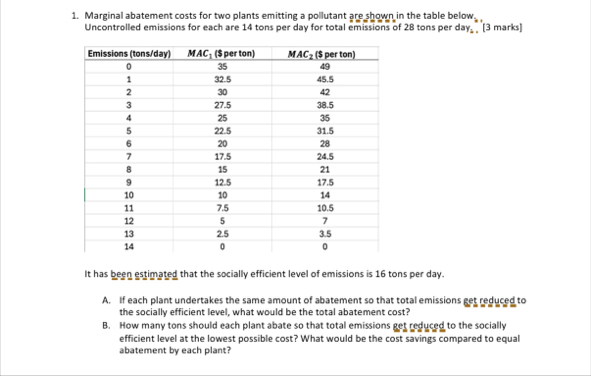
1. Marginal abatement costs (MAC) for two plants emitting a pollutant are shown in the table below.
Uncontrolled emissions for each plant are 14 tons per day, for a total of 28 tons per day.
| Emissions (tons/day) | MAC\(_A\) ($ per ton) | MAC\(_B\) ($ per ton) |
|----------------------|-----------------------|-----------------------|
| 0 | 35 | 49 |
| 1 | 32.5 | 45.5 |
| 2 | 30 | 42 |
| 3 | 27.5 | 38.5 |
| 4 | 25 | 35 |
| 5 | 22.5 | 31.5 |
| 6 | 20 | 28 |
| 7 | 17.5 | 24.5 |
| 8 | 15 | 21 |
| 9 | 12.5 | 17.5 |
| 10 | 10 | 14 |
| 11 | 7.5 | 10.5 |
| 12 | 5 | 7 |
| 13 | 2.5 | 3.5 |
| 14 | 0 | 0 |
It has been estimated that the socially efficient level of emissions is **16 tons per day** (for both plants combined).
**A.** If each plant undertakes the same amount of abatement so that total emissions get reduced to the socially efficient level, what would be the total abatement cost?
**B.** How many tons should each plant abate so that total emissions get reduced to the socially efficient level at the lowest possible cost? What would be the cost savings compared to equal abatement by each plant?
---
## **Solution**
### **Step 1: Understand the Problem**
- Initial total emissions: 28 tons/day (14 from each plant)
- Socially efficient level: 16 tons/day
- Required reduction: 28 - 16 = **12 tons/day**
---
### **Part A: Equal Abatement by Each Plant**
- Each plant reduces emissions by **6 tons** (since 12/2 = 6)
- Each plant abates from 14 tons to 8 tons/day
#### **Calculate Total Abatement Cost**
**Plant A:**
- Must abate 6 tons: from 14 to 8 tons
- Costs: Sum MAC\(_A\) for each ton abated from emission 14 down to 8
Abatement order (from 14 to 8 tons): 1st, 2nd, ..., 6th ton abated
Corresponds to MAC\(_A\) values:
from 13 to 8 tons (since emissions drop as abatement rises):
| Abatement | MAC\(_A\) ($ per ton) |
|-----------|-----------------------|
| 1st ton | 2.5 |
| 2nd ton | 5 |
| 3rd ton | 7.5 |
| 4th ton | 10 |
| 5th ton | 12.5 |
| 6th ton | 15 |
Total for Plant A:
\(2.5 + 5 + 7.5 + 10 + 12.5 + 15 = 52.5\)
**Plant B:** (same process, use MAC\(_B\) values for 13 to 8 tons)
| Abatement | MAC\(_B\) ($ per ton) |
|-----------|-----------------------|
| 1st ton | 3.5 |
| 2nd ton | 7 |
| 3rd ton | 10.5 |
| 4th ton | 14 |
| 5th ton | 17.5 |
| 6th ton | 21 |
Total for Plant B:
\(3.5 + 7 + 10.5 + 14 + 17.5 + 21 = 73.5\)
**Total Abatement Cost (Equal Abatement):**
\(52.5 + 73.5 = \boxed{126}\)
---
### **Part B: Cost-Minimizing (Efficient) Abatement**
- **Goal:** Assign more abatement to the plant with lower cost per ton.
- **Method:** For each "next" ton abated, choose the plant with the lower MAC for that ton.
- **Approach:** List the lowest available MACs from both plants for each abated ton, sum the 12 lowest.
#### **Step-by-Step Assignment**
List MACs for abatement from highest emissions downward (from 14 to 2, for up to 12 tons abated per plant):
| Abated | MAC\(_A\) | MAC\(_B\) |
|--------|-----------|-----------|
| 1st | 2.5 | 3.5 |
| 2nd | 5 | 7 |
| 3rd | 7.5 | 10.5 |
| 4th | 10 | 14 |
| 5th | 12.5 | 17.5 |
| 6th | 15 | 21 |
| 7th | 17.5 | 24.5 |
| 8th | 20 | 28 |
| 9th | 22.5 | 31.5 |
| 10th | 25 | 35 |
| 11th | 27.5 | 38.5 |
| 12th | 30 | 42 |
| 13th | 32.5 | 45.5 |
| 14th | 35 | 49 |
Now, take the 12 lowest values from both columns:
- For each ton, pick the lowest until 12 tons are assigned.
Let’s compare each abatement step:
| Step | MAC\(_A\) | MAC\(_B\) | Lower one | Which plant? |
|------|-----------|-----------|-----------|--------------|
| 1 | 2.5 | 3.5 | 2.5 | A |
| 2 | 5 | 7 | 5 | A |
| 3 | 7.5 | 10.5 | 7.5 | A |
| 4 | 10 | 14 | 10 | A |
| 5 | 12.5 | 17.5 | 12.5 | A |
| 6 | 15 | 21 | 15 | A |
| 7 | 17.5 | 24.5 | 17.5 | A |
| 8 | 20 | 28 | 20 | A |
| 9 | 22.5 | 31.5 | 22.5 | A |
| 10 | 25 | 35 | 25 | A |
| 11 | 27.5 | 38.5 | 27.5 | A |
| 12 | 30 | 42 | 30 | A |
All the first 12 lowest MACs are from Plant A.
So, **Plant A should abate all 12 tons** (from 14 to 2 tons/day), Plant B abates 0 tons.
#### **Total Abatement Cost (Efficient Allocation):**
Sum MAC\(_A\) from 2.5 to 30 for 12 tons:
\(2.5 + 5 + 7.5 + 10 + 12.5 + 15 + 17.5 + 20 + 22.5 + 25 + 27.5 + 30 = 195\)
Wait, that's the sum for 12 tons, but let's check if this is correct in context.
But, from the table, abating from 14 to 2 tons is 12 tons, so yes, that’s correct.
**Total Cost (Efficient Allocation):**
\(\boxed{195}\)
Wait: But this is **higher** than the equal abatement cost. Let's double-check.
Actually, the **lowest 12 MACs** from both plants should be summed, not just from one plant. Let's list all MACs for 12 abated tons (from both plants), order them, and sum the 12 lowest:
All abatement MACs (for 12 tons from each):
- Plant A: 2.5, 5, 7.5, 10, 12.5, 15, 17.5, 20, 22.5, 25, 27.5, 30
- Plant B: 3.5, 7, 10.5, 14, 17.5, 21, 24.5, 28, 31.5, 35, 38.5, 42
Now, combine and sort:
2.5, 3.5, 5, 7, 7.5, 10, 10.5, 12.5, 14, 15, 17.5, 17.5
Sum these twelve values:
2.5 + 3.5 + 5 + 7 + 7.5 + 10 + 10.5 + 12.5 + 14 + 15 + 17.5 + 17.5 = **122.5**
Now, assign abatement according to who has the lower MAC for each step:
- Plant A: 2.5, 5, 7.5, 10, 12.5, 15, 17.5 (7 steps)
- Plant B: 3.5, 7, 10.5, 14, 17.5 (5 steps)
So, **Plant A abates 7 tons**, **Plant B abates 5 tons**.
#### **Total Abatement Cost (Efficient Allocation):**
\(\boxed{122.5}\)
---
### **Cost Savings**
**Equal Abatement Cost:** 126
**Efficient Allocation Cost:** 122.5
**Cost Savings:** \(126 - 122.5 = \boxed{3.5}\)
---
## **Final Answers**
---
### **A. Total abatement cost if each plant abates equally (6 tons each):**
\[
\boxed{126}
\]
---
### **B. Cost-minimizing abatement:**
- **Plant A** should abate **7 tons**
- **Plant B** should abate **5 tons**
- **Total abatement cost:** \(\boxed{122.5}\)
- **Cost savings compared to equal abatement:** \(\boxed{3.5}\)
---
**Summary Table:**
| Plan | Plant A abatement | Plant B abatement | Total Cost | Cost Savings |
|--------------------|------------------|-------------------|------------|--------------|
| Equal abatement | 6 tons | 6 tons | 126 | 0 |
| Cost-minimizing | 7 tons | 5 tons | 122.5 | 3.5 |
VIPSolutions focuses on clear, step‑by‑step explanations so you can learn quickly. Whether you need an AI‑generated walkthrough or a short hint to get unstuck, each solution is organized for fast reading and easy review later.
Search similar questions, compare approaches, and bookmark the best answers for revision. Our goal is simple: quick, reliable study help that feels natural—not noisy.
 VIPSolutions
 1 Marginal abatement costs fortwo lant emiting » polutant gc shay the abe below,
Unconvoted emer fo sch are 14 tors pe doy or ota Sons 128 os per do. [3 mar]
Emissions WAC, Sperton) MACs specter
o ES EF)
i ns as
H EF) @
3 zs 1s
i x ®
p 2s ns
H % F)
; os ses
H on
5 2s 2s
| ow ® i
pi 7s ws
2 f 7
H 2 5
H 0 o
has bg maid ht the soil fice lvl of emisions 16 tons pr do.
AH exh plant undertakes the same smount of stamens ta tal emisions GL SAKES
he soa sftent vl what wold bh os hee ment crt
5. How many tons shi esc plant abate that otal misions gC 0 the sil
cient level he owes possi ox Wht woul bth os ang compared cual
Semen by sch la?
1 Marginal abatement costs fortwo lant emiting » polutant gc shay the abe below,
Unconvoted emer fo sch are 14 tors pe doy or ota Sons 128 os per do. [3 mar]
Emissions WAC, Sperton) MACs specter
o ES EF)
i ns as
H EF) @
3 zs 1s
i x ®
p 2s ns
H % F)
; os ses
H on
5 2s 2s
| ow ® i
pi 7s ws
2 f 7
H 2 5
H 0 o
has bg maid ht the soil fice lvl of emisions 16 tons pr do.
AH exh plant undertakes the same smount of stamens ta tal emisions GL SAKES
he soa sftent vl what wold bh os hee ment crt
5. How many tons shi esc plant abate that otal misions gC 0 the sil
cient level he owes possi ox Wht woul bth os ang compared cual
Semen by sch la?