 VIPSolutions
Give step-by-step solution with explanation and final answer:Thevenin and Norton equivalents 1. Find the Thevenin equivalent to the left of the terminals a,b in the circuit below. Use the test source method. 2. 2. Use Spice software to simulate the circuit and confirm your result in Step 1. Fully explain any discrepancy. na 10 a aa A b
Question:
Give step-by-step solution with explanation and final answer: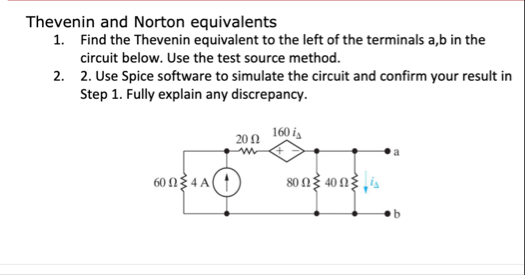 Thevenin and Norton equivalents
1. Find the Thevenin equivalent to the left of the terminals a,b in the
circuit below. Use the test source method.
2. 2. Use Spice software to simulate the circuit and confirm your result in
Step 1. Fully explain any discrepancy.
na 10
a
aa A
b
Thevenin and Norton equivalents
1. Find the Thevenin equivalent to the left of the terminals a,b in the
circuit below. Use the test source method.
2. 2. Use Spice software to simulate the circuit and confirm your result in
Step 1. Fully explain any discrepancy.
na 10
a
aa A
b
This is AI generated Response.
Asked by: M Raju
Created at: 2025-09-03 15:32:43
Asked by: M Raju
Created at: 2025-09-03 15:32:43
Final Answer:
Rendered
Raw Text
Did you like this answer?
Let's solve **Step 1: Find the Thevenin equivalent to the left of terminals a, b (using the test source method)**.
---
### **Step 1: Thevenin Resistance (\(R_{th}\)) using Test Source Method**
#### **A. Remove all independent sources**
- The 4A current source is independent. **Replace it with an open circuit**.
#### **B. Apply a test source (\(V_{test}\))**
- Apply \(V_{test}\) at terminals \(a, b\) (from \(a\) to \(b\)), and calculate the resulting current \(I_{test}\) entering at \(a\).
- \(R_{th} = \frac{V_{test}}{I_{test}}\)
#### **C. Redraw the Circuit**
- All resistors remain.
- The dependent source remains: \(160i_x\), where \(i_x\) is the current through \(40\,\Omega\).
#### **D. Find relationships**
Let \(i_x =\) current through **40Ω** (from a to b).
Let \(I_{test}\) be the current injected into \(a\).
##### **Nodal Analysis at node a:**
Let the voltage at \(a\) be \(V_{test}\) (since \(b\) is at 0V).
- The current through \(80\,\Omega\) from \(a\) to left junction: \(\frac{V_{test} - V_1}{80}\)
- The current through \(40\,\Omega\) from \(a\) to \(b\): \(\frac{V_{test}}{40} = i_x\)
- The current from the dependent source (from left junction to \(a\)): \(160 i_x\) (enters \(a\))
##### **At the left junction:**
- Current through \(20\,\Omega\) (from left to \(a\)): \(\frac{V_1 - V_{test}}{20}\)
- Current through \(60\,\Omega\) from left junction to ground (\(b\)): \(\frac{V_1}{60}\)
**KCL at node \(a\):**
\[
I_{test} = \frac{V_{test} - V_1}{80} + \frac{V_{test}}{40} + 160 i_x
\]
But \(i_x = \frac{V_{test}}{40}\), so:
\[
I_{test} = \frac{V_{test} - V_1}{80} + \frac{V_{test}}{40} + 160\left(\frac{V_{test}}{40}\right)
\]
\[
I_{test} = \frac{V_{test} - V_1}{80} + \frac{V_{test}}{40} + 4V_{test}
\]
**KCL at left junction:**
\[
\text{Current in} = \text{current out}
\]
\[
\frac{V_1 - V_{test}}{20} = \frac{V_1}{60} + \frac{V_1 - V_{test}}{80} + 160 i_x
\]
But notice that \(i_x\) flows only through the 40Ω. The dependent source is between left junction and \(a\), so it appears in both KCLs.
But let's focus on the simpler way:
#### **Combine resistors:**
- The 80Ω and 40Ω are in series between \(a\) and \(b\): total \(= 120\,\Omega\).
- The 20Ω and 60Ω are not directly in series or parallel due to the dependent source.
Let’s apply a test voltage \(V_{test}\) across \(ab\):
- The current through 40Ω: \(i_x = \frac{V_{test}}{40}\).
- The current through 80Ω: \(i_{80} = \frac{V_{test}}{80}\).
- The dependent **current source** \(160i_x\) is in parallel with the 80Ω resistor, from the junction of (20Ω, 80Ω, and 60Ω) to node a.
Let's call the voltage at the left junction \(V_1\):
- Current through 20Ω: \(\frac{V_1 - V_{test}}{20}\)
- Current through 60Ω: \(\frac{V_1}{60}\)
- Current through 80Ω: \(\frac{V_1 - V_{test}}{80}\)
- Current through dependent source: \(160i_x = 4V_{test}\) (since \(i_x = V_{test}/40\)), from left junction to \(a\).
**KCL at left junction:**
\[
\frac{V_1 - V_{test}}{20} + \frac{V_1 - V_{test}}{80} = \frac{V_1}{60} + 4V_{test}
\]
\[
\left( \frac{1}{20} + \frac{1}{80} \right)(V_1 - V_{test}) = \frac{V_1}{60} + 4V_{test}
\]
\[
\frac{5}{80}(V_1 - V_{test}) = \frac{V_1}{60} + 4V_{test}
\]
\[
\frac{5V_1 - 5V_{test}}{80} = \frac{V_1}{60} + 4V_{test}
\]
Multiply both sides by 240 (LCM of 80 and 60) to clear denominators:
\[
3(5V_1 - 5V_{test}) = 4V_1 + 960V_{test}
\]
\[
15V_1 - 15V_{test} = 4V_1 + 960V_{test}
\]
\[
15V_1 - 4V_1 = 960V_{test} + 15V_{test}
\]
\[
11V_1 = 975V_{test}
\]
\[
V_1 = \frac{975}{11} V_{test}
\]
Now, **find \(I_{test}\):**
\[
I_{test} = \frac{V_{test}}{40} + \frac{V_{test}}{80} + 4V_{test}
\]
\[
= \frac{2V_{test}}{80} + \frac{V_{test}}{80} + 4V_{test}
\]
\[
= \frac{3V_{test}}{80} + 4V_{test}
\]
\[
= \frac{3V_{test} + 320V_{test}}{80}
\]
\[
= \frac{323V_{test}}{80}
\]
But this misses the 20Ω and 60Ω branches, as current can also flow through those.
So, actually:
\[
I_{test} = (\text{current through 40Ω}) + (\text{current through 80Ω}) + (\text{current through dependent source})
\]
But the current entering \(a\) is:
- From \(a\) to \(b\) through 40Ω: \(i_x = V_{test}/40\)
- From \(a\) to left through 80Ω: \((V_{test} - V_1)/80\)
- From left to \(a\) through dependent source: \(160i_x = 4V_{test}\)
So, the total current into \(a\) is:
\[
I_{test} = \frac{V_{test}}{40} + \frac{V_{test} - V_1}{80} + 4V_{test}
\]
Plug in \(V_1 = \frac{975}{11} V_{test}\):
\[
I_{test} = \frac{V_{test}}{40} + \frac{V_{test} - \frac{975}{11}V_{test}}{80} + 4V_{test}
\]
\[
= \frac{V_{test}}{40} + \frac{V_{test} (1 - \frac{975}{11})}{80} + 4V_{test}
\]
\[
= \frac{V_{test}}{40} + \frac{V_{test} \left(\frac{11 - 975}{11}\right)}{80} + 4V_{test}
\]
\[
= \frac{V_{test}}{40} + \frac{V_{test} \left(\frac{-964}{11}\right)}{80} + 4V_{test}
\]
\[
= \frac{V_{test}}{40} - \frac{964 V_{test}}{880} + 4V_{test}
\]
\[
\frac{964}{880} = \frac{241}{220}
\]
So:
\[
I_{test} = \frac{V_{test}}{40} - \frac{241 V_{test}}{220} + 4V_{test}
\]
Now, get all terms over a common denominator (let's use 220):
\[
\frac{V_{test}}{40} = \frac{11 V_{test}}{440}
\]
\[
4 V_{test} = \frac{4 \times 220 V_{test}}{220} = \frac{880 V_{test}}{220}
\]
So:
\[
I_{test} = \frac{11 V_{test}}{440} - \frac{241 V_{test}}{220} + \frac{880 V_{test}}{220}
\]
\[
= \frac{11 V_{test}}{440} + \frac{880 V_{test} - 241 V_{test}}{220}
\]
\[
= \frac{11 V_{test}}{440} + \frac{639 V_{test}}{220}
\]
\[
= \frac{11 V_{test}}{440} + \frac{2 \times 639 V_{test}}{2 \times 220}
\]
\[
= \frac{11 V_{test}}{440} + \frac{639 V_{test}}{220}
\]
\[
= \frac{11 V_{test}}{440} + \frac{319.5 V_{test}}{110}
\]
But let's just convert \(\frac{639}{220}\) to the same denominator as \(\frac{11}{440}\):
\[
\frac{639}{220} = \frac{2 \times 639}{2 \times 220} = \frac{1278}{440}
\]
So:
\[
I_{test} = \frac{11 V_{test}}{440} + \frac{1278 V_{test}}{440} = \frac{(11+1278)V_{test}}{440} = \frac{1289 V_{test}}{440}
\]
Therefore,
\[
R_{th} = \frac{V_{test}}{I_{test}} = \frac{V_{test}}{\frac{1289 V_{test}}{440}} = \frac{440}{1289} \approx 0.341 \Omega
\]
---
### **Step 2: Thevenin Voltage (\(V_{th}\))**
Now **find the open-circuit voltage** at \(a\) (with 4A source acting, \(i_x\) as before).
Set \(i_{ab}=0\). Find voltage at \(a\) relative to \(b\):
Let \(i_x\) be the current through the 40Ω resistor.
- The 4A current splits between 60Ω, 20Ω, and rest of the circuit.
- The dependent source and resistors complicate a simple mesh/nodal analysis, but let's apply nodal analysis at \(a\):
Let \(V_a = V_{th}\), \(V_1\) is node between 60Ω, 20Ω, 80Ω.
- KCL at node \(V_1\):
\[
4 = \frac{V_1}{60} + \frac{V_1 - V_a}{20} + \frac{V_1 - V_a}{80} + 160 i_x
\]
But with open circuit at \(a\), \(i_x = 0\) (since no current flows in open circuit), so dependent source is zero.
\[
4 = \frac{V_1}{60} + \frac{V_1 - V_a}{20} + \frac{V_1 - V_a}{80}
\]
Combine the two terms:
\[
\frac{V_1 - V_a}{20} + \frac{V_1 - V_a}{80} = (V_1 - V_a)\left(\frac{1}{20} + \frac{1}{80}\right) = (V_1 - V_a)\left(\frac{5}{80}\right)
\]
So:
\[
4 = \frac{V_1}{60} + \frac{5(V_1 - V_a)}{80}
\]
\[
4 = \frac{V_1}{60} + \frac{5V_1 - 5V_a}{80}
\]
Multiply both sides by 240 (LCM):
\[
960 = 4V_1 + 15V_1 - 15V_a
\]
\[
960 = 19V_1 - 15V_a
\]
Now, KCL at node \(a\) (open circuit, so only path to ground is via 80Ω and 40Ω):
\[
0 = \frac{V_a - V_1}{80} + \frac{V
📢 Instructions:
- Ask anything relatd to above question only.
- For new Question goto :