 VIPSolutions
Give step-by-step solution with explanation and final answer: Give step-by-step solution with explanation and final answer:The figure below shows a compound planetary gear train (not to scale). Use tabular solution to find ®,m, given the following information: N,=30, N;=25, N,=45, Ns=50, Ns=200, ©,=50 rpm, ©¢=0 rpm _ 6 $= & " Sh Am = . 4 . rn NE | r2 [f/ Am- 457) Pre [Am [Cd +f LTO Lat | oY " | 2 _ | ma Lh (] f J — 4 \ \ y / Bearing — a ml
Question:
Give step-by-step solution with explanation and final answer:
Give step-by-step solution with explanation and final answer: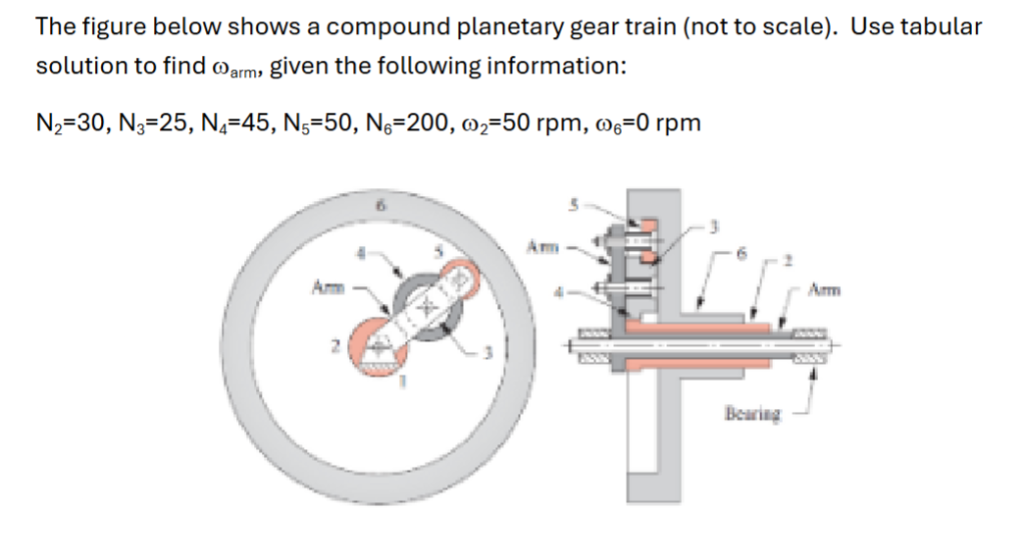 The figure below shows a compound planetary gear train (not to scale). Use tabular
solution to find ®,m, given the following information:
N,=30, N;=25, N,=45, Ns=50, Ns=200, ©,=50 rpm, ©¢=0 rpm
_ 6 $=
& " Sh Am = .
4 . rn NE | r2
[f/ Am- 457) Pre [Am
[Cd +f LTO Lat
| oY " |
2 _ | ma
Lh (] f J — 4
\ \ y / Bearing —
a ml
The figure below shows a compound planetary gear train (not to scale). Use tabular
solution to find ®,m, given the following information:
N,=30, N;=25, N,=45, Ns=50, Ns=200, ©,=50 rpm, ©¢=0 rpm
_ 6 $=
& " Sh Am = .
4 . rn NE | r2
[f/ Am- 457) Pre [Am
[Cd +f LTO Lat
| oY " |
2 _ | ma
Lh (] f J — 4
\ \ y / Bearing —
a ml
This is AI generated Response.
Asked by: Veera manikanta
Created at: 2025-09-03 22:24:03
Asked by: Veera manikanta
Created at: 2025-09-03 22:24:03
Final Answer:
Rendered
Raw Text
Did you like this answer?
Let's solve the problem step by step using the **tabular method** for compound planetary gear trains.
### **Given Data**
- Number of teeth:
- \( N_2 = 30 \) (Sun 1)
- \( N_3 = 25 \) (Planet 1)
- \( N_4 = 45 \) (Planet 2)
- \( N_5 = 50 \) (Ring 1)
- \( N_6 = 200 \) (Ring 2)
- Angular velocities:
- \( \omega_2 = 50 \) rpm (Sun 1)
- \( \omega_6 = 0 \) rpm (Ring 2 is fixed)
- **Find:** \( \omega_{\text{arm}} \) (Arm angular velocity)
---
## **Step 1: Tabular Approach Setup**
### **Compound Planetary Gear Train**
- The arm (carrier) holds planets 3 and 4.
- Sun gear 2 meshes with planet 3.
- Planet 4 meshes with ring 6 (fixed).
- Planets 3 and 4 are rigidly attached and rotate together.
---
## **Step 2: Relative Motion Table**
We use the principle:
- **Step 1:** Lock the arm (arm = 0), rotate sun gear 2 by +1 rev.
- **Step 2:** Add +\( x \) revs to all elements (move everything by \( x \) revs).
Let:
- \( x \) = Arm motion (to be determined)
- \( y \) = Relative motion (when arm is locked, sun 2 rotates +1 rev)
| Step | Arm (\(\omega_{\text{arm}}\)) | Sun 2 (\(\omega_2\)) | Ring 6 (\(\omega_6\)) |
|---------------------|------------------|----------------|-----------------|
| 1. Arm locked, +1 rev at Sun 2 | 0 | +1 | ? |
| 2. Add \(x\) to all | \(x\) | \(x + y\) | \(x + z\) |
We'll focus on Sun 2, Arm, and Ring 6 (since that's where we have the velocities).
---
## **Step 3: Find the Ratio for Locked Arm**
**With the arm locked**:
- Sun 2 (\(N_2\)) meshes with planet 3 (\(N_3\)), which is rigid to planet 4 (\(N_4\)), which meshes with ring 6 (\(N_6\)).
- This forms a compound gear train from Sun 2 to Ring 6.
**Gear Ratio:**
\[
\text{Overall ratio} = \frac{N_2 \cdot N_4}{N_3 \cdot N_6}
\]
The movement of ring 6 when sun 2 rotates +1 rev (arm locked):
- From compound train: (since planet arms are locked, it’s like a simple train)
\[
\text{If sun 2 rotates by } +1 \text{ rev, ring 6 rotates by:}
\]
\[
\frac{\omega_6'}{\omega_2'} = -\frac{N_2 \cdot N_4}{N_3 \cdot N_6}
\]
\[
\omega_6' = -\frac{N_2 \cdot N_4}{N_3 \cdot N_6} \cdot 1
\]
Plug in the numbers:
\[
\omega_6' = -\frac{30 \cdot 45}{25 \cdot 200} = -\frac{1350}{5000} = -0.27
\]
So, when the arm is locked and sun 2 rotates +1 rev, ring 6 rotates \(-0.27\) rev.
---
## **Step 4: Write the General Equation**
Let \( x = \omega_{\text{arm}} \), and let the motion we just found be \( y \) times the actual sun rotation (here, \( y = \omega_2 - x \)). The actual motions are:
- Sun 2: \( \omega_2 \)
- Ring 6: \( \omega_6 \)
- Arm: \( \omega_{\text{arm}} \)
The tabular equation:
\[
\omega_{\text{element}} = \omega_{\text{arm}} + (\text{relative motion with respect to arm}) \cdot (\omega_2 - \omega_{\text{arm}})
\]
For ring 6:
\[
\omega_6 = \omega_{\text{arm}} + (\text{ratio}) \cdot (\omega_2 - \omega_{\text{arm}})
\]
Here, ratio is \(-0.27\) (from above).
Given: \( \omega_6 = 0 \)
\[
0 = \omega_{\text{arm}} + (-0.27) \cdot (\omega_2 - \omega_{\text{arm}})
\]
---
## **Step 5: Solve for \(\omega_{\text{arm}}\)**
\[
0 = \omega_{\text{arm}} - 0.27 (\omega_2 - \omega_{\text{arm}})
\]
\[
0 = \omega_{\text{arm}} - 0.27 \omega_2 + 0.27 \omega_{\text{arm}}
\]
\[
0 = (1 + 0.27)\omega_{\text{arm}} - 0.27 \omega_2
\]
\[
1.27\omega_{\text{arm}} = 0.27 \omega_2
\]
\[
\omega_{\text{arm}} = \frac{0.27}{1.27} \omega_2
\]
Plug in \( \omega_2 = 50 \) rpm:
\[
\omega_{\text{arm}} = \frac{0.27}{1.27} \times 50
\]
\[
\omega_{\text{arm}} = \frac{13.5}{1.27} \approx 10.63 \text{ rpm}
\]
---
## **Step 6: Final Answer**
\[
\boxed{\omega_{\text{arm}} \approx 10.63 \text{ rpm}}
\]
---
### **Summary Table**
| Gear | Number of Teeth | RPM (Given/Found) |
|--------------|:--------------:|:-----------------:|
| Sun 2 | 30 | 50 |
| Planet 3 | 25 | - |
| Planet 4 | 45 | - |
| Ring 5 | 50 | - |
| Ring 6 | 200 | 0 |
| Arm | - | **10.63 (Ans)** |
---
## **Explanation**
1. **Locked Arm:** Find the ratio of sun's motion to the ring (with arm locked).
2. **Tabular Equation:** Express actual velocities in terms of arm and relative motion.
3. **Solve:** Use given velocities and solve for the unknown arm velocity.
---
**Final Answer:**
\[
\boxed{\omega_{\text{arm}} \approx 10.63 \text{ rpm}}
\]
📢 Instructions:
- Ask anything relatd to above question only.
- For new Question goto :